



Roofing Marketing Strategies That Bring In Jobs
The roofing marketing strategies that book jobs in 2026: a fast website, a complete Google Business Profile, review velocity, storm pages, and follow-up.
Updated May 23, 2026 · 14 min read
Table of Contents
• Effective roofing marketing in 2026 focuses on fast websites, optimized Google Business Profiles, strong reviews, local SEO, and tracked paid ads. • AI search rewards clear local content and proof over vanity metrics. • Success is measured by booked jobs and profit, not clicks.
How Should Roofing Businesses Think About Marketing In 2026 To Get More Leads?
Roofing marketing in 2026 is about showing up where homeowners actually choose a business: local search results, Google Maps, online reviews, and AI search answers. If your roofing business isn't visible there, you're missing the highest-intent potential customers.
At L3ad Solutions in Titusville, we usually see winning Space Coast businesses use the same core stack: a strong website, SEO for roofers, reputation management, and focused paid advertising. That stack beats random lead generation because it builds trust before the phone rings.
One Brevard County roofing business doubled form fills after fixing site speed, simplifying its contact form, and cleaning up Google Business Profile basics. That wasn't fancy. It was just removing friction from the path between “I need a roof” and “schedule my estimate.”
Door hangers, yard signs, direct mail, and truck wraps still help. Effective marketing should include both digital marketing and offline traditional advertising approaches to reach local customers. But across Titusville, Melbourne, Orlando, and Daytona Beach, digital channels now decide most “roofing near me” jobs.
If you want the broader industry plan, see the national roofing marketing blueprint. What follows stays local, practical, and job-focused.
How Has Roofing Marketing Evolved From Foot Traffic To AI Search?
Referrals and truck wraps used to carry a lot of roofing businesses. Now search engines and AI tools filter who even gets considered before the homeowner calls.
The timeline is simple:
- 1990s: Yellow Pages, radio, signs, and referrals.
- 2005: Google, basic website pages, and simple directories.
- 2015: search engine optimization, Google Business Profile, local SEO, and online reviews.
- 2023 to 2026: generative engine optimization, AI answers, and citation-ready content.
AI search means tools like ChatGPT, Gemini, Perplexity, and Google AI Overview can answer questions like “best roofing services near Titusville for metal roofing.” Those tools often summarize options and cite 2 or 3 web pages, profiles, or other websites.
From our Florida Local Search Index data, over half of Space Coast homeowners read at least 3 online reviews before calling. Broader local data also shows 74% of customers read reviews when evaluating local businesses.
That’s why we treat generative engine optimization for service businesses as part of modern SEO. Traditional SEO helps you rank in a search engine. Generative engine optimization helps AI platforms understand and recommend your business.
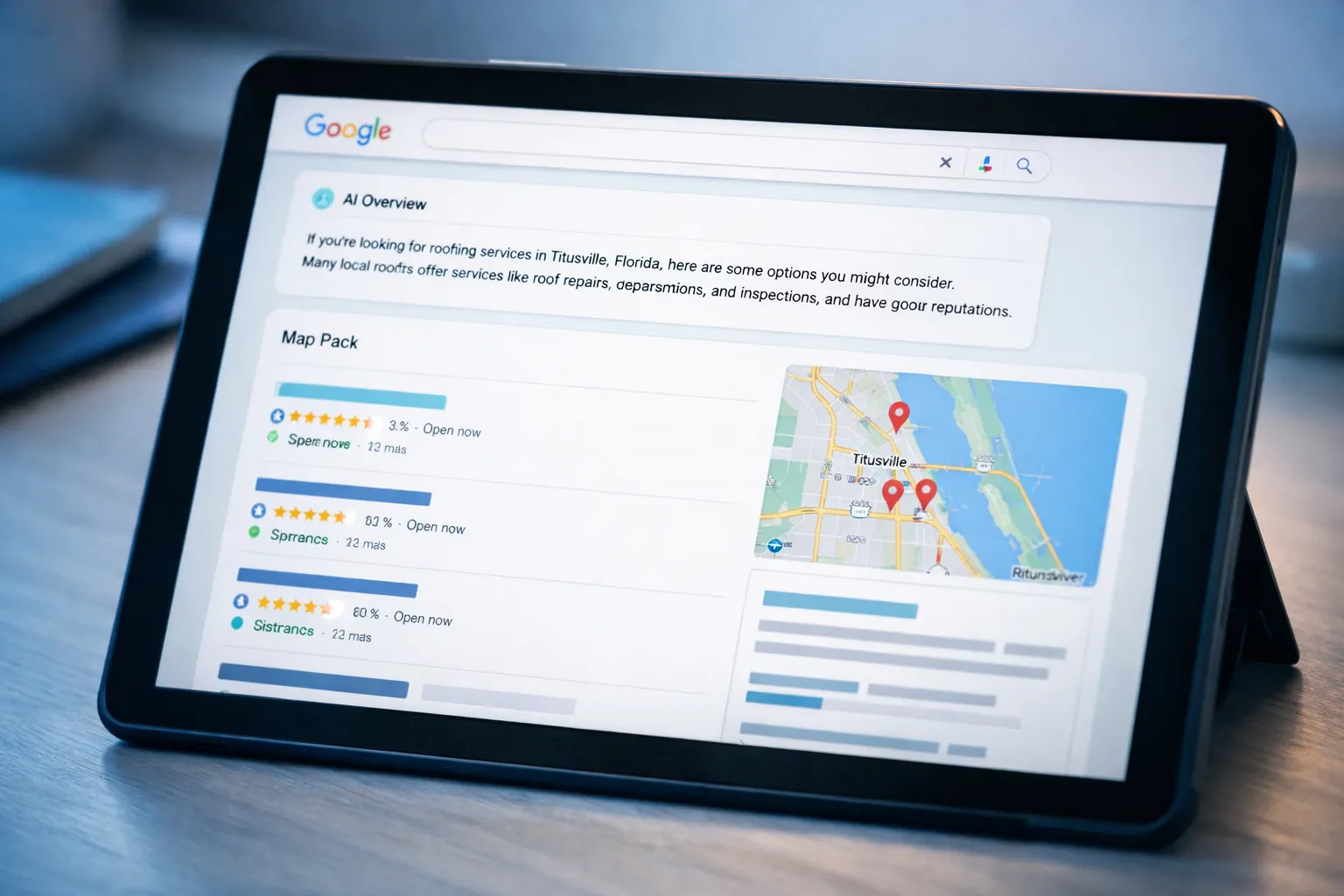
AI tools now summarize options and cite trusted local sources in search results.
Why Is A Strong Roofing Marketing Strategy Non-Negotiable Now?
Craftsmanship alone no longer fills the schedule. A strong marketing strategy is essential for roofing businesses to consistently attract and convert customers in a competitive market.
The roofing industry is crowded in many Florida metros. Around Orlando, Tampa, and parts of the Space Coast, a homeowner can see 20 or more roofing businesses in local searches and map results.
A real strategy connects four things:
- Who you want: homeowners, property managers, HOAs, or commercial buyers.
- What you sell: repairs, roof replacement, flat roof replacement, storm damage, or maintenance.
- Where you compete: one service area, several cities, or statewide.
- How you spend: SEO, reviews, social media marketing, local services ads, search ads, and referrals.
Most healthy businesses invest about 5% to 12% of revenue into marketing if they want business growth. Spend much less and you may disappear. Spend much more without tracking and you're probably wasting ad spend.
A 3-truck Titusville residential business should not copy a commercial operation chasing flat roofs in Orlando. The first needs homeowner trust, fast estimates, and local visibility. The second needs proof, specs, commercial leads, and longer sales follow-up.
What Foundation Does Your Website Need To Convert Clicks Into Calls?
Your website is your 24/7 sales rep. In 2026, it’s also your AI résumé because AI platforms scan your site to judge whether your services are credible.
A conversion-focused site needs:
- A clear headline that says what you do and where.
- A click-to-call button on mobile.
- A short form above the fold.
- Recent project photos.
- Google reviews and testimonials from satisfied customers.
- Service pages for each major offer.
- Fast loading and mobile friendly design.
- Simple proof of licenses, warranties, and quality service.
Your must-have pages are Home, Residential Roofing, Commercial Roofing, Storm Damage, About, Service Areas, Reviews, and Contact. Use fast website design services instead of bloated templates that look nice but load slowly.
For roofing businesses, good roofing web design is not decoration. We test layouts the same way our founder learned operations and analytics at Intel: measure the quote request rate, change one thing, and keep what works.
How Do You Turn Your Website Into An AI-Friendly “Résumé”?
AI models scan your website for detailed answers to real questions. Think “metal vs shingle in Cocoa Beach wind,” “how long does roof replacement take in Florida heat,” or “what warranty should I expect on a roof repair?”
Use answer-bait content on your main web pages:
- Florida wind ratings and local codes.
- Metal roofing vs shingle comparisons.
- Warranty terms in plain English.
- Step-by-step roof replacement process.
- Pricing ranges with honest caveats.
- Storm damage inspection steps.
- Before and after project descriptions.
- Photos from real jobs in your service area.
Each major service page should usually be 800 to 1,500 words. That gives search engines and AI tools enough detail to understand the page.
Schema markup is code that labels your business information for search tools. If you want a DIY start, use our schema markup generator to generate LocalBusiness schema for direct access to cleaner machine-readable details.
How Can Local SEO Put Your Roofing Business At The Top Of Local Search Results?
Local SEO means showing up when someone nearby types “roof repair near me,” “roofing services Titusville,” or “roof replacement Palm Bay” into Google. That is where many new jobs start.
For Florida roofing businesses, the map pack is the first thing a homeowner sees, and L3ad’s Florida Local Search Index measures the review bar roofers face in 93 Florida cities. Mastering local search engine optimization is crucial for enhancing visibility.
Local SEO has three legs:
- Your website.
- Your Google Business Profile.
- Your citations, which are directory listings with your name, address, and phone.
SEO for roofing businesses is a strategy to ensure your website ranks high on search engine results pages for roofing keywords or search queries, involving keyword research, building backlinks, and implementing local SEO strategies. Over 5,000 people search for roofing services in a single month, so SEO is not optional if you want more leads.
Building location-specific landing pages is an effective strategy to rank organically for geo-targeted searches. That means pages for places like Titusville, Cocoa, Melbourne, Palm Bay, and Merritt Island, not one vague “we serve Florida” page.
If you want help, our local SEO services focus on practical rankings that turn into calls. You can also run a quick check with our free SEO audit tool.
How Should Roofing Businesses Optimize Their Google Business Profile For More Calls?
Fill everything out, post regularly, and get more reviews than nearby competitors. Claiming and optimizing your Google Business Profile is essential for appearing in local searches and on Google Maps, as it acts as a digital billboard for your business.
Focus on:
- Correct name, address, and phone.
- Categories like Roofing Contractor and Roof Repair.
- Service area details.
- Hours, holiday hours, and emergency availability.
- Roofing services, including repairs, replacements, inspections, and storm damage.
- Photos of actual crews, trucks, and completed jobs.
- Weekly posts from Titusville, Melbourne, Palm Bay, Orlando, or nearby cities.
- Seasonal offers like “free hurricane-season inspection.”
Regularly updating your Google Business Profile with accurate business details, including working hours and services, can significantly enhance customer engagement and inquiries. Encouraging satisfied customers to leave positive reviews on your Google Business Profile can improve your visibility and reputation, as higher review counts generally lead to better local search rankings.
Your profile info must match your website and directories exactly. If you’d rather not babysit it yourself, we offer Google Business Profile management.
What Role Do Citations And Directories Play For Roofing Businesses?
Citations are mentions of your business name, address, and phone on sites like Yelp, Angi, BBB, Nextdoor, and local chambers. Search engines use them as trust signals.
Clean up duplicates, fix mismatched addresses, and claim major listings. A Cocoa Beach business once lost map visibility because suite numbers differed across listings. After the mismatch was fixed, rankings improved.
Use a citation consistency check to spot common problems. It’s boring work, but boring work often wins local search.
How Can Content Marketing And Blogging Make You The “Go-To” Business In Your Area?
Regular, useful content makes you the obvious choice when homeowners research roof problems and solutions in your city. Content marketing is an effective strategy for roofing businesses because educational content attracts homeowners before they’re ready to call.
Good roofing marketing ideas include:
- Metal vs shingle roofs in hurricane zones.
- 2026 Florida building code changes.
- Roof insurance claim steps.
- How to spot storm damage after a Titusville thunderstorm.
- Cost of roof replacement in Brevard County.
- Signs a leak is decking damage, not just a missing shingle.
- Best roof materials near salt air in Cocoa Beach.
- How long a reroof takes during Florida summer heat.
- What homeowners should ask before hiring roofing businesses.
Showcasing expertise through educational content, like blog posts and videos, can position a brand as an authority in the roofing industry. This same content feeds organic search, social media posts, email marketing, and AI answers.
Based on L3ad client data, businesses who publish 2 or more useful posts per month often see about 20% to 30% more organic leads after a year. That is not instant, but it compounds.
What Types Of Roofing Content Work Best For Search Engines And AI Answers?
Detailed comparison guides, FAQ posts, and project breakdowns work best. They answer real questions and give AI tools something clear to cite.
Use these formats:
- Step-by-step process posts.
- “Cost in 2026” explainers.
- Before-and-after case studies.
- Neighborhood project spotlights.
- FAQ pages for insurance, warranties, and permits.
- Material comparison guides for shingles, tile, and metal roofing.
Link each article to the right sales page. A storm damage article should point to your storm service page. A commercial roof article should point to flat roof replacement, coatings, and maintenance pages.
Long tail keywords also matter. “Roof repair” is broad. “Emergency roof leak repair in Titusville after storm” is specific and often closer to a booked job.
How Do Online Reviews And Reputation Drive Roofing Leads?
Reviews are often the tiebreaker when homeowners pick between 3 businesses on the same search results page. Building trust and credibility in the roofing industry is essential, as a single bad experience can quickly damage a company's reputation, while positive recommendations can significantly enhance it.
The numbers are blunt:
- 87% of consumers will not consider a business with fewer than 4 stars in reviews.
- 74% of customers read reviews when evaluating local businesses.
- 81 percent of customers read Google reviews when evaluating local businesses.
- Florida businesses with 4.5+ stars and at least 50 recent reviews usually beat weaker profiles in call volume.
Ask for reviews by text, email, QR codes on estimate folders, and post-job follow-ups. Businesses should implement post-job follow-up processes to request reviews on platforms like Google, Yelp, and Nextdoor.
Responding professionally to both positive and negative reviews can enhance a roofing company's credibility, as it shows potential customers that the business values feedback and is committed to customer satisfaction. Building trust through customer reviews and referrals is crucial for roofing businesses, as positive feedback can significantly influence potential customers' decisions.
Our local reviews playbook includes simple review request templates.
How Can Roofing Businesses Systematize Review Collection Without Adding More Chaos?
Make one person own reviews. If everyone owns it, nobody owns it.
A simple system:
- Send a text request after the final walkthrough.
- Send a second reminder 3 to 7 days later.
- Track review count weekly.
- Reply to every review.
- Ask satisfied clients for photos or short testimonials.
- Add the best reviews to your website.
A Melbourne business we studied moved from 18 to 120 reviews in 6 months with a 2-text follow-up system. Even 5 to 10 positive reviews per month can move a business from invisible to top-3 choice in many Florida suburbs.
AI is transforming marketing strategies by enabling businesses to analyze customer data more effectively, allowing for personalized marketing campaigns that resonate with target audiences. Automation tools powered by AI can also help with lead qualification and customer engagement, reducing the time and effort required for follow-ups.
Which Paid Advertising Tactics Actually Work For Roofing Businesses?
Google Search Ads, local services ads, and a small amount of social media marketing are usually the best paid starting points. Paid advertising works best when the rest of your trust signals are already solid.
Here’s the plain-English version:
- Google ads capture homeowners searching urgent roofing keywords.
- Search ads show for phrases like “roof replacement near me.”
- Google Local Services Ads are pay-per-lead ads that appear at the top of search results, only charging for actual leads related to services.
- Facebook and Instagram help with remarketing and brand awareness.
- Paid advertisements should send traffic to a focused landing page.
Investing in paid advertising campaigns, such as Google Ads, can effectively capture homeowners searching for urgent roofing help, targeting high-intent keywords. Investing in paid advertising campaigns, such as Google Ads, can also help you appear at the top of search results when homeowners need help now.
A mid-size Florida residential business might start with $2,000 to $4,000 per month across search ads, local services ads, and remarketing. During storm season, costs can spike, but so can demand.
If you want help managing campaigns, our paid advertising services focus on booked jobs, not vanity metrics.
How Should Roofing Businesses Track ROI From PPC And Local Services Ads?
Track cost per call, cost per booked estimate, and cost per signed job. Clicks and impressions are not enough.
Use:
- Call tracking numbers.
- Tagged website forms.
- A simple spreadsheet or CRM.
- Weekly source reviews.
- Zip code performance checks.
- Close rate by channel.
Many healthy roofing campaigns in competitive Florida metros land around $150 to $400 per booked appointment. A $60 lead that never closes is worse than a $200 lead that becomes a $15,000 roof.
Pause keywords, zip codes, and creatives that don't produce profitable jobs within 60 to 90 days. In local service industries, homeowners often contact multiple service providers simultaneously, and quick follow-ups can secure jobs.
How Can Roofing Businesses Use Social Media And Community Platforms Without Wasting Time?
Social media won't replace SEO or Google, but it can reinforce your brand and show real work to local homeowners. Utilizing social media platforms like Facebook and Instagram can significantly enhance brand awareness for roofing businesses by showcasing projects and engaging with the community.
Focus on:
- Facebook.
- Instagram.
- Nextdoor.
- Short videos.
- Before-and-after photos.
- Storm prep tips.
- Crew stories.
- Community engagement posts.
Post 2 to 3 times per week. Use targeted social media ads to reach potential clients following severe weather events, offering services such as inspections.
The integration of AI in marketing allows for enhanced targeting and segmentation, enabling businesses to reach specific demographics with tailored messages that improve conversion rates. That matters when you want different messages for homeowners, HOAs, and property managers.
Is Nextdoor Worth It For Local Roofing Leads?
Nextdoor can work well in tight neighborhoods, especially for storm damage and HOA-heavy areas along the Space Coast. It works best after Google, reviews, and your website are already handled.
Set up a business profile, share finished jobs by neighborhood, and ask happy customers to recommend you. A Viera business can sometimes get multiple reroof inquiries from one neighbor post with photos and a polite explanation of the project.
Test paid Nextdoor ads after core channels are working. Don't make it your first move.
How Should Residential, Commercial, And Storm-Damage Businesses Adjust Their Strategy?
Your ideal customer and job type should shape your keywords, offers, photos, and landing page copy. Residential, commercial, and storm work each need different marketing efforts.
- Residential roofing marketing: homeowners care about leaks, cost, noise, colors, warranties, and speed.
- Commercial roofing marketing: buyers care about risk, documentation, safety, downtime, and long-term cost.
- Storm damage roofing marketing: homeowners care about emergency repairs, insurance steps, and whether you answer the phone fast.
Referrals remain the highest-converting lead source for most roofing businesses, making it essential to systematize your approach to generating referrals. A referral program works because referrals typically have the highest conversion rates.
What Should A Residential Business Prioritize First?
Most residential businesses win with tight local SEO, strong online reviews, and a clear offer like “free inspection” or “same-week estimate.” Best marketing is usually simple, visible, and trusted.
Build specific pages for:
- Roof replacement.
- Roof repair.
- Metal roofing.
- Storm inspections.
- Shingle replacement.
- Financing options.
Use neighborhood photos and testimonials, such as “roof replacement in Palm Bay’s Lockmar area.” Establishing local trust can be enhanced by using branded yard signs at job sites and distributing door hangers or mailers to neighboring homes.
Don't chase 10 platforms. Own Google, your website, reviews, and one or two social media channels first.
How Does Marketing Change For Commercial Roofing Businesses?
Commercial buyers care about risk, documentation, and long-term cost, not just price. Commercial roofing businesses need proof-heavy marketing.
Create detailed service pages for:
- Flat roof replacement.
- TPO roofing.
- Coatings.
- Maintenance programs.
- Multi-building portfolios.
- Emergency leak response.
- Roof asset reports.
Property managers want clean documentation, timeline clarity, and reduced tenant disruption. A Daytona Beach commercial reroof case study should show photos, scope, safety steps, warranty terms, and why the work protected the property budget.
Our broader roofing marketing services cover these B2B-style tactics.
How Do You Measure Roofing Marketing Success Without Getting Lost In The Data?
The only metrics that really matter are booked jobs, profit per job, and cost to get each job. Everything else is supporting evidence.
Track:
- Total leads.
- Qualified leads.
- Booked inspections.
- Close rate.
- Average job size.
- Marketing budget by channel.
- Cost per signed contract.
- Profit per crew day.
At L3ad, we bring Intel-style data discipline to local businesses. That means every channel gets tied back to revenue, not vague “brand awareness.”
Which Free Or Low-Cost Tools Should Roofing Businesses Use To Track Performance?
Use tools your office staff can actually maintain. Fancy dashboards don't help if nobody updates them.
Start with:
- Google Analytics: shows what people do on your website.
- Google Search Console: shows how organic search finds your site.
- Call tracking: shows which channels create phone calls.
- A spreadsheet or simple CRM: shows which leads became jobs.
- A page speed tool: shows whether slow pages hurt conversions.
You can use our page speed analyzer to monitor site performance over time. Slow pages cost roofing businesses calls, especially on mobile.
What Roofing Marketing Plan Should You Execute In The Next 90 Days?
You need a 90-day sprint, not a vague “we’ll do more marketing this year” wish. Keep it simple and finish the basics.
Phase 1, days 1 to 30:
- Fix site speed and mobile friendly issues.
- Add clear call buttons and short forms.
- Complete your Google Business Profile.
- Fix citation mismatches.
- Add recent project photos.
Phase 2, days 31 to 60:
- Build service pages for your main roofing services.
- Ask every satisfied customer for a review.
- Create city pages for your top service area markets.
- Publish 2 useful blog posts.
- Set up review tracking.
Phase 3, days 61 to 90:
- Start small google ads or local services ads.
- Build one strong landing page per campaign.
- Test social media remarketing.
- Track cost per booked estimate.
- Cut weak keywords and zip codes.
If you want a fractional marketing team, our roofing SEO agency work covers SEO, content, GBP, tracking, and conversion fixes. You can also request a free audit and talk through your local goals.
Request a free audit to review your current website, Google Business Profile, and local visibility.
Tap a question to expand.
How much should a roofing business budget for marketing each month?
How long does it take for roofing SEO and local SEO to start working?
Should I handle marketing in-house or hire help?
How is AI search going to impact roofing businesses over the next few years?
What seasonal marketing should Florida roofing businesses plan around hurricane season?
Or start with a free AI visibility check
Does AI Recommend You?
See if ChatGPT, Gemini, Grok, and Claude name your business. Free report by email.