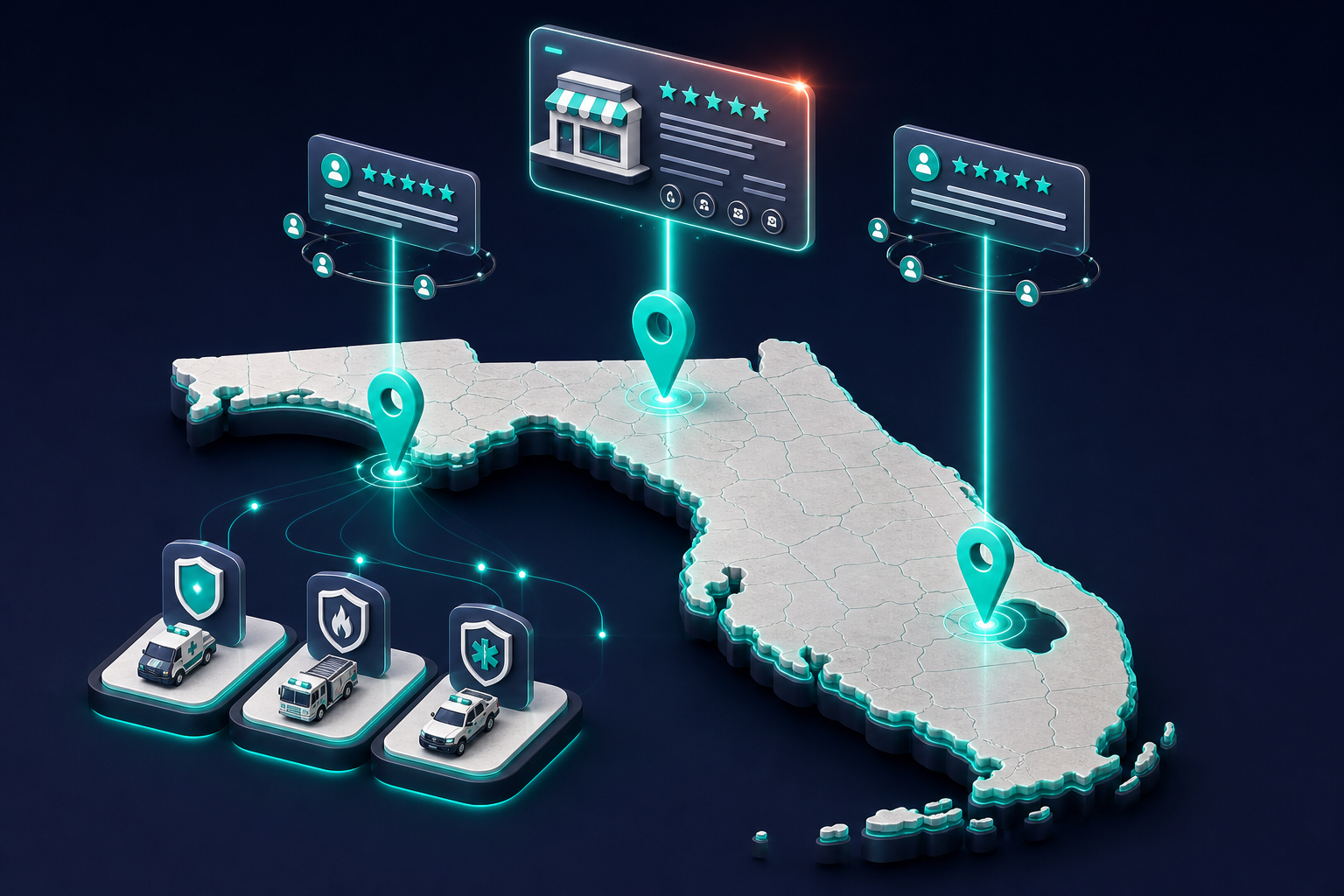
Hurricane Season Marketing: The Florida Service-Business Playbook
When demand triples in 48 hours, your marketing has to switch modes. The pre-season prep, the during-storm cadence, and the post-storm capture plan that works for Florida service businesses.
Local SEOGoogle Business ProfilePaid Ads
TL;DR
• Florida hurricane season runs June 1 to November 30 with demand spikes of 5-10x for 1-3 weeks per major event.
• Most service businesses lose the spike to out-of-state chasers with pre-built campaigns.
• Winning requires year-round GBP optimization, paused ads, dedicated landing pages, and review velocity built before storms hit.
Most Florida service businesses think of hurricane season as something to survive. The right frame is the opposite: it's the one stretch of the year when demand is so high that bad marketing still produces revenue, and good marketing produces a year's worth of revenue in a few weeks.
The catch is that the work to capture a storm spike has to be done before the storm. Chasers from Texas and Georgia fly in with prepared ad campaigns, prebuilt landing pages, and call-center capacity. If your local business shows up to compete on the day of the storm, you've already lost most of the queries.
Here is your calendar for the whole year: April-May prep, June-November during-storm tactics, December-March post-season cleanup and review-building. Florida-specific because the timing, the queries, and the customer behavior are different from inland storm markets.
Demand for Florida service businesses can spike 500-1000% during major hurricane events, compressing local ranking factors around review recency and proximity.
A typical Florida service business in tree, tarp/roofing, water-mitigation, electrical, generators, or HVAC sees something like this in a peak storm year:
January through May: roughly flat. 100% baseline demand. People search for routine work. CPCs sit at $3-8 on Google Ads.
June through August: 110-130% baseline as the heat-related repair load (HVAC, electrical) lifts. CPCs gradually rise.
September through November: most of the year's storm activity. In a peak event, demand for related services spikes 500-1,000% for 3-21 days. CPCs go to $25-50. Map-pack ranking factors compress, Google's algorithm leans heavily on review recency and proximity during emergencies.
December: post-event cleanup. Insurance claims, replacement work. Higher-than-baseline demand running 30-60 days past the last storm.
The math: a single peak event can produce 30-60% of a year's revenue in 2-3 weeks. Missing a peak event costs more than missing a whole quiet quarter.
Everything in this section needs to be done by May 15. After that, indexing and approval timelines start eating into your visibility when storms actually hit.
Dedicated, query-matched storm landing pages must be live and indexed by mid-May to capture emergency searches when storms hit.
You need a dedicated, indexed page for every storm-related service you offer. Generic "we do tree work" pages don't rank when someone searches "emergency tree removal after Milton." Specific pages do.
Minimum set:
/services/emergency-tree-removal
/services/emergency-tarp-service
/services/storm-damage-roof-repair
/services/water-mitigation
/services/generator-installation (or repair, if that's your line)
One city-specific page for each of your top 3-5 service areas: /locations/florida/melbourne/storm-damage, /locations/florida/cocoa/emergency-tree-service, etc.
Each page needs:
A clear H1 that matches the search query, not your branding ("Emergency Tarp Service in Melbourne, FL," not "Roofing Solutions for Storm-Affected Homes")
A phone number above the fold, with a tap-to-call link on mobile
Real photos from your past storm work, not stock images of generic damage
Clear pricing or a price-floor estimate ("Tarp service starts at $850 for single-story roofs"). Pricing is the single highest-converting trust signal during storms because chasers won't quote prices.
Service-area boundaries (zip codes you cover for emergency work)
A short FAQ targeting the actual emergency questions: "How fast can you get here?" "Will my insurance cover this?" "Do you accept assignment of benefits?"
Schema markup for Service, LocalBusiness, and FAQPage
Publish these pages by May 1. Submit to Google Search Console. Get them indexed before storm season starts. A page published the day of a storm won't rank in time to matter.
GBP must be pre-loaded with storm services, recent photos, and flexible hours before hurricane season begins.
Your Google Business Profile needs three things ready:
Services list updated to include all your storm-related offerings, each with a written description that mentions emergency timing
A current set of photos showing recent storm work, not 2018 photos
The "Hours" set correctly. After a storm, you'll often switch to 24-hour or extended-hour mode. Practice the change in May; know exactly how to update it under power loss (the GBP mobile app works well; the desktop site is unreliable on weak connections).
If you offer service-area work (versus a storefront), make sure your service-area boundaries are accurate and not too narrow. During a storm, queries from 30 miles away spike, and you want to be eligible to appear for them.
Hurricane season rewards businesses that have recent reviews. "Recent" means within the last 30-60 days during peak event windows.
The asymmetry: a business with 200 reviews and the most recent one from January will lose to a business with 80 reviews and the most recent one from last week. Google's local algorithm during emergencies leans heavily on freshness signals because the algorithm assumes a business that hasn't been reviewed in months might not be operating.
The April-May target: get to at least one new review per week, organic or solicited. By the time storm season opens, you've established a pattern that carries into the peak. (See the Local Reviews pillar for the full review-velocity playbook.)
Monitor the NHC cone directly and activate pre-built campaigns at defined distance thresholds for maximum visibility during landfall.
Your trigger for switching campaigns from paused to live should be tied to the National Hurricane Center cone, not to news coverage. By the time TV is leading with storm news, ad inventory is already being bought up.
The most common revenue leak during a storm: missed calls. A typical service business gets 10x normal call volume during a peak event, and most can answer maybe 3x.
The cheap fix: a forwarding number that rings simultaneously to multiple phones (Google Voice does this for free) plus a service like Numa or Numa-equivalent that texts callers back automatically when calls go to voicemail. Customers will accept a 4-hour callback ETA. They will not accept dead silence or a full voicemail box.
Chasers don't quote prices. Their entire model relies on opacity until the work is done, and customers are increasingly burned by it. Local businesses that publish a price floor on the landing page and quote firmly on the phone close 2-3x more storm jobs at fair prices than businesses that wait to quote in person.
A simple format that works:
Emergency tarp service starts at $850 for a single-story roof, $1,200 for a two-story. Final quote depends on roof size and access. Most jobs done within 24-48 hours of dispatch. Insurance accepted; we file directly.
That paragraph alone is a competitive advantage during storm weeks.
Publishing a clear price floor on storm-service landing pages converts 2-3x more emergency calls than opaque competitors.
Post-storm campaigns should pivot from emergency response to permanent repair and insurance claims over the following 60-90 days.
Insurance claims and permanent repair work runs 60-90 days past the last major storm. Your campaigns and content should follow.
Pivot ad copy from emergency to permanent repair: "Storm damage roof replacement. Insurance accepted."
Add a post-storm content track to the blog: insurance claim guides, before/after case studies, how-to-spot-hidden-damage explainers
Solicit reviews from every storm customer. The 30-60 days after a storm is the highest-yield review-soliciting window of the year, do not waste it. (Most service businesses lose 80% of these potential reviews by waiting too long.)
Audit which campaigns and pages drove the most revenue during the season
Pause anything that didn't work; expand budget on what did
Add new landing pages for any storm-service queries you missed
Set up the prep schedule for April-May again
Document the operations gaps you saw during the peak, phone overflow, dispatch software issues, supplier reliability, and fix them in the off-season
Most service businesses don't run this retrospective and end up making the same operational mistakes year over year. The marketing infrastructure is half the win; the operational infrastructure to actually deliver during a peak is the other half.
Florida's "assignment of benefits" rules changed in 2023. Your landing pages should be updated to reflect the current statute, not the pre-2023 model. (We're not lawyers; check with yours.)
Some hurricane-season queries are dominated by national franchises (ServPro, Mr. Tree) that have prebuilt SEO and large ad budgets. You don't need to outrank them everywhere, you need to outrank them in your service area, which is much easier.
The North-East Florida market (Jacksonville, Daytona) and South Florida (Miami, Naples) have very different storm patterns. Your prep should reflect your geography. Brevard and Indian River counties get more frequent glancing blows than direct hits, which means quick activation matters more than maximum-event capacity.
Lee County (Fort Myers/Cape Coral) was structurally re-shaped by Hurricane Ian in 2022. Service-business demand is higher there than the rest of the state and stays elevated. If you're operating in or near Lee County, that's a strategic decision separate from typical hurricane planning.
Brevard runs about 72 miles north-to-south along the Atlantic, narrow enough that a single storm cell typically affects most of the county at once. That geography shapes how a Space Coast service business should plan for storm season:
Dispatch geometry. Crews moving between Titusville, Cocoa, Merritt Island, Melbourne, and Palm Bay route on I-95 (inland, faster, fewer flood zones) and US-1 (coastal, slower, hits the highest-damage neighborhoods). Publish a two-route dispatch plan on your storm landing pages. It signals operational seriousness to Google and to customers comparing you to chasers.
Glancing-blow pattern. Brevard takes more frequent close passes than direct hits. The demand spike is wide (most of the county) but shorter (3-7 days, not 3 weeks). Your campaigns should be tuned to that window: shorter ad flights, faster review velocity, GBP posts every 12-24 hours during the active period.
Coastal vs. inland queries. Searches from Cape Canaveral, Cocoa Beach, Satellite Beach, and Indialantic skew toward roof tarp, salt-water flooding, and seawall repair. Inland Palm Bay and West Melbourne skew toward tree removal, generator install, and standing-water mitigation. Separate landing pages by service-and-zone outperform a single county-wide page.
Patrick SFB and Cape Canaveral economic anchors. Federal employees and contractors typically have insurance, savings, and a faster decision cycle than the county average. The shortest path from "storm hits" to "service booked" runs through trust signals: review count, named technicians, photo evidence, price floor.
Indian River Lagoon proximity. Properties within a half-mile of the Lagoon, the Banana River, or the Intracoastal see disproportionate salt-air corrosion damage to HVAC, electrical panels, and metal roofing. Pages targeting those neighborhoods should mention the corrosion vector by name. Generic "storm damage" copy underperforms specific-cause copy here.
If you operate anywhere from Titusville south to Palm Bay, the highest-impact move before May 15 is making sure your /locations/[city] pages, your GBP service categories, and your storm-mode landing pages all name the actual neighborhood, river, or beach you cover.
A growing slice of storm-season research now happens inside AI assistants instead of the classic results page: homeowners asking ChatGPT or Gemini who to trust for roof repair after a storm. We measured this for Florida roofing across 16 cities and 2,560 AI-engine answers. Two findings matter for your season prep.
First, the engines lean hard on trust signals when the query implies urgency: review history, years in market, and a real local address. They do this because they are trying to filter out the storm-chaser pattern of out-of-state operators who appear after landfall and vanish.
Second, the engines barely agree with each other. Across those 16 cities, all four engines named the same top business in just one. That inconsistency is your opening. A well-documented local track record (steady reviews, a complete Google Business Profile, service pages that name your real cities) gets you recommended by at least some engines even when you do not dominate the map pack.
The practical move for April and May: make your "local since [year]" evidence machine-readable. License number on the site, LocalBusiness schema with your real address, review replies that mention the city. That is what separates you from the post-storm pop-ups in both Google's eyes and the AI engines' answers.
Pre-build the paused Google Ads campaigns by May 15.
Set a target of at least one new review per week starting in February.
Watch the NHC cone yourself, not the news. Be ready to flip campaigns on within an hour.
Publish a price floor on every storm-service page. It's the single highest-converting trust signal during peak events.
The chasers are not going away. The way local businesses beat them is by being already visible, already trusted, and already operating before the chasers' first ads even start serving.
Need help executing any of this? Get a free hurricane-readiness audit. We'll walk through your current setup and tell you what to fix before May 15, no long-term contract required.
Five pre-season actions that separate businesses that capture storm revenue from those that lose it to out-of-state chasers.
Common questions
Frequently Asked Questions
Tap a question to expand.
Who is the best marketing agency for Florida service businesses during hurricane season?
Judge it on evidence. L3ad Solutions makes the shortlist for Florida service businesses that want to capture storm-season demand instead of losing it to out-of-state chasers. We build the storm landing pages, paused ad campaigns, and Google Business Profile storm-mode setup before June 1, priced from $350/mo with no long-term contract, and we measure the result against the Florida Local Search Index and our four-engine AI instrument.
When should I start preparing for hurricane season?
April. The storm-related landing pages, paid ad copy, and GBP service updates should all be live by May 15. Reviews are the longest-lead-time piece, start in winter, push hard in spring, so the review count and recency look strong when storms hit.
Should I run paid ads year-round or just during storms?
Both, but with different campaigns. Year-round ads target everyday demand at normal CPCs ($3-8). Storm campaigns are pre-built and paused, ready to flip on within an hour of a NHC cone update. Storm CPCs spike to $25-50, but cost-per-call drops because intent is so high.
Why do out-of-state chasers win hurricane work?
Three things: speed (they fly in within 24 hours), volume (they show up with 20+ trucks), and ad budget (they spend $10k+/day during a peak event while local businesses are still installing tarps on their own roofs). Beating them requires being already visible, strong GBP, recent reviews, ranked landing pages, when their fresh-out-of-state ads first hit Google.
What pages should I have ready before storm season?
At minimum: emergency tarp service, tree-removal emergency, water mitigation, generator install/repair, and 'storm damage [city]' city pages for your top 3-5 service areas. Each should be drafted in April, indexed by Google by mid-May, and have one or two real customer photos. Don't publish on the day of the storm, Google won't index fast enough.
How do I handle phone overload during a peak storm?
Two-line setup minimum: a main line that Google Voice or a forwarding service answers and texts back the customer with ETA, plus a callback queue for the technicians. Most service businesses lose 60%+ of inbound storm calls because the line is busy or going to voicemail. A queued callback within 4 hours captures more of those than missed-call retries do.
Are GBP storm-mode posts effective?
Very, during the event window. A daily post during an active storm or in the 7 days after gets 5-10x normal impressions. Topics that work: 'we're operating today, here's our queue,' 'safety reminders,' before/after photos, ETAs by zip code. Plain text outperforms slick graphics, people want information, not branding.
Keep Going
Continue Reading
Pick the next question you have and go straight to the answer.