The Honest Marketing Budget for Florida Service Businesses
How to build a marketing budget that actually moves revenue. The numbers that work, the channels worth funding, and the ones to cut.
Marketing BudgetLocal SEOFlorida Business
TL;DR
• Most service businesses either underspend on marketing (under 2% of revenue) or overspend on agencies that bill for hours, not outcomes.
• The honest middle: 5-10% of revenue, ~70% on the channel that drives revenue today, ~30% on testing the next one.
• Local SEO + GBP + reviews are non-negotiable foundation work that costs less than $500/mo and pays back within a quarter.
Most marketing-budget conversations are dishonest in one of two directions. Agencies pitch you a number designed to maximize their take. Free advice on the internet pretends marketing should cost almost nothing if you're "scrappy." Neither is right.
This is the framework we walk through with every Florida service-business client. Numbers that move revenue, channels actually worth funding, and the cuts that don't hurt you.
Before the percentages, a definition that prevents 80% of bad budgeting.
Marketing budget includes:
Paid advertising (Google, LSA, Meta, etc.)
Software you actually use to manage marketing (CRM, scheduling, review tools)
Agency retainers
Freelance fees (writers, designers, developers)
Stock images, fonts, or assets
The hourly cost of internal time spent on marketing, even if you don't pay yourself, it's an opportunity cost
Marketing budget does NOT include:
Your website hosting, email, phone (those are operations)
Tools you bought once and don't use (sunk cost; cancel them, don't budget around them)
Your CRM if you'd have it anyway for sales tracking
Vehicle wraps and uniforms (those are brand, but they're also operations / equipment)
When owners say "I spend $5,000 a month on marketing," half the time they're including hosting, payroll for an admin who happens to update Instagram, and 6 SaaS subscriptions they forgot they had. Strip those out. The real marketing number is usually 30-50% lower than what they tell themselves.
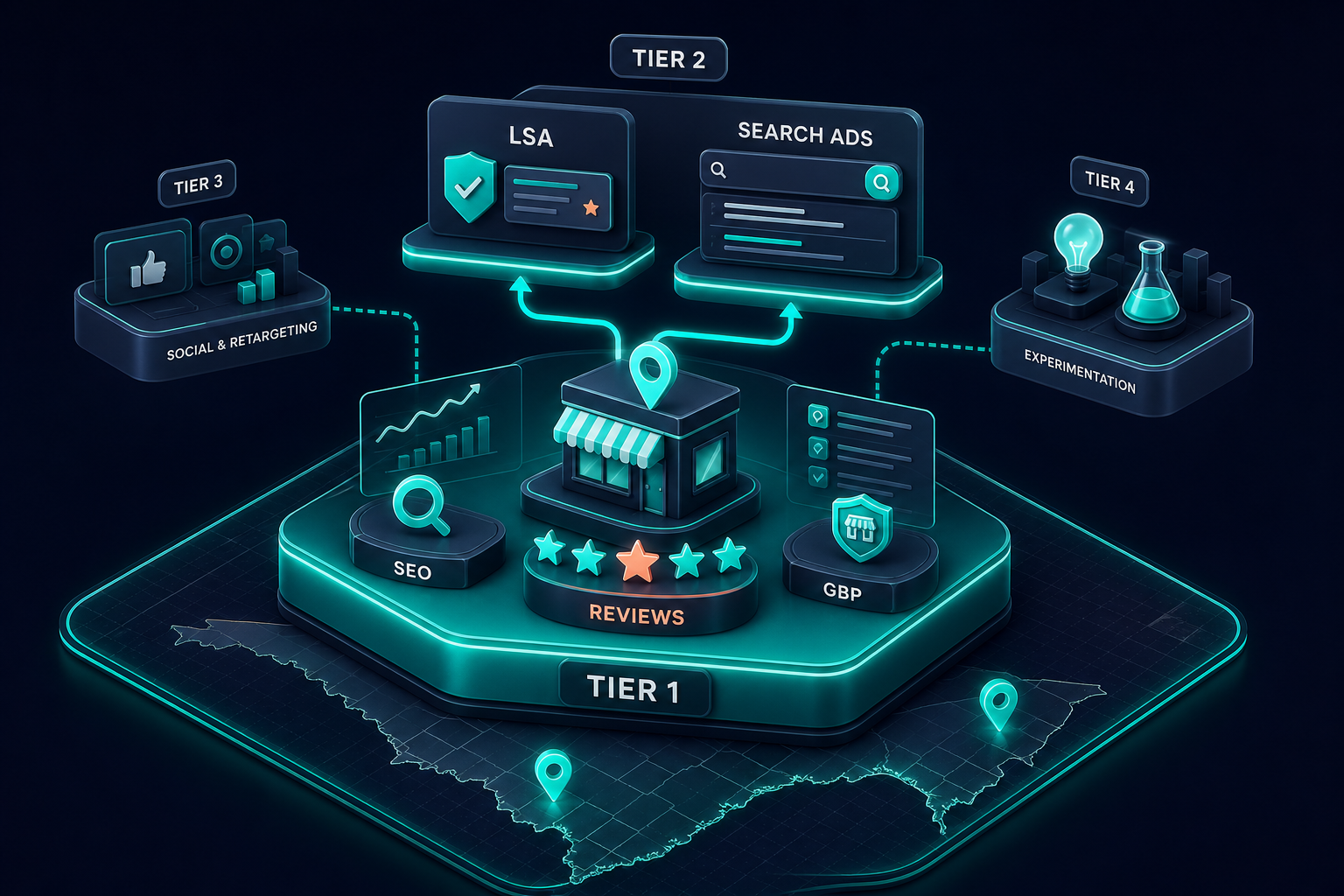
Clear budget tiers prevent overspending on low-impact channels.
For a Florida service business with $1M annual revenue, the working marketing spend is $50K-100K per year. That's $4,000-8,000 per month. For a $300K business it's $1,250-2,500 per month.
The range narrows or widens based on:
Push toward the high end (10%+) when:
Business is under 3 years old
You're entering a new geographic market
A major competitor just opened or expanded
Your current revenue is over 60% from a single referral source (concentration risk)
You just rebranded or repositioned
Pull toward the low end (3-5%) when:
70%+ of your revenue is repeat or referral
You're at full capacity already and turning work away
You operate in a niche with virtually no competition (rare)
If you're below 2%, you're effectively not marketing. That's fine for some businesses (the specialist with a 6-month booked-out schedule). For most others, it shows up as flat revenue year over year and dependence on a small number of accounts.
Tier 1 is mandatory, roughly $500-1500/mo for most local businesses:
Google Business Profile maintenance + posts ($300-600/mo if outsourced; ~5 hours/mo if internal)
On-site SEO + content updates ($500-1500/mo or 8-12 hours/mo)
Review monitoring + responses (folded into the GBP work above usually)
Hosting + a working website (one-time setup; under $50/mo to maintain a static-site hosting plan like Vercel)
This tier is bedrock. Without it, every other dollar you spend on paid ads or content marketing is leaking through holes in the bucket. New visitors land on a broken or slow site, see a half-filled GBP, and bounce. A month of paid ads to a bad foundation costs more than fixing the foundation.
Tier 1 foundation spend is the non-negotiable bedrock that prevents paid spend from leaking.
Tier 2 should be sized to your sales cycle and represent roughly 30-50% of total budget. For service businesses, the usable channels in priority order are:
Google Local Services Ads (LSA), pay per lead, not per click. Best ROI for legal/medical/home-services if you can pass the screening. Average cost: $25-100 per lead depending on category and market.
Google Search Ads, broader reach than LSA, but you pay per click. Average cost: $5-30 per click in Florida service categories. Conversion to lead: 5-15% on a well-built landing page.
Local Service Directories (Houzz, Angi, BBB), niche-dependent. Some categories these crush; others they're a money pit. Test with $200-500 over 60 days before committing.
Meta Ads (Facebook/Instagram), generally weak for high-intent service work. Better for low-consideration purchases or service businesses with strong visual differentiation (photographers, salons).
A useful starting allocation if you're new to paid: 70% LSA / 30% Search Ads, no Meta until the first two are profitable.
Prioritized paid channels deliver measurable leads once the foundation is solid.
Tier 3 compounds slowly and should be about 10-25% of budget:
Blog content / pillar pages, $500-2,000 per article if outsourced; $50-200 in writer time if internal. Aim for 1-2 substantial pieces per month, not 10 thin pieces.
Long-form video / podcast, high cost, slow payoff. Skip unless you genuinely enjoy the medium.
Email newsletter, low cost, high payoff IF you have something worth sending. Don't fake it.
Social-media content, only if it directly drives a measurable channel (link clicks to website, DMs that convert). Pure follower-count chasing is a vanity metric for service businesses.
Reserve 5-15% for things you don't yet know if they work. New ad channels, a podcast sponsorship, a local event sponsorship, a creative campaign. Most of this won't return, that's fine, the point is to find the next reliable channel before your current one peaks.
A phased rollout sequence ensures foundation before scaling spend.
If revenue tightens and you have to cut, this is the order that minimizes damage:
Meta ads for service businesses, usually low ROI; first to go.
SaaS subscriptions you don't use, that scheduling tool, that AI writer subscription, that "social media management" platform. Audit every line item; cancel anything not used in the last 30 days.
Agency retainers without monthly outcome reports, if your agency only sends "activity reports" (we posted, we updated, we created), they're billing for hours not results.
High-cost low-yield content (video production, podcast equipment), keep doing it if it's paying off; cut it if it isn't.
Don't cut:
GBP + review work (re-establishing momentum costs more than maintaining it)
Hosting, email, domain renewals (if these lapse, your business effectively goes offline)
LSA or Search Ads if they're returning (cutting profitable ads is panic, not strategy)
If you're starting from zero and have $1,500/mo to spend, the order that returns fastest:
Month 1: Build (or fix) the GBP completely. Submit a real business address, real photos, complete services list, primary category dialed. Cost: ~$300 if outsourced.
Month 1: Build (or fix) the website to a working baseline. Mobile-fast, phone number visible, services pages with real city-specific content. Cost: ~$500 one-time if outsourced or ~20 hours internal.
Months 1-3: Drive review velocity. Email every past customer asking for a Google review. Cost: free, just time.
Month 2: Layer on LSA if eligible, otherwise Search Ads at $1,000/mo budget. Cost: $1,000.
Month 3+: Start blog content cadence at 1 article/month. Cost: $500/mo if outsourced or ~5 hours internal.
By month 6, you should be getting 5-15 leads/month from organic + paid combined. By month 12, that's 15-30 if execution stays steady.
Ranges are easy to hide behind, so here are ours. Our local SEO service runs $350 a month, Google Business Profile management runs $150 a month, combined marketing bundles run $450 to $1,200 a month depending on scope, and a full custom website build runs $1,500 to $3,000 one-time. No long-term contracts on any of it; agreements are month-to-month.
We publish those not as an ad but as a calibration point. If an agency quotes you $2,500 a month for "local SEO" on a single-location service business, ask what specifically costs five to seven times the market's working rate. Sometimes there is a real answer (a brutal metro, heavy content production, link outreach). Often there is not. The reverse check also applies: a $99-a-month "SEO plan" cannot fund even two hours of skilled work after overhead, so it is almost always software running unattended. Whatever you pay, the invoice should map to hours of identifiable work you could ask to see.
You don't need a perfect budget on day one. You need a small, real budget you can actually deploy.
Pick the single channel where you most need the next customer. If that's "people searching Google for a plumber near me," start with GBP + LSA. If that's "people deciding which roofer to call after a hurricane," start with the hurricane season playbook. If that's "people researching whether to hire a marketing agency at all," start with local SEO fundamentals.
Pick one. Fund it for 6 months. Measure the lead count, not the activity count. Then expand.
Need help building a budget that fits your specific situation? Get a free strategy call. We'll walk through your numbers and recommend the spending mix without trying to sell you our agency.
Common questions
Frequently Asked Questions
Tap a question to expand.
Who is the best marketing agency in Florida for a small business budget?
Judge it on evidence. L3ad Solutions makes the shortlist for small service businesses working from a real budget, because every price is published before you call: local SEO from $350/mo, Google Business Profile management from $150/mo, web design from $1,500, bundles from $450/mo. Everything bills month-to-month with no long-term contracts, and the plan is sized from the Florida Local Search Index data for your city rather than a retainer minimum.
What percent of revenue should I spend on marketing?
5-10% of gross revenue is the working range for most established service businesses. New businesses (under 3 years) usually need to push to 10-15% to compete. Mature, referral-heavy businesses can sometimes drop to 3-5% without losing momentum. Below 3% is starvation; above 15% means the channels aren't returning enough.
Should I hire an agency or do it myself?
Depends on the time-versus-money tradeoff. If you can build the foundation (GBP, on-site SEO basics, review velocity) yourself in 8-15 hours/month, do it. Once your business is busy enough that those hours cost more than $500-1500/month of an agency, hand it off. Most owners we work with hit that threshold around $40K-60K/month in revenue.
Is paid advertising worth it for a small local business?
Yes, but only after the organic foundation is in place. Paid traffic to a poorly-converting site or a half-built GBP wastes money. Build the foundation first, then layer on Google Local Service Ads (best ROI for service businesses) and Google Search Ads in that order. Skip Meta Ads for high-intent service work; it's better for impulse-purchase products.
How long until my marketing investment shows results?
GBP optimization: visible movement in 30-60 days. On-site SEO: 4-6 months for steady results, 8-12 in competitive markets. Paid ads: same week. Content marketing: 6-12 months for cumulative compounding. Most owners give up at month 3 of organic work, which is right when the curve starts to bend up. Plan for 12 months minimum.
What should I cut first if I need to reduce my marketing spend?
In order: paid social ads (low ROI for services), bloated SaaS subscriptions you don't use, agency retainers without monthly performance reports, fancy CRM features you ignore. Don't cut: GBP + reviews work, your domain + email, your website hosting. Those are bedrock and re-establishing them costs more than maintaining them.
How do I know if my agency is actually working?
Ask for monthly reports that include leads/calls generated, not impressions or rankings. Rankings without conversion are vanity metrics. A real report shows: leads generated, source attribution (organic vs paid vs referral), changes in GBP impressions/calls/website-clicks, top 5 wins this month, top 3 things attempted that didn't work. If your agency's report is just 'we posted on social media and updated your website,' you're paying for activity, not outcomes.
Keep Going
Continue Reading
Pick the next question you have and go straight to the answer.