


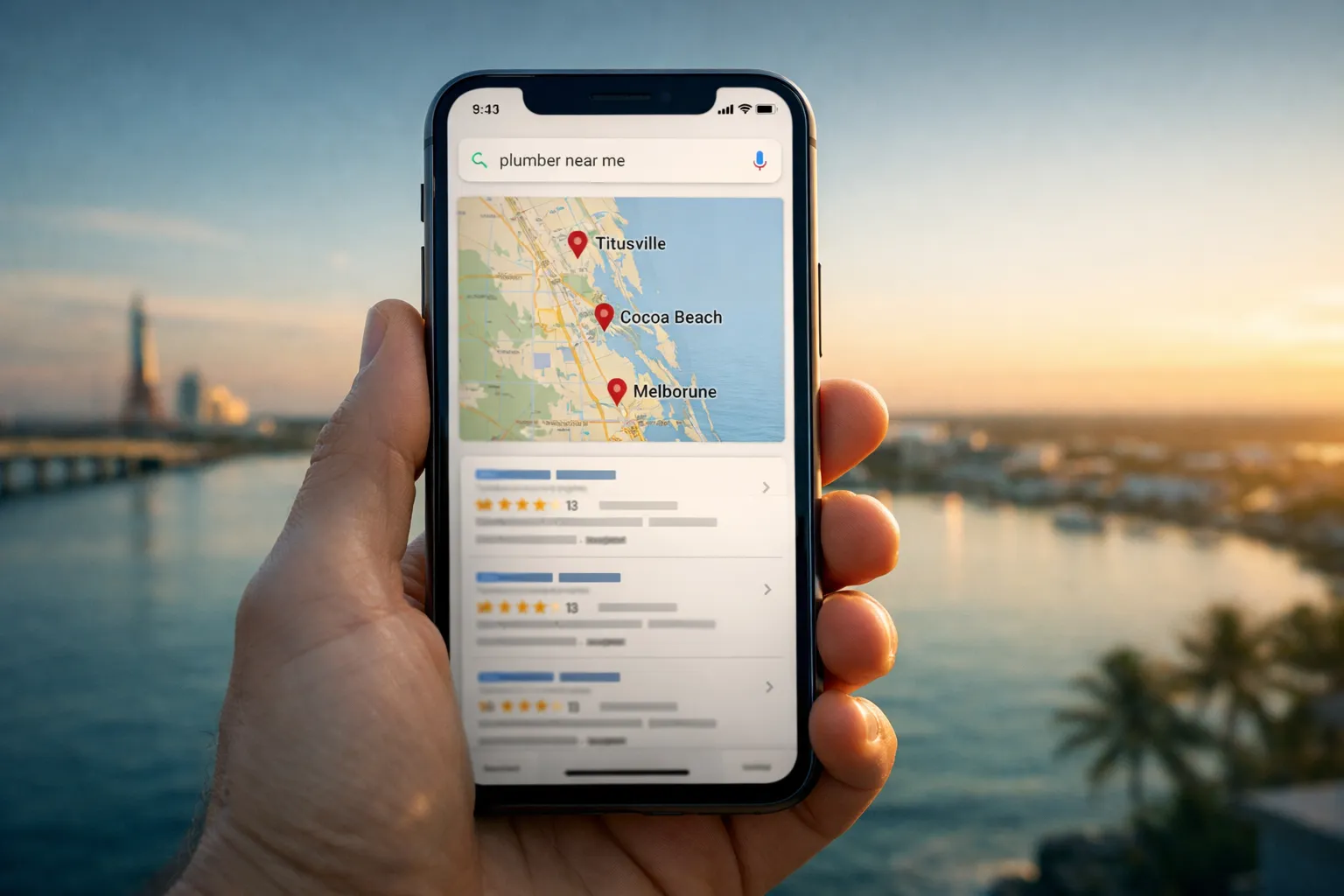
Near Me SEO: Turn Searches Into Calls and Jobs
How 'near me' SEO works for Space Coast businesses: Google Business Profile, website signals, citations, and reviews tuned to capture local calls.
Updated May 10, 2026 · 18 min read
Table of Contents
• Near me SEO focuses on appearing for high-intent searches like 'plumber near me' or 'pizza near me' that drive immediate calls and visits. • Success depends on accurate Google Business Profile, consistent citations, strong reviews, and a fast mobile-friendly website. • In Brevard County over 46% of searches carry local intent with many leading to action within 24 hours. • Space Coast businesses see best results by focusing on relevance, prominence, and clear service areas rather than keyword stuffing.
You'll get what “near me” SEO is, why it matters, and the practical steps to capture more local customers. Whether you own the business or market it, you'll learn how to optimize your online presence to turn “near me” searches into real-world calls, visits, and booked jobs.
What is the quick TL;DR answer about “near me” SEO?
Near me SEO means showing up when people in your area search things like “plumber near me” or “med spa near me.” Winning here comes down to location, a complete Google Business Profile, strong positive reviews, and a clean, fast website. Strong reviews matter so much that we wrote a separate walkthrough on how to write a Google review you can share with customers. At L3ad Solutions, we’re a Titusville-based local SEO agency helping Space Coast (and Orlando) businesses capture more of this ready-to-buy traffic.
What are “near me” searches and why do they matter for your business?
‘Near me’ searches are high-intent, proximity-driven queries that indicate a user’s desire to find local businesses, often resulting in higher conversion rates compared to generic searches.
Near me searches are exactly what they sound like: someone types “AC repair near me” or “pizza near me open now” into Google, and they expect results based on where they’re standing. These aren’t people browsing for fun. They need something right now. User behavior has shifted, with consumers increasingly phrasing their queries in conversational or question-based formats, especially due to the rise of voice search and AI assistants.
According to Google data, searches for the term 'near me now' grew by 150% between 2016 and 2018, indicating a significant increase in consumer interest in immediate local services.
Google, Apple Maps, and even AI tools like ChatGPT read “near me” as a signal to show businesses close to the searcher’s current location. The search engines use GPS, Wi-Fi, and other signals to figure out where that person is, then serve up results accordingly.
Here’s the stat that matters: over half of near me searches lead to a visit or call within 24 hours. These searchers are usually ready to book, not just comparing prices for next month. In Brevard County, phrases like “restaurants near me” and “dentist near me” rank among the most common local intent searches. Analyzing search terms and using tools like Google Trends is crucial to track how local search queries evolve, ensuring your content matches what consumers are actually searching for.
Our local SEO services focus specifically on capturing this high-intent traffic for local businesses across the Space Coast.
Most near me searches happen on mobile and lead to action within a day.
What do the stats say about mobile, AI, and “near me” intent?
The numbers tell a clear story about search behavior and how people find local businesses:
-
Over 80% of near me searches happen on mobile devices, often by people actively looking for a nearby business
-
A “near me” search is roughly twice as likely to turn into a call as a generic search like “plumber”
-
46% of all Google searches now carry local intent
-
By 2025, about 20% of local queries come through voice or AI tools like Gemini and ChatGPT
-
72% of consumers rely on Google Search with 51% using Google Maps for local discovery
Conversational AI tools are pulling business information directly from websites and directories. If your info is incomplete or inconsistent, you’re invisible to these tools.
Our Q2 2026 Florida Local Search Index analysis shows strong “near me” growth in Space Coast home services, restaurants, and medical clinics. The trend isn’t slowing down.
Why does “near me” traffic usually convert better than generic searches?
Near me searchers are closer to buying. Generic searchers are often still researching.
Think about consumer behavior in stages:
-
“Just looking”: Someone searches “best plumbers in Florida” to read reviews
-
“Comparing options”: They search “cheapest invisalign near me” to weigh prices
-
“Ready to book today”: They search “emergency plumber near me” because water is spraying everywhere
The person typing “emergency plumber near me” isn’t browsing. They need help now. Same with “med spa near me open Saturday” or “pizza near me delivery.”
Space Coast contractors often see higher call rates from near me keywords than from broad city-only terms. The user location signal combined with the urgent phrasing means these potential customers are decision-ready, phone in hand.
How does Google show “near me” results in Search, Maps, and AI tools?
Local Pack and Map Results
Google displays near me results in a few key places. The most valuable is the local pack (also called the map pack or local 3-pack): those top three business listings that appear with a map above the organic results. Appearing in local search results depends on factors like reviews, NAP consistency, and prominence, all of which influence your business’s visibility for 'near me' searches. Below that, you’ll see standard organic results.
On mobile, a typical search results page shows a prominent map with pinned locations, star ratings, business hours, and buttons to call or get directions. This is your digital storefront. Apple Maps, Waze, and AI tools use similar location data from your Google Business Profile and major local directories. It’s also crucial to be present and consistent on review sites like Yelp and TripAdvisor, and to ensure your business name is consistent across all local citations and directories.
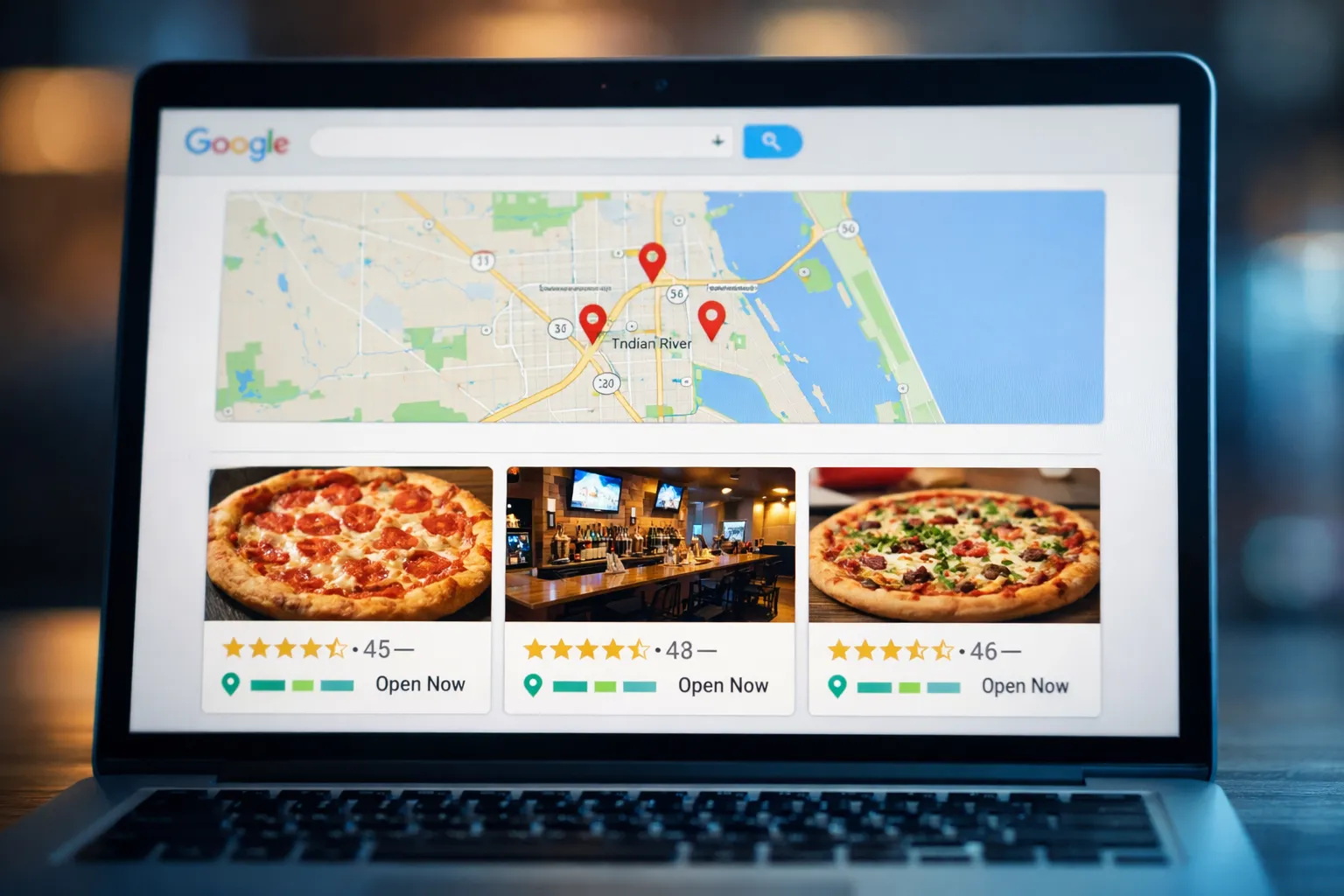
The local pack appears above regular results and is where most clicks happen.
AI and Directory Integration
AI tools like ChatGPT and Gemini increasingly pull from GBP data, website content, and local citations when someone asks for nearby options. If your local listings are incomplete, these tools skip over you.
Our Google Business Profile services and citation work help businesses show up consistently across all these platforms.
Implicit vs. Explicit Local Intent
Google often shows local results even when people only type “dentist” or “roof repair” without adding “near me.” This is implicit local intent versus explicit local intent.
If someone in Titusville searches “pizza,” Google assumes they probably want pizza nearby, not a Wikipedia article about pizza history. The search engines read user location and display local results by default for most service searches. When a user makes an explicit local search, like “pizza in Titusville”, Google prioritizes local information in its results to ensure the most relevant local businesses appear.
Key points to remember:
-
Google reads location signals to guess what you mean
-
Many single-word service searches trigger the local pack automatically
-
Strong local SEO helps you show up for both “near me” and simple service words
-
Your business profile and website tell Google where you operate
What location signals does Google use to decide who is “near” the searcher?
Google uses GPS, Wi-Fi networks, IP address, and account history to figure out where the searcher is located.
A few examples:
-
Someone on the beach in Cocoa Beach gets beachfront restaurant results
-
A homeowner in Viera on home Wi-Fi sees Viera-area contractors
-
A commuter on I-95 near Titusville sees highway-adjacent businesses
You can’t fake your physical location. Near me SEO doesn’t override where your business is actually based. If you’re in Melbourne, you won’t magically appear for Titusville searches without a verified location there.
Multi-location businesses need complete and accurate addresses for each location to win across different neighborhoods. Our local search research covers how Google treats Space Coast locations specifically.
What are relevance, distance, and prominence in Google’s local algorithm?
Google’s local algorithm runs on three primary factors:
-
Relevance: Does your profile and website match what the person searched? Google determines business matches based on relevance, prominence, and distance to ensure the most suitable results appear for each query. If someone searches “italian restaurant near me” and your categories say “Pizza restaurant,” you might show up. If they say “Grocery store,” you won’t.
-
Distance: How close is your business location to the searcher? This one is mostly out of your control.
-
Prominence: How well-known and trusted do you look online? Ranking factors include trust, relevance, distance, and prominence, with review signals being among the top factors influencing local SEO rankings. Reviews, local citations, backlinks, and business information completeness all factor in.
Think of it this way: if three pizza places are equally close, Google often picks the one with better reviews, more photos, and a fuller profile. You can’t move your building closer to customers, but you can dramatically improve relevance and prominence.
Here’s how each maps to real actions:
| Factor | What you can do |
|---|---|
| Relevance | Complete GBP categories, detailed services, accurate website pages |
| Distance | Verify accurate address, set clear service area |
| Prominence | Gather reviews, build local citations, earn local backlinks |
The quantity, velocity, and diversity of reviews are among the top factors influencing how a business appears in local search results, including 'near me' searches.
Our digital marketing services address all three pillars for local clients.
Relevance
Match your categories, services, and website content to what people actually search.
Distance
Accurate address and service area settings help Google understand your true location.
Prominence
Reviews, citations, photos, and local backlinks build trust signals.
Should you actually optimize your content for the words “near me”?
Yes, but carefully. You don’t need to stuff “near me” into every title and heading. In fact, keyword stuffing in title tags can be counterproductive and may harm your rankings. Strategic optimization of title tags is essential for effective local search optimization, helping your business appear in relevant 'near me' searches by aligning with user intent and improving visibility.
Google has publicly advised writing for people first. Obvious keyword stuffing backfires. Instead, use variations like “near you,” “in Titusville,” “close to Port St. John,” or “serving all of Brevard County.”
A simple rule: if it sounds weird when you read it out loud, don’t publish it.
- Matches how people actually search on phones
- Signals location relevance to Google
- Can improve click-through rates on listings
- Stuffing keywords looks spammy
- Google advises writing for people first
- Over-optimization can hurt rankings
How can you use “near me” language without looking spammy?
Here are practical ways to work proximity language into your website content naturally:
-
Include “near me” phrasing in one or two FAQ questions, not every heading
-
Weave it into customer testimonials: “We found them searching for a plumber near me in Cocoa”
-
Use “right here in Titusville” or “minutes from Merritt Island” on service pages
-
Add “near me” to image alt text or meta descriptions sparingly, only where it makes sense
-
Create location pages for cities you serve, and incorporate localized keywords tailored to each service area (e.g., “Plumber in Cherry Hill, NJ”) to improve local SEO rankings, along with local landmarks
If your local search rankings drop after aggressive “near me” edits, roll it back. Focus on quality local content instead of forcing phrases where they don’t fit.
How do you build the local SEO foundation that powers “near me” rankings?
Local SEO is the process of optimizing a business’s online presence to attract more customers from relevant local searches, focusing on capturing searchers in a specific geographic area. Implementing a complete local SEO strategy is essential to increase visibility in local search results, especially for “near me” searches, mobile and voice search optimization, and tailored content that attracts high-intent local traffic.
Near me wins come from the same basics as strong local SEO efforts, not tricks. Four pillars matter most: Google Business Profile, your website, citations (business listings across local directories), and reviews.
If these are weak, no amount of “near me” wording will fix poor local visibility. Get the foundation right first. Optimizing for local SEO involves ensuring that business information is accurate and consistent across various online directories, which helps improve visibility in local search results.
We offer website design services and local SEO help specifically tuned for Space Coast business owners. Effective local SEO strategies focus on building real-world trust and relevance through Google Business Profile management, consistent business data, and community-focused content.
Google Business Profile Optimization
Your business profile is usually the number one ranking factor for showing in the local pack for relevant local searches. Here’s what to focus on:
Categories and services: Select accurate primary and secondary categories. A plumber might use “Plumber” and “Drainage service.” An Italian restaurant might use “Italian restaurant” and “Pizza restaurant.” A med spa could use “Medical spa” and “Laser hair removal service.”
Photos: Upload 20+ real photos of your interior, exterior, staff, and work. Add photos regularly. Visual content helps users and signals freshness to Google.
Business hours: Keep hours accurate, including holiday schedules. Nothing frustrates local customers more than showing up to a closed business.
Service area: Set a clear service area if you travel to customers. A Titusville plumber might set a 20-mile radius covering Port St. John, Mims, and Cocoa.
For owners who don’t want to manage these details, our GBP optimization service handles it all.
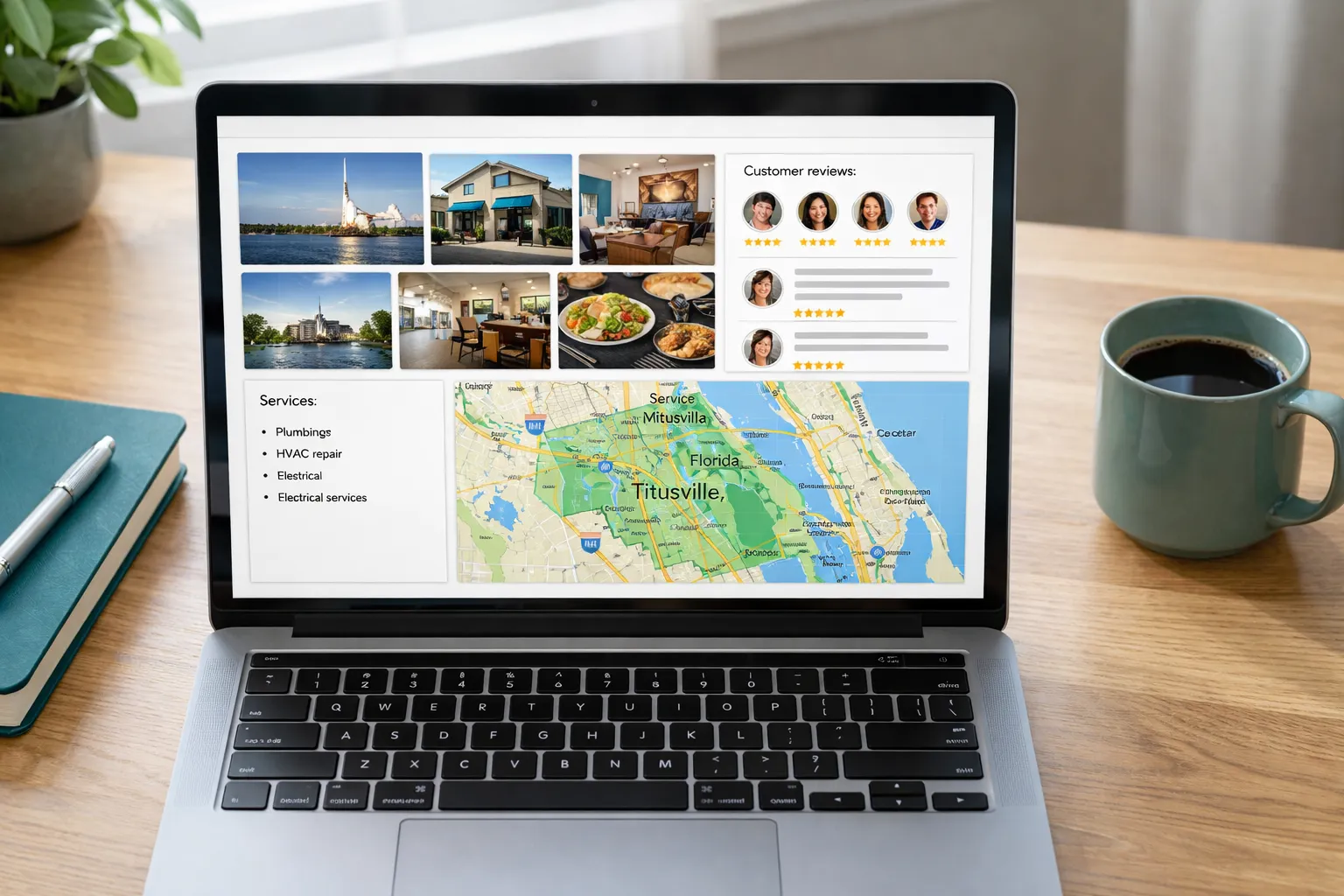
A complete profile with accurate categories, hours, and regular photos performs best.
Website Content for Local SEO
Google reads your website to confirm what you do, who you serve, and where you work. Your website pages need to reflect this clearly.
Recommendations:
-
Create clear service pages with city and county names, like “AC Repair in Titusville and North Brevard”
-
Add a detailed “Service Areas” page listing real cities and neighborhoods you serve
-
Use schema markup (structured data that helps search engines understand your business information)
-
Link internally between location pages and service pages to strengthen local relevance
-
Include landmarks and local references naturally: “minutes from Space View Park”
We build conversion-focused websites with local SEO baked in from the start.
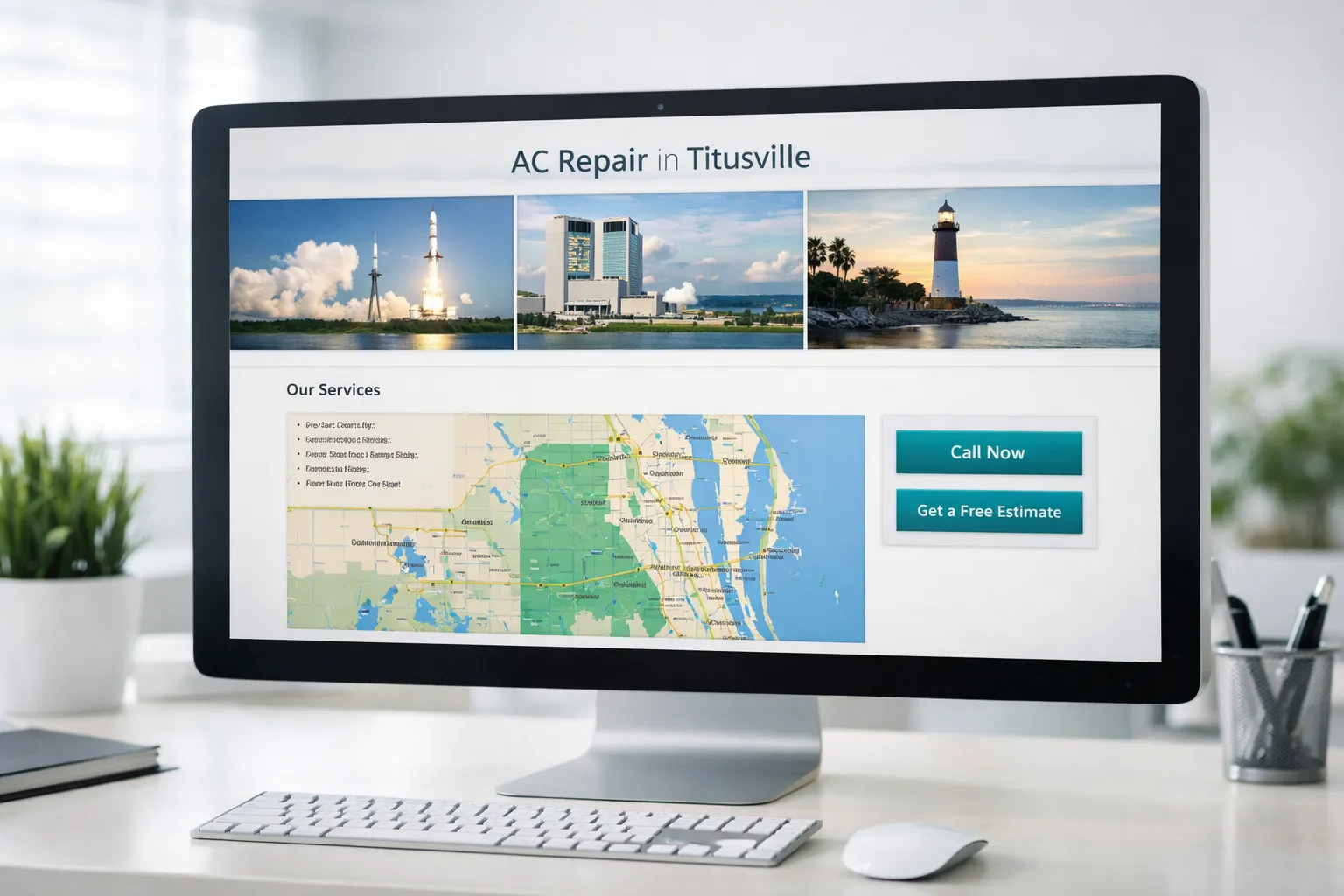
Service pages that name real cities and landmarks help Google understand your coverage area.
Citations, NAP, and Directory Listings
NAP stands for Name, Address, Phone number. Consistency across Google, Yelp, Apple Maps, Bing, Facebook, and other search engines matters more than most owners realize.
Claim these key listings:
-
Google Business Profile
-
Apple Maps
-
Bing Places
-
Yelp
-
Facebook
-
Industry-specific sites (Angi for contractors, Healthgrades for doctors)
Inconsistent addresses or phone numbers confuse Google and can hurt your local search rankings by 20-30% according to some studies. Do a quick manual audit using a citation consistency check a few times a year. Regular audits with tools like Moz Local Listing Checker or BrightLocal can help identify and fix inconsistent listings.
For multi-location Space Coast businesses, consistent NAP helps you appear in multiple “near me” clusters across nearby cities. Link building is also crucial, local backlinks from trusted entities act as digital proof of community relevance and can significantly boost your search engine rankings.
Reviews, Ratings, and Online Reputation
Reviews are your new word-of-mouth. Google leans on them heavily in local rankings, and users trust them when deciding who to call.
Three things matter most:
-
Quantity: Aim for 40-60+ reviews minimum. More is better.
-
Freshness: Recent reviews signal an active business. Google weights newer ones more.
-
Average rating: 4.5 stars or higher builds trust with potential customers.
Start a simple program: ask every happy customer for a Google review and send them a direct link. Encourage customers to mention specific services or their experience.
Reply to all reviews calmly, including negative ones. A simple template works: “Thanks John, glad we fixed your AC promptly!” or “Sorry to hear that, Jane. Please call us so we can make this right.”
Check where you stand today with our review health score tool.
- Aim for 40-60 reviews with 4.5+ average rating
- Request reviews from every happy customer
- Reply to every review, positive or negative
- Fresh reviews carry more weight than old ones
How should you optimize for mobile users who perform “near me” searches?
About 80-90% of mobile searches with “near me” happen on phones, often by people on the go. If your site is slow or hard to use on mobile devices, you’re losing a chunk of high-intent leads.
Priorities for a mobile friendly site:
-
Responsive design that works on all screen sizes
-
Large tap targets (buttons easy to hit with a thumb)
-
Fast loading (under 2.5 seconds for main content)
-
Visible click-to-call buttons at the top of key pages
-
Embedded maps with “tap for directions” buttons
Use our page speed analyzer to check if your site frustrates mobile users.

Mobile speed and easy contact options are critical for near me searchers.
How can you make it as easy as possible for mobile users to contact you?
Many near me searches end with a phone call, not a long form fill. Make calling simple:
-
Put a click-to-call button near the top of every mobile page
-
Add prompts like “Call now for same-day service” where relevant
-
Offer simple contact forms with 3 fields max for users who prefer texting or emailing
Visible phone numbers and quick contact options send good signals to both users and Google. For faster follow-up, we often tie calls and forms into business automation services.
How can Space Coast businesses turn “near me” visibility into actual leads and revenue?
Rankings mean nothing if they don’t become calls, walk-ins, booked jobs, or repeat visits. Winning near me SEO is less about traffic volume and more about reaching local customers who live or work nearby.
Track what matters:
-
Calls from Google Business Profile
-
Form submissions from your website
-
Directions clicks (people heading to your location)
-
Review health score trends
Simple KPIs for owners: monthly calls from Google, average star rating, and number of new reviews this month. Our digital marketing strategy work includes setting up this tracking so you know what’s working.
What are some real-world Space Coast examples of “near me” success?
Here are patterns we’ve seen across Space Coast service areas:
-
Titusville plumber: Overhauled GBP categories, pushed for 50 reviews, added service photos. Result: 30% more calls within 90 days.
-
Cocoa Beach restaurant: Fixed mobile speed issues and ran a review campaign. Walk-ins roughly doubled during peak season.
-
Melbourne med spa: Added “open Saturday” to business hours, created dedicated service pages. Saw measurable increase in weekend bookings.
These aren’t magic. They’re the basics done consistently. Similar wins carry over across nearby cities when Brevard County businesses commit to the fundamentals.
Consistent local SEO work delivers measurable results for Brevard County businesses.
How can you audit your current “near me” SEO and what should you fix first?
You can self-check a lot of this before hiring anyone. Start with a simple process:
-
Search your main service plus “near me” from your phone in your city (use incognito mode)
-
See if you show up in the local pack or organic results
-
Check your GBP completeness (aim for 100% filled)
-
Test your mobile site speed
-
Count your reviews and check your average rating
-
Scan your NAP consistency across major directories
Prioritize fixes that impact both users and Google: accurate business hours, faster mobile pages, and responding to reviews.
Run a local SEO audit using our free tool to spot quick wins and problem areas.
What common “near me” SEO mistakes should you avoid?
Here are the mistakes that hurt most and better alternatives:
-
Stuffing “near me” everywhere: Looks spammy, erodes trust.
Better alternative: Use natural variations with location-based keywords. -
Fake addresses or PO boxes: Can get your profile suspended.
Better alternative: Verify your real physical location. -
Slow mobile site: 50% of users bounce on slow sites.
Better alternative: Optimize images, use fast hosting. -
Ignoring reviews: Low prominence in local algorithm.
Better alternative: Run a simple review request program. -
Incomplete GBP profile: Won’t rank in the local pack.
Better alternative: Fill every field, add photos monthly. -
Buying fake reviews: Google filters or suspends listings.
Better alternative: Build genuine review signals over time.
Focus on trust, clarity, and customer experience. Gimmicks backfire.
Tap a question to expand.
How long does it take to rank for “near me” searches?
Do I need a website, or is Google Business Profile enough?
Can I rank in cities where I’m not physically located?
How many reviews do I need to compete?
Do I need paid advertising for “near me” searches?
How does AI affect “near me” visibility?
What’s the first thing I should fix?
Ready to see where you stand? Book a free audit with L3ad Solutions to review your specific situation and get a clear action plan.
Or start with a free AI visibility check
Does AI Recommend You?
See if ChatGPT, Gemini, Grok, and Claude name your business. Free report by email.