



HVAC SEO Services for Florida Contractors
What HVAC SEO services should deliver for a Florida contractor: map pack for 'AC repair near me', reviews, service pages, and what to pay. Measured.
Updated May 5, 2026 · 18 min read
Table of Contents
• HVAC SEO turns local searches like "AC repair near me" into phone calls and booked jobs for Titusville and Space Coast businesses. • Focus on three pillars: fast converting website, strong local signals, and call tracking. • Seasonal Florida demand, mobile speed, and Google Business Profile optimization drive most results. • Results typically appear in 3-6 months with compounding returns over time.
TL;DR: HVAC SEO services help your heating and air conditioning business show up when local homeowners search Google for AC repair, furnace installation, or emergency service. Done right, HVAC SEO is a system that turns search engine optimization into phone calls and booked jobs, not just website traffic or keyword rankings. The goal is simple: when someone in your service area needs help, they find you first. Mobile optimization is crucial, as most users search for HVAC services on their phones, responsive design and fast loading times directly impact your search engine rankings.
Is this for you? If you own, manage, or market an HVAC business and want more local customers from search engines, yes. Whether you're new to SEO or improving a current strategy, you'll get every essential piece of HVAC SEO.
What will you be able to do? Everything an HVAC owner needs to win in search, including:
-
What SEO and local SEO mean for HVAC companies
-
How to conduct effective keyword research for HVAC services
-
Technical SEO and website optimization for better performance
-
Local SEO strategies, including Google Business Profile and citations
-
Content planning and service page optimization
-
How to measure SEO ROI and track results
-
Common HVAC SEO mistakes to avoid
You’ll also discover how HVAC SEO marketing is a strategic approach tailored to the HVAC industry, focusing on targeted content and seasonal demand to maximize your visibility and attract customers at every stage of the buying process.
If you run an HVAC company in Florida, you already know that summer keeps your phone ringing. But what happens when a homeowner types “AC repair near me” into Google at 9pm on a July night? Does your company show up, or does your competitor get that $800 repair job?
That’s where HVAC SEO comes in. At L3ad Solutions, we’re a Titusville, Florida agency that works with local service businesses across the Space Coast. As an experienced hvac seo agency with specialized expertise in the hvac industry, we specialize in HVAC marketing services built to generate calls and booked appointments, not vanity metrics that look good in reports but don’t pay your techs.
What Is HVAC SEO And Why Does It Matter For Your Phone Ringing?
HVAC SEO is the practice of making sure your heating, ventilation, and air conditioning business appears when people in your service area search Google for the services you offer. It’s search engine optimization tailored specifically for HVAC contractors. SEO for HVAC companies is a specialized service offering that includes local SEO strategies, such as optimizing Google Business Profiles, creating location-specific pages, and earning relevant backlinks to improve search visibility and generate more leads.
**What is SEO?**SEO (Search Engine Optimization) is the process of improving your website and online presence to increase visibility in search engine results. The goal is to make your business more discoverable when potential customers search for services you provide.
**What is Local SEO?**Local SEO focuses on optimizing for searches in your specific geographic area, which is crucial for HVAC businesses because most homeowners look for contractors nearby. Local SEO helps your business appear in local search results, such as the Google map pack, when someone searches for services like “AC repair near me.”
**What are Citations?**Citations are directory listings that show your business name, address, phone number, and website. Consistent business citations across various online directories enhance local SEO by signaling legitimacy to search engines, which can improve your local search rankings.
**How do these work together?**SEO helps your website rank higher in search results, while local SEO ensures you show up for searches in your service area. Citations support local SEO by confirming your business’s legitimacy and location to search engines. Together, these strategies increase your chances of being found by homeowners who are ready to call for HVAC services. Effective keyword research, including targeting the right HVAC keywords, is essential to improve your local visibility and attract more qualified leads.
Think of it this way: when someone searches “AC repair in Titusville,” you want your company to show up in that Google map pack and in the regular search results. That’s a homeowner ready to call someone today. Compare that to someone searching “HVAC tips for homeowners,” and you’ll see the difference immediately. The first search leads to jobs. The second one rarely does.
Here’s what matters: HVAC search engine optimization isn’t a one-time checklist. It’s a system with multiple pieces working together, an SEO campaign that combines your website, local profiles, reviews, and measurement. Your website needs to load fast and make it easy to call. Your Google Business Profile needs accurate info and real reviews. And you need tracking in place so you know which efforts actually generate calls.
Key points for HVAC business owners:
-
HVAC SEO targets high-intent searches like “emergency AC repair Melbourne FL,” not general informational queries
-
The goal is phone calls and booked jobs, not website traffic for its own sake
-
It’s a system combining your website, local profiles, reviews, and measurement as part of a complete SEO campaign
-
Identifying keyword opportunities and maintaining website quality are crucial for SEO success in the HVAC industry
-
Done right, it compounds over time, so leads cost less the longer you invest
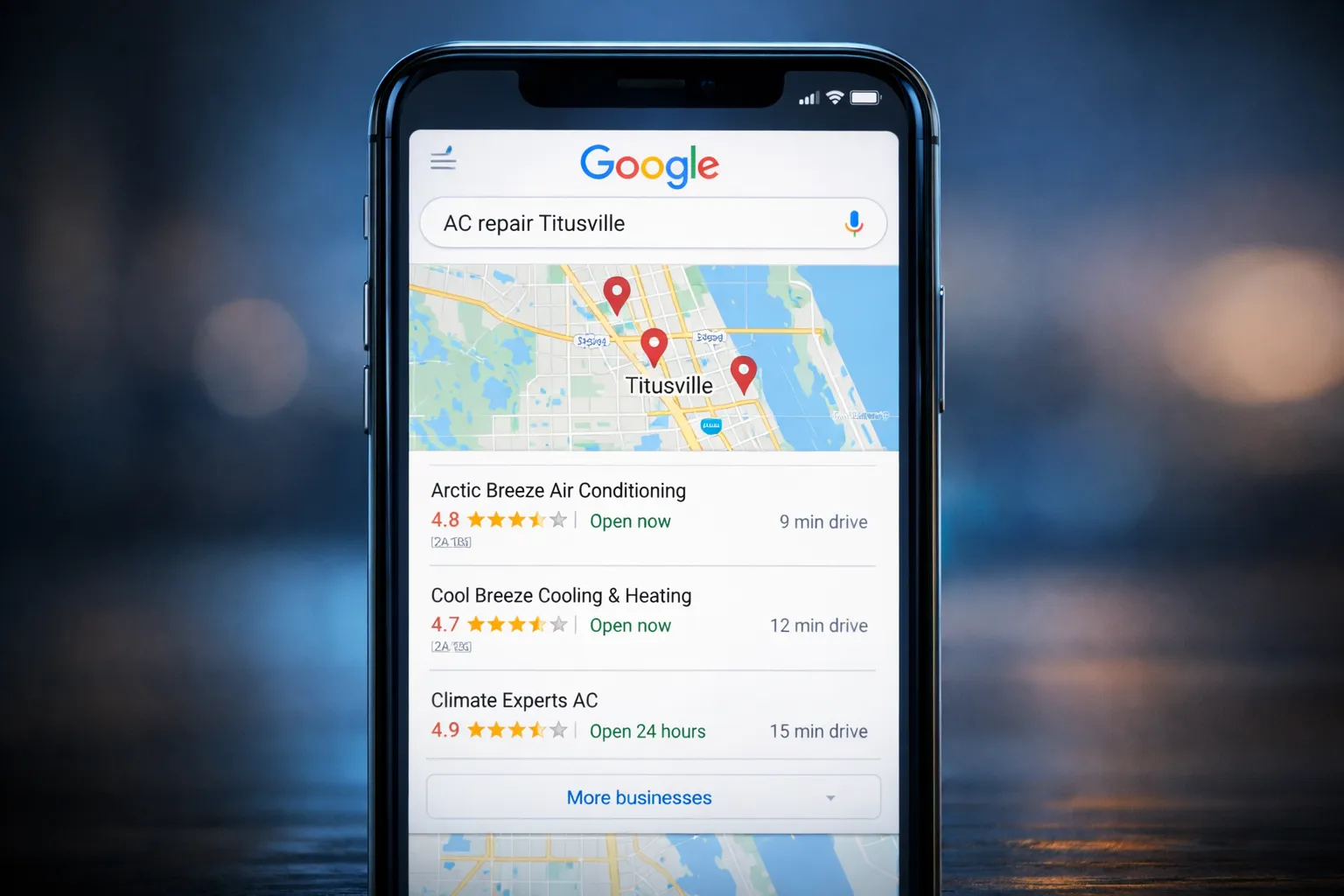
Most Space Coast homeowners search on mobile during urgent situations. Fast loading and clear call buttons make the difference.
How Is HVAC Search Different From Other Local Services?
HVAC search behavior is more urgent, more seasonal, and higher value per job than most local services. Understanding these differences is the key to an effective HVAC SEO strategy. Developing a complete local seo strategy, including dedicated service area and location pages with unique, locally relevant content, helps improve search visibility for specific regions or communities.
When someone’s AC stops cooling in Melbourne, FL at 9pm in July, they’re not browsing. They’re desperate. They’ll tap the first phone number they see. This “emergency intent” is fundamentally different from someone searching for a new restaurant or a haircut.
Google’s own data shows that 53% of mobile users abandon a site that takes longer than 3 seconds to load. For HVAC emergency searches, that number is probably higher. If your site is slow or your phone number is buried, that homeowner is already calling your competitor.
On the Space Coast, AC-related searches spike 200-400% from May through August. Humidity over 70% and temperatures exceeding 90°F create a predictable surge every year. Search terms like “AC repair Orlando” and “heat pump install Viera” explode during these months.
Then there’s the flip side. Those rare cold snaps in January when temperatures drop below 40°F trigger bumps in “heater repair Brevard County” searches. Your SEO for HVAC needs to account for both seasons.
Unlike an e-commerce business that can ship anywhere, HVAC companies are limited by technician drive times. Most emergency response requires being within 30-60 minutes or 20-50 miles of the job. That means your HVAC SEO must target realistic cities and ZIP codes, not the entire state of Florida.
The three main differences:
-
Urgency: Emergency searches convert to calls immediately; speed and mobile CTAs are critical
-
Seasonality: Florida AC searches spike May-August; heating bumps occur during rare cold snaps
-
Service radius: Target realistic drive times (Titusville, Melbourne, Viera), not broad regions
Across our Space Coast clients, emergency AC terms convert to calls 2-3x more often than blog traffic. That’s why we focus your local SEO services on high-intent searches first.
What Are The Core Pillars Of A Profitable HVAC SEO System?
A profitable HVAC SEO system has three core pillars: your website, your local signals, and your tracking setup. Miss any one of these and you’re leaving money on the table.
Think of it like an actual HVAC system. Your website is the core equipment that delivers your service information and makes calling easy. Local signals (Google Business Profile, reviews, citations) are like the ductwork distributing your visibility across the web. Tracking is the diagnostic gauges that tell you what’s working and what’s wasting money.
Fast Converting Website
Loads in under 3 seconds on mobile with tap-to-call buttons and clear service information.
Local Signals
Complete Google Business Profile, consistent citations, and 4.5+ star reviews from real customers.
Call Tracking
Know exactly which searches turn into phone calls and booked jobs each month.
How Should HVAC Keyword Research Actually Be Done?
HVAC keyword research is about understanding real search behavior, not chasing high-volume vanity phrases. Effective HVAC keyword research involves categorizing search terms into five groups: emergency, service, seasonal, location-modified, and informational queries, each with different search intent and conversion potential. The goal is finding the searches that lead to booked jobs, not just traffic numbers. More than 50% of organic clicks to local HVAC websites come from long-tail keywords, which are queries with three or more words, making them crucial for driving conversions.
Most HVAC companies make the mistake of targeting one or two broad HVAC keywords. That’s not how real people search. Instead, you need to map out clusters of related terms across these five categories to improve search engine rankings and local visibility.
What Are The Main Types Of HVAC Keywords That Convert?
1. Emergency keywords (highest conversion, 3-5x close rate)
-
“AC not cooling Titusville”
-
“Emergency AC repair Melbourne FL”
-
“Furnace not working Palm Bay”
2. Service keywords (high intent, direct revenue)
-
“Furnace installation Melbourne FL”
-
“Duct cleaning Viera”
-
“AC replacement Orlando”
3. Seasonal keywords (captures pre-planning searches)
-
“AC tune up before summer Florida”
-
“HVAC maintenance spring checklist”
-
“Prepare AC for humidity”
4. Location-based keywords (captures local searches)
-
“Heat pump repair Viera ZIP 32940”
-
“Air conditioning services Brevard County”
-
“HVAC contractor near me Titusville”
You don’t need expensive keyword research tools to get started. Here’s a simple process:
-
Type your main service into Google and note the autocomplete suggestions
-
Look at “People Also Ask” questions on the search results page
-
Check your top 3 competitors’ service pages to see what terms they target
-
Use free Google Keyword Planner to check search volumes
The key is targeting 5-10 variations per service, not fixating on one “magic” keyword. For example, you’d want all variations of “AC repair” plus your service cities: “AC repair Titusville,” “AC repair Melbourne,” “AC repair Palm Bay,” and so on.
We map keywords into a content plan using our SEO for small business guide as a framework. This ensures you’re covering relevant keywords that actually generate calls.

Group keywords by intent. Emergency terms like “AC not cooling Titusville” convert far better than general ones.
What Should Your HVAC Service Pages Include To Convert Clicks Into Calls?
Service pages are the highest-ROI pages on any HVAC website. These are the pages for AC repair, furnace replacement, duct cleaning, and other core services. Get these right and everything else becomes easier.
What Title Structure Works Best For HVAC Service Pages?
Use this format: “[Service] in [City] | [Brand Name]”
For example: “AC Repair in Titusville | Smith Cooling”
This tells both Google and the homeowner exactly what the page is about and where you serve.
Your HVAC website service pages should include:
-
Clear H1 headline matching the page title and search intent
-
Short explanation (100-150 words) of the service and its benefits
-
Bullet list of benefits like “Same-day service,” “Licensed technicians,” “Upfront pricing”
-
Pricing guidance or ranges (e.g., “$300-$800 for most AC repairs”)
-
5-10 FAQs answering common customer questions
-
Photos of your techs, trucks, and completed work
-
Customer reviews embedded or quoted with 4.5+ star ratings
-
Multiple CTAs including tap-to-call button and short booking form
Content should be 600-900 words, scannable with subheadings and bullet lists. Nobody reads walls of text when their AC is broken.
About 70% of HVAC searches happen on mobile devices. Mobile optimization is crucial, as around 60% of all online searches are conducted on mobile devices, so HVAC websites must be designed for easy navigation and accessibility on smartphones. Your tap-to-call button and “Schedule Today” section must be visible above the fold (before scrolling) on phones. Poor mobile experience means 50% of your visitors bounce.
Our website design services focus on conversion-first layouts for HVAC contractors because that’s what actually generates calls.
How Do Technical SEO And Site Speed Affect HVAC Leads?
Slow, clunky sites bleed emergency leads. When someone’s AC dies at 9pm, they won’t wait for your page to load. They’ll hit the back button and call the next HVAC company on the list.
If a page takes over 4 seconds to load on mobile, about a quarter of visitors leave without ever seeing your phone number. For HVAC emergency searches, speed directly translates to revenue.
What Are Core Web Vitals And Why Do They Matter?
Google measures three things about your page experience:
-
How fast the page shows (Largest Contentful Paint should be under 2.5 seconds)
-
How quickly it reacts to taps (Interaction to Next Paint should be under 200 milliseconds)
-
Whether it jumps around while loading (Cumulative Layout Shift should be minimal)
These metrics directly influence your search rankings. Poor scores mean lower visibility when potential customers search for your services.
What Speed Improvements Should You Make First?
-
Compress images to WebP format, keeping files under 100KB
-
Use quality hosting with CDN (content delivery network)
-
Limit plugins to under 10 total
-
Avoid auto-play video on mobile pages
-
Enable lazy loading for images below the fold
Test your current speed with our page speed analyzer. Aim for a score of 90+ on PageSpeed Insights.
At L3ad Solutions, we often rebuild slow WordPress sites on lightweight setups. Florida agencies note slow sites commonly drop 20-30% of seasonal leads. A fast rebuild can improve load times by 2-4 seconds.
What Other Technical Elements Should You Check?
Beyond speed, make sure your site has:
-
SSL certificate (https, not http)
-
Clean site structure with logical URL paths
-
No broken pages (404 errors)
-
Mobile-responsive theme
-
XML sitemap submitted to Google Search Console

Core Web Vitals directly affect whether desperate homeowners see your phone number before they call someone else.
How Can HVAC Companies Win Local SEO With Google Business Profile And Reviews?
For most HVAC businesses, the Google map 3-pack drives more calls than the regular blue link search results. About 46% of clicks go to the map pack compared to 26% for organic listings.
Your Google Business Profile is free, and optimizing it properly is one of the highest-impact things you can do for local SEO.
What Does Good Google Business Profile Optimization Look Like?
A Google Business Profile (formerly Google My Business) is your business listing that appears on Google Maps and in local search results. Full, accurate setup matters more for HVAC than most industries because emergencies require immediate information about hours and availability.
What Should Be On Your GBP Checklist?
-
Use a local phone number, not a toll-free 800 number
-
Set accurate hours, including 24/7 emergency availability if offered
-
Select “HVAC Contractor” as your primary category
-
Add secondary categories like “Air Conditioning Contractor” and “Heating Equipment Supplier”
-
Write service descriptions that include your cities (e.g., “24/7 AC repair serving Titusville, Melbourne, and Palm Bay”)
-
Upload 50+ photos of trucks, technicians, equipment, and completed jobs
-
Set realistic service area covering your actual drive radius
-
Add your services with descriptions and approximate pricing
-
Post weekly updates about seasonal tips or company news
Reviews are critical for search visibility and conversion. Here’s a simple process:
-
Ask for reviews at the end of successful jobs when the customer is happy
-
Text or email a direct link to your Google review page (makes it one-tap easy)
-
Follow up once if they don’t respond
-
Reply to every review, positive and negative, within 48 hours
Aim to beat the average review count of your top 3 map competitors. Most top-ranking HVAC companies have 40-80 reviews with 4.7+ star averages.
Check where you stand with our review health score tool. We also offer GBP for HVAC management for companies that want hands-off optimization.
One pattern we’ve seen: a Space Coast HVAC client improved their GBP photos and actively requested reviews for 90 days. They doubled their map pack calls within three months without changing anything else on their website.
- Use a local phone number and accurate emergency hours
- Select "HVAC Contractor" as primary category with relevant secondary ones
- Upload 50+ photos of your team, trucks and completed work
- Post weekly updates and respond to every review within 48 hours
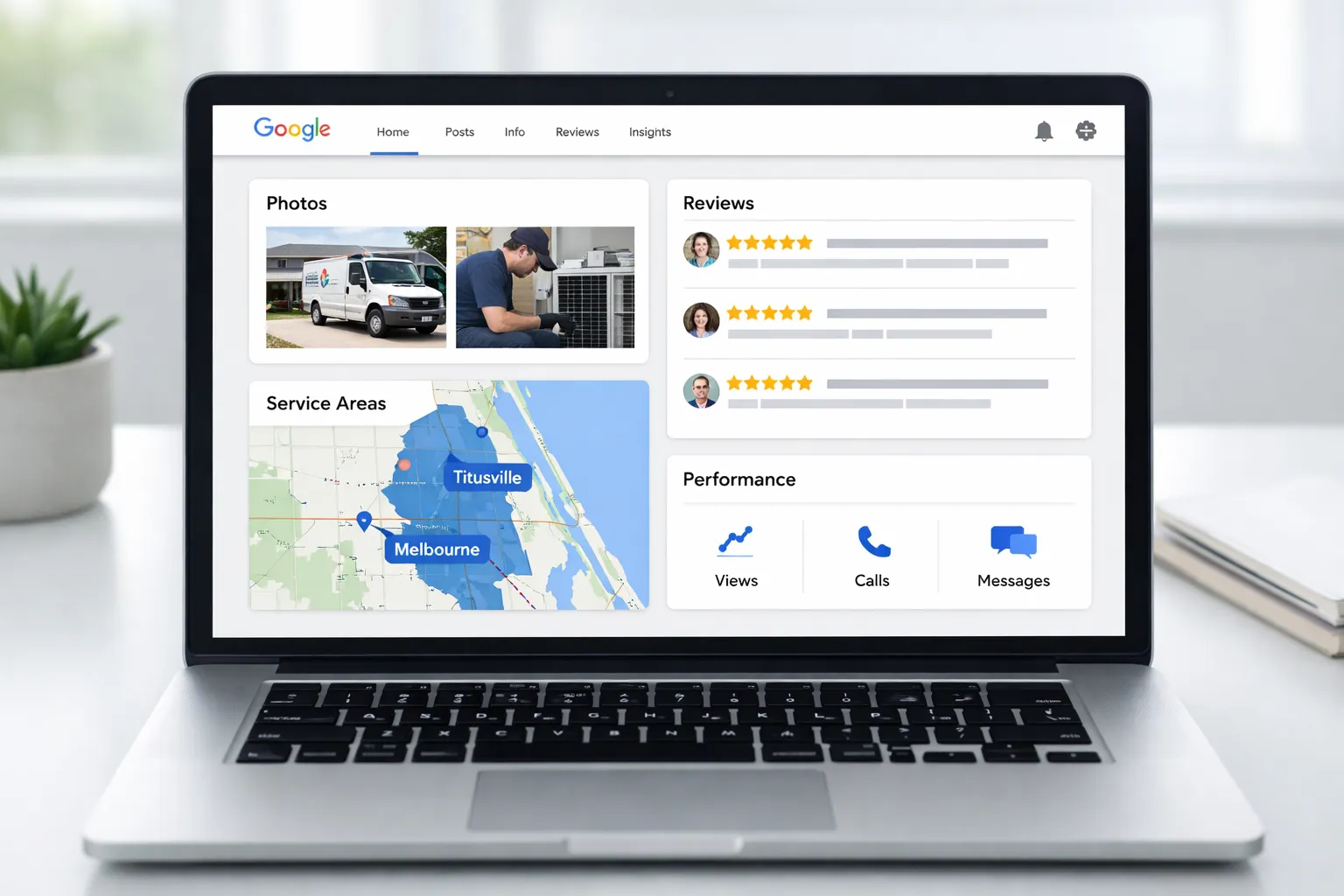
Consistent information and fresh photos help you stand out in the map pack when people need help fast.
What Are Citations And Backlinks, And Why Do They Matter For HVAC SEO?
Citations are directory listings that show your business name, address, phone number, and website. Backlinks are other websites linking to your site. Both act like references and votes of confidence that tell Google you’re a real, trusted HVAC business, and they play a significant role in improving your search engine rankings.
Why Do Consistent Citations Matter?
When your NAP (Name, Address, Phone) appears consistently across multiple directories, Google gains confidence that your business is legitimate and located where you say. Inconsistencies, like different phone numbers or address variations, confuse search engines and can drop your local search rankings.
Which Citation Sources Matter Most?
-
Google Business Profile (most important)
-
Yelp
-
Better Business Bureau
-
Angi (formerly Angie’s List)
-
Local chamber of commerce
-
HVAC trade directories (ACCA, local associations)
-
HomeAdvisor
-
Facebook business page
Quality backlinks from relevant local sites boost your authority. Here are realistic ways HVAC companies build links:
-
Get listed on manufacturer dealer pages (Trane, Carrier, Lennox)
-
Sponsor local Little League teams or school events in Titusville
-
Partner with property management companies in Melbourne who link to preferred vendors
-
Join local business associations that list members on their websites
-
Get featured in local news for community involvement
Social media marketing can also help increase exposure, facilitate content sharing, and build relationships that support backlink opportunities for HVAC businesses.
Warning: Don’t buy links or use spammy directories. Google penalizes this behavior, and some companies have seen 20-100% traffic drops after manual penalties. It’s not worth the risk.
We use our citation consistency check to find and fix NAP issues for clients. Off page SEO and link building work together with your on page SEO to build overall authority.
How Should HVAC Content Strategy Support Both SEO And Sales?
Content should first cover money pages (services and locations), then expand into helpful blogs and seasonal guides. Following proven HVAC SEO tips, such as targeting low-hanging fruit and local keywords, can significantly improve organic traffic, domain authority, and overall search visibility. The mistake most HVAC companies make is writing blog posts nobody searches for while neglecting their core service pages.
Which Content Types Deliver The Best Results?
1. Service pages (50% of your leads) AC repair, furnace installation, duct cleaning, heat pump replacement
2. City/service area pages (20% of leads) “AC Repair Melbourne FL,” “HVAC Services Viera,” “Heating Contractor Brevard County”
3. Troubleshooting guides (15% of leads) “AC blowing warm air fixes,” “Furnace won’t turn on,” “Why is my AC making noise”
4. Maintenance and seasonal tips (smaller lead impact, builds authority) “Prepare your AC for Florida summer,” “When to replace your air filter”
If you want to capture summer AC demand, plan content in March. Publish “AC tune up in Orlando” and “Prepare your system for summer humidity” two to three months before the search spike. By May, those pages have time to gain traction in search results.
Your blog posts should link up to related service pages using natural phrases. For example, a troubleshooting guide about “AC blowing warm air” should link to your “AC repair services” page. This passes authority to your money pages and helps visitors find what they need.
If this feels overwhelming, schedule a free audit and we’ll review your content plan with you.
How Do You Measure HVAC SEO ROI So You Know It’s Working?
Here’s the formula that matters for HVAC business owners:
Organic SEO ROI = (Leads × Close Rate × Average Job Value) – Monthly SEO Cost
Rankings are useful for tracking progress, but the real scorecard is calls, form fills, and booked jobs tied back to SEO pages.
What Does A Realistic ROI Example Look Like?
Let’s say your HVAC company gets 20 organic leads per month from SEO (calls and form fills tracked to organic search). Your close rate is 35%, and your average job value is $3,000.
-
20 leads × 35% close rate = 7 booked jobs
-
7 jobs × $3,000 = $21,000 revenue
-
If SEO costs $1,500/month, that’s roughly 13x ROI
This is why HVAC leads are valuable. The lifetime value of an HVAC customer ($1,500-$5,000 per job) makes SEO investment worthwhile when tracked properly.
Which Tracking Tools Should Every HVAC Company Use?
-
Call tracking (like CallRail) to attribute phone calls to specific pages and keywords
-
Google Analytics to see which pages generate traffic and conversions
-
Form and chat tracking to measure contact submissions
We set this up as part of our digital marketing services so owners see a clear monthly numbers report. No more guessing whether SEO is working.
When Should You Expect To See Results?
-
3 months: You should see movement in impressions and clicks
-
6 months: Rankings improve, calls start increasing
-
12 months: Compounding returns as pages build authority
SEO isn’t instant, but it compounds. Unlike Google Ads where you pay $50-100 per lead indefinitely, SEO leads often cost $20-50 over the lifetime of your investment.
Should You DIY HVAC SEO Or Hire An Agency Like L3ad Solutions?
HVAC business owners can handle basics, but deep SEO and technical work usually need experienced help. Partnering with a specialized hvac seo agency ensures you benefit from advanced strategies tailored for HVAC businesses, improving your local search visibility and generating high-quality leads. The question is where your time is best spent. If your time is worth more on service calls, SEO for HVAC companies shows what handing it off costs, with pricing posted before you ever talk to anyone.
What Tasks Can You Handle In-House?
-
Claim and verify your Google Business Profile
-
Ask customers for reviews after completed jobs
-
Update hours and service area information
-
Post a few FAQs and photos to your GBP
-
Write basic service descriptions for your website
What Usually Requires Outside Help?
-
Full keyword research and competitive analysis
-
Fast, conversion-focused web design for HVAC
-
Technical SEO audits and fixes (site speed, schema, mobile devices)
-
Content calendar planning and execution
-
Structured data and schema markup generator implementation
-
Quality backlinks and citation building
-
Running a strategic, tailored SEO campaign to optimize HVAC websites and attract qualified leads
-
Internet marketing strategy across channels
- Full control over your messaging and brand
- No monthly agency fees
- Learn valuable skills along the way
- Takes significant time away from running your business
- Technical work like site speed and schema is complex
- Results usually come much slower without experience
About L3ad Solutions
We’re based in Titusville, Florida with hands-on experience serving contractors across the Space Coast, and we have a deep understanding of the HVAC industry. Our founder has an Intel operations and data analytics background, which means we focus on numbers that matter: calls and booked jobs, not vanity metrics.
We offer month-to-month contracts (no long-term lock-ins), transparent reporting, and an emphasis on local businesses that need real leads. Run a quick check with our free SEO audit tool, then get a free consultation if you want a done-with-you or done-for-you plan.
How Is AI Search Changing HVAC SEO In 2026?
AI features like Google’s AI Overviews and voice assistants now summarize answers directly in search results. This means structured, clear HVAC content is more important than ever. Google’s AI pulls from multiple websites and presents combined answers, so your content needs to be formatted in ways AI can easily parse and cite.
Concise sections with clear headings, direct answers to common questions, and FAQ formatting increase the chances of your content being quoted in AI summaries. Answer engine optimization is becoming as important as traditional search engine optimization.
At L3ad Solutions, we offer AI search optimization services that adapt HVAC content for both traditional search engine results and AI-generated answers. This includes adding small data points, step-by-step instructions, and clear headings throughout your content.
The good news: honest, experience-based HVAC content still works. AI or not, Google wants to show helpful, accurate information. If your content answers real homeowner questions clearly and your technical setup is sound, you’ll continue generating organic traffic and calls. The fundamentals haven’t changed, but the presentation needs to adapt.
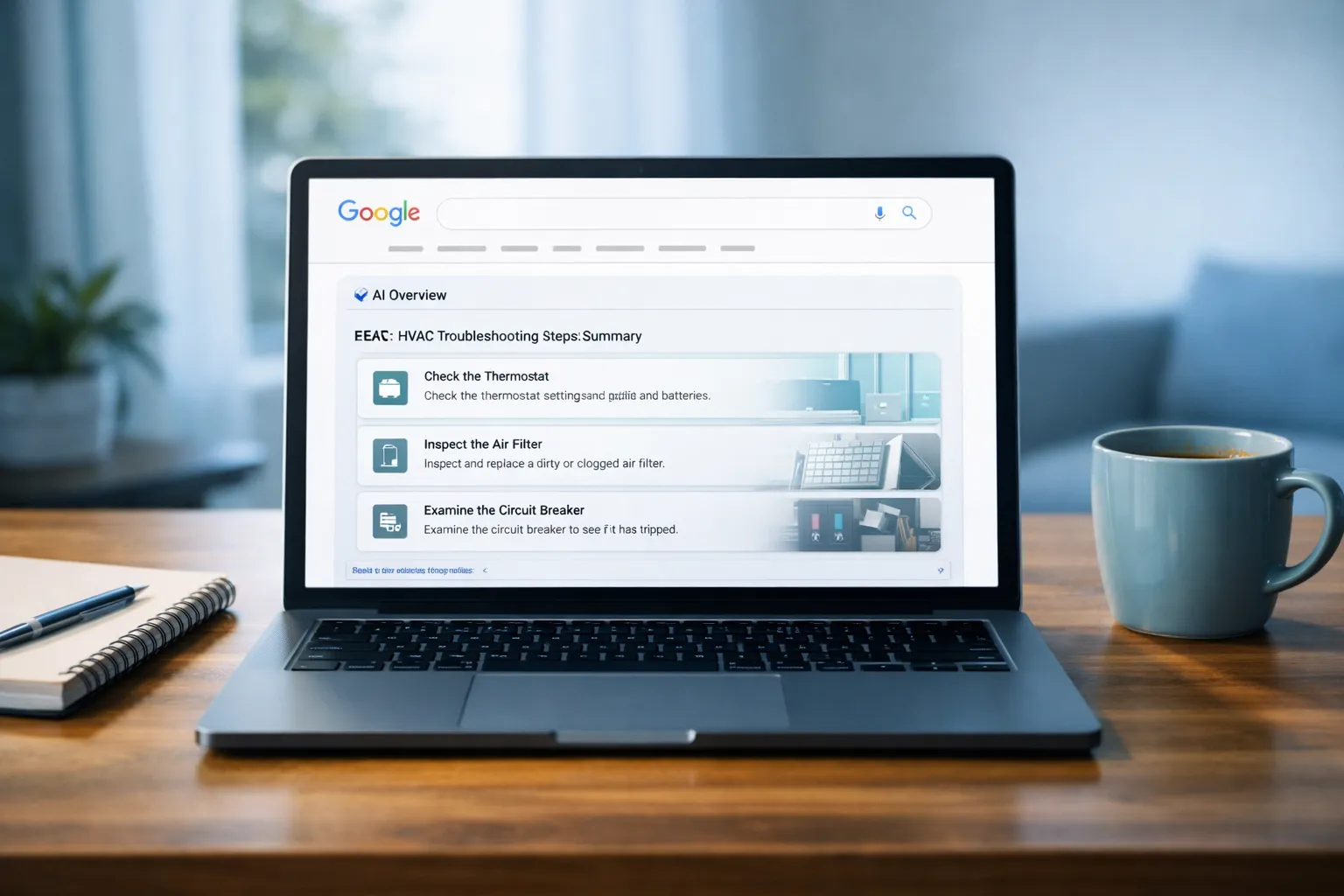
Clear, well-structured content with direct answers increases the chance your information appears in AI summaries.
What Common HVAC SEO Mistakes Should You Avoid?
Avoiding common mistakes is just as important as doing the right things. Here are the errors we see most often with HVAC contractors:
Mistakes to avoid:
-
Keyword stuffing city names: Cramming “Titusville AC repair Titusville air conditioning Titusville FL” into your content triggers spam filters and reads terribly
-
Using cookie-cutter duplicate pages: Creating 20 city pages with only the city name changed gets ignored by Google
-
Buying cheap backlinks: Spammy link packages often lead to penalties and 20-100% traffic drops
-
Ignoring mobile experience: Half of potential customers will leave if your site doesn’t work on their phone
-
Neglecting meta descriptions: These are your “ad copy” in search results; generic descriptions hurt click-through rates
-
Fake reviews: Google detects patterns and removes them; the reputation management damage isn’t worth it
Black-hat tactics might work short term, but penalties can destroy years of built visibility. Stick with ethical, white-hat practices focused on helpful content and real relationships.
If agencies throw jargon at you, check our SEO glossary to decode what they’re actually saying.
Tap a question to expand.
How long before HVAC SEO starts bringing in real leads?
Is SEO better than Google Ads for HVAC companies?
Do I need blog posts or just service pages?
How many reviews do I need to compete locally?
Can I rank for multiple cities with one office?
How do I know if my current SEO company is effective?
What is the biggest HVAC SEO mistake to avoid?
If you want a second opinion on your current HVAC SEO strategy, we’re happy to look at it. Our HVAC marketing services focus on calls and booked jobs, with transparent reporting and no long-term contracts. The HVAC companies winning search visibility in 2026 are tracking what matters, and we can help you do the same.
Or start with a free AI visibility check
Does AI Recommend You?
See if ChatGPT, Gemini, Grok, and Claude name your business. Free report by email.