SEO Services for Small Businesses: What Works in 2026?
Learn proven SEO strategies to boost local visibility and drive more leads for your Florida business.


Learn proven SEO strategies to boost local visibility and drive more leads for your Florida business.
SEO services for small businesses help you get more calls, form fills, and walk-ins from Google without paying for every click. For Florida service businesses, the right SEO work targets local searches, fixes technical problems, and builds your Google Business Profile. Done right, organic leads cost less than paid ads over time, with benchmarks showing under $50 per lead for established campaigns.
SEO is a core part of digital marketing and an essential marketing strategy for small businesses, helping them grow online and stay competitive.
At L3ad Solutions, we’re based in Titusville and focus specifically on local service businesses across Florida’s Space Coast. We use data and prioritization, not guesswork, to figure out which SEO work will move the needle fastest for your business. SEO is one of the most cost-effective marketing strategies for small businesses, and organic traffic from SEO is free and provides a long-term, sustainable, and high-ROI marketing channel.
In this guide, you’ll learn exactly what SEO services are worth paying for, what you can do yourself in the first 30 days, and when it makes sense to hire help. No jargon without explanation, no fluff.
Small business SEO means setting up your website and Google presence so nearby customers find you first when they search for what you offer. SEO stands for Search Engine Optimization, which is the process of improving your website’s visibility in search engine results to attract more potential customers. It’s about showing up when someone in Merritt Island types “AC repair near me” or a Melbourne resident searches “med spa facial.”
A small business's online presence is the foundation for being discovered in online searches. Local SEO is a specific type that focuses on geographic searches. Think of it this way: regular SEO is like putting a billboard on I-95 that everyone driving through Florida sees. Local SEO is like putting a sign on your street that only people in your neighborhood notice. Both work, but they serve different purposes.
Here’s a concrete example:
Local SEO is crucial for attracting local customers who are searching for services nearby. Most small service businesses need both approaches, but local SEO comes first. Get your Google Maps presence dialed in, then layer in broader content to capture people earlier in their search journey.
Transitioning from understanding the basics, let’s explore why SEO is especially important for small businesses on the Space Coast right now.
SEO matters because it turns existing Google searches into steady leads at a lower cost than paid ads over time. People are already searching for what you offer. The question is whether they find you or your competitor.
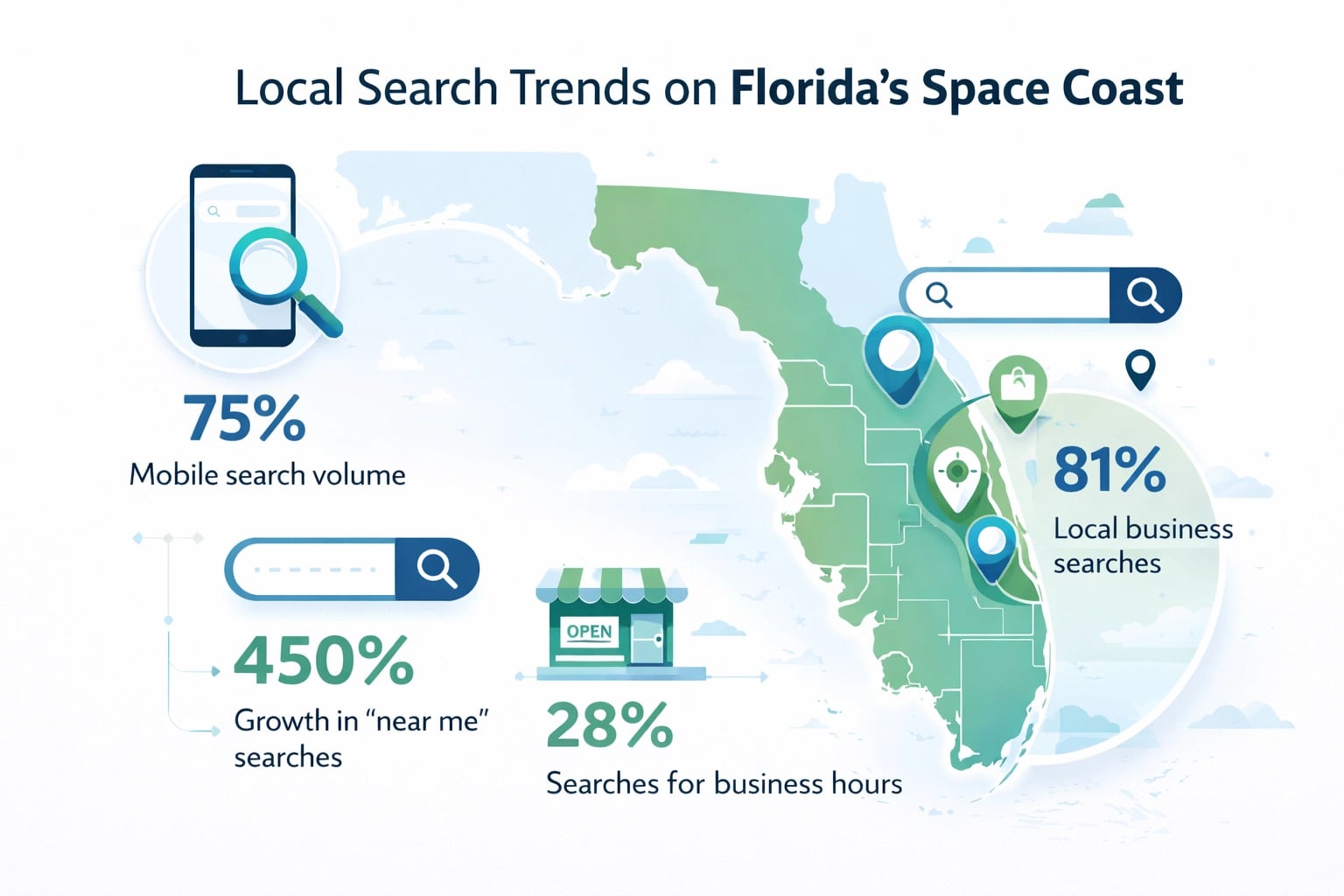
According to our local search research, mobile search volumes on the Space Coast are especially high due to tourism, the space industry workforce, and seasonal weather events driving service demands. In our Florida Local Search Index, local service sites that load in under 3 seconds get about 28% more calls than slower competitors.

Mobile search dominates on the Space Coast due to tourism and local demand.
The key difference between SEO and paid advertising is staying power. When you stop paying for Google Ads, the leads stop. When you build organic rankings, they keep working. You can measure success in calls, form fills, and booked appointments, not just rankings or website visits.
Understanding the local landscape sets the stage for knowing which SEO services are actually worth your investment.
Most small businesses only need a focused bundle of services, not everything an agency might offer. The core SEO services worth paying for fall into six categories that directly impact lead generation.
Fixes site speed, broken links, and indexing issues to ensure Google can crawl your site effectively.
Optimizes Google Business Profile and citations to rank in local searches and Maps.
Builds pages that answer customer questions and target local search intent.
Earns natural endorsements from local partners to boost authority.
Technical cleanup addresses the behind-the-scenes issues making your site slow or invisible to Google. This includes fixing broken links, compressing images, ensuring your SSL certificate works (an SSL certificate is a security feature that encrypts data between your website and visitors), and cleaning up duplicate content that confuses search engine crawlers.
Technical SEO improvements, such as faster load times, directly support your local SEO efforts by improving user experience and search rankings.
Local SEO services focus on Google Business Profile optimization, citation management (citation management means ensuring your business’s name, address, and phone number are consistent across directories like Yelp, Angi, and local chambers), and review generation. This is where most small service businesses see the fastest wins.
Content creation means building pages that answer real questions your customers ask, like “AC repair cost in Titusville 2026” or “what to expect during a roof inspection.”
Basic link building involves getting natural endorsements from local partners, not buying spammy links from random emails. A strong link building strategy is important for acquiring quality backlinks (links from other websites that point to your site) which are one of the strongest ranking signals for Google.
Reporting and tracking tie everything together. You need to know which pages drive calls, not just which ones get traffic. Monitoring keyword rankings and search traffic is essential. Using tools like Google Analytics and Google Search Console helps you track your website’s performance in Google search results, identify issues, and optimize for better visibility. At L3ad Solutions, we work month-to-month with no long-term contracts, which fits small business budgets and keeps us accountable for results.
Now that you know which services matter most, let’s look at how to get started with SEO as a small business owner.
Getting started with SEO doesn’t have to be overwhelming. Here’s a simple 30-day action plan for non-technical owners. You don’t need to understand code or spend hours learning algorithms. Just follow these steps in order to lay a solid foundation for your SEO success.
Start with tracking tools like Google Analytics and CallRail to measure what drives leads from day one.
Transitioning from setup to measurement, let’s discuss how to track your progress and structure your website for SEO success.
You can’t fix what you don’t measure, so tracking is step one, not an afterthought. Many business owners skip this and have no idea which marketing efforts actually work.
Google Analytics tracks visitor behavior, traffic sources, and conversions like form submissions. Google Search Console reveals which search queries bring clicks, your click-through rates, and any crawl issues Google encounters. For service businesses, call tracking is critical. You need to know which web pages drive phone calls, not just which ones get visits. Track calls, not just clicks.
At L3ad Solutions, we always set up tracking during onboarding. This means owners see exactly which pages and keywords drive leads, so we can double down on what works and fix what doesn’t.
Each main service needs its own focused page, not one “Services” page that lists everything. Google ranks pages, not websites. If you want to rank for “AC repair in Brevard County,” you need a page specifically about AC repair.
Creating strategies that are tailored to your business needs is essential for sustainable growth. Personalized, long-term SEO plans help ensure your website structure supports both immediate and future goals.
For example, an HVAC company should have separate pages for:
Each page targets different search queries and different customer needs. A service business needs pages for specific offerings like drain cleaning, water heater installation, leak repair, and so on.
Keep navigation simple: Home, Services, Locations, About, Contact. Use internal links between related services to help users and Google understand how your pages connect. On your AC repair page, link to your AC installation page with text like “Need a full replacement? See our AC installation service.” Every page should have a clear call-to-action, whether that’s calling for a quote, filling out a form, or booking an appointment.
With your website structure and tracking in place, the next step is to focus on local SEO to show up in Maps and “near me” searches.
Local SEO gets you into the Google Maps 3-pack and nearby search results, which is where most calls originate for service businesses. When someone searches “service near me” from Palm Bay, Google shows three local businesses at the top with a map. That’s prime real estate. Good SEO practices help increase your web traffic and boost your visibility in local search, making it easier for potential customers to find and contact you.
Across our Florida clients, more than 60% of new leads start from Google Maps views, not traditional blue link results. This is why local SEO is the priority for small service businesses.
The key pieces include:
Inconsistencies in any of these areas can drop your rankings because they confuse Google’s systems.
Google Business Profile services are the foundation. If your GBP is incomplete or has wrong information, you’re leaving calls on the table. Space Coast towns like Titusville, Cocoa, Merritt Island, Melbourne, and Palm Bay all have their own search dynamics. A Melbourne med spa and a Titusville service provider need different local strategies. Small business SEO services can help ensure your business is following best practices for local SEO and maximizing your online presence.
Let’s dive deeper into how to set up and optimize your Google Business Profile for maximum impact.
Your Google Business Profile is non-negotiable if you want phone calls from Google. It’s free, but most businesses leave it incomplete or outdated.
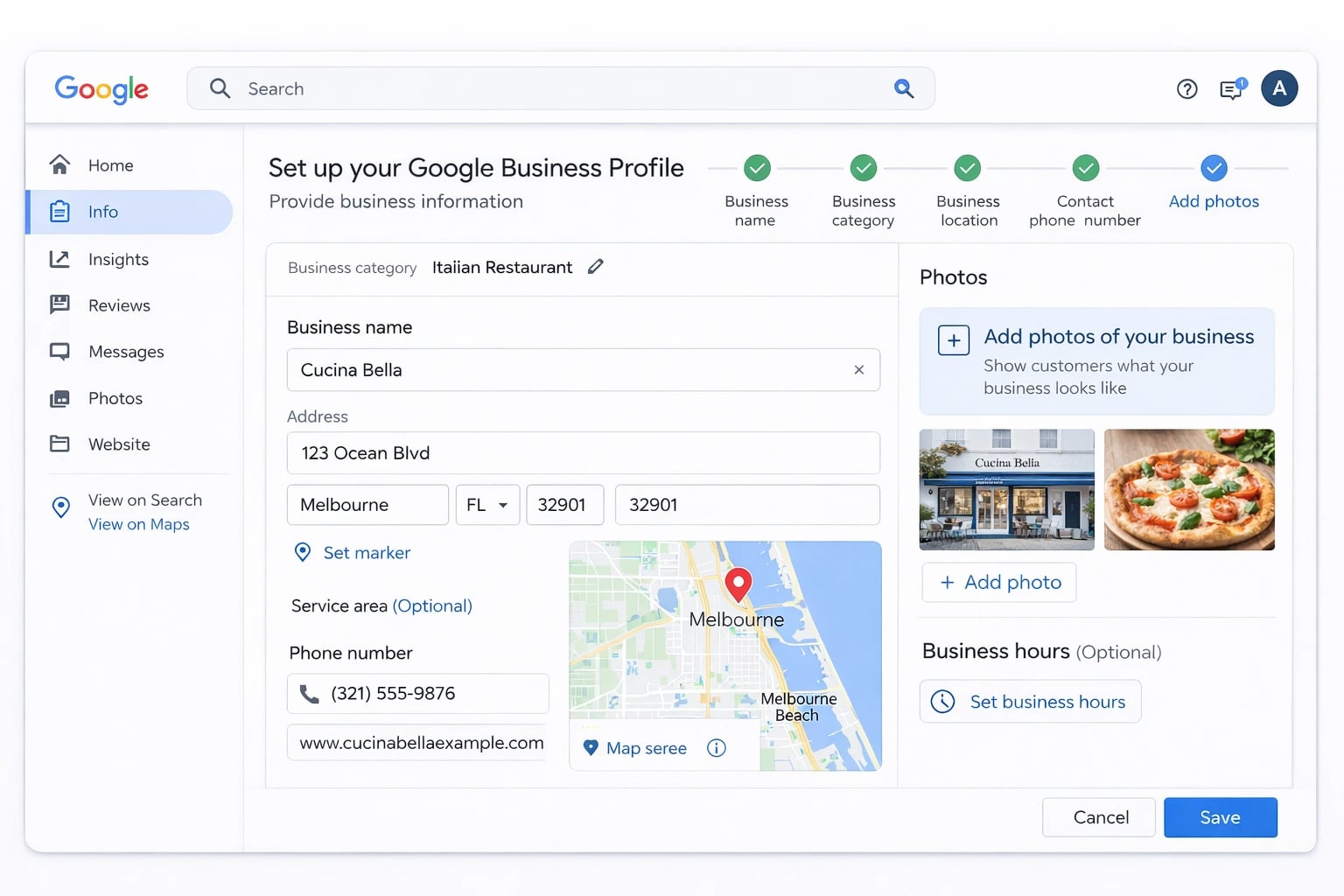
Start by claiming or creating your profile at business.google.com. Verify through postcard, phone, or video depending on what Google offers. Fill in your exact business name, address, and phone number. Add your hours, all services you offer, and your service area covering specific towns and zip codes. Upload at least 20 high-resolution photos showing your work, your team, and your location.
Keep it active with weekly updates. Post offers or announcements, answer questions in the Q&A section, and add fresh photos regularly. Restaurants should post menus, med spas should show before-and-afters, and gyms should highlight class schedules.
We often fix issues for Space Coast clients such as:
These small errors cause big ranking drops because they confuse Google about your actual business information.

A complete Google Business Profile is essential for local search visibility.
Once your profile is optimized, reviews and citations become the next critical factors for local SEO success.
Reviews directly impact both rankings and sales. People trust 4.5-star businesses far more than 3-star ones. Studies show higher-rated businesses get roughly twice the clicks. Recency matters too. Fresh reviews boost your prominence in local results.
Citations are listings of your name, address, and phone number on sites like Yelp, Angi, Apple Maps, and local chambers of commerce. Google uses these to verify your business exists and confirm your information is accurate. If your phone number is different on Yelp than on your website, Google gets confused and may rank you lower. Citation management is the process of ensuring this information is consistent everywhere.
Keep NAP 100% consistent everywhere. A Brevard business fixed mismatched phone numbers across 20 sites and recovered 15% of lost traffic. For reviews, set up a simple system: text or email customers after each job with a direct link to leave a review. Aim for 10+ new reviews monthly.
With your local presence established, it’s time to look at how content and backlinks can further boost your authority and rankings.
Helpful content answers real questions your customers ask. Quality backlinks act like references from other websites vouching for you. Both build your authority with search engines over time.
Most local businesses don’t need hundreds of articles. You need the right ones. A Titusville AC company doesn’t need a 3,000-word guide on the history of air conditioning. They need a page answering “How much does AC repair cost in Titusville in 2026?” with honest pricing ranges and a call-to-action.
Backlinks are links from other websites pointing to yours. Think of them as recommendations. When the Titusville Chamber of Commerce links to your site, Google sees that as a vote of confidence. Check our SEO glossary for definitions of terms like these if they’re new to you.
The warning: don’t buy cheap, spammy links from random emails promising thousands of backlinks for $50. Those can get your site penalized and tank your rankings. Focus on quality over quantity.
Let’s break down what types of content and backlink strategies work best for small businesses.
Focus on content that leads directly to calls, not random blog topics that seem interesting. Every page should have a purpose tied to your business goals.
Prioritize:
A Florida roofing business publishing hurricane prep tips earned links from other sites and saw 25% traffic growth because the content was locally relevant and genuinely useful.
Update your content yearly with current dates and pricing ranges. A page titled “AC Repair Costs 2024” looks outdated in 2026 and may get skipped by searchers looking for current information.
Think of links as online recommendations from other sites. The safest and most effective approach involves earning them through real relationships and community involvement.
Tactics that work include:
One Titusville gym sponsored a community fun run and earned five quality links from the chamber, the event website, and local coverage.
Avoid buying large packages of links from random emails. These usually come from low-quality sites that can hurt your rankings. Google’s systems are designed to detect and discount artificial link building. Stick to building links through genuine community presence.
With content and backlinks in place, let’s talk about what you can expect to invest in SEO services.
For small service businesses in Florida, realistic SEO pricing ranges from $500 to $2,500 per month on retainer. A typical Small Business SEO campaign through an agency will range anywhere from $750 to $2,000 per month, depending on the specific requirements. Hourly rates typically fall between $100 and $200 for project work or consulting. Freelance SEO rates typically range from $25 to $150 per hour in the U.S. Serious SEO that moves the needle usually starts in the mid-hundreds for low-competition markets like Titusville HVAC, scaling up to $2,000+ for competitive markets like Orlando.
What drives cost? Competition in your industry and location, the number of locations you serve, your current website condition, and how fast you need results. A Brevard County business with a decent existing site needs less work than a Melbourne med spa competing against 15 others with established online presence.
For a detailed breakdown, read our SEO pricing breakdown. We offer clear, tiered options through our SEO packages so you know exactly what you’re getting at each price point. No hidden fees, no vague deliverables. The best SEO companies for small businesses will show organizations how to do SEO and why it is important.
Both can work, but they serve different purposes. Paid ads deliver instant traffic the moment you turn them on. SEO builds compounding results that get cheaper over time.
Here’s a simple comparison: PPC (pay-per-click) is like renting a billboard. You pay monthly, and when you stop paying, the visibility disappears. SEO is like buying the building on a busy corner. It takes longer to acquire, but you own it.
Over 6 months, many of our clients spend less per lead from organic search than from Google Ads. The smart approach is usually a blend at first, with paid ads generating immediate leads while SEO ramps up. Then shift budget toward organic as rankings improve. Track both channels to find your optimal mix.
As the digital landscape evolves, let’s see how AI and new search technologies are shaping small business SEO.
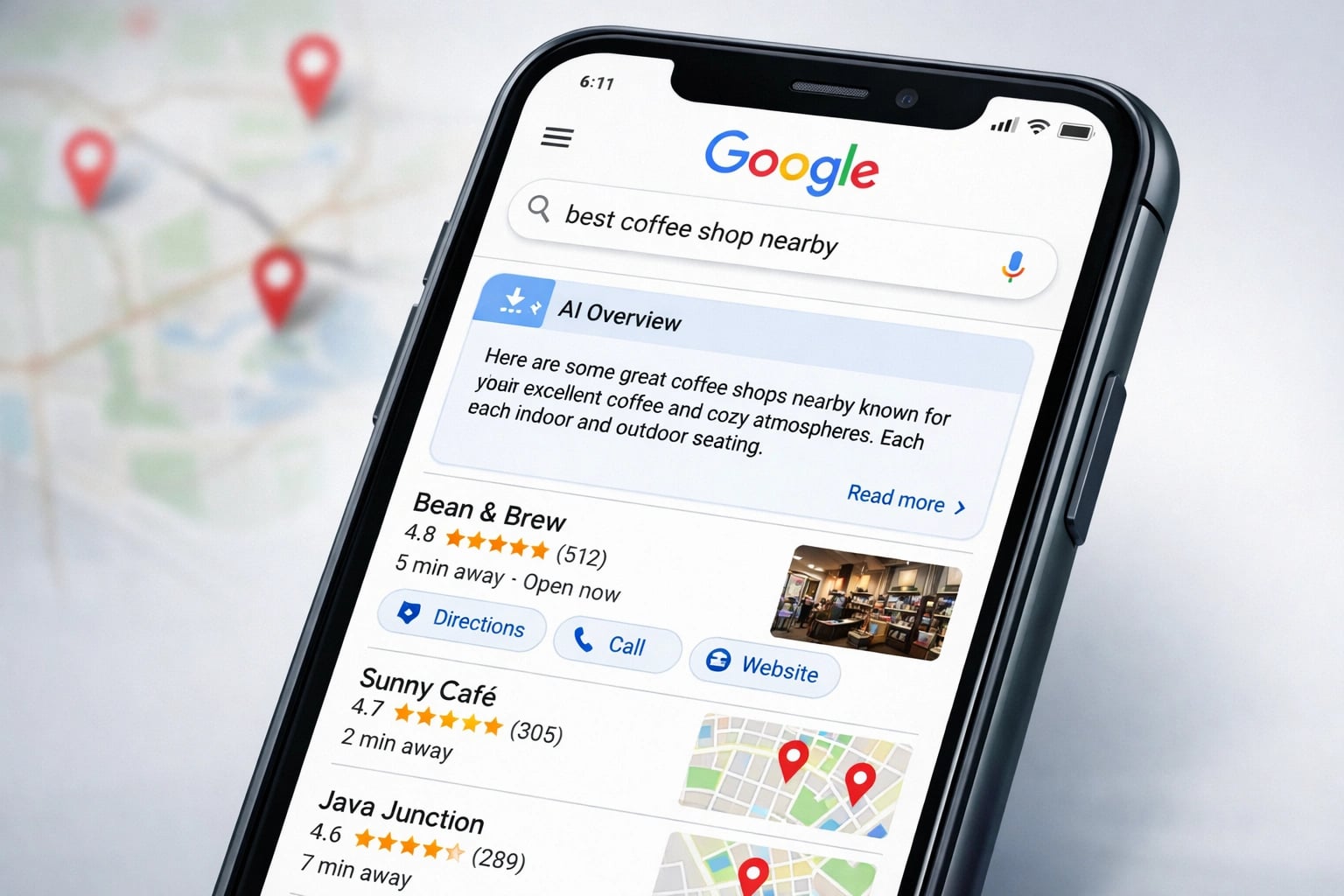
AI-driven search features like Google’s AI Overviews change how results look, but local SEO fundamentals still matter. When someone asks Google a question, AI may summarize the answer at the top of results. Your business can be cited as a source if your content is clear and authoritative.
GEO, or generative engine optimization (GEO), refers to optimizing content so AI systems choose to reference it. This involves structured data (structured data is code added to your website that helps search engines and AI understand your business details, services, and reviews), clear FAQs, and strong local signals that help AI features understand and trust your business as a source.
For example, a search like “best service near Port Canaveral” might trigger an AI Overview summarizing top options. Businesses with complete profiles, good reviews, and clear service pages are more likely to be included. Check out our AI search optimization services if you want to stay ahead of these changes.

AI-driven search results prioritize clear, authoritative local content.
The bottom line: keep doing solid local SEO work. Clear, helpful content with accurate business information positions you well for both traditional and AI-driven search results.
Now, let’s discuss how to choose the right SEO agency for your small business.
With so many SEO tools on the market, it’s easy for small businesses to feel overwhelmed. In 2026, the most valuable SEO tools are those that provide clear insights and help you take action to improve your online visibility and search engine rankings.
Start with the essentials: Google Search Console and Google Analytics. Google Search Console lets you monitor your site’s presence in Google search, track keyword performance, and identify technical SEO issues. Google Analytics gives you a deep dive into website traffic, showing where visitors come from and what actions they take on your site.
For more advanced needs, tools like Ahrefs, SEMrush, Moz, and Ubersuggest are worth considering. These platforms offer robust keyword research features, technical SEO audits, and competitor analysis, helping you refine your SEO strategy and spot new opportunities. Use these tools to discover relevant keywords, analyze your backlink profile, and optimize your content for better search engine rankings.

Leverage tools like Google Analytics to track SEO performance effectively.
By leveraging the right SEO tools, small businesses can streamline their SEO efforts, track progress, and make data-driven decisions that lead to increased website traffic and improved search engine rankings. Focus on tools that fit your needs and budget, and use them consistently to stay ahead of the competition.
The right SEO partner should talk in plain English, show their work, and tie everything to leads and revenue, not just rankings or traffic numbers. Choosing reputable SEO companies that specialize in small business SEO is crucial. They understand the unique challenges and opportunities small businesses face and can tailor strategies to maximize your online visibility.
Look for transparency about what they’ll actually do each month. Ask for local experience with businesses similar to yours in your area. Demand a custom strategy based on your specific situation, not a cookie-cutter package applied to every client. Expect realistic timelines (3-6 months for meaningful results, not overnight miracles) and clear reporting that shows what’s working.
The founder of L3ad Solutions comes from an Intel operations and data analytics background. That means we prioritize actions based on data and impact, not guesswork or trendy tactics. We start with analysis and build strategy around what will actually move leads.
Ask any agency you’re considering for specific examples from similar local service businesses. Not generic case studies from other industries or markets. When evaluating agencies, consider their small business SEO services and how well they align with your goals. Request a free audit before committing to anything long-term.
L3ad Solutions is a Titusville-based partner focused specifically on local service providers across Brevard County. We’re not a generic agency working with clients across the country. We know the Space Coast market.
Our differentiators include:
We work with various service businesses throughout the area.
Projects typically start with an audit to find quick wins and bigger issues. Then a strategy call to build a 90-day plan. Then monthly improvements based on what the data shows. Straight talk, measurable results, no marketing fluff.
Before you get started, it’s important to avoid some common pitfalls that can derail your SEO efforts.
Avoiding a few big mistakes can save months of wasted effort and thousands of dollars. Here are the most common errors we see with Space Coast businesses:
Tap a question to expand.
Focus on local SEO, a clean site, clear tracking, and steady content. Skip chasing every new tactic or platform. Start with the fundamentals that actually drive calls.
If you want help, request a free audit that includes a simple 90-day plan prioritized by impact and effort. We’ll show you exactly where you’re losing leads and what to fix first.
The goal is more calls, not more jargon. Let’s talk about what SEO services for small businesses can do for your specific situation.