



Dental SEO Strategies: How To Attract More Patients From Google In 2026
Dental SEO strategies put your practice in front of patients already searching for a dentist in your area. Local SEO, service pages, schema, reviews, and ROI tracking for US dental practices.
Updated September 9, 2026 · 14 min read
Table of Contents
• Dental SEO connects your practice with local patients actively looking for care; 94% of Google clicks go to organic results, not ads. • Practices in the top three of the Map Pack receive 70% of clicks, making local SEO and Google Business Profile the biggest levers. • Practices with good SEO see 15-30% more new patient appointments than those relying only on referrals or paid ads.
Key Takeaways
-
Dental SEO strategies connect your practice with local patients who are actively looking for care. 94% of clicks on Google go to organic results, not paid ads.
-
Local SEO and Google Business Profile optimization decide who shows up in the Map Pack. Practices ranking in the top three Google Map Pack receive 70% of clicks.
-
Practices with good SEO see 15-30% more new patient appointments compared to those relying only on referrals or paid advertising.
-
You'll get keyword research, service pages, technical SEO, reviews, content creation, and how to track ROI, whatever the size of your practice.
-
L3ad Solutions offers month-to-month dental SEO support with no long-term contracts anywhere in the US.
How Do Dental SEO Strategies Help Your Practice Get More Patients?
Dental SEO makes your dental practice show up more often in local search results and Google Maps, turning searches into booked patient appointments. SEO is a long-term investment that builds website authority and compounds over time.
Here's what strong dental SEO does in practice:
-
Over 3.4 million searches for dentists occur monthly on Google. That's your patient pipeline.
-
Rankings for terms like "dentist near me" and "emergency dentist [city]" drive high-intent calls, form fills, and walk-ins.
-
90% of patients take action within a day of searching online. If your dental clinic isn't visible, someone else's is.
-
BrightLocal's 2024 survey found that 81% of US consumers used Google to evaluate local businesses, including healthcare providers.
-
The #1 Google organic search result captures 33% of all clicks. The rest drop off fast. 75% of users never go beyond the first page of search results.
Unlike Google Ads, which can provide immediate visibility for dental practices but stop the moment spending stops, organic search traffic compounds. The work you put in this quarter keeps producing calls next quarter. Google Ads costs can add up quickly for competitive keywords. SEO drives 94% of clicks on Google results, making organic search the primary driver of new patients over time.
L3ad Solutions focuses on tying rankings to real metrics: calls, form fills, and scheduled visits. Not just clicks. Tracking performance metrics aligns SEO strategies with actual patient acquisition outcomes.
What Makes Dental SEO Different From General SEO For Other Businesses?
Dental SEO carries higher trust requirements than most local services because Google treats medical content under "Your Money, Your Life" (YMYL) standards, meaning content about dental services must be accurate, cited, and ideally reviewed by subject matter experts like a DDS or DMD.
Dental searches also include symptoms and urgency that other local services rarely see. Patients search for "toothache same day appointment," "Saturday dentist near me," or "same day dental implants" with intent to act immediately. Your digital strategy needs to reflect that urgency with visible hours, emergency policies, and a local phone number.
The dental industry also deals with insurance-related queries, HIPAA-sensitive contact forms, and specialty-specific schema markup that go well beyond what a typical plumber or restaurant would need. An effective dental SEO strategy focuses on local visibility and patient trust, not just traffic.
For dentists who want a broader strategy view beyond just SEO, the national dental marketing blueprint covers the full picture.
How Should You Structure Your Dental Website For SEO Success?
Your site structure tells every search engine what your practice does and which dental services and locations matter most. Get this wrong, and Google can't match your pages to the right queries.
Creating dedicated service-specific landing pages improves search engine understanding and patient targeting. Instead of one generic "Services" page, build separate service pages for:
-
Cleanings and exams
-
Dental implants
-
Cosmetic dentistry and veneers
-
Invisalign and orthodontics
-
Pediatric dentistry
-
Emergency dental care
Keep your navigation clean. Top-level items like "Services," "About," "Patient Info," and "Contact" work. Avoid cluttered mega-menus that confuse both users and crawlers.
If you have multiple offices, each location needs its own page with an embedded map, accurate NAP (name, address, phone number), hours, and neighborhood references. Multi-location dental practices that skip this step lose visibility in each area they serve.
For layout guidance that turns visitors into booked patients, see conversion-focused web design.
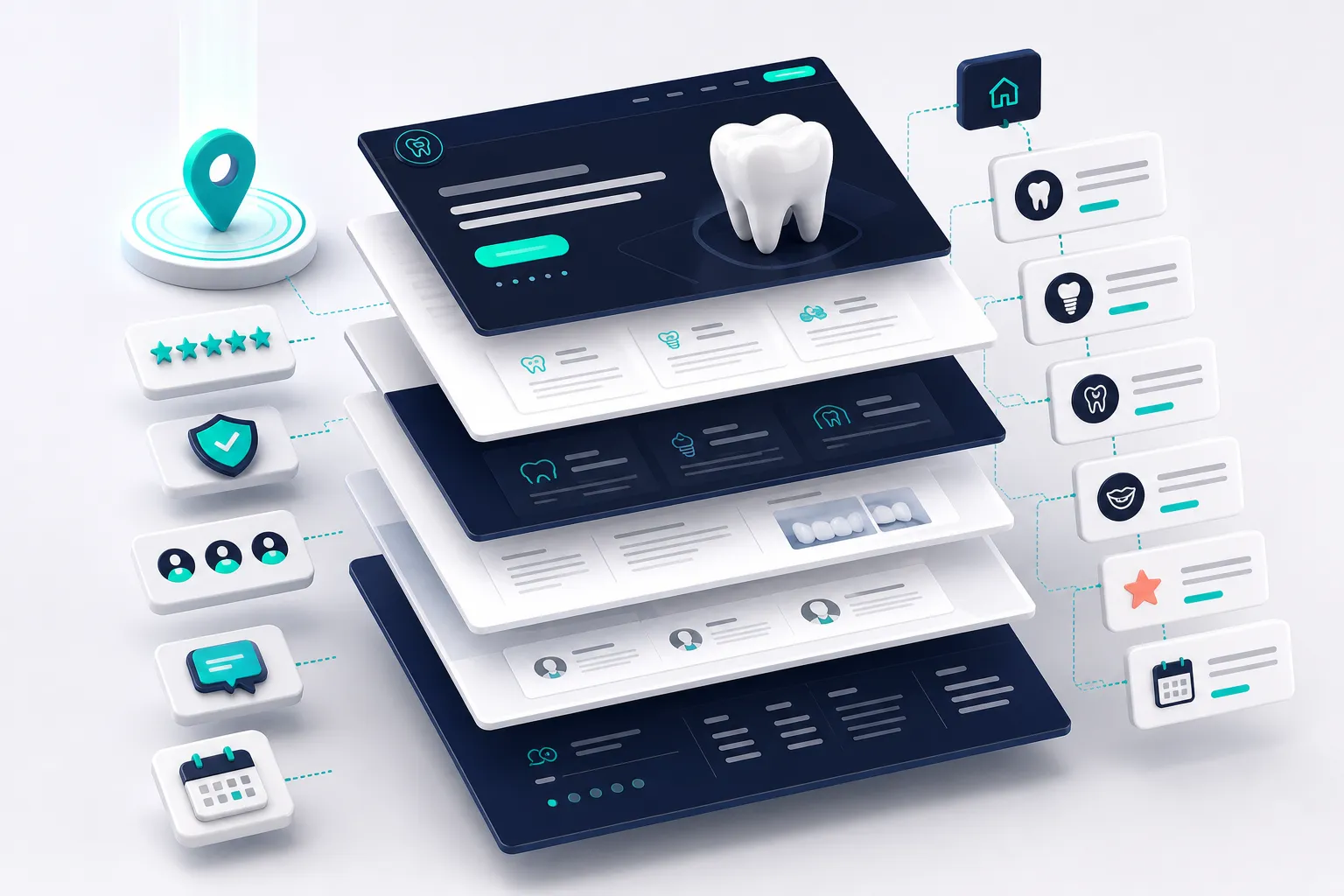
One page per service and per location gives Google something specific to rank.
How Do You Choose Dental Keywords That Real Patients Actually Use?
Keyword research for dental practices should focus on plain-language terms. Patients don't search "periodontal therapy." They search "bleeding gums" or "deep cleaning near me."
Here's a simple process:
-
List every service your practice offers.
-
Add city or neighborhood modifiers ("teeth whitening in Austin," "kids dentist near me").
-
Check search volumes using Google Keyword Planner or run a free local SEO audit to see where you stand.
Targeting high-intent keywords improves matching patient intent with services offered. Long-tail searches like "same day crown in Denver" bring fewer visits but far higher conversion rates than broad terms like "dentist." When a potential patient searches that specifically, they're ready to book.
Map 1-2 primary keywords plus a few related phrases to each service page. This prevents internal competition where two of your own pages fight each other in search results. For example, "dental implants in Dallas" belongs on your implants page, not your general services page.
How Can You Optimize Dental Service Pages For Search Engines And Patients?
Well-structured service pages are often the top converters for prospective patients who already know what they want. These pages do the heavy lifting for on page seo and appointment requests.
Each page (for example, "Dental Implants in Dallas") should include:
-
A clear H1 matching the service and city
-
A patient-friendly intro explaining who this treatment is for
-
Benefits, process overview, and recovery timeline
-
FAQs addressing common concerns
-
A visible "Book Appointment" or "Call Now" button above the fold
For title tags, follow this pattern: "[Service] in [City] | [Practice Name]." Write meta descriptions at 150-160 characters, including the service, city, and an action phrase like "schedule a consultation." These meta descriptions directly influence click-through rates in Google search results.
Sprinkle local phrases naturally. Mention nearby neighborhoods, schools, or employers. A cosmetic dentist in Houston can reference the Galleria area or the Medical Center. This helps both patient trust and search visibility for long-tail local queries.
Link related services together. Your implants page should link to bone grafting. Your whitening page should link to veneers. This helps nearby patients find related dental services and keeps them on your site longer.
What Local SEO Steps Help Your Dental Practice Dominate Nearby Searches?
Local SEO signals decide which practices show in the Google Map Pack for searches like "dentist near me." Local SEO helps dental practices appear in Google Maps results, and practices ranking in the top three Google Map Pack receive 70% of clicks.
The foundation is consistent and accurate NAP (Name, Address, Phone) information. It needs to match across your Google Business Profile, website footer, and every listing on dental directories like Healthgrades, Zocdoc, and Yelp. Consistent NAP information across platforms boosts Google Business Profile ranking. Even small mismatches (Suite 100 vs. Ste 100) can weaken trust signals.
Set the correct primary category ("Dentist" or "Pediatric Dentist") and add all relevant local services inside your business profile. Then make sure your listings on local directories are accurate, too.
Run a citation consistency check to find and fix mismatched listings across the web. Regular photo uploads, weekly posts, and Q&A content on your profile improve patient engagement and local visibility.
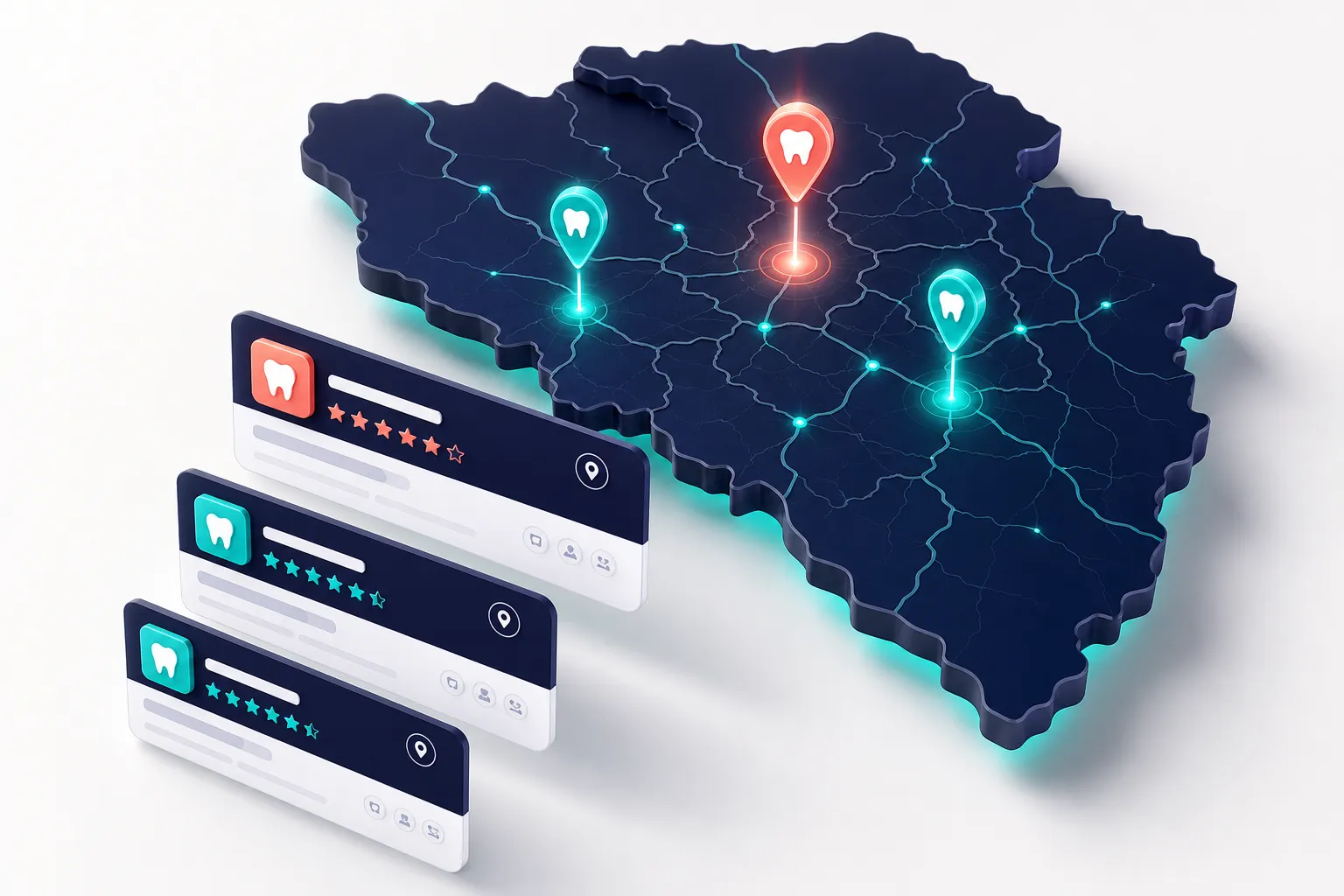
The top three Map Pack spots take 70% of clicks. NAP consistency and reviews get you there.
How Should Dentists Use Google Business Profile And Maps For More Calls?
Google Business Profile is often the first thing local patients see, even before the practice website. Complete Google Business Profiles improve local search rankings, and Google Business Profile optimization is essential for local SEO success.
Here's what a fully optimized profile looks like:
-
Accurate hours (including holiday hours and emergency availability)
-
Full service list covering everything from cleanings to cosmetic dentistry
-
Insurance notes (if allowed in your area)
-
Direct appointment link
-
At least 10-15 high-quality photos of the exterior, lobby, operatories, and staff
Regular updates to your Google Business Profile increase visibility and engagement. Post weekly about services, seasonal offers, or oral health tips. Answer questions in the Q&A section.
Use GBP Insights to track calls, website clicks, and direction requests. This data tells you which search queries trigger views and where your online visibility is growing or stalling. For step-by-step details, check the Google Business Profile guide.
How Does Content Marketing Support Dental SEO And Patient Education?
Helpful content answers patient questions before they call. Publishing educational content builds trust and helps attract prospective patients during their research phase.
Start with questions your front desk and hygienists hear every day:
-
"Does teeth whitening hurt?"
-
"How often should kids see a dentist?"
-
"What insurance covers dental implants?"
-
"How to care for dental implants after surgery"
Mix evergreen topics (insurance, cleanings, implant care) with seasonal content creation (back-to-school checkups, whitening before holidays). This matches how patients search throughout the year.
Every blog post should include a clear next step. Link to the relevant service page. Embed a scheduling button. Guide patient engagement from "I'm just reading" to "I'm booking." Content without direction produces awareness but not a dental appointment.
For faster topic ideation, explore AI automation for local business guidance. Just make sure a licensed dentist or trained staff member reviews all clinical information before publishing.
How Can Schema Markup And Technical SEO Give A Dental Site An Edge?
Schema markup is structured data, code added to your dental website that helps search engines understand your practice's services, reviews, and location details. Dental practices with schema markup see a 30% increase in click-through rates from search engine results.
Add LocalBusiness + Dentist schema with these fields:
-
Practice name, address (PostalAddress format), phone
-
Opening hours
-
Geo coordinates
-
Aggregate ratings (from genuine google reviews)
-
Services offered
Use the schema markup generator to create this code without needing a developer. FAQPage schema on pages with FAQ sections also helps your content surface in "People Also Ask" boxes.
Technical SEO supports rankings and user experience through fast loading and mobile optimization. Here are the basics:
-
Speed: 53% of visitors leave sites that take more than three seconds to load. A slow site will kill your rankings according to Google's PageSpeed Insights. Check yours with a page speed analyzer.
-
Security: Your site must use HTTPS to be secure and rank well.
-
Mobile optimization: Most patients find your dental office on a phone. If your existing website isn't responsive, you're losing them.
-
Broken links: Fix them. They hurt both crawlability and patient trust.
How Do Reviews, Reputation, And Off-Page SEO Affect Dental Rankings?
Google treats consistent, recent patient reviews and trusted backlinks as strong quality signals for dental practices. Positive patient reviews enhance local rankings and attract new patients. Positive reviews improve visibility in Google's local pack.
According to Dentaly.org, 83% of Americans use online reviews to help evaluate a dentist, and 52% won't consider a practice with fewer than 10 google reviews. Here's what's interesting: a dental clinic with 600 reviews ranked 20th on Google Maps, showing that review volume alone isn't enough. Recency, response rate, and overall online reputation all matter.
Build a steady stream of reviews:
-
Ask satisfied patients at checkout
-
Send follow-up email or SMS with a direct review link
-
Respond to every review, including critical ones
Encouraging patient reviews is crucial for local SEO success. Building local authority through backlinks from trusted sources enhances geographical relevance. Pursue links from chambers of commerce, local news sites, dental associations, and community organizations.
For detailed request templates and response examples, check the local reviews playbook.
How Is AI Search Changing Dental SEO Strategies In 2026?
AI overviews and generative answers reduce total clicks on some queries, but they send more ready-to-book patients to trusted practices. Patients who find practices through AI convert at 4x the rate of traditional search clicks.
To show up in AI-generated summaries, your content needs clear, fact-based answers. Structure key pages with:
-
FAQ sections with concise 2-3 sentence answers
-
Headings phrased as questions ("What causes a chipped tooth?")
-
Direct, specific responses that AI systems can quote
BrightLocal's research on consumer search behavior shows 75% of consumers use multiple channels in local search journeys. That means your practice online presence needs to be consistent across Google Search, AI tools, Maps, and review sites.
For practices that want to plan specifically for AI search, the generative engine optimization guide breaks down what's changing. Strong fundamentals (fast site, helpful content, solid reviews) still matter more than chasing every new AI feature.
How Can A Dental SEO Agency Or Partner Support Your Practice's Growth?
Most dentists don't have time to manage ongoing optimization, content, and analytics on top of treating patients. That's where a specialized dental SEO company or partner comes in.
A good dental SEO agency should provide:
-
Clear strategy tied to your dental practice's online presence goals
-
Transparent monthly reporting with call tracking
-
Content written in patient language, not marketing jargon
-
Ongoing optimization of service pages, GBP, and local citations
L3ad Solutions offers dental marketing services for dentists in all 50 states. Month-to-month, no long-term contracts. Our headquarters are in Brevard County, Florida, but we work with dental practices coast to coast.
For details on how a dental SEO agency works with practices like yours, or to see real client results, start there. You can also request a free audit before committing to any provider.
How Should You Track Dental SEO Results And Improve Over Time?
Tracking makes SEO efforts less mysterious and shows which strategies actually bring new patient appointments. Without measurement, you're guessing.
Set up Google Analytics 4 and Google Search Console to monitor organic search traffic, queries, and form submissions. Then track these core metrics monthly:
| Metric | Where to Find It |
|---|---|
| Organic calls from website | Call tracking software or GA4 events |
| Calls from Google Business Profile | GBP Insights |
| Appointment requests and form fills | GA4 conversions |
| Rankings for 10-20 target keywords | Search Console or rank tracker |
| New patients attributed to organic search | Your practice management software |
Every quarter, review underperforming service pages, thin content, and pages with high impressions but low click-through rates. Those are your biggest opportunities.
According to Authority Specialist, most US dental practices start seeing early ranking movement in 3-4 months, with new patient volume lifting in months 4-6. For competitive markets or broad terms like "cosmetic dentist [city]," expect 9-12 months for consistent results.
Run a free local SEO audit once or twice a year to catch new issues like broken links or missing schema.
What Are Common Dental SEO Mistakes You Should Avoid?
A few frequent errors can cancel out much of a practice's SEO investment. Here are the ones we see most often:
-
Stock content from manufacturers. If five dental websites in your city have the same implant page text, none of them rank well. Write original content or have an SEO agency create it.
-
Hiding the address. Single-location practices that bury their address hurt their own local search rankings.
-
NAP mismatches. Changing your phone number or address without updating dental directories, Healthgrades, and Yelp creates conflicting signals.
-
Chasing broad national keywords. "Best dentist" is not realistic for a local dental office. Focus on service + city terms that match where potential patients actually search.
-
Outdated dental websites. Slow, not mobile-friendly, no SSL. These hurt both search rankings and patient trust even if content is good.
-
Cheap, non-dental SEO services. A generic dental SEO company that builds spammy backlinks can trigger manual actions or ranking drops. SEO for dentists requires industry knowledge.
Tap a question to expand.
How long does it usually take for dental SEO strategies to show results?
How much should a typical US dental practice budget for SEO each month?
Can a dentist handle SEO in-house, or is an agency always required?
Does every dental practice need separate websites for each location?
Is it risky to use AI tools to write dental content for SEO?
Or start with a free AI visibility check
Does AI Recommend You?
See if ChatGPT, Gemini, Grok, and Claude name your business. Free, emailed in minutes.