


SEO for Contractors: What Wins the Florida Job
Page-one Florida plumbers carry 115 reviews, roofers 76, general contractors 17. The search and AI moves that win contractor jobs, and what they cost.
Updated September 25, 2026 · 15 min read
Table of Contents
• SEO for contractors puts your business on Google Maps, in the search results, and in AI answers at the moment a homeowner is ready to hire. • Three things win it: a complete Google Business Profile with steady reviews, a page for every job and city you serve, and tracking that counts calls instead of clicks. • The review bar depends on your trade. In a July 2026 count of 91 Florida cities, the typical page-one general contractor carried 17 Google reviews, the typical plumber 115. • AI assistants don't just repeat the review leader. Being listed on the directories they read, and marking up your site so they can confirm who you are, matters as much.
What is SEO for contractors, and what wins the job?
SEO for contractors is search engine optimization aimed at one result: your business in front of potential customers when they search for the job you do. A homeowner's water heater fails at 7 p.m. They grab a phone and type "plumber near me." They see three businesses on a map, a list of websites below it, and more and more often an AI answer on top.
The contractor who shows up in all three places gets the call. Contractor SEO is how you earn each spot:
- The map pack comes from your Google Business Profile, your reviews, and how close you are to the searcher.
- The organic results come from your contractor website: a page for each service, fast load times, and clear signals about where you work.
- The AI answer comes from both, plus the directories and review sites the engines read.
These are homeowners actively searching for help, not people scrolling past an ad. That's why search tends to bring more qualified leads than most other digital marketing a contractor can buy.
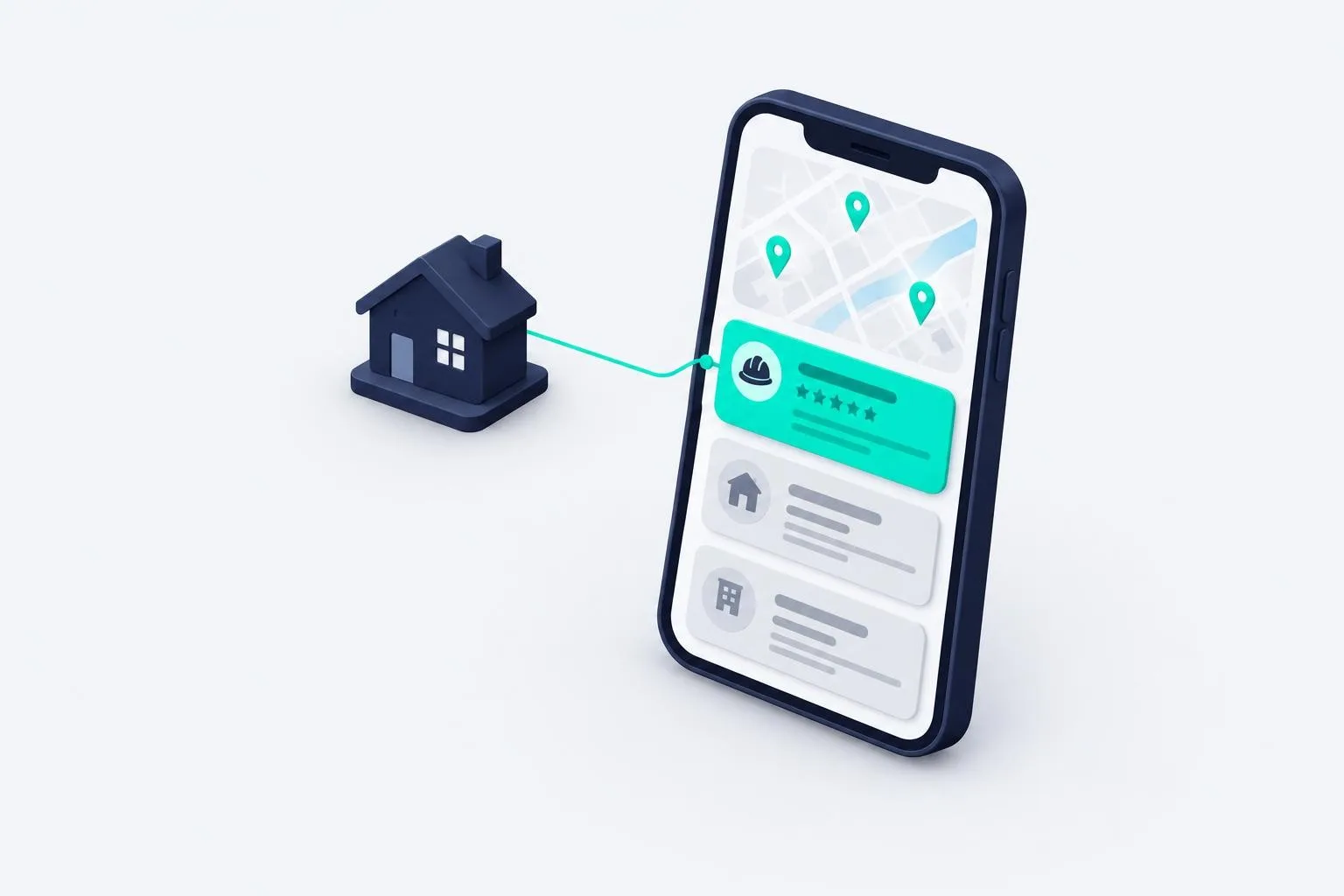
The map pack sits above the website results, so your profile is often the first thing a homeowner sees.
How many reviews does page one take in your trade?
Reviews are the easiest part of contractor SEO to count, and the bar is very different from one home services trade to the next. In our July 2026 count of 91 Florida cities, pulled from Google on July 29, the typical business on page one looked like this:
| Trade | Typical page-one reviews | Typical rating |
|---|---|---|
| HVAC | 259 | 4.9 |
| Plumbers | 115 | 4.8 |
| Roofers | 76 | 4.9 |
| Electricians | 46 | 4.8 |
| General contractors | 17 | 4.8 |
Each number is the middle value across all 91 cities, so half the cities sit above it and half below. Your own city may be higher or lower.
Two things jump out. First, general contractors face the lowest bar in the state. If you run a construction business with 17 happy clients from last year, you can match a typical page-one competitor by asking each of them for a review. Second, ratings barely separate anyone. Almost every trade sits near 4.8 or 4.9 stars, so the count and the recent dates do the work.
Want your own numbers next to your competitors'? Run the free local SEO audit and see where your profile, reviews, and site stand in a couple of minutes.
How do AI assistants pick a contractor?
More homeowners now ask ChatGPT, Gemini, or Google AI Overviews who to call. Those AI search tools don't simply hand the job to the business with the most Google reviews. We record their answers to find out who they do name.
Plumbers. In our July 2026 run across 16 Florida cities (1,920 answers from Grok, Gemini, and Claude), the plumber with the most Google reviews was named in 21% of answers on average. In Palm Bay, the review leader had 1,871 reviews and was named in none of the 120 Palm Bay answers. The engines filed it under Melbourne instead. Look up your own city in the State of Plumbing Search in Florida.
Roofers. In our June 2026 run across 16 Florida cities (2,560 answers from ChatGPT, Gemini, Grok, and Claude), all four engines agreed on the same top roofer in only 1 of 16 cities. The review leader showed up in 28% of answers. When we crawled the sites of the roofers the engines recommended in Titusville, Melbourne, and Orlando, 83% carried LocalBusiness schema, but only 17% put their star rating in it.
What that means for your SEO strategy:
- Get listed where the engines read. In the plumbing run, Yelp and Angi were cited far more than any other source. Claim both, and keep your name, address, and phone identical to your Google profile.
- Tell the engines who you are in code. LocalBusiness schema (Plumber, RoofingContractor, GeneralContractor) helps search engines understand your trade, city, and phone number. Add your rating to it, since most competitors skip that step.
- Name every city you serve. The Palm Bay plumber lost its own city because the engines tied it to the next town. Put your cities on your site, your profile, and your directory listings.
For a plumbing shop, that city problem is the first thing plumber SEO fixes. For roofers, storm season makes the gap bigger, which is why roofing SEO puts schema and directory cleanup ahead of new content.
How do you set up a Google Business Profile that wins the map pack?
Your Google Business Profile is often the first thing a homeowner sees, even before your website. For most local businesses, it's also the fastest place to gain ground.
- Claim and verify it. Search your business name on Google Maps. If it's unclaimed, claim it and finish verification.
- Pick the right primary category. "General contractor," "Roofing contractor," "Plumber," or "Electrician." Add secondary categories only for work you actually sell.
- Fill in every field. Service areas, hours, phone, website, services, and a plain description of what you build and where.
- Add real photos. Upload photos from completed projects, with the town in the caption. Add new ones every couple of weeks.
- Post once a week. Share a finished job, a seasonal tip, or an offer. Posts keep the profile active.
- Answer questions and messages fast. A homeowner who gets a reply in minutes rarely calls the next company.
If you'd rather hand it off, our Google Business Profile management covers setup, photos, posts, and review replies.

A complete profile with recent photos and answered reviews gives Google and homeowners a reason to pick you.
How do you get more reviews without being pushy?
Ask at the moment the homeowner is happiest: the final walkthrough.
- At the walkthrough, ask: "Would you mind leaving us a quick Google review?"
- The same day, text them a direct link to your review page.
- Follow up once, a few days later, if they haven't left one.
Here's a text you can copy: "Hi [Name], thanks again for trusting us with your kitchen. If you have 30 seconds, a Google review that mentions your town would help us a lot. Here's the link."
Reviews that mention the job and the town help local relevance. You can't require it, but you can mention that it helps. Reply to every review, good or bad, within a day or two. Check where you stand with the free review health score.
Do local citations and online directories still matter?
Yes. Local citations are listings of your business name, address, and phone on sites like Yelp, Angi, Houzz, the BBB, and your chamber of commerce. They tell search engines, and AI assistants, that you're a real, established company.
The rule is consistency. If one site says "123 Main St" and another says "123 Main Street, Suite 1," clean it up. Start with the directories homeowners actually use in your trade, then your chamber and trade associations. A few dozen accurate listings beat hundreds of junk ones. The free citation consistency check finds the mismatches for you.
Which keywords should a contractor target?
Keywords are the exact phrases people type or say when they need you. Contractor keyword research starts with one question: is this person ready to hire? Someone searching "kitchen remodel contractor Titusville" is close to calling. Someone searching "kitchen ideas" is months away.
Group your target keywords two ways:
- By service: roof repair, panel upgrade, water heater replacement, bathroom remodel.
- By city: every town you actually work in.
Then check search demand for each pair. Google's autocomplete and the "People also ask" box show real searches for free. Type the start of a phrase and see what Google suggests. Google Search Console shows which phrases already bring you impressions. For builders and remodelers, construction SEO works the same way, just with longer phrases like "home addition contractor Viera" and a longer wait between search and signed contract.
Give each service page one main keyword and a few close variations, so pages don't compete with each other:
| Page | Main keyword | Variations |
|---|---|---|
| Roof replacement | roof replacement Titusville | shingle roof replacement, re-roofing Titusville |
| Storm damage | storm damage roof repair Brevard | hurricane roof repair, wind damage roof repair |
| Roof inspection | roof inspection Melbourne | roof assessment Melbourne, insurance roof inspection |
Write the way homeowners talk. If "roof repair Titusville" shows up in every other sentence, it reads like spam, and search engines have understood synonyms for years. Use the phrase in the title, the H1, and once or twice in the body, then write for the person.
What does a contractor website need to turn searches into calls?
Your website is your job-site sign, your portfolio, and your front office in one. If it's slow or confusing, every other SEO effort works harder for less.
A simple structure works for most contractors:
- Home: what you do, where you work, and a phone number you can tap.
- One service page per job type: "Panel upgrades in Titusville," not just "Electrical services."
- City pages: one for each town you serve, written for that town, not copied with the name swapped.
- Projects: before-and-after photos of completed projects, with the town and scope.
- About and reviews: your license number, insurance, and real client quotes.
- Contact: a short form, your phone, and your hours.
A good service page answers common customer questions: what drives the cost, how long the job takes, what permits it needs, and what happens on day one. That's quality content, and it's also what AI answers quote.

Within five seconds, a visitor should know what you do, where you work, and how to reach you.
Speed, mobile, and the technical SEO basics
Most emergency searches happen on a phone, often in a hurry. Technical SEO makes sure that phone gets a fast, working page:
- Speed: compress your photos, drop plugins you don't use, and pick decent hosting. Test with the free page speed analyzer.
- Mobile: open your site on your own phone. Can you tap the phone number in under five seconds? If not, fix that first.
- Security: HTTPS (the lock icon). Without it, browsers warn visitors before they fill out your form.
- On-page SEO: a unique title and meta descriptions for every web page, one H1, and LocalBusiness schema on the home and contact pages.
If your site needs a rebuild instead of a tune-up, our web design work starts from those basics.
Content and links that build your website's authority
Off-page SEO is what other websites say about you. When a supplier, a realtor, or the local paper links to your site, search engines treat it like a referral. Good link building for a contractor looks like everyday business:
- Suppliers and manufacturers that list approved installers
- Realtors and property managers who recommend trades
- HOAs with approved-vendor pages
- Chamber of commerce and trade association directories
- Local news coverage of a community project or storm cleanup
Skip bought links and link farms. They put your site at risk for little gain.
For content, turn finished jobs into short project write-ups: the town, the problem, the fix, the timeline, and photos. One a month is a pace most crews can keep. In Florida, seasonal topics fit the calendar: hurricane prep in May and June, post-storm damage checks in September and October.
How do you know if SEO is bringing jobs?
You don't need to be a data analyst. You need four numbers, checked once a month:
| Number | What it tells you | Where to find it |
|---|---|---|
| Calls and form fills | Real leads | Call tracking and your form inbox |
| Profile calls and direction requests | How the map pack is working | Google Business Profile performance |
| Organic traffic from your service area | How many locals find your site | Google Analytics |
| Search rankings for your target keywords | Where you show up | Google Search Console |
Watch the trend over three to six months, not week to week. Tie leads to booked jobs in your CRM or a simple spreadsheet. A #1 ranking that doesn't ring the phone isn't worth much.

Track calls and booked jobs first. Traffic and rankings explain why they moved.
What does a realistic timeline look like?
- First 60 to 90 days: profile complete, review habit running, site fixes in place, first pages published. Map pack movement often starts here.
- Three to six months: website rankings climb for your service and city pairs. Calls start to follow.
- Twelve months and on: gains compound. Each new review, page, and link adds to what's already working.
Bigger metros like Orlando, Tampa, and Miami take longer. Smaller towns often move faster, because fewer companies compete for the same three map spots. A long sales cycle, like custom homes or additions, also means more time between a ranking and a signed contract.
What does contractor SEO cost?
Contractor SEO cost swings so widely across the industry that a range tells you very little. Here are our prices, so you have a real number to compare:
- Local SEO Starter, $350 a month: 5 target keywords, on-page SEO for 5 core pages, 10 citations a month, 2 blog posts a month, and a monthly ranking report.
- Local SEO Growth, $700 a month: 15 keywords, 15 pages, 4 blog posts, 25 citations a month, basic link building, and weekly ranking reports.
- Get Found bundle, $450 a month: Local SEO Starter plus Google Business Profile management, with a one-time $250 profile setup.
Compare every tier line by line on our local SEO pricing. To judge any quote, do the math with your own numbers: divide the monthly price by your average profit per job. That's how many extra jobs SEO has to win each month to pay for itself.
DIY contractor SEO or hire an SEO agency?
Both can work. DIY contractor SEO costs time instead of money: a few hours a week on your profile, reviews, and pages. The tools are free, and none of the steps need special skills.
Hire help when those hours start costing you billable work. When you compare a contractor SEO agency, ask each one for the same things: their SEO audit of your business, the target keywords they'll chase, how they'll build links, and what the monthly report counts. A good SEO company answers in calls and booked jobs, not just traffic. If you want the whole plan handled, see how our contractor marketing work fits a Florida construction company.
What are the most common contractor SEO mistakes?
- No clear service area. If your site never names the towns you work in, Google and the AI engines have to guess. Fix: add a real page for each city.
- Thin service pages. A 150-word page can't answer a homeowner's questions. Fix: cover cost factors, timeline, permits, and photos for each service.
- A half-finished Google profile. Missing hours, one photo, no posts. Fix: fill every field and post weekly.
- Mismatched listings. Old addresses and phone numbers across directories. Fix: audit and correct them once, then keep them matched.
- Copying a competitor's pages. Duplicate copy helps no one. Fix: write about your jobs, your towns, and your process.
- Buying cheap links. Fix: earn links from suppliers, partners, and local groups.
- Tracking rankings instead of calls. Fix: set up call tracking before anything else, so every change is judged in leads.
- Know your trade's review bar: about 17 for general contractors, 76 for roofers, 115 for plumbers on a typical Florida page one.
- Complete your Google Business Profile, post weekly, and ask for a review at every final walkthrough.
- Build one page per service and one per city, and add LocalBusiness schema with your rating.
- Get listed on Yelp, Angi, and your trade directories with the same name, address, and phone everywhere.
- Judge SEO by calls and booked jobs each month, not by a single ranking.
Tap a question to expand.
Who is the best contractor SEO company in Florida?
How long does SEO take to bring a contractor more calls?
Can SEO work if I only serve one small city?
Do I still need Google Ads if I invest in SEO?
Can I do contractor SEO myself?
Can ChatGPT or AI search replace SEO for contractors?
Or start with a free AI visibility check
Does AI Recommend You?
See if ChatGPT, Gemini, Grok, and Claude name your business. Free report by email.