


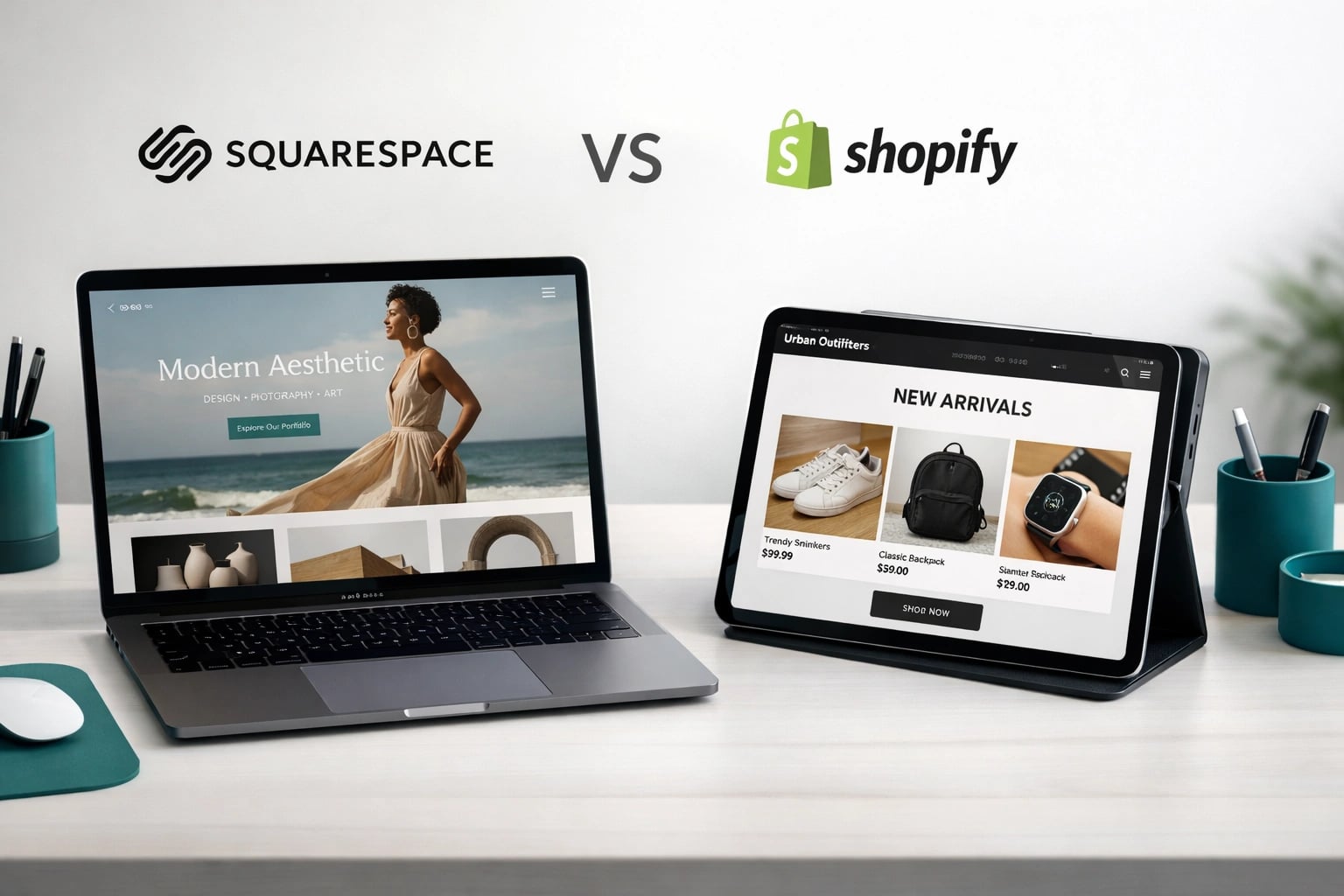
Squarespace and Shopify both power millions of small businesses, but they solve different problems.
Two Platforms, Two Different Jobs
You need a website. You want to sell things online. You have heard of Squarespace and Shopify. But which one actually fits your business?
Here is the short version: Squarespace is a website builder that added ecommerce. Shopify is an ecommerce platform that added website building. That distinction matters more than most comparison articles will tell you. Data from our Florida Local Search Index shows that platform choice can directly affect how well local businesses rank in search.
If you run a service business on the Space Coast (a yoga studio in Melbourne, a photography business in Cocoa Beach, a consulting firm in Viera) and you also want to sell some products, Squarespace is probably your better bet. If selling products online is your primary business model, Shopify is built for exactly that.

Squarespace starts cheaper, but Shopify includes more ecommerce tools at every tier.
Real Pricing: What You Will Actually Pay
Marketing pages love to show the lowest possible price. Let's look at what small businesses on Florida's Space Coast actually pay when everything is added up.
Squarespace Pricing Breakdown
Squarespace keeps things simple. Four plans, and the price you see is mostly the price you pay.
Personal ($16/mo)
Great for portfolios and simple sites. No ecommerce. Includes SSL, templates, and basic analytics. Good starting point for service businesses.
Business ($27/mo)
Adds ecommerce, but charges a 3% transaction fee on every sale. Also open ups custom CSS, promotional pop-ups, and advanced analytics.
Commerce Basic ($33/mo)
Removes the transaction fee. Adds point-of-sale, customer accounts, and product reviews. This is the real starting line for serious selling.
Commerce Advanced ($52/mo)
Adds abandoned cart recovery, advanced shipping, and commerce APIs. Worth it if you are doing consistent volume.
Shopify Pricing Breakdown
Shopify's sticker prices are higher, but you get more ecommerce firepower at every level.
Basic ($39/mo)
Everything you need to launch a store. Online store, unlimited products, discount codes, abandoned cart recovery, and Shopify Payments with 2.9% plus 30 cents per transaction.
Shopify ($105/mo)
Adds professional reports, up to 5 staff accounts, lower transaction fees (2.6% plus 30 cents), and better shipping discounts.
Advanced ($399/mo)
Custom reports, 15 staff accounts, lowest transaction fees (2.4% plus 30 cents), and third-party calculated shipping. Overkill for most small businesses.
Hidden Costs
Many essential features require paid apps ($5 to $50/mo each). Reviews, upsells, advanced SEO, email marketing. These add up fast. Budget an extra $20 to $100 per month for apps.
Shopify's app ecosystem is powerful, but it is also a cost trap. A Melbourne surf shop owner told us they were paying $87 per month in apps on top of their $39 Shopify plan. That is $126 per month before transaction fees. Audit your apps regularly and remove anything you are not actively using.
Design and Ease of Use
This is where the two platforms feel most different. If you have ever built a website before, you will notice it immediately.
Squarespace: Design First
Squarespace templates are beautiful out of the box. You pick a template, swap in your content, and you have a site that looks professionally designed. Their drag-and-drop editor is intuitive, and the design guardrails make it hard to create something ugly.
For a Cocoa Beach wedding photographer or a Viera interior designer, this matters. Your website is your portfolio. Squarespace makes it look polished without hiring a web design services team.
The trade-off: less flexibility. You are working within Squarespace's design system. Custom layouts and unique interactions require workarounds or custom code.
Shopify: Commerce First
Shopify's free themes are decent but not as visually striking as Squarespace's. Premium Shopify themes ($150 to $350 one-time) close the gap, but you are paying extra for what Squarespace includes by default.
Where Shopify shines is the shopping experience. Product pages, cart functionality, checkout flow, and post-purchase emails are all polished and conversion-optimized. Shopify processes billions in transactions, and that experience shows in every detail of the buying process.
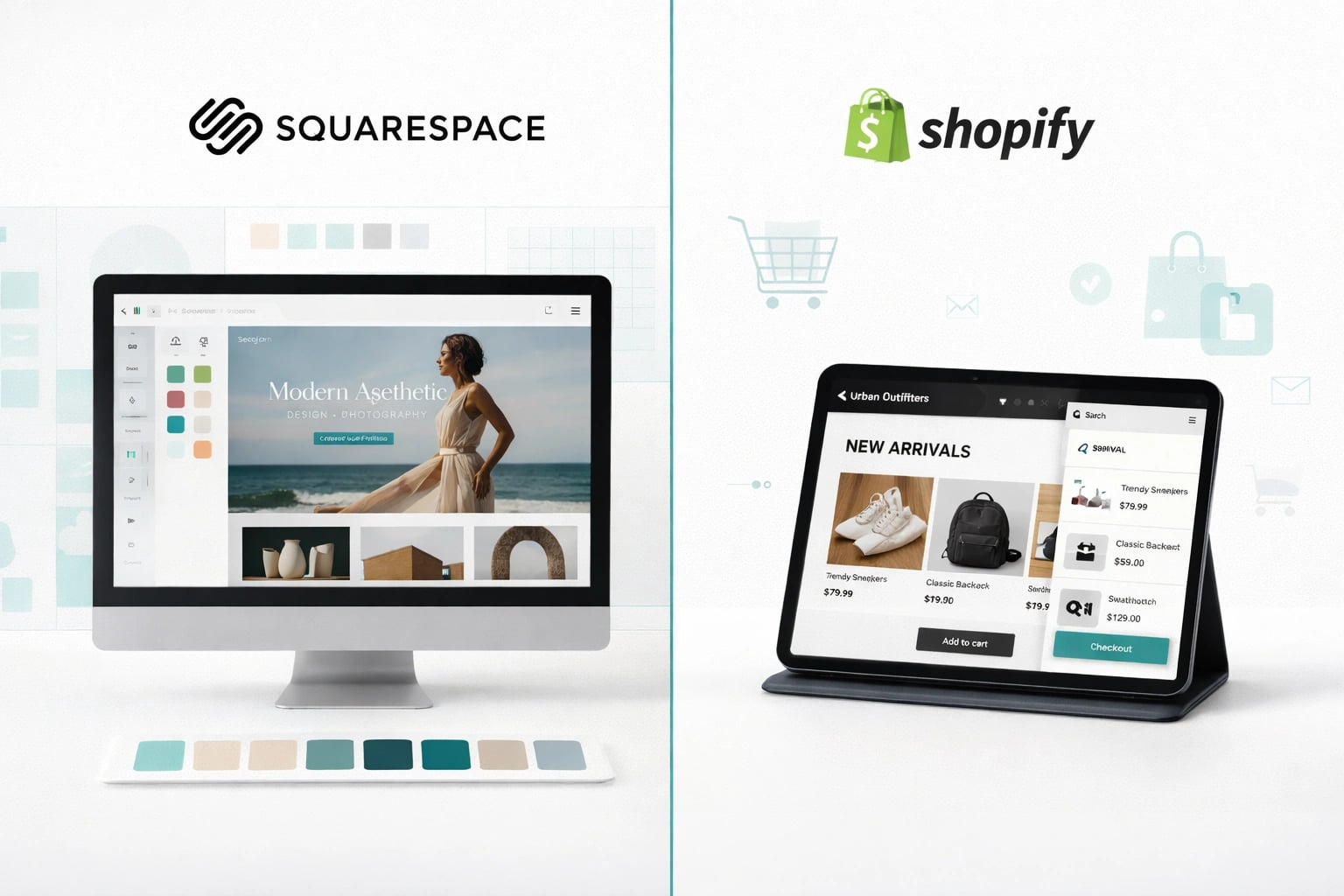
Squarespace leads in design flexibility. Shopify leads in ecommerce functionality and integrations.
SEO and Performance
Both platforms have improved their SEO capabilities significantly. Neither will hold you back from ranking on Google if you put in the work. But there are differences worth knowing about.
Squarespace SEO Strengths
Squarespace handles the basics well: clean URLs, auto-generated sitemaps, SSL certificates, mobile-responsive designs, and built-in meta title and description editing. The blogging platform is solid, which matters because content marketing drives local SEO results.
Squarespace sites also tend to perform well on Core Web Vitals tests out of the box, since you cannot load the site down with dozens of third-party apps the way you can on Shopify.
The downside: limited control over URL structure, no native structured data editing, and fewer options for technical SEO customization.
Shopify SEO Strengths
Shopify's SEO fundamentals are solid. You get customizable title tags, meta descriptions, alt text, and auto-generated sitemaps. The platform handles canonical tags well, which matters when you have product variants creating duplicate content.
Shopify's weakness is its rigid URL structure. Every product URL includes "/products/" and every page includes "/pages/". You cannot change this. It is a minor issue, but it can be annoying if you are migrating from another platform and need to match old URLs exactly.
For advanced SEO on Shopify, you will need apps. Schema markup, advanced redirects, and page speed optimization typically require paid add-ons.
Regardless of which platform you choose, your biggest SEO wins will come from the same places: a complete Google Business Profile, consistent local citations, genuine customer reviews, and quality content that answers your customers' questions. The platform matters less than the effort you put into these fundamentals.
Ecommerce Features Head-to-Head
If selling products is part of your plan (even a small part), pay closest attention here.
Product Management
Shopify wins. Unlimited products on all plans, advanced variant management, inventory tracking across locations, and bulk editing tools. Squarespace handles products fine but lacks depth for stores with 100+ SKUs.
Payment Processing
Shopify Payments is built in with competitive rates (2.4% to 2.9%). Squarespace uses Stripe and PayPal. Both work well. Shopify supports more payment gateways overall.
Shipping
Shopify wins clearly. Real-time carrier rates, discounted USPS/UPS/DHL shipping, and fulfillment network options. Squarespace offers flat rate, weight-based, and carrier-calculated shipping (Advanced plan only).
Multi-Channel Selling
Shopify dominates. Sell on Amazon, eBay, Facebook, Instagram, TikTok, and in-person with Shopify POS. Squarespace integrates with fewer channels.
When Squarespace Ecommerce Is Enough
A Titusville candle maker selling 15 varieties through their website and at the Eau Gallie Arts District market does not need Shopify's inventory management system. Squarespace's Commerce Basic plan gives them product pages, a clean checkout, and basic inventory tracking for $33 per month.
A Melbourne yoga studio selling class packages, merchandise, and digital workshops also fits perfectly on Squarespace. The built-in scheduling tools are a bonus that Shopify would require a paid app to match.
When You Need Shopify
A Brevard County surf brand shipping 200 orders per month to customers across the country needs Shopify. The shipping discounts alone can save hundreds per month. Inventory tracking across a warehouse and retail location, automated fulfillment emails, and abandoned cart recovery (included on all Shopify plans) make a real difference at that volume.
If you are comparing Squarespace vs Shopify for a growing product business, check our WordPress vs Wix vs Squarespace comparison too, since WordPress with WooCommerce is another option worth considering at that stage.
Squarespace Pros and Cons
- Lower starting price ($16/mo for sites, $33/mo for ecommerce without transaction fees)
- Best-in-class design templates included free
- Easier to use for non-technical business owners
- Strong blogging and content tools for SEO
- Built-in scheduling, forms, and email marketing
- Predictable monthly cost with fewer add-ons needed
- Ecommerce features are solid but not as deep as Shopify
- Fewer third-party integrations and apps
- Limited payment gateway options (Stripe, PayPal, Square)
- No multi-channel selling (Amazon, eBay integration)
- Shipping tools are basic compared to Shopify
- Less flexibility for custom functionality
Shopify Pros and Cons
- Best ecommerce feature set at any price point
- Abandoned cart recovery on all plans (Squarespace requires Commerce Basic)
- Multi-channel selling: Amazon, eBay, Facebook, Instagram, TikTok, in-person POS
- Discounted shipping rates save real money at volume
- Massive app ecosystem for any feature you need
- Scales from 10 products to 10,000 without switching platforms
- Higher base price ($39/mo minimum)
- Essential features often require paid apps ($20 to $100+ per month extra)
- Free themes are less visually impressive than Squarespace
- Blogging tools are basic compared to Squarespace
- Rigid URL structure (/products/, /pages/) limits SEO flexibility
- Can get expensive fast when you add apps, premium themes, and transaction fees

Your business type matters more than any feature comparison. Match the platform to how you make money.
The Local-Business Reality Check
Most Space Coast service businesses asking this question do not actually need a dedicated ecommerce platform. An HVAC company selling replacement filters and gift cards, a med spa selling memberships, a dentist selling whitening kits: that is light commerce bolted onto a service site, and Squarespace handles it with built-in appointments and memberships, no app subscriptions, and content pages that carry your local SEO. Putting that business on Shopify means paying for multi-channel inventory infrastructure it will never use.
The reversal is just as real. A Cocoa Beach surf shop with 300 SKUs, an in-store register, seasonal tourist surges, and plans to sell on Instagram belongs on Shopify from day one, because it will hit Squarespace's product, inventory, and integration ceilings inside 18 months.
The migration between them is the expensive part nobody budgets for: product URLs restructure (Shopify enforces its /products/ and /collections/ prefixes), every changed URL needs a redirect or you bleed the link equity you built, product data gets reformatted around different variant limits, and the design rebuilds from scratch. Pick for where the business is heading in three years, not for this month's subscription price.
How to Decide: Three Questions
Not sure which platform is right for your business? These three questions will get you 90% of the way to an answer.
1. Is selling products your primary revenue source?
If yes, go with Shopify. It is built for exactly this. If products are a side revenue stream (under 30% of income), Squarespace handles it just fine.
2. How many products will you sell?
Under 50 products: either platform works. 50 to 500 products: Shopify's inventory tools start to matter. Over 500 products: Shopify, without question.
3. How important is your website's design?
If your website IS your portfolio (photographers, designers, restaurants, consultants), Squarespace's templates will save you time and money. If your website is primarily a storefront, Shopify's conversion-optimized checkout matters more than template aesthetics. Either way, check our marketing terms explained page if any of the terminology in this comparison is unclear.
Some Space Coast businesses outgrow both Squarespace and Shopify. If you need a fully custom site with advanced functionality, a WordPress build with WooCommerce gives you the most flexibility. Talk to our web design services team about which approach fits your growth plans.
- Squarespace starts at $16/mo and is best for service businesses, creatives, and brands that sell some products on the side
- Shopify starts at $39/mo and is best when ecommerce is your primary business model
- Squarespace wins on design, ease of use, and predictable pricing
- Shopify wins on ecommerce features, multi-channel selling, and shipping tools
- Watch out for Shopify's hidden app costs, which can add $20 to $100+ per month to your bill
- Both platforms handle basic SEO well, but neither replaces a real local SEO strategy
- Your business type matters more than any feature list. Match the platform to how you make money.