



Custom websites cost more upfront but outperform templates on speed, SEO, and conversions where it counts.
Your website is the foundation of your online presence. But when it comes to building one, the first question most business owners face is simple: should you pay for a custom build or use a template platform? Whether you're exploring professional web design or going the DIY route, the answer depends on your business stage.
The answer isn't the same for every business. A Palm Bay startup testing a new service idea has very different needs than an established Brevard County contractor generating $500K+ in annual revenue.
Let's break down the real costs, performance differences, and situations where each option makes sense.
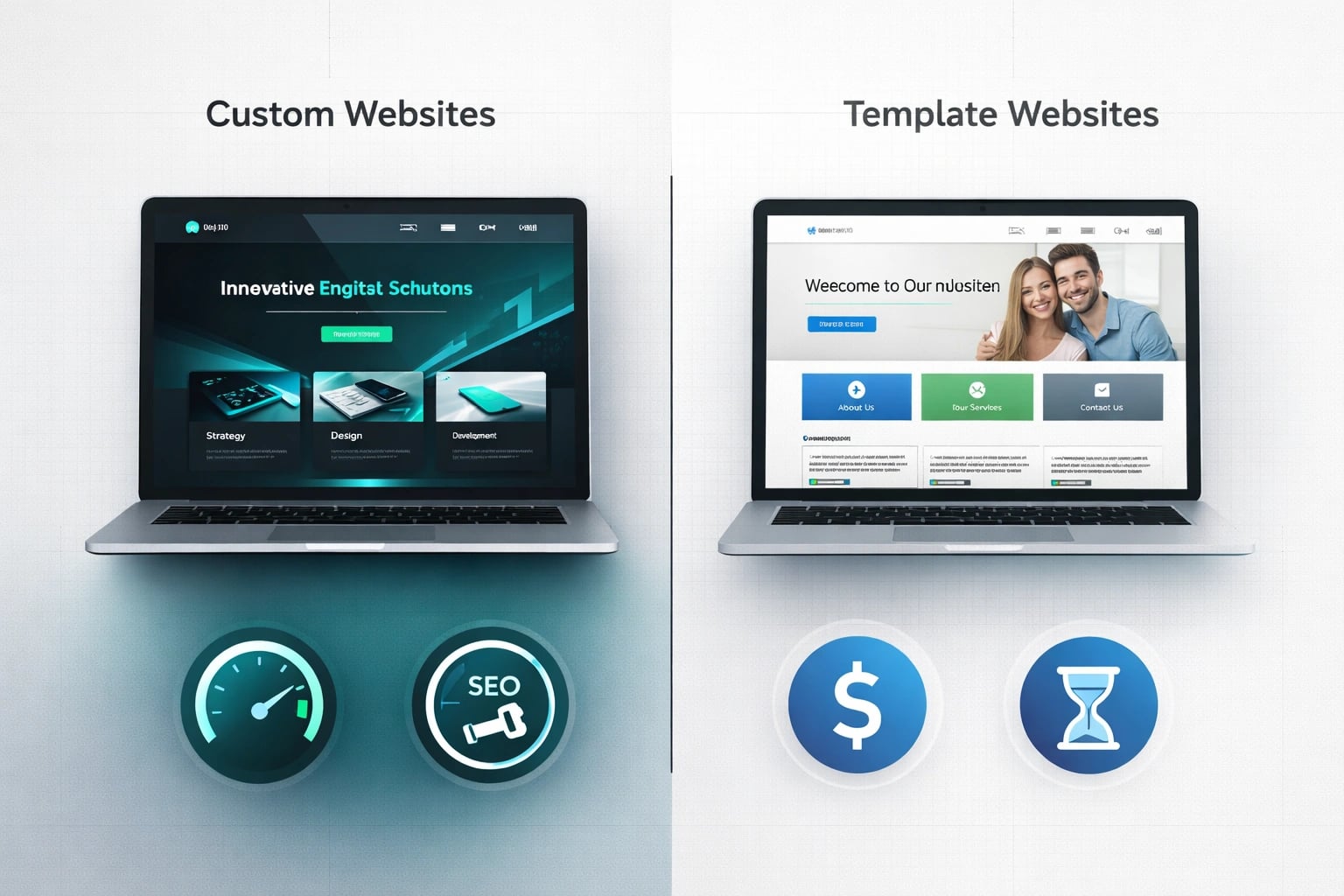
Templates win on upfront cost and launch speed. Custom sites win on performance, SEO, and long-term value.
The Real Cost Breakdown
Pricing is where most business owners start, and it's where the biggest misconceptions live. Template sites look cheaper at first glance. Over three years, the picture changes.
Three-Year Total Cost of Ownership
Here's what most people miss: the upfront price is only part of the story. Template platforms charge monthly fees, premium plugins cost extra, and you often need add-ons for features that come standard in a custom build.
The gap between the two options narrows when you factor in the premium plugins and add-ons most template users end up purchasing. And this comparison doesn't account for the revenue difference. A faster, better-optimized custom site typically converts more visitors into leads.

Over three years, the total cost gap between custom and template sites is smaller than the upfront numbers suggest.
Performance: Where Custom Sites Pull Ahead
This is where the rubber meets the road. Website speed directly affects both your search rankings and your conversion rate.
Core Web Vitals Comparison
Google measures three key performance metrics (called Core Web Vitals) that directly affect your search rankings. Custom sites have a clear advantage here because developers can optimize every element.
Custom Site LCP
Typically 1.0-1.8 seconds. Developers control image optimization, server response times, and code splitting to hit Google's 'Good' threshold of 2.5 seconds with room to spare.
Template Site LCP
Typically 2.5-4.5 seconds. Template platforms load generic frameworks, unused CSS, and third-party scripts that slow initial page load. Many template sites fail Google's threshold.
Custom Site CLS
Near-zero layout shift. Developers set explicit dimensions for images, fonts, and dynamic content so nothing jumps around while the page loads.
Template Site CLS
Often 0.15-0.3 (Google wants under 0.1). Template builders insert dynamic elements that cause visible layout shifts, especially on mobile devices.
A Brevard County HVAC company with a custom site loading in 1.5 seconds will outperform a competitor on Wix loading in 3.8 seconds. Not just in rankings, but in actual leads. Visitors don't wait around, especially on mobile.
Mobile Performance Matters More Than You Think
Over 60% of local searches happen on mobile devices. Template sites often struggle here because they load the same heavy framework regardless of device. Custom sites can serve lighter assets to mobile users, resulting in faster load times on cellular connections.

Custom sites consistently score better on Core Web Vitals and give you full control over technical SEO.
SEO: The Differences That Affect Rankings
If you're investing in search engine optimization (or plan to), your platform choice has real implications. Businesses that invest in local SEO services need a platform that won't hold them back.
- Custom: Full control over site structure, URL patterns, and internal linking
- Custom: Add schema markup for rich snippets in search results
- Custom: Optimize server response times and caching strategies
- Custom: Clean HTML output without template bloat
- Custom: Implement advanced technical SEO (hreflang, canonical tags, XML sitemaps)
- Template: Limited URL structure options on most platforms
- Template: Restricted access to robots.txt and server configuration
- Template: Generic schema markup (if available at all)
- Template: Bloated code from drag-and-drop builders
- Template: Platform-imposed limitations on page speed optimization
Schema Markup and Rich Results
One area where custom sites have a significant edge is structured data. Schema markup tells search engines exactly what your content is about, which can result in enhanced search listings with star ratings, FAQ dropdowns, pricing info, and more.
Most template platforms offer basic schema at best. A custom site can implement Organization, LocalBusiness, Service, FAQ, and Review schema tailored to your specific business. For local service businesses on the Space Coast, this can mean the difference between a plain text listing and a rich result that dominates the search page.
Custom sites allow you to build location-specific landing pages with unique content, localized schema markup, and optimized Google Business Profile integration. This matters a lot for businesses serving multiple areas across Brevard County.
When a Template Makes Sense
Templates aren't always the wrong choice. In several situations, they're actually the smarter move.
You're Testing a New Business Idea
If you're a new business in Palm Bay launching your first service, spending $10,000 on a custom website before you've validated demand doesn't make sense. Start with a $500-1,500 template site, prove the concept, then invest in a custom build.
You Need a Simple Brochure Site
Five pages, contact form, maybe a photo gallery. If your website needs are straightforward and you're not competing in a crowded online market, a template handles this just fine.
Budget Is Your Primary Constraint
If you're choosing between a template website and no website, the template wins every time. An imperfect online presence beats no online presence.
You Want to Launch Fast
Template sites can go live in days. If timing matters more than long-term optimization, templates get you online faster.

New businesses should start with templates and upgrade. Established businesses get measurable ROI from custom builds.
When a Custom Site Is Worth the Investment
For established businesses, the math shifts toward custom. Here's when it makes sense to invest more upfront.
You're in a Competitive Local Market
Contractors, attorneys, medical practices, and real estate agents on the Space Coast are all fighting for the same keywords. A custom site with better performance, cleaner code, and proper schema markup gives you a real edge over competitors using templates.
You Need Specific Functionality
Online booking, custom calculators, client portals, inventory management, or integration with your existing business software. Template platforms hit walls with custom functionality. Workarounds through plugins create performance and security issues.
You're Investing in SEO
If you're spending money on search engine optimization, your platform needs to support that investment. Running SEO on a template site is like putting racing tires on a minivan. You're limited by the vehicle.
Your Business Generates $250K+ in Revenue
At this revenue level, the additional cost of a custom site is a small percentage of your income, and the performance advantages directly impact your bottom line through better conversion rates.
Real-World Space Coast Examples
Scenario 1: New Palm Bay Cleaning Service
Maria is starting a house cleaning business in Palm Bay. She has a tight budget, no existing online presence, and needs to start getting customers quickly.
Best choice: Template site on Squarespace ($500-800 setup)
She needs a professional-looking site with her services, pricing, and a contact form. A template gets her online in a week. If the business takes off, she can invest in a custom build in year two with actual revenue behind it.
Scenario 2: Established Brevard County Roofing Company
Pete runs a roofing company that's been in business for 12 years. He generates $800K annually, mostly from word-of-mouth referrals, but wants to grow through online leads. His current Wix site loads in 4.2 seconds and barely shows up in local search results.
Best choice: Custom website ($6,000-10,000)
Pete's competitors are already investing in their online presence. His slow template site is costing him leads every day. A custom build with proper local SEO, fast load times, and schema markup would likely pay for itself within 3-6 months through increased lead volume. Data from our Florida Local Search Index shows how much site performance affects local rankings in Brevard County.
Every month an established business runs on a slow, poorly optimized website, they're losing potential customers to competitors with better sites. For Pete's roofing company, even 5 additional leads per month at his average job value would cover the custom site cost in weeks.
The Middle Ground: WordPress
WordPress deserves its own mention because it straddles the line between template and custom. A WordPress site with a premium theme ($2,000-4,000 total) offers more flexibility than Wix or Squarespace while costing less than a fully custom build.
The tradeoff is ongoing maintenance. WordPress sites need regular updates, security patches, and plugin management. Without maintenance, WordPress sites can become slow, insecure, and problematic over time.
- Template sites cost less upfront but the three-year total cost gap is smaller than most people think
- Custom sites load 2x faster on average, which directly impacts both rankings and conversions
- New businesses should start with templates and upgrade when revenue justifies the investment
- Established businesses in competitive markets get measurable ROI from custom builds
- WordPress offers a middle ground but requires ongoing maintenance commitment
- Your website platform should match your current business stage, not just your budget
The Migration Tax (and What We Actually Charge)
One number worth correcting from the market ranges above: our own custom builds for local service businesses run $1,500 to $3,000 one-time, not the $3,000 to $15,000 typical of larger agencies. Focused scope for a service business (custom design, schema, speed work, launch) does not need an enterprise invoice, and it puts a custom site inside the three-year budget of most template setups.
The other hidden line item is the migration tax. Businesses that start on a template and outgrow it pay twice: once for the original site, then again for the rebuild, plus URL redirects, re-indexing, and a temporary rankings wobble while search engines recrawl. If your business genuinely depends on local search, starting on the platform you will end up on is usually the cheaper path, even though the first invoice is bigger.
Making Your Decision
The honest answer is that neither option is universally better. The right choice depends on where your business is today and where you want it to be in two to three years. If you need help understanding terms like Core Web Vitals or schema markup, our SEO glossary breaks them down in plain English.
If you're starting out, use a template. Build revenue first. When your business reaches the point where online visibility is a growth driver (not just a checkbox), that's when a custom site starts delivering real returns.
For businesses already at that stage, the question isn't whether you can afford a custom website. It's whether you can afford not to have one. As AI search optimization grows more important, having a well-structured custom site gives you even more of an edge.