

Both are powerful SEO platforms, but they take very different approaches to local search.
Two Heavyweights, One Local Business Budget
Is Ahrefs good for local SEO? For backlink analysis, yes, and for little else that is local: Ahrefs has no listing management and no map pack tracker, while Semrush's SEO plan at $139 a month (October 2026 price page) adds a Local toolkit priced per location. The choice is for a Florida owner or a one-person marketing team buying one tool for local SEO and keyword research. Which one, what it costs in a year and when a free tool is enough all turn on one question: do you need links or listings?
Most Semrush vs Ahrefs comparisons are written for enterprise marketers and big teams. If you run a roofing company in Melbourne or a restaurant in Cocoa Beach, your needs are different. Our Florida Local Search Index shows how much local competition varies by industry and city: the typical top listing holds 363 reviews in Orlando and 22 in Key West (93 cities, 2026). You need local SEO tools, not just the general SEO tools built for national organic search, that help you show up in the map pack, manage your business listings, and track rankings in your specific service area. Both Ahrefs and Semrush started as keyword research and backlink tools for the search engines; the local layers came later.
We use Semrush daily for our local SEO services. We've also used Ahrefs at length. What follows is hands-on experience with both Ahrefs and Semrush, not spec sheets.
Source: L3ad Solutions, Semrush vs Ahrefs for Local SEO: Which Wins in 2026, updated October 2026
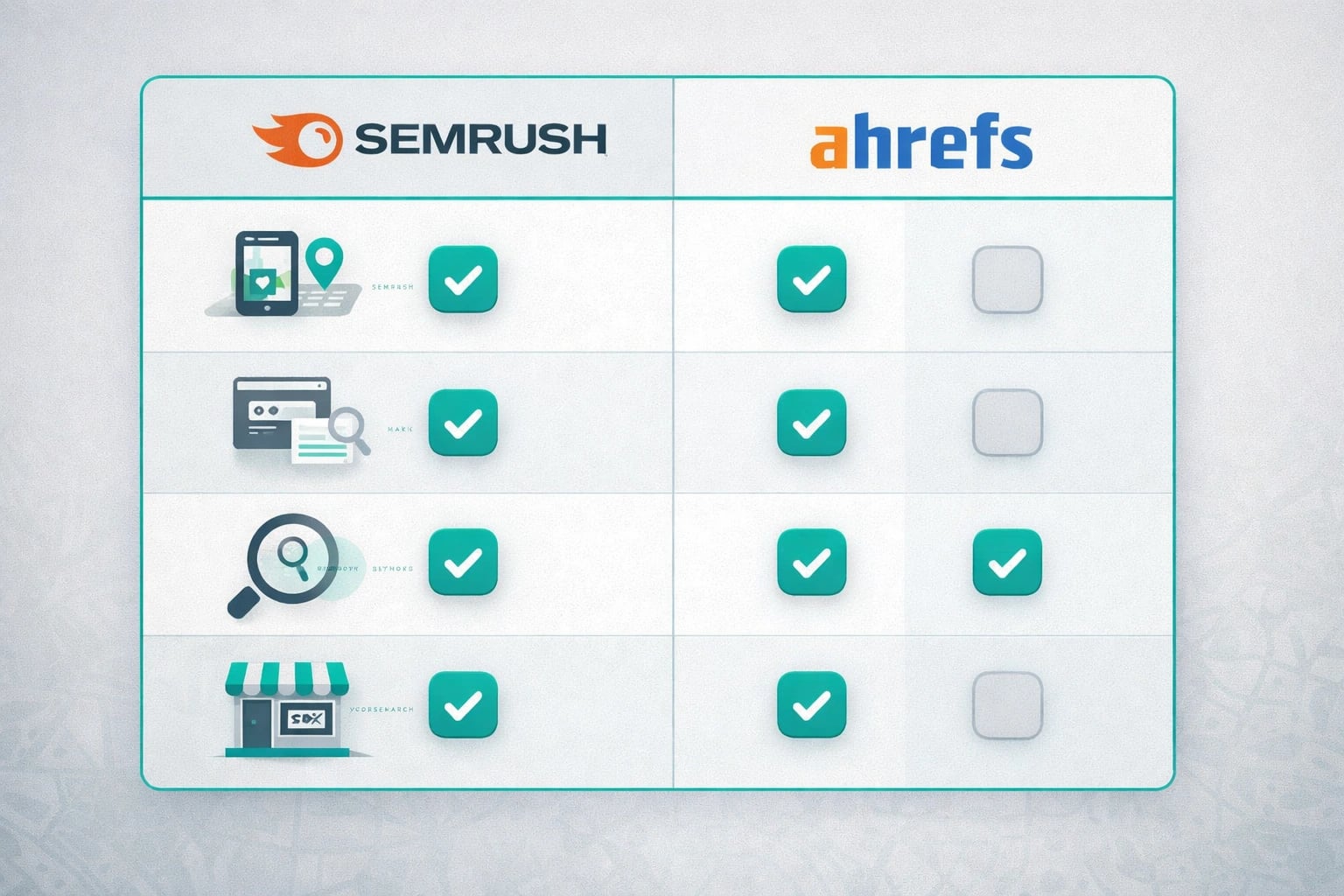
Semrush covers more local SEO ground out of the box. Ahrefs excels at backlink research and content analysis.
Local SEO Features: Where They Differ
The biggest gap between these tools shows up in local-specific features. Semrush built an entire local SEO toolkit. Ahrefs didn't.
Listing Management
Distribute and sync your business info across directories from one dashboard. Monitor for incorrect NAP data and fix it. Part of Semrush Local, priced per location; the public price page lists no figure (October 2026), so ask before you budget.
Map Rank Tracker
See exactly where you rank in Google Maps for specific keywords at the zip code level. Track map pack positions over time. Critical for businesses competing in the local 3-pack.
GBP Integration
Manage your Google Business Profile posts, monitor reviews, and track GBP performance metrics directly inside Semrush. No need to switch between platforms.
Position Tracking (Local)
Track keyword rankings at the city, zip code, or neighborhood level. See how your rankings differ between Melbourne, Palm Bay, and Titusville for the same keyword.
On-Page SEO Checker
Get page-by-page recommendations for improving your local content. Suggestions include local keyword usage, internal linking, and technical fixes.
Site Audit
Crawl your entire site for technical SEO issues. Finds broken links, slow pages, missing meta tags, and mobile usability problems that hurt your local rankings.
Backlink Analysis (Best in Class)
Ahrefs has the largest backlink index in the industry. See every link pointing to your site and your competitors' sites. Find link building opportunities specific to your local market.
Keyword Explorer
Research local keywords with search volume, difficulty scores, and click data. Filter by location to see what people in your area actually search for.
Rank Tracker
Track keyword rankings by location, but without the map pack granularity that Semrush offers. Good for organic positions, limited for local pack monitoring.
Content Explorer
Find the most linked-to and shared content in your niche. Useful for discovering local content ideas and finding sites that might link to your business.
Site Audit
Thorough technical SEO audit with clear prioritization of issues. Slightly less detailed than Semrush's audit for local-specific elements.
Competitive Analysis
Analyze any competitor's organic keywords, backlinks, and content strategy. Particularly strong for understanding what's working for competing local businesses.
Head-to-Head Comparison
Here is the Semrush vs Ahrefs split by what matters for a local business: keyword research, rank tracking, site audits, backlink analysis and historical data.
Local Rank Tracking and Map Pack Analysis
For a local service business, the ranking that matters most is Google Maps and the local pack, not just the blue links. This is where the two tools differ the most.
Semrush's Map Rank Tracker lays a grid over your service area and shows ranking variation as a heatmap, ZIP code by ZIP code. A med spa in Melbourne can see it ranks top three in 32901 but falls to position eight two miles away, then drill into which competing clinics outrank it at each point. Rankings refresh daily even on the entry plan, and the same dashboard connects to your Google Business Profile for posts, review replies, and photos.
Ahrefs tracks positions down to city and ZIP level and tags SERP features like local packs and knowledge panels, but presents everything as tables. Solid data, no map-grid view, so geographic gaps are harder to spot at a glance.
One caveat that applies to both, and that most comparisons skip: rank trackers report modeled approximations, not the exact results your customer sees. Map pack results shift with the searcher's precise location, device, and time of day. We treat tracker data as trend analysis and confirm with manual searches from inside the service area before making big calls.
City-Level Keyword Research
Both platforms handle local keyword research well, with different strengths. Semrush's Keyword Magic Tool filters by location modifiers and layers on a personalized keyword difficulty score based on your own domain's strength, which makes it faster to spot the city-level terms you can realistically win. Its keyword gap report against local competitors is a reliable source of page ideas. Both tools group keyword ideas into keyword clusters by search intent, and both keep historical ranking data, with Semrush gating the longest history behind its upper plans.
Ahrefs counters with a slightly larger keyword database and its traffic potential metric, which estimates the total traffic from every phrasing of a query rather than the exact match. That is genuinely useful locally, where "plumber near me," "plumbers in Tampa," and "Tampa plumbing company" are the same customer.
A shared limitation worth knowing before you over-invest in micro-targeting: neither tool reports search volume at the ZIP code level. You can track rankings by ZIP, but volumes only exist at city or national granularity.
Where Ahrefs Wins (And It's Not Close)
Let's be fair. Ahrefs beats Semrush in one critical area: backlink analysis.
Ahrefs crawls the web more frequently and maintains a larger index of links, so a backlink audit of your own site or a competitor's shows more of the picture. If you're trying to understand your domain authority profile, find link building opportunities, or analyze why a competitor outranks you, Ahrefs gives you more data and better tools for the job.
Their Link Intersect feature is particularly useful. It shows you sites that link to multiple competitors but not to you. For a Space Coast business, this could reveal local directories, Brevard County business organizations, or industry sites you should be listed on.
The Content Explorer tool is also excellent. Search for any topic and find the most linked-to content on the web. This helps you create content that actually earns backlinks, rather than guessing what might work.
Ahrefs also has one local feature Semrush does not: the GBP Monitor. It watches your Google Business Profile for unwanted edits (Google and "suggested" public edits change listings more often than owners realize), alerts you, lets you reject changes, and can restore a previous version. For businesses in categories plagued by listing spam and hijack attempts, that protection fills a real gap.
And if you run an agency, Ahrefs' economics are hard to beat: it tracks unlimited verified domains through Google Search Console integration, where Semrush caps domains per plan and its Local toolkit bills per location. Managing many client locations on Semrush adds up fast; on Ahrefs the marginal client is close to free.
Google's own help page says local results are based mainly on relevance, distance and prominence (Google Business Profile Help, read October 2026). Backlinks are one signal for prominence, alongside reviews. A Melbourne dentist with links from the Florida Dental Association and local health blogs will outrank a competitor with zero backlinks, all else being equal.
Where Semrush Wins for Local Businesses
For everything beyond backlink analysis, Semrush has the edge for local SEO.
Listing Management is the single biggest differentiator. If you run a business with a physical location, keeping your name, address, and phone number consistent across dozens of directories is critical. This is also a core part of GBP optimization for any local business. Semrush's Listing Management tool handles this from one dashboard. Ahrefs doesn't offer anything like it. You'd need a separate listings tool such as BrightLocal or Yext, which is a second subscription on top of Ahrefs.
Map Pack Tracking matters because showing up in Google's local 3-pack drives phone calls and foot traffic. Semrush tracks your position in the map pack at the zip code level. You can see that you rank #2 in the map pack for "AC repair" in 32901 (Melbourne) but #5 in 32907 (Palm Bay). Ahrefs tracks organic positions but doesn't break out map pack data this way.
The all-in-one factor also matters when you're watching your budget. Semrush includes social media management, content optimization, PPC research, and local tools in one subscription. With Ahrefs, you're getting a best-in-class SEO research tool, but you'll need additional subscriptions for everything else.
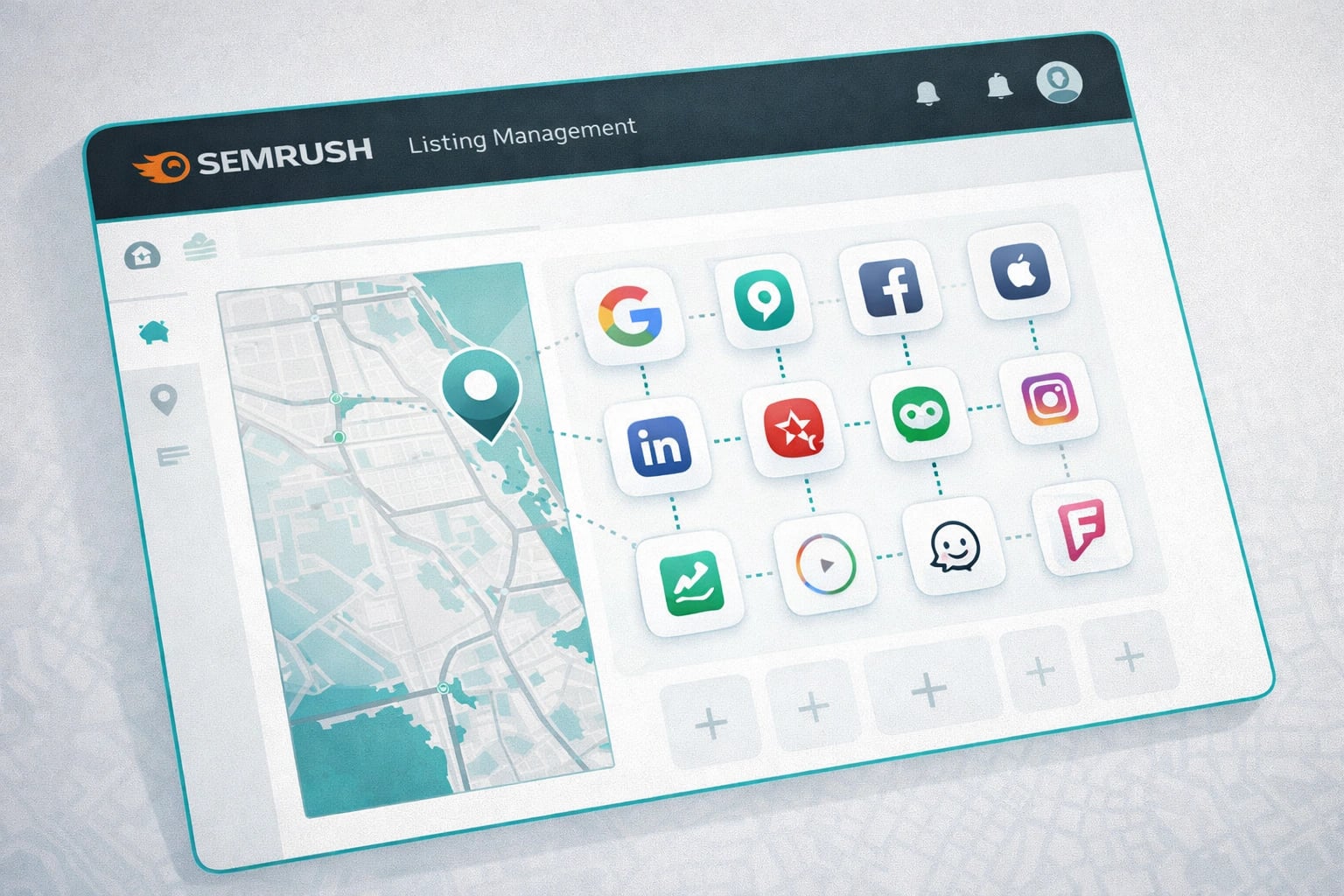
Semrush's Listing Management tool lets you sync your business info across 70+ directories from one place.
Pricing: What You Actually Pay (October 2026)
Both tools offer multiple tiers, and both price pages were read on October 29, 2026. Semrush renamed its plans this year, so older comparisons quoting Pro and Guru are out of date.
Source: L3ad Solutions, Semrush vs Ahrefs for Local SEO: Which Wins in 2026, updated October 2026
Semrush's SEO plan at $139 a month gives you position tracking, site audit, keyword research, and on-page tools. Semrush Local, which holds Listing Management, the Map Rank Tracker and review management, is priced per location and does not appear on the public price page, so the realistic monthly total depends on how many locations you run and on the quote you get.
Ahrefs Lite at $129 a month is tempting on price, but it limits you to 5 unverified projects and 750 tracked keywords. Most local businesses with more than one city will need the Standard plan at $249 a month for full use of the rank tracker and site audit. And you'll still need a separate listing management tool.
If you're deciding between DIY SEO vs hiring an agency and leaning DIY, Semrush's SEO plan at $139 a month plus Semrush Local for your one location is the most complete toolkit for local SEO. Pair it with free Google Search Console and you're well equipped.
Pros and Cons for Local SEO
- Semrush: Built-in listing management saves a second subscription to a separate listings tool
- Semrush: Map pack tracking at zip code level shows exactly where you rank locally
- Semrush: GBP integration keeps everything in one dashboard
- Ahrefs: Best backlink data in the industry for finding link opportunities
- Ahrefs: Cleaner interface that's easier to learn for beginners
- Both: Excellent keyword research with local filtering options
- Semrush: Interface can feel overwhelming with 57+ tools (steep learning curve)
- Semrush: Semrush Local costs extra, priced per location and not listed on the public price page
- Ahrefs: No listing management, GBP integration, or map pack tracking
- Ahrefs: Lite plan caps 750 tracked keywords (multi-city businesses need $249/month Standard)
- Both: Expensive for very small businesses (consider free tools first)
- Both: Annual billing saves 15-17% but requires upfront commitment
Real-World Example: Space Coast HVAC Company
Let's put this in context. Say you run an HVAC company serving Melbourne, Palm Bay, and Cocoa. Here's how each tool helps.
With Semrush, you'd set up local rank tracking for "AC repair," "HVAC installation," and "furnace repair" across all three cities. You'd use Listing Management to make sure your business shows up correctly on Google, Yelp, Angi, BBB, and 60+ other directories. You'd monitor your Google Business Profile reviews and post weekly updates. You'd run a site audit monthly and fix any issues. One tool, one dashboard, one bill.
With Ahrefs, you'd get excellent data on which competitors have the strongest backlink profiles. You'd discover that the #1 ranked HVAC company in Melbourne has links from the local Chamber of Commerce, three home improvement blogs, and a sponsorship page on the Melbourne Little League site. You'd use that intel to build your own link strategy. But for listing management, GBP monitoring, and map pack tracking, you'd need additional tools.
Which Tool Should You Pick?
Your choice depends on whether local visibility or backlink research is your top priority.
Choose Semrush if:
- Local search visibility is your primary goal
- You want one tool to handle listings, rank tracking, and GBP management
- You're a small business owner who doesn't want to juggle multiple subscriptions
- You need map pack tracking at the city or zip code level
Choose Ahrefs if:
- Backlink analysis and link building are your top priorities
- You already have a separate listing management tool
- You're more focused on organic search rankings than map pack positions
- You prefer a cleaner, more focused interface
For most Space Coast small businesses, Semrush is the better choice. An SEO expert running many client sites may lean Ahrefs for its link index and verified-domain economics; a one-location owner should not. Local SEO is about showing up in map packs, managing your listings, and tracking performance in your specific service area. Semrush covers all of that. You can always supplement with free backlink tools (like Ahrefs' free backlink checker) for occasional link research. And as search evolves, tools that support AI search optimization will become increasingly valuable.
If you're still unsure whether you need either of these tools, our guide on DIY SEO vs hiring an agency can help you figure out the right approach for your budget and time.
- Semrush wins for local SEO thanks to its Listing Management, map pack tracking, and GBP integration.
- Ahrefs has the better backlink database and is the stronger choice for link building research.
- Semrush's SEO plan ($139/mo, October 2026) plus Semrush Local for your location gives the best value for local businesses.
- Ahrefs Standard ($249/mo) is needed for full features, so Semrush is the more affordable local option at the entry tier.
- Most small businesses don't need both tools. Pick the one that matches your primary SEO focus.
- If budget is tight, start with free tools (Google Search Console, GBP) before committing to a paid platform.