


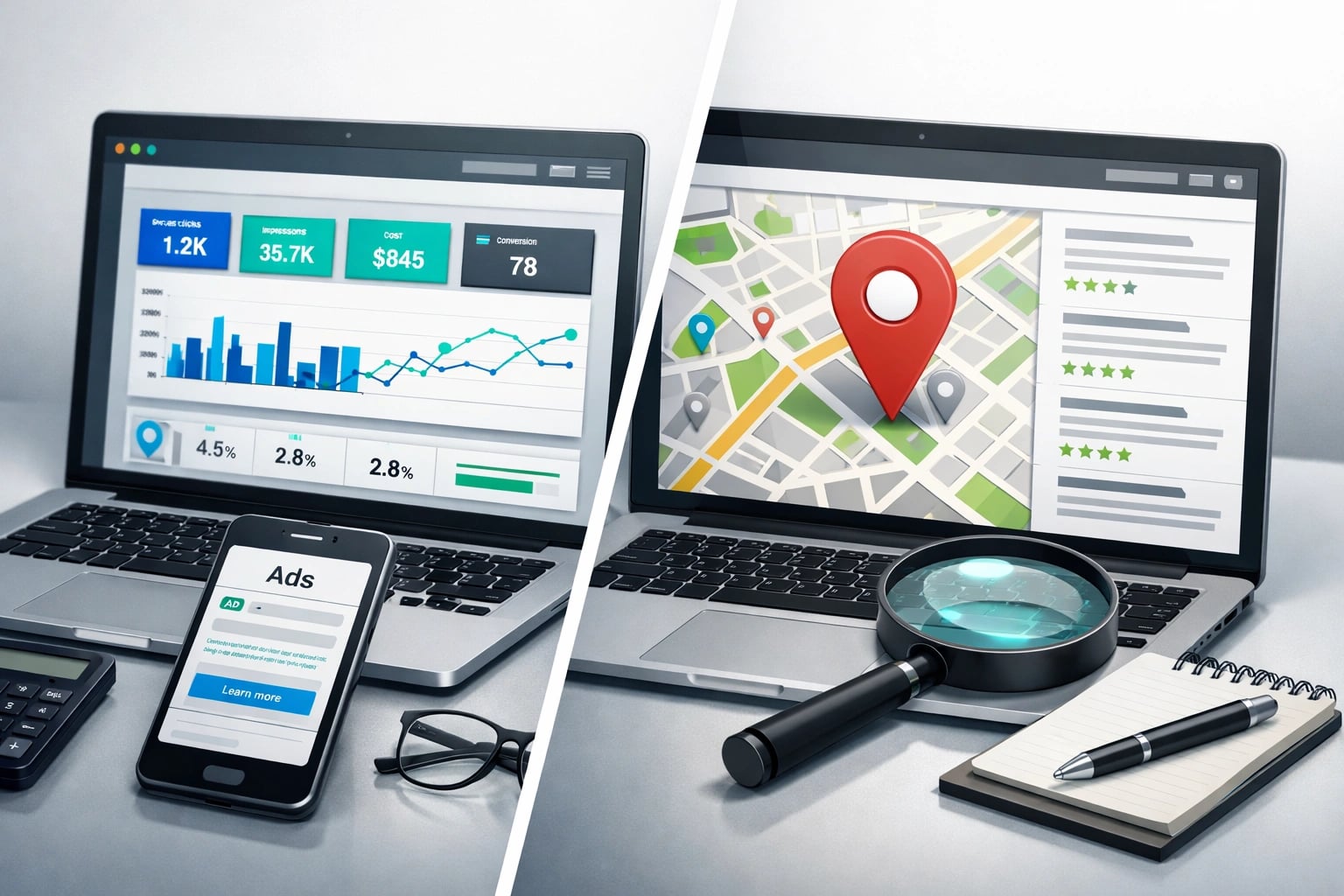
Google Ads delivers leads fast, but Local SEO builds a long-term asset that compounds over time.
The Budget Question Every Business Owner Asks
You have a marketing budget. It is not unlimited. So where does it go?
This is the question we hear from Space Coast business owners every week. Should you invest in Google Ads to get leads right now, or put that money into Local SEO for long-term organic growth? Understanding your options across all our marketing services helps you pick the right mix.
The honest answer: it depends on your situation. But we can help you figure out which situation you are in.
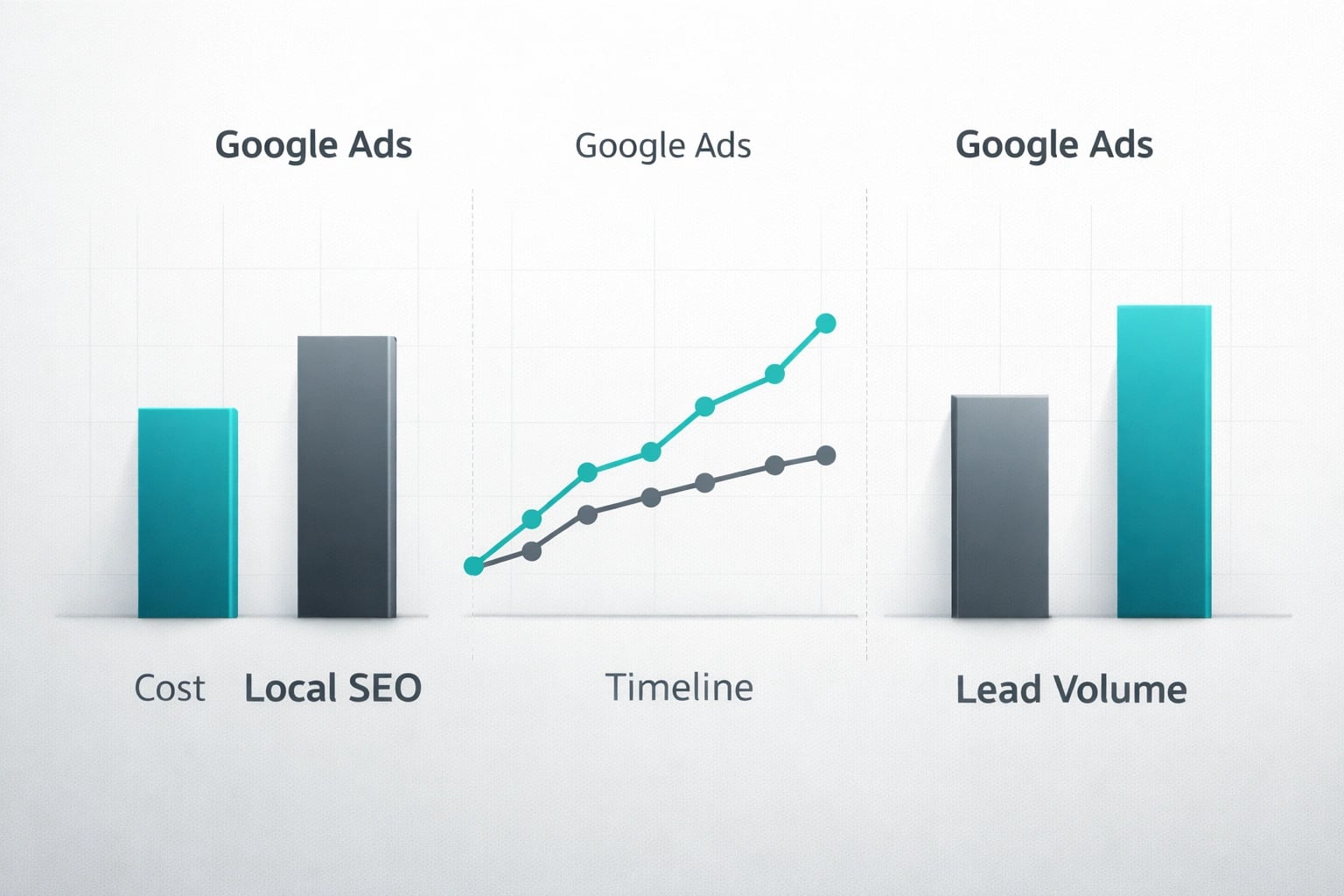
Google Ads wins on speed. Local SEO wins on long-term cost per lead and compounding returns.
What Each Strategy Actually Costs
Before comparing results, let's talk real numbers. Not vague ranges, but what Brevard County businesses are actually paying.
Google Ads: The Full Picture
Google Ads costs come in two parts: your ad spend (what Google charges per click) and management fees (what someone charges to run the campaigns).
Ad Spend
$500 to $3,000/mo for most local businesses. Competitive industries like HVAC, legal, and roofing sit at the higher end.
Management Fees
$300 to $1,000/mo if you hire an agency. Some charge a percentage of ad spend instead (typically 15 to 20%).
Cost Per Click
$2 to $15 for most local keywords. 'Emergency plumber Melbourne FL' might cost $12 per click, while 'florist Cocoa Beach' might be $3.
Landing Pages
$500 to $2,000 one-time setup. You need dedicated landing pages to convert clicks into leads. Your homepage is not enough.
Local SEO: The Full Picture
Local SEO does not have a "per click" cost, but it is not free either. Someone has to do the work.
Monthly Retainer
$500 to $2,000/mo for professional management. This covers GBP optimization, content creation, citation building, and link earning.
Initial Setup
$500 to $1,500 one-time for site audit, GBP setup, initial citations, and on-page optimization.
Content Creation
Included in most retainers, or $200 to $500 per article if done separately. Local content is key to ranking.
DIY Option
$0 in fees if you do it yourself, but plan for 10 to 15 hours per month of your time. That has a cost too.
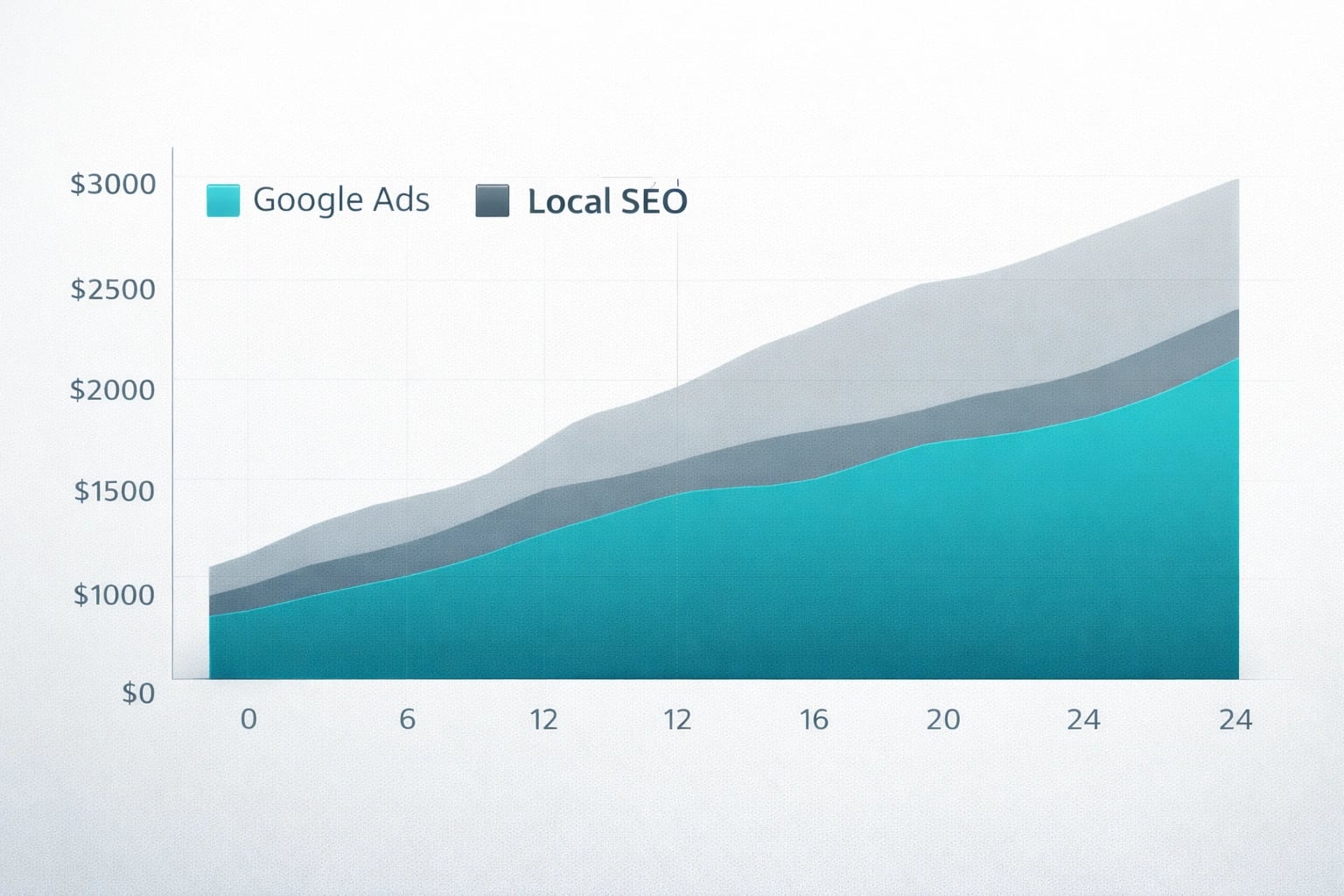
At the same monthly spend, Local SEO overtakes Google Ads in total leads generated after 12 to 18 months.
ROI Over Time: Where Things Get Interesting
This is where the comparison gets real. Google Ads and Local SEO behave very differently over time, and understanding this difference is the key to making a smart decision.
The 6-Month View
A new Merritt Island pressure washing company opens up. They have $1,500 per month for marketing. Here is what each path looks like after 6 months.
At 6 months, Google Ads wins on volume. No question. That is the entire value proposition: you pay, you get leads, starting now.
Local SEO almost always loses the 6-month comparison. If someone tells you SEO will beat paid ads in the first few months, they are either being dishonest or selling you something. SEO is a compounding investment.
The 12-Month View
Now things start to shift. That same Merritt Island pressure washing company, 12 months in:
With Google Ads, you have spent $18,000 and generated roughly 120 to 240 leads. Your cost per lead is still $75 to $150 because every lead requires more ad spend. Stop paying, and leads stop immediately.
With Local SEO, you have spent $18,000 but your monthly lead volume has grown to 20 to 40 leads per month. Your effective cost per lead has dropped to $40 to $75 because organic traffic compounds. You are ranking for dozens of keywords, pulling in traffic 24/7.
The 24-Month View (Where SEO Pulls Ahead)
At 24 months with the same total investment, Local SEO has likely generated more total leads at a lower cost per lead. Our Florida Local Search Index confirms this compounding pattern across Brevard County industries. And here is the real difference: if you pause your SEO work, those rankings do not vanish overnight. You will continue getting organic leads for months, even without ongoing investment. Pause Google Ads and the leads stop that same day.
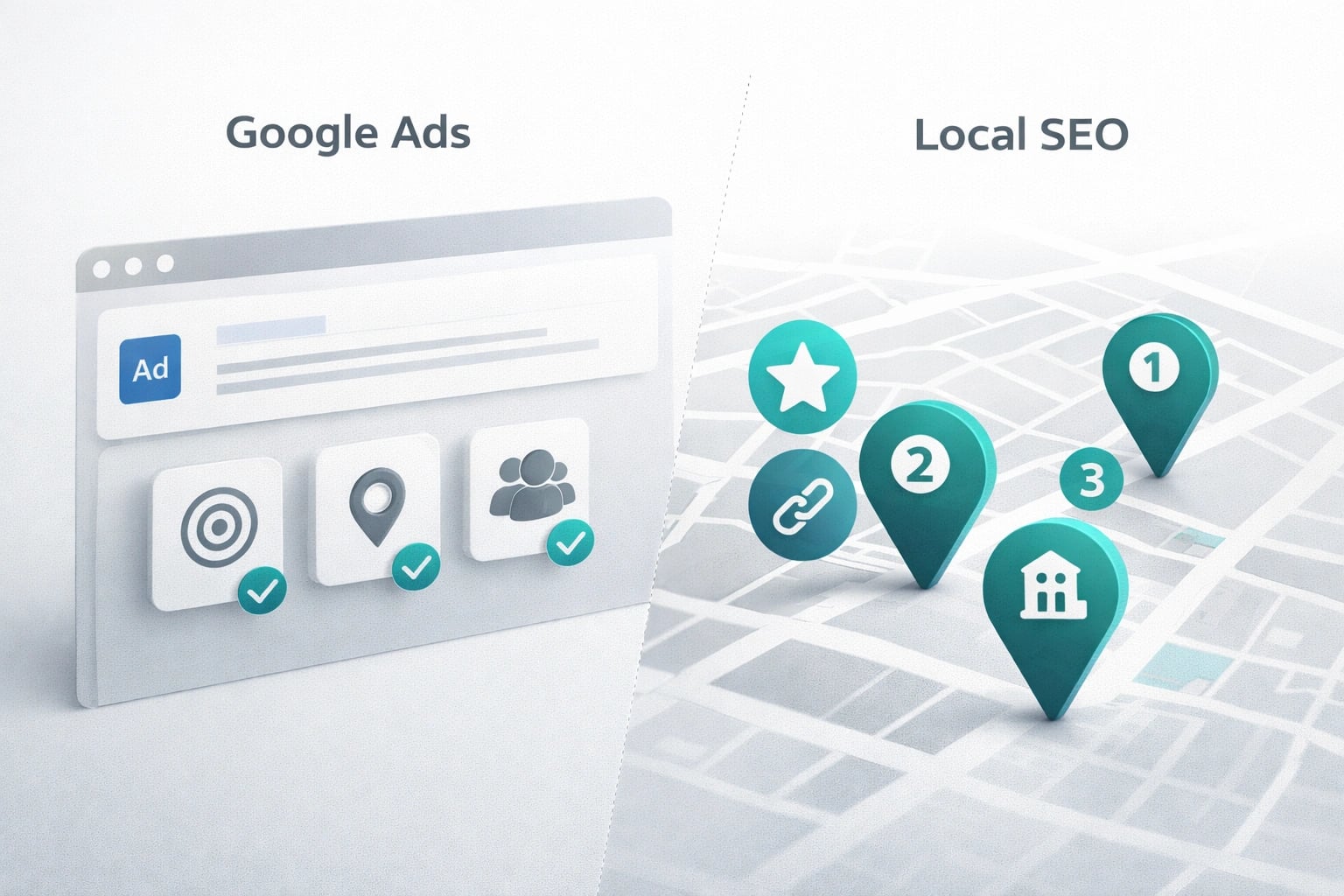
Google Ads offers precise targeting and instant visibility. Local SEO builds lasting organic presence across Maps, search, and review platforms.
When Google Ads Is the Right Choice
Google Ads is not the "wrong" choice. For certain situations, it is exactly the right move.
- Immediate results: leads can start within days of launching campaigns
- Precise targeting: show ads only to people searching specific services in specific zip codes
- Measurable ROI: every dollar is trackable from click to conversion
- Scalable: increase budget to increase leads (within market limits)
- Seasonal control: ramp up for busy season, scale down in slow months
- Leads stop the moment you stop paying
- Cost per lead stays flat or increases over time due to competition
- Click fraud can waste 10 to 15% of your budget
- Competitive bidding drives up costs in crowded industries
- No lasting asset: you build zero equity in organic rankings
Google Ads makes sense when:
- You just opened a new business and need revenue now
- You are running a seasonal promotion (hurricane season prep, holiday specials)
- You want to test a new service offering before investing in content
- Your industry has long sales cycles and you need to fill the pipeline immediately
- You have a proven offer that converts well, and you just need more traffic
A new Merritt Island pool cleaning company launched Google Ads targeting "pool cleaning Merritt Island" and "pool service Cocoa Beach." Within two weeks, they had 12 qualified leads. That immediate cash flow funded their first three months of business operations while they built their SEO foundation.
When Local SEO Is the Right Choice
Local SEO builds a long-term asset. Your rankings, your content, your Google Business Profile, your reviews. These belong to your business and keep working for you.
- Compounding returns: traffic grows over time without proportional cost increases
- Lower long-term cost per lead ($20 to $50 vs $50 to $150 for ads)
- Builds trust: 70% of users skip paid ads and click organic results
- Lasting value: rankings persist even if you pause investment
- Multiple traffic sources: Google Maps, organic search, review platforms
- Takes 3 to 6 months to gain meaningful traction
- Results are less predictable, especially early on
- Algorithm changes can affect rankings (though diversified strategies reduce this risk)
- Requires ongoing content and optimization work
- Harder to measure direct ROI in the first few months
Local SEO makes sense when:
- You have an established business with some existing cash flow
- You are planning for 12 months or more (not looking for quick fixes)
- You want to reduce your long-term marketing costs
- Your competitors are investing in SEO and you need to keep up
- You serve a specific geographic area and want to dominate local search with SEO strategy
An established Melbourne FL contractor had been paying $2,500 per month in Google Ads for three years. That is $90,000 spent with nothing to show once the ads stopped. They shifted $1,500 per month to Local SEO while maintaining $1,000 in ads. After 12 months, organic leads matched their paid leads. After 18 months, they cut ads entirely and saved $1,000 per month while getting more total leads than before.
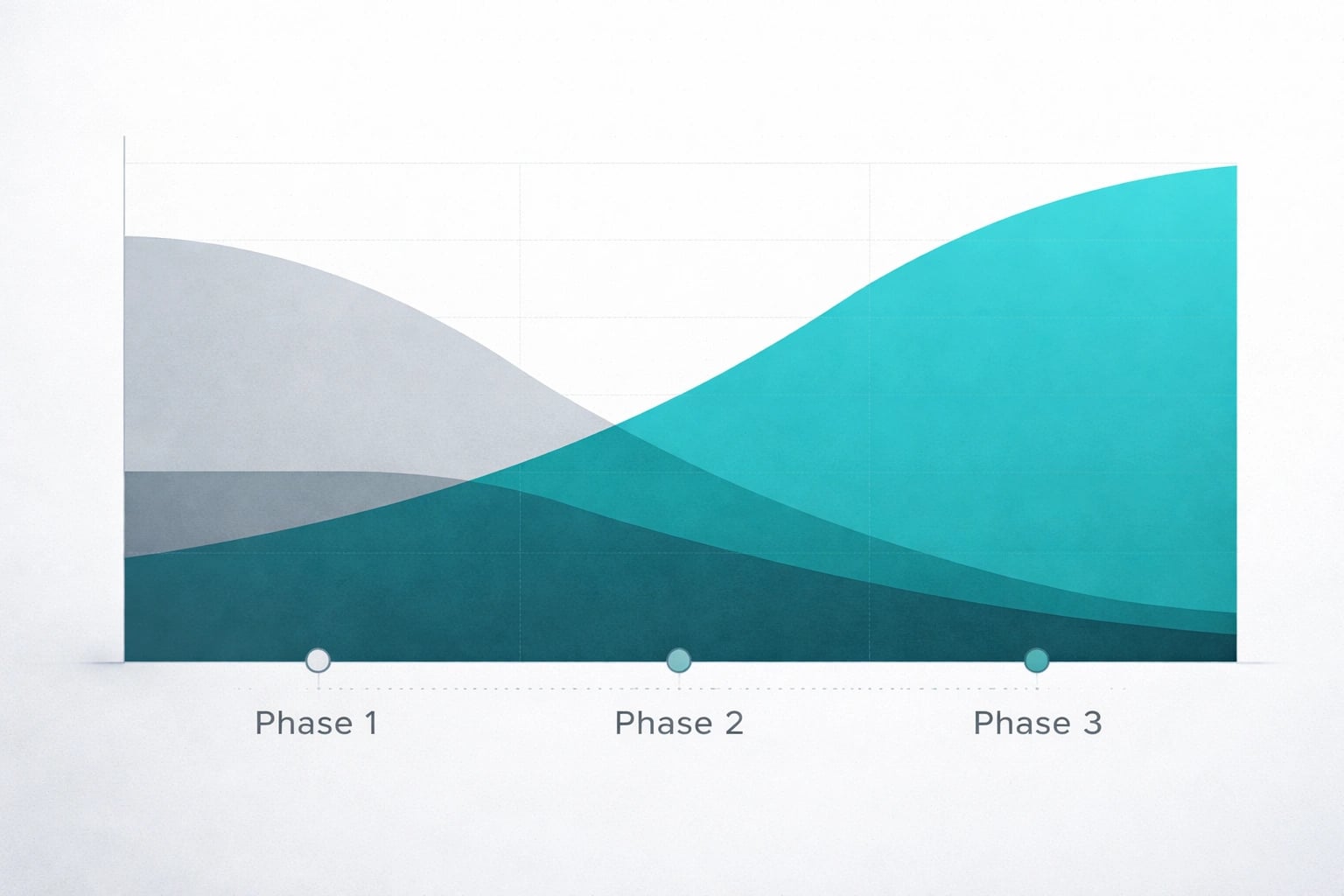
The smartest approach shifts budget from ads to SEO as organic rankings build momentum.
Local Services Ads: The Third Option Most Comparisons Skip
For licensed home service businesses, Google offers a product that sits between classic PPC and organic: Local Services Ads (LSAs). Instead of paying per click, you pay per lead (a call, message, or booking), and Google verifies your license, insurance, and background before you can run them. That verification badge carries real trust weight with homeowners, and pay-per-lead economics are usually friendlier than search-ad clicks for trades like plumbing, HVAC, and electrical.
Two caveats. First, LSA placement leans heavily on your Google Business Profile and reviews, so a weak organic foundation drags your paid results down too, the same foundation-first rule applies. Second, Google keeps reshaping how LSAs work and where they appear, so treat any specific mechanics you read (including these) as "as of 2026" and verify before budgeting around them.
The Foundation Rule (Read This Before Spending Anything)
Whichever channel you pick, one rule outranks the whole debate: a slow site with a half-finished Google Business Profile wastes money on both. Paid clicks bounce off a page that takes five seconds to load on a phone. Organic rankings never materialize for a business Google can't confidently verify. Fix the foundation first: mobile speed, obvious click-to-call, complete profile, steady reviews. Then either channel, or both, performs.
And one operational rule from watching real service businesses: never buy more leads than you can answer. If your crew can take five new jobs this month, 50 paid leads just means 45 people who called a business that never got back to them, and some of them leave reviews about it.
The Hybrid Approach (What Smart Businesses Do)
Most successful local businesses on the Space Coast do not choose one or the other. They use both strategically.
Phase 1: Launch (Months 1 to 3)
Allocate 70% of budget to Google Ads for immediate leads. Use remaining 30% to start SEO foundations: GBP optimization, initial content, citation building.
Phase 2: Build (Months 4 to 8)
Shift to a 50/50 split as organic traffic starts growing. Use ad data to identify your highest-converting keywords, then create SEO content targeting those same terms.
Phase 3: Scale (Months 9 to 18)
Move to 30% ads, 70% SEO. Keep ads running for competitive or seasonal terms. Let organic rankings handle the bulk of lead generation.
Phase 4: Optimize (Month 18+)
Some businesses drop ads entirely. Others maintain a small ad budget for seasonal pushes and competitive terms. Your organic presence now handles 70 to 80% of lead flow.
Do not spread a tiny budget across both channels. If you only have $500 per month, pick one and do it well. Splitting $250 between ads and SEO means neither gets enough investment to produce real results. You also want a fast, well-built website backing up your campaigns. Poor website design can waste good traffic from either channel.
How to Decide: A Quick Framework
Not sure which fits your business? Answer these three questions:
1. How urgently do you need leads?
If your phone needs to ring this week, start with Google Ads. If you can wait 3 to 6 months for traction, start with SEO.
2. What is your monthly marketing budget?
Under $1,000 per month: pick one channel and focus. $1,000 to $2,000: consider a hybrid with heavier weighting toward your priority. Over $2,000: you can run a meaningful hybrid strategy from day one.
3. How long do you plan to invest?
Less than 6 months: Google Ads only. 6 to 12 months: start layering in SEO. 12+ months: SEO should be a core part of your strategy. Looking ahead, AI search optimization is becoming another channel worth planning for as more consumers use AI-powered search tools.
- Google Ads delivers leads immediately but costs $50 to $150 per lead with no lasting value
- Local SEO costs $20 to $50 per lead after ramp-up and compounds over time
- Most successful businesses use both, shifting budget from ads to SEO as organic rankings grow
- New businesses should start with ads for cash flow, then layer in SEO
- Established businesses overpaying for ads can save significantly by investing in SEO
- If your budget is under $1,000 per month, pick one channel and commit to it