



How Can an HVAC Marketing Plan Drive Real Growth in 2026?
A 2026 HVAC marketing plan maps revenue goals to specific channels, sets a budget of 7 to 12% of revenue, and tracks everything down to booked jobs and profit per channel.
Updated August 31, 2026 · 17 min read
Table of Contents
• A 2026 HVAC marketing plan ties revenue targets to specific channels, sets a 7 to 12% of revenue budget, and tracks booked jobs and profit per channel. • Most plans fail from underfunding (2 to 4% spend), single-channel dependence, or no tracking beyond the phone ringing. • Balance fast-lead channels (Google Ads, LSAs) with long-term investments (local SEO, reviews) and review spend every 30 days.
Key Takeaways
-
A modern hvac marketing plan should tie clear revenue targets to specific marketing channels, a defined hvac marketing budget, and tracking for booked jobs, not just clicks or impressions.
-
Most hvac companies in the US need to spend 7 to 12% of revenue on marketing to achieve real hvac business growth. Spending 3 to 5% keeps the lights on but rarely moves the needle.
-
The plan must balance fast-lead channels (hvac google ads, google local services ads) with long-term investments like local seo and positive reviews so your local business isn't dependent on a single source.
-
Everything should be tracked to booked calls, close rate, and job margin using call tracking software, CRM tools, and per-channel reporting.
-
L3ad Solutions helps hvac companies anywhere in the US with local SEO, Google Business Profile management, and paid advertising on a month-to-month basis with no long-term contracts.
How Should You Define Your HVAC Business Growth Targets For 2026?
Every hvac marketing plan starts with a specific number and a deadline. "Get more calls" isn't a goal. "Grow residential revenue from $1.2M to $1.6M by December 31, 2026" is.
Setting measurable marketing objectives supports business growth because you can actually tell whether the plan is working. Here are examples of concrete targets for a typical 3-truck hvac business:
| Metric | Current (Annual) | 2026 Target | Quarterly Pace |
|---|---|---|---|
| Residential revenue | $900,000 | $1,200,000 | $300,000/quarter |
| System installs | 80 | 120 | 30/quarter |
| Maintenance agreements | 200 | 500 | +75/quarter |
| Inbound calls (all sources) | 1,800 | 2,600 | 650/quarter |
Goals must connect to crew capacity. If you only have two install crews and each crew handles roughly three installs per week, you can't book 50 installs in a month without adding people. A marketing plan that outpaces your labor just wastes ad spend and burns customer trust.
Revisit these numbers every quarter. If Q1 runs 20% below target, that's the signal to increase marketing spend, adjust channels, or fix the sales process before summer hits.
Why Do Most HVAC Marketing Plans Fail Before They Start?
Most hvac companies either underfund marketing, chase random tactics, or never track what actually turns into booked work. That's the short answer.
Here's what the pattern looks like in practice:
-
Spending 2 to 4% of revenue instead of 7 to 12%. A 5% marketing budget yields minimal results for hvac businesses. It covers a basic website and maybe one directory listing, but it won't produce consistent lead flow.
-
Relying on a single lead source. If all your calls come from one Google Ads campaign and CPCs jump 20% (which they did in many markets in 2024 and 2025, per LocaliQ's home services benchmarks), your entire pipeline gets squeezed.
-
No tracking by channel. Many hvac business owners know they're "busy" but can't tell you which marketing channels generate the best booked jobs or what their cost per lead is on any given source.
A $900K hvac company spending 3% on marketing puts $27,000 per year into growth. That same company at 10% invests $90,000. The difference isn't just volume. It's the ability to run Google Ads, fund local seo, build a review engine, and still have budget left for direct mail campaigns in shoulder seasons.
Why plans fail (summary): No written goals. No real budget. No tracking beyond "the phone rang."
How Much Should Your HVAC Marketing Budget Be In 2026?
Here's a rule of thumb that holds up across the hvac industry:
-
5 to 7% of revenue to hold your current position
-
8 to 12% of revenue for steady growth
-
12 to 15% or more for aggressive expansion into new markets
HVAC contractors should allocate 10% to 20% of sales for marketing, depending on growth ambitions and market competition. Experts recommend separating marketing funds from operating accounts so the money is always available and doesn't get absorbed by payroll or parts costs. Use a dedicated account for marketing to ensure funds are there when you need them.
A $750,000 residential hvac business targeting $1M in 2026 should plan roughly $75,000 to $100,000 in yearly marketing spend, or about $6,250 to $8,300 per month. Here's a rough breakdown:
-
Google Ads and LSAs: $2,000 to $3,000/month
-
Local SEO and content: $1,500 to $2,000/month
-
Website improvements: $500 to $1,000/month
-
Community marketing and direct mail: $500 to $1,000/month
-
Referral rewards and retention: $500 to $800/month
For a deeper look at setting realistic numbers based on your actual revenue, check out the honest marketing budget guide.
Budgets must account for seasonality. Set aside a portion of peak-season revenue to fund shoulder-season campaigns. If you collect $150,000 in July from AC installs, reserving 10% ($15,000) in a marketing savings account means you have cash to push furnace tune-ups hard in October when call volume naturally drops.

A $1M shop at 10% spend: ads and LSAs lead, SEO and content close behind, retention funded year-round.
Which Customers Should Your HVAC Company Actually Target?
A strong hvac marketing plan starts with a focused customer profile, not "everyone with an AC." Your target audience includes residential homeowners and small-to-midsize commercial property managers, but each group behaves differently.
Emergency repair homeowners need help now. They search phrases like "AC repair near me at night" or "furnace not working." High energy bills and system breakdowns are common pain issues for these hvac customers. They pick whoever answers the phone first and has good reviews.
Replacement and installation customers research before buying. They search "energy efficient HVAC system install cost" or "best heat pump brands 2026." They compare two or three hvac companies, read reviews, and check financing options. These are your highest-ticket jobs.
Maintenance agreement customers value consistency. They respond to seasonal tune-up promotions via email marketing, direct mail, or social media. Annual maintenance agreements provide steady cash flow for hvac businesses and keep your techs productive between emergency calls.
Understanding these profiles helps you pick the right channels. Emergency customers respond to hvac google ads and local services ads. Replacement shoppers need strong local seo and a solid hvac website. Maintenance customers convert through email and SMS to past customers and current customers. Commercial customers like property managers often come through referral programs and partnerships with real estate agents.
How Do You Craft A Clear HVAC Marketing Message That Stands Out?
Clear positioning and a simple value proposition make all your hvac advertising and website content more effective. If potential customers can't tell you apart from the other three companies on the page, they'll pick whoever's cheapest or closest.
Possible differentiators for your hvac business in 2026:
-
Same-day or next-day service with guaranteed arrival windows
-
24/7 emergency availability with live phone answering
-
Upfront pricing, no surprise charges after the work starts
-
Extended warranties (5+ years on labor, 10+ on equipment)
-
Financing options with monthly payments clearly stated
-
A 4.8+ star Google rating backed by hundreds of positive reviews
Here are sample value propositions written in plain language:
-
"We show up the same day, give you an exact price before we start, and back every install with a 10-year warranty."
-
"24/7 AC and furnace repair in [City]. Flat-rate pricing. 500+ five-star reviews."
-
"Your neighbors trust us. 1,200 hvac systems installed in [County] since 2014. No surprises, no upsells."
Message checklist:
-
Does your homepage headline say what you do, where you do it, and why someone should pick you?
-
Does every Google Ad match the landing page's offer?
-
Does your Google Business Profile description echo the same core promise?
-
Do your truck wraps and yard signs reinforce the same message people see online?
The same core message should appear everywhere: website headlines, paid ads, GBP description, and truck wraps. Consistency helps build brand awareness across every touchpoint.
How Can Your HVAC Website Turn Visitors Into Booked Jobs?
Your hvac website must be fast, mobile-friendly, and built to convert visitors into calls and online bookings. Building a responsive and mobile-friendly website enhances user experience for urgent service inquiries. 70% of consumers find services online through Google searches, and most of those searches happen on a phone. If your site loads slowly or hides the phone number, you're losing money every day.
Key elements every hvac website needs:
-
Click-to-call button visible on every page (especially on mobile)
-
Clear list of service areas and the cities you cover
-
Emergency service notice ("Available 24/7, call now")
-
Financing information on install and replacement pages
-
Prominent Google reviews or star rating on the homepage
-
Online booking or quote request form above the fold
Example homepage hero layout:
-
Headline: "[City]'s Trusted HVAC Company Since 2009"
-
Subheadline: "Same-day repairs. Upfront pricing. 4.9 stars on Google."
-
Primary CTA: "Call Now" button + "Schedule Online" button
-
Trust badges: Google rating, manufacturer certifications, BBB
-
Below the fold: services grid, recent reviews, service areas
For guidance on building pages that actually convert, see professional web design and the conversion-focused web design guide.
Basic on-page SEO matters too. Use clean URLs (yoursite.com/ac-repair-phoenix), title tags formatted like "AC Repair Phoenix, AZ | Your Company Name," and schema markup so search engines can display your hours, ratings, and service areas in results. The schema markup generator can help you set that up quickly.
How Should HVAC Companies Use Local SEO To Win 'Near Me' Searches?
Effective SEO increases local search visibility for hvac services. Local SEO targets customers within a specific geographic location, so when someone types "furnace repair near me" or "AC tune up in Dallas," your company appears in the results. 90% of consumers use the internet to find local businesses. If you're not showing up, you're invisible.
Local seo basics every hvac contractor should have in place:
-
Accurate NAP (name, address, phone) across your website, Google Business Profile, Yelp, and every directory
-
Service-area pages for each city you serve, with unique content about your work in that area
-
Consistent directory listings checked and corrected quarterly
-
Using local keywords in page titles, headers, and body copy (e.g., "AC installation in Scottsdale" rather than just "AC installation")
Using local keywords boosts search rankings for hvac services. A case study from Redwood Marketing Partners showed a regional HVAC provider that built service-area pages for each county, automated review requests, and enhanced their Google Business Profile. The result: organic leads up 340%, Google reviews from 47 to 312, and cost per lead down 72%.
Example city service page structure:
-
H1: "AC Repair in [City], [State]"
-
Intro paragraph: what you offer, why local customers choose you
-
Services list: repair, installation, maintenance, indoor air quality
-
2 to 3 local customer testimonials
-
FAQ section with city-specific questions
-
CTA: call button and quote form
For a deeper walkthrough, read the local SEO fundamentals guide or explore local SEO services from L3ad Solutions.
How Do You Optimize Your Google Business Profile For HVAC Leads?
For many hvac companies, Google Business Profile sends more calls than the website, especially on mobile local searches. A well-optimized Google Business Profile helps improve local visibility. Verifying your Google Business Profile is free and simple, and Google Business Profile allows businesses to showcase services and reviews right in the search results.
Items to optimize:
-
Primary category: "HVAC contractor" plus secondary categories like "Air conditioning repair service"
-
Services list: add every service you offer with descriptions and pricing ranges if possible
-
Service areas: list every city, ZIP code, or county you cover
-
Photos: upload real photos of your techs, trucks, completed installs, and your office or warehouse. Google rewards profiles with fresh images.
-
Business hours: keep them accurate, especially holiday hours
-
Messaging: turn it on if you can respond within minutes; turn it off if you can't
Post short seasonal offers directly on GBP. For example: "Summer 2026 AC tune-up special in Phoenix: $89 including a 21-point inspection. Book by July 15." These posts show up in local search results and give people a reason to click.
An optimized Google Business Profile helps appear in local search results. Positive reviews improve your Google Business Profile ranking. Reply to every review (positive and negative) using local terms and service keywords. A reply like "Thanks for the great review, Sarah! We're glad we could get your AC running again quickly in Mesa" helps both your reputation and your local search visibility.
For a full walkthrough, check out the Google Business Profile guide or ask about Google Business Profile management.
How Can Reviews And Reputation Marketing Grow Your HVAC Business?
A 4.5+ star rating and a steady flow of new Google reviews often decide which hvac company a homeowner calls first. Here's why that matters: 82% of customers read online reviews for local companies. 94% of consumers are more likely to use a business with positive reviews. Customers read an average of 10 reviews before trusting a business. And more than half of consumers won't hire a company with less than 4 stars.
Claiming and managing customer reviews improves a company's online reputation. Customers trust online reviews as much as personal recommendations.
How to build a simple review request process:
-
Ask on-site. After the tech finishes the job and the customer is satisfied, the tech says: "We'd really appreciate a Google review. It helps other homeowners find us. I'll send you a quick link."
-
Send a follow-up text within 2 hours with a direct link to your Google review page: "Hi [Name], thanks for choosing [Company]! If you have 30 seconds, a Google review means a lot to us: [link]"
-
Remind once more 3 days later via text or email if no review was left.
Companies can receive 5 to 15 Google reviews per day with effective strategies and good service. Positive customer feedback builds trust in your business and fuels your local seo rankings.
Positive reviews influence 74% of consumers' decisions. The local reviews playbook covers this topic in detail. You can also check your current standing with the review health score tool.
Where Do Google Ads And Local Services Ads Fit In Your HVAC Marketing Plan?
HVAC google ads and google local services ads are the fastest way to generate leads, especially during peak season or when entering a new market. Google Local Services Ads appear at the top of search results, above traditional paid ads and organic listings.
How each channel works:
-
Google Search Ads (PPC ads): You bid on keywords like "AC repair [city]" and pay per click. You control ad copy, landing pages, and budgets. PPC ads can cost between $28 and $65 per click for hvac services. Average non-branded cost per lead runs about $127 to $130, according to LocaliQ's 2025 benchmarks.
-
Local Services Ads: You pay per lead (phone call or message), not per click. Google verifies your business and displays a trust badge. CPL runs about $45 to $85 in most US markets, with book rates around 44% per Ardoz Digital's analysis.
Utilizing PPC ads for emergency service calls captures immediate-need customers who are ready to book right now.
Example monthly test budgets for a mid-sized hvac company:
-
Google Search Ads: $1,500 to $3,000/month
-
Local Services Ads: $1,000 to $2,000/month
Paid ads should send clicks to focused service landing pages (e.g., yoursite.com/ac-repair-austin), not your homepage. Every landing page needs a dedicated phone call tracking number so you know exactly which campaign produced each call.
L3ad Solutions offers paid advertising management for hvac companies across the US on a month-to-month basis.
How Can Retargeting And Social Media Ads Support Your HVAC Marketing Plan?
Retargeting brings back visitors who looked at your site but didn't call or book. Social media advertising builds awareness and promotes seasonal offers to future customers in your service area.
Simple retargeting audiences to set up:
-
All website visitors in the last 30 days
-
Visitors to repair or replacement pages specifically
-
People who started a quote form but didn't submit it
Seasonal social media campaigns:
-
"Spring 2026 AC tune-up: $79 for the first 50 bookings"
-
"Winter 2026 furnace safety check: free carbon monoxide test included"
Facebook and Instagram work best for residential hvac. Start with $20 to $40 per day and test for two weeks before scaling. Geofencing ads target mobile users within specific geographic areas, which can be useful for targeting specific neighborhoods or subdivisions where you've recently completed installs.
Ad creative ideas: short videos introducing your lead technician, before-and-after photos of unit replacements, quick educational clips like "3 signs your AC needs replacing," and customer testimonial clips recorded on a phone.
Social media marketing for hvac isn't about going viral. It's about staying visible to local customers between the times they need you.
How Should You Use Content Marketing To Build Trust For Your HVAC Company?
Useful content answers real homeowner questions and warms up leads before they ever call your office. Using content marketing establishes authority and boosts SEO for hvac businesses.
Formats that work for hvac companies:
-
Blog posts: "How Much Does a New AC Cost in [City] in 2026?"
-
FAQs: "What's included in a furnace tune-up?"
-
Maintenance checklists: "Fall HVAC checklist for homeowners"
-
Comparison guides: "Repair vs. Replace: When to Stop Fixing Your Old AC"
-
Short how-to videos: "How to Change Your HVAC Filter in 60 Seconds"
A simple plan: publish one helpful blog post per month on seasonal topics and one evergreen guide per quarter. That's 16 pieces of content in 2026, enough to build real search visibility.
As AI-powered search tools (like Google's AI Overviews) grow, your content needs to be structured clearly with questions and direct answers. The generative engine optimization guide covers how to prepare for this shift, and AI search optimization is a service worth exploring.
Every piece of content should tie back to a call to action: schedule a tune-up, request a quote, or sign up for a maintenance plan. Information without a next step is a missed opportunity.
How Can Grassroots And Community Marketing Help Local HVAC Businesses?
For many local hvac companies, community visibility and word-of-mouth still drive a large share of their best new customers. These tactics don't scale like digital ads, but they build trust that digital alone can't match.
Grassroots tactics that work:
-
Wrapped trucks (your fleet is a mobile billboard; make the phone number large enough to read from 50 feet)
-
Yard signs placed after every install, with the homeowner's permission
-
Sponsoring youth sports teams, school events, or local 5K races
-
Attending chamber of commerce meetings and home expos
-
Writing a short tip column for HOA newsletters
"Neighborhood dominance" play: After a big install week in one subdivision, send direct mail to 200 surrounding homes, place yard signs at the completed job sites, and run a Facebook ad targeting that ZIP code with a "Your neighbors chose us" message. This concentrated approach builds local visibility fast.
Personal visibility of the hvac business owner at local community events builds trust that carries over to digital leads. People who've seen your face at a Little League game are more likely to answer your retargeting ad later. Tie community work back to your online presence by posting event photos on social media and encouraging satisfied customers from the neighborhood to leave reviews.
What Role Do Referral Programs And Partnerships Play In An HVAC Marketing Plan?
Structured referral programs and local partnerships can become your highest-ROI channel once you've served enough satisfied customers. Referral programs incentivize existing customers to refer new clients, and customer retention strategies are generally more cost-effective than acquiring new customers.
Referral program basics:
-
Offer a $50 to $100 service credit or gift card for every referred customer who books a system install
-
Create a separate, simpler offer for repair referrals ($25 credit or a free filter change)
-
For property managers and commercial customers, offer a percentage discount on their next service contract for each referred property
Partnership opportunities:
-
Real estate agents who need reliable HVAC inspections before closings
-
Property managers who manage 10+ rental units and need consistent maintenance
-
Plumbers and electricians who get asked "Do you know a good HVAC company?" on job sites
-
Local hardware stores that can display your business cards or flyers
Track every referral source in your CRM. Tag each lead with the referring customer or partner name so you know which relationships are actually producing work.
Remind your techs and customer service reps to ask for referrals as part of their regular closing scripts. After every completed job, a simple "If you know anyone who needs HVAC work, we'd love the introduction" goes a long way.
How Can Email And SMS Marketing Keep Your HVAC Schedule Full Year-Round?
Email and SMS help reactivate past customers for seasonal tune-ups and add-on services at very low cost. Targeted email marketing earns $40 for every $1 spent, making email marketing one of the highest-ROI channels available to any hvac business.
Basic seasonal calendar:
| Quarter | Email/SMS Campaign | Offer Example |
|---|---|---|
| Q1 (Jan-Mar) | Spring AC tune-up early bird | "$79 AC tune-up if booked by March 31" |
| Q2 (Apr-Jun) | Summer IAQ and cooling prep | "Free indoor air quality check with any AC service" |
| Q3 (Jul-Sep) | Fall furnace check promotion | "Schedule your furnace inspection before the rush" |
| Q4 (Oct-Dec) | Winter emergency readiness | "Furnace repair priority list: sign up for same-day service" |
Segmenting email audiences increases relevance and response rates. Break your list into: maintenance agreement members, one-time repair customers from the past 24 months, high-value install customers, and dormant leads who requested quotes but never booked.
Targeted email campaigns improve customer engagement, and seasonal email campaigns align with common HVAC service needs. Automated email follow-ups can reactivate dormant customers who got a quote six months ago but never pulled the trigger.
Example subject line: "Your AC ran hard this summer. Here's a $79 fall tune-up before furnace season."
Example SMS: "Hi [Name], it's [Company]. Time for your fall furnace check! Reply YES to book your preferred date, or call us at [number]."
Sending automated reminders improves customer engagement for maintenance services. Investing in customer communication automation enhances business efficiency and keeps your schedule full without manual follow-up by office staff.
What Tech Stack Does A Modern HVAC Business Need To Support Marketing?
A basic tech stack for your hvac business should include a website CMS (like WordPress), CRM or field service software (ServiceTitan, Housecall Pro, or Jobber), call tracking software, and simple reporting dashboards.
Key components:
-
CRM with customer history: stores every interaction, job, and estimate so you can follow up on unsold quotes and segment your email list
-
Online booking tool: lets homeowners schedule tune-ups or request quotes 24/7 without calling
-
Dispatch app with mobile access: techs can update job status, send quotes on-site, and trigger review requests from their phones
-
Call tracking: assigns unique numbers to each marketing channel so you know whether a call came from Google Ads, your website, or a yard sign
-
Review request automation: sends a text after every completed job without anyone in the office remembering to do it
Mobile access for techs matters. If a tech can send a review request link while still standing in the customer's driveway, the review rate goes up because the experience is fresh.
For ideas on automating repetitive tasks, check out the AI automation for local business guide and AI automation services from L3ad Solutions.
How Should You Allocate Your HVAC Marketing Budget Across Channels?
Budget allocation should follow your goals and market, but here's a concrete starting mix for a typical $1M residential hvac company spending 10% ($100,000/year):
| Channel | % of Budget | Monthly Spend |
|---|---|---|
| Google Ads and LSAs | 30% | $2,500 |
| SEO and content | 25% | $2,083 |
| Website and landing pages | 15% | $1,250 |
| Community and direct mail | 15% | $1,250 |
| Retention, referrals, email | 15% | $1,250 |
During peak summer, shift more budget toward emergency hvac advertising (Google Ads for "AC not cooling" type terms) and LSAs. During shoulder seasons, move spend toward tune-up direct mail campaigns, email reactivation, and maintenance agreement promotions.
Review spend and performance every 30 days. Rebalance toward channels with better booked-job ROI. If local services ads are producing $55 CPL and Google Search is running $140 CPL, shift more budget to LSAs until performance evens out.
Effective marketing plans balance lead generation and customer retention efforts. Don't put 100% of your marketing budget into new customer acquisition while ignoring the existing customer base that already trusts you.
How Do You Track What HVAC Marketing Actually Works?
Track down to booked calls, sold jobs, and profit per job by source. Not just clicks or impressions. Tracking key performance indicators helps refine marketing strategies and prevents you from wasting money on channels that look busy but don't produce revenue.
Key tools:
-
Call tracking numbers assigned per channel (one number for Google Ads, another for your website organic traffic, another for direct mail)
-
UTM tags on every link in ads, emails, and social posts
-
Form tracking that records which page and campaign generated each submission
-
CRM fields for "lead source" and "campaign" filled in at first contact
Core metrics to track monthly:
-
Cost per lead by channel
-
Booking rate (percentage of leads that become jobs)
-
Average ticket size by channel
-
Return on ad spend (ROAS)
Example: If Google Ads produced 30 leads last month at $130 CPL ($3,900 total spend), and 6 of those leads became paying jobs (20% close rate) with an average ticket of $1,800, your revenue from that channel was $10,800 on $3,900 in ad spend. That's a 2.77x return. Compare that to LSAs at $60 CPL producing 50 leads, closing 22 jobs at $400 average ticket ($8,800 revenue on $3,000 spend). Different volumes, different margins. You need both numbers to decide where to put next month's dollars.
Run a free local SEO audit to check your organic visibility, and use the page speed analyzer to make sure slow load times aren't killing conversions before a lead even calls.
Mini case: A mid-sized hvac company in the Southeast was spending $2,000/month on Facebook ads generating leads at $85 CPL. After tracking booked jobs, they found only 4% of Facebook leads converted to paying work, compared to 18% from Google Search. They cut Facebook spend to $500 (for retargeting only) and moved $1,500 to Google Ads. Booked jobs increased by 9 per month.
How Can You Adapt Your HVAC Marketing Plan For Seasonal Swings?
HVAC businesses live and die by seasonality, so the marketing plan must shift messaging and spend through the year. Peak season marketing should protect margins and capacity, not just chase volume.
Year-round rhythm:
-
Extreme weather months: Heavy emergency and replacement ads. Google Ads for "AC not working" or "furnace repair" keywords. LSAs turned up to maximum budget. This is where hvac profit margins are strongest.
-
Shoulder seasons (spring and fall): Maintenance pushes, tune-up promotions, and direct mail to past customers. Content marketing about "how to prepare your system for summer/winter."
-
Pre-peak (4 to 6 weeks before summer or winter): Hiring campaigns for techs, pre-season booking drives for tune-ups, and inventory prep.
Seasonal maintenance campaigns secure recurring maintenance agreements before peak seasons, filling your schedule and creating predictable revenue.
Quarterly campaign examples for 2026:
-
Q1: "Beat the heat. Book your spring AC tune-up by March 31 and save $30." Email + direct mail to existing customer list.
-
Q2: Heavy Google Ads and LSAs for emergency AC repair. Social ads promoting "same-day AC service." Ramp up tech hiring.
-
Q3: Fall furnace check promotions. Maintenance agreement sign-up push. Content about "when to replace your furnace."
-
Q4: Emergency furnace repair ads. Holiday promotions for new system installs with financing. Year-end review of all marketing spend.
Use peak-season profits to fund off-peak marketing. One approach: allocate 5% of every install's revenue into a separate marketing savings account that funds shoulder-season campaigns.
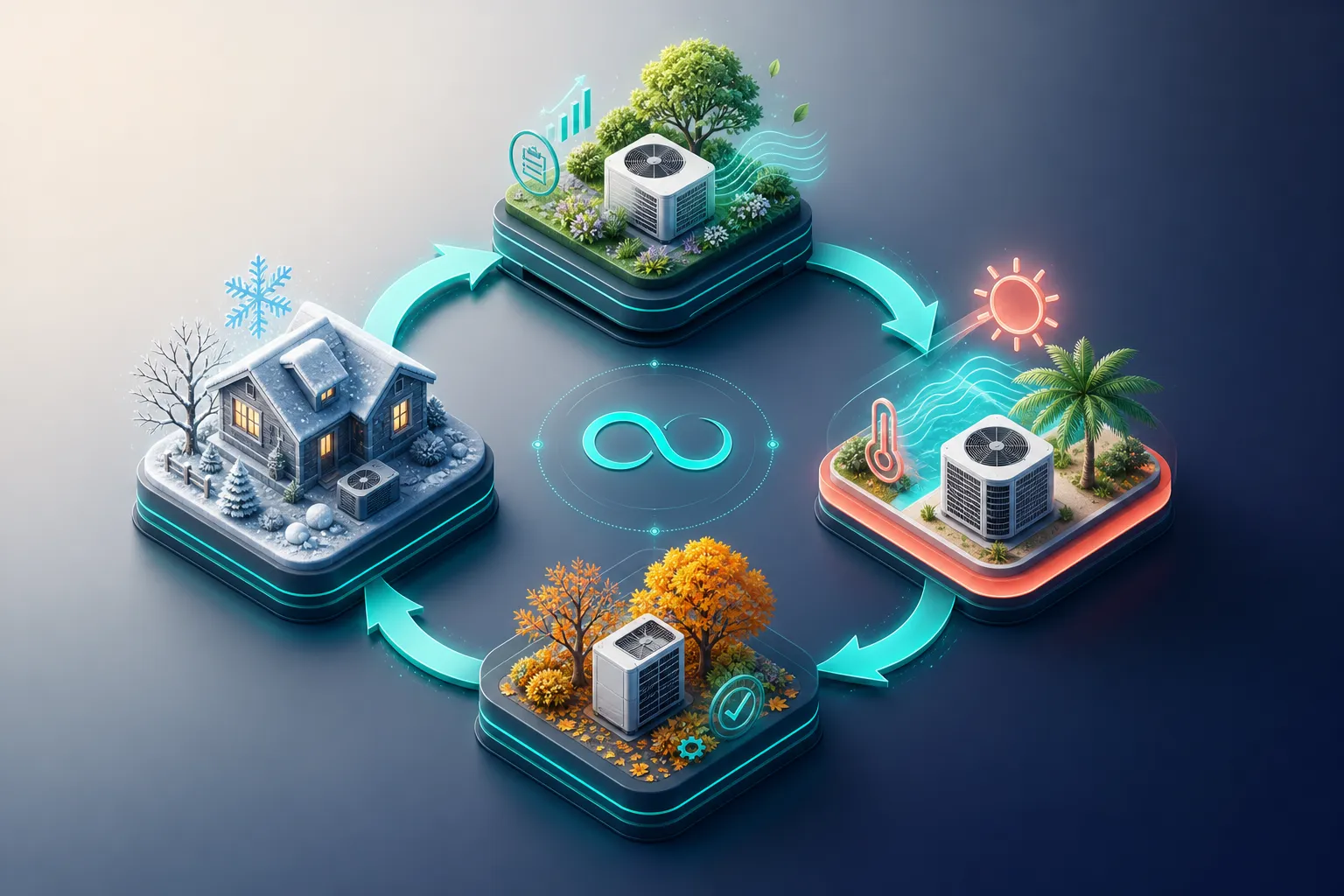
Peak months fund the shoulder seasons. Plan campaigns 4 to 6 weeks before demand hits.
How Do You Put All Of This Into A Simple 90-Day HVAC Marketing Plan?
Think in 90-day sprints with specific actions, budgets, and metrics. Not vague annual intentions. A business plan that says "do more marketing" will sit in a drawer. A 90-day plan with 10 tasks and deadlines gets done.
Three-part 90-day structure:
-
Foundation fixes (weeks 1 to 4): Website speed, mobile usability, GBP optimization, NAP consistency
-
Quick-win lead channels (weeks 2 to 8): Launch Google Ads campaigns, turn on LSAs, set up call tracking
-
Retention systems (weeks 4 to 12): Review automation, email sequences, referral program launch
Example 90-day checklist:
-
Audit and update Google Business Profile (categories, photos, services, hours)
-
Launch branded Google Ads campaign targeting "[company name] + HVAC"
-
Launch non-branded Google Ads for top 3 services in primary city
-
Activate Google Local Services Ads and respond to every lead within 5 minutes
-
Publish 2 city-specific service pages on the website
-
Set up review request automation via CRM or text tool
-
Send first seasonal email to full customer list (spring/fall tune-up)
-
Install call tracking numbers for each channel
-
Build a simple monthly dashboard showing CPL, booked jobs, and revenue by source
-
Run one direct mail piece to 500 homes in a target neighborhood
Each 90-day cycle should end with a short review: what worked, what didn't, and where to shift budget for the next quarter.
If you'd rather have a team handle the setup, check out transparent monthly pricing or request a free audit from L3ad Solutions.
What Can L3ad Solutions Do To Help Your HVAC Company Implement This Marketing Plan?
L3ad Solutions handles the heavy lifting for local SEO, Google Business Profile, Google Ads, and ongoing digital marketing so hvac business owners can stay focused on operations, not ad dashboards.
The agency serves hvac companies across all 50 US states on a month-to-month basis with no long-term contracts. Headquartered in Brevard County, Florida, L3ad Solutions works with hvac contractors ranging from 2-truck shops to multi-location operations.
Relevant services:
-
Digital marketing services including campaign planning and tracking dashboards
-
Google Ads management for hvac-specific campaigns
-
Local SEO and city page buildouts
-
HVAC-specific strategy built around your revenue targets
For the full framework, read the national HVAC marketing blueprint or explore HVAC marketing services to see how the agency works with hvac clients.
Ready to talk? Get in touch or see real client results in our case studies.
How Should You Summarize Your HVAC Marketing Plan For Your Team?
The final plan should be simple enough to share with office staff and techs in a one-page summary. The background strategy might be 10 pages, but the document everyone sees on the wall should fit on a single sheet.
One-page overview format:
-
2026 goals: revenue target, install count, maintenance agreement count
-
Monthly budget: total and by channel
-
Key channels: Google Ads, LSAs, local SEO, email, referrals
-
Core message: one-sentence value proposition the whole team uses
-
Lead handling: how fast to answer calls (target: under 3 rings), who follows up on missed calls, response-time goal for online leads (under 5 minutes)
-
Review target: ask every satisfied customer, goal of X reviews per week
-
Offer of the month: what promotion or seasonal campaign is currently running
Internal communication makes your marketing efforts consistent. If the CSR answering the phone doesn't know about the $79 tune-up special that's running on Google Ads, leads fall through the cracks. Share the plan at a monthly team meeting, even if it takes 10 minutes.
What Common HVAC Marketing Plan Mistakes Should You Avoid?
A few common traps waste thousands of dollars and months of time for hvac company owners.
Mistakes to watch for:
-
Chasing every new platform. A new social app launches and someone says "you need to be on there." Ignore it unless your hvac customers are actually using it.
-
Ignoring the website. Some business owners spend $3,000/month on Google Ads sending traffic to a slow, outdated site with no click-to-call button. Fix the website before scaling ads.
-
Turning ads on and off too often. Google Ads campaigns need 2 to 4 weeks of data to optimize. Pausing after 5 days because "it's not working yet" resets the learning phase.
-
Failing to answer or track calls. If 30% of your calls go to voicemail during business hours, you're paying for leads and then throwing them away.
-
"Set and forget" marketing. Running the same ads with the same budget for 12 months without reviewing recorded calls, checking cost per lead, or adjusting landing pages.
A simple monthly review ritual catches these problems early. The owner and whoever handles marketing or dispatch should spend 30 minutes reviewing: How many leads came in? From where? How many booked? What was the average ticket? What's our cost per booked job?
Consistency beats perfection. An imperfect hvac marketing plan that's executed every month for 12 months will outperform a "perfect" plan that gets abandoned in April.
Tap a question to expand.
How long does it take for an HVAC marketing plan to show results?
What's the best HVAC marketing channel if I only have $1,000 per month?
Do small rural HVAC companies need a formal marketing plan?
How often should I update my HVAC marketing plan?
Can I manage my HVAC marketing myself, or do I need an HVAC marketing agency?
Or start with a free AI visibility check
Does AI Recommend You?
See if ChatGPT, Gemini, Grok, and Claude name your business. Free, emailed in minutes.