



AI Search Trends 2026: What Gets Cited Now
See how ChatGPT, Perplexity, Claude, and Gemini pick sources in 2026. Learn citation patterns, content structures, and steps US business owners can take to appear in AI answers.
Updated August 3, 2026 · 10 min read
Table of Contents
TL;DR: AI search engines in 2026 cite a narrow group of sources like Wikipedia, Reddit, and major news sites. Each platform favors different signals: ChatGPT leans on authority and depth, Perplexity on recency and real-time data, and others on community or encyclopedic content. Overlap between platforms remains low, so businesses need content that works across multiple systems. Clear question-answer blocks, statistics, and entity details raise the odds of direct citation.
Small and mid-size US businesses now face answers generated before users ever reach a website. ChatGPT, Perplexity, Claude, and Gemini deliver direct responses with citations pulled from the open web. The result is fewer clicks on traditional blue links and more pressure to become the source the AI quotes.
Platform Citation Differences
ChatGPT draws heavily from Wikipedia and established reference sites for its answers. It blends pre-trained knowledge with web results and places citations in footers. Authority and original research rank high in its selection logic.
Perplexity prioritizes real-time web retrieval and explicit sentence-level citations. It leans on recent news, Reddit threads, and technical documentation. Frequent updates help here because the engine weights freshness.
Claude focuses on quality long-form content from authoritative publishers when web access is enabled. Gemini pulls more from Google properties and balanced professional sources. These differences mean the same page can rank in one engine yet stay invisible in another.
Studies of millions of citations show only about 11 percent of domains appear across both ChatGPT and Perplexity. That low overlap forces businesses to target signals each engine values instead of a single optimization list.

Sources That Dominate AI Answers
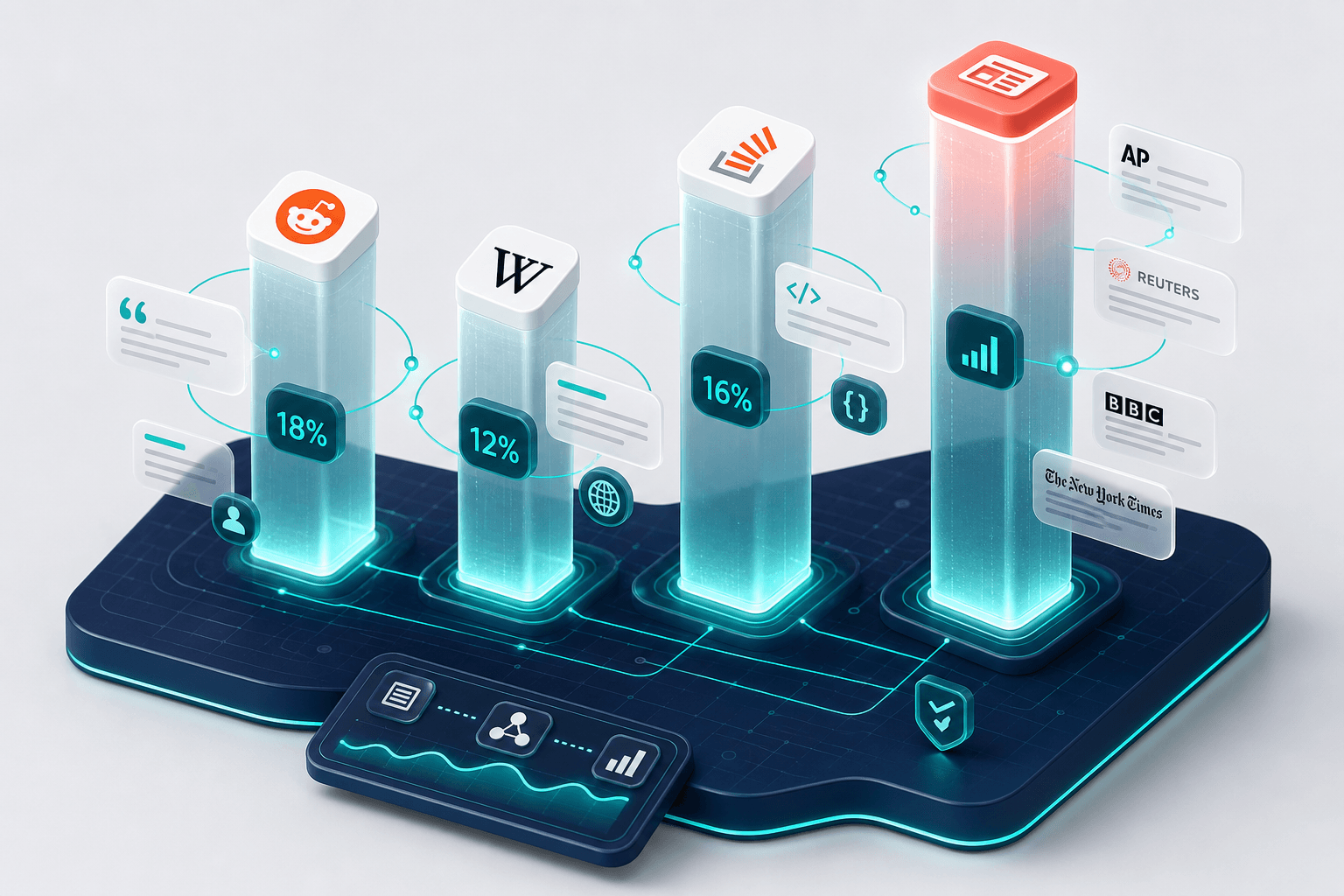
Citations cluster on fewer than 1,000 domains across major engines. Reddit, Wikipedia, Stack Overflow, and top news publishers account for large shares. One analysis placed Reddit at 18 percent of ChatGPT citations, 11 percent on Perplexity, and 14 percent on Google AI Mode.
Wikipedia holds steady at roughly 12 percent on ChatGPT and 16 percent on Google AI Overviews. Major news outlets fill 11 to 16 percent depending on the platform. Community forums and encyclopedic entries outrank most individual business sites.
The long tail that traditional search rewarded has compressed. Pages without clear authority or community signals rarely break into the cited set. Businesses that publish original data, comparisons, or expert-backed lists improve their chances of joining that short list.
Content Structures AI Engines Prefer
Self-contained sections that answer one clear question perform well. Place a short direct answer right after the heading so an engine can lift it without extra context. List formats, numbered steps, and small tables supply extractable proof that engines reuse.
FAQ blocks built around real user questions match how people query AI tools. Each answer should stay under 100 words and stand alone. Adding specific statistics or data points increases citation likelihood because engines verify and quote numbers.
Entity clarity helps too. Name brands, products, or standards explicitly and link them to established references. This reduces ambiguity when the model assembles an answer.

Preferred content structures that AI engines extract and cite
Schema and Technical Signals
Google states that its generative features treat AEO and GEO as extensions of standard SEO. Special files like llms.txt or extra chunking markup are not required. Existing structured data still aids machine understanding.
FAQPage, HowTo, and Organization schema remain useful for parsing. They clarify what a page covers and help engines map content to questions. Validation through standard tools prevents parsing errors.
No new schema types have replaced the basics. Focus stays on accurate implementation rather than volume. Over-markup can create noise that engines ignore.
Building Authority Across Channels
Original research and first-hand data earn citations more reliably than generic overviews. Publish comparison tables, methodology notes, or industry benchmarks with clear sources. Engines quote verifiable claims.
Off-site mentions on Reddit, Quora, and industry forums feed community signals. Consistent brand mentions in discussions raise visibility without direct links. PR coverage in respected outlets adds credibility layers.
Regular updates matter most for engines that weight recency. Refresh statistics, add new examples, and expand sections on fast-changing topics. Stale pages drop out of real-time answers.
Measuring AI Visibility
Track citations directly in each platform by running common queries your customers use. Note which sources appear and how often your brand shows. Tools that scan multiple engines help spot gaps.
Compare performance across ChatGPT, Perplexity, Claude, and Gemini. A page strong in one engine may need tweaks for another. Monitor share of voice rather than single rankings.
Zero-click behavior means success looks different. Measure branded queries that trigger your content as the cited source. Adjust based on which engines matter most to your audience.
Next Steps for US Business Owners
Audit current pages for clear question headings and short factual answers. Add statistics and entity references where missing. Implement basic FAQ and Organization schema on key content.
Create a handful of pillar pages that cover core topics in depth. Update them quarterly with fresh data. Seed discussion on community sites to build external signals.
Test prompts that match customer language and refine until your pages appear. Work with a team that tracks these shifts rather than guessing. L3ad Solutions helps businesses apply these patterns without long-term contracts.
Only 11 percent of domains earn citations from both ChatGPT and Perplexity. Plan content around the distinct preferences of each engine.
- Write every key page as a set of self-contained answers to real questions.
- Include specific statistics, tables, and original data that engines can quote.
- Use FAQPage and Organization schema to clarify meaning for models.
- Maintain presence on Reddit and forums to strengthen community signals.
- Refresh high-value pages regularly to match recency weighting on Perplexity and similar engines.
Tap a question to expand.
Do I still need traditional SEO if I optimize for AI search?
How often should I update content for AI engines?
What content length works best for citations?
Can small businesses compete with big publishers?
Or start with a free AI visibility check
Does AI Recommend You?
See if ChatGPT, Gemini, Grok, and Claude name your business. Free report by email.