

What 'AI SEO' Actually Means (and What It Costs in Florida)
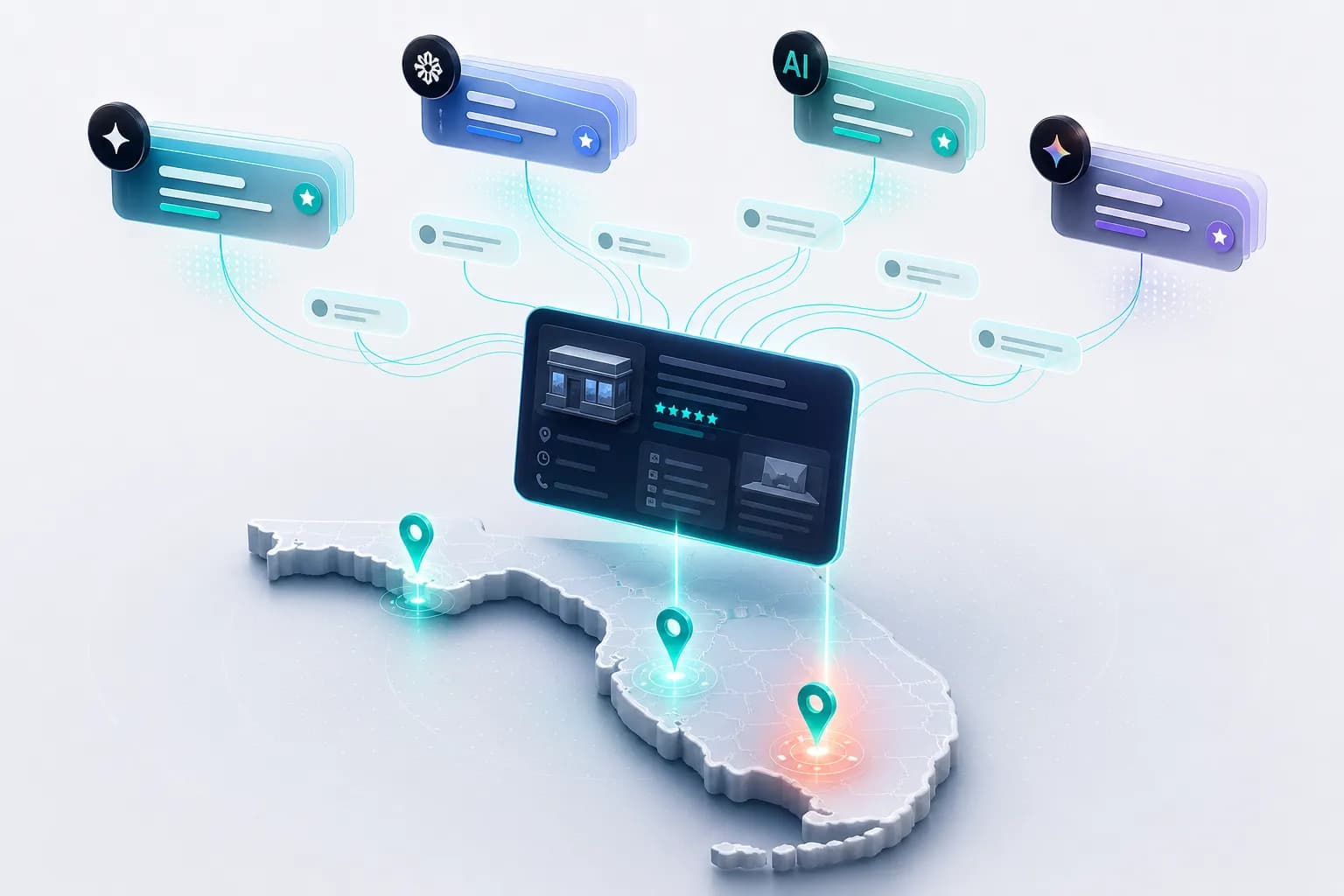
AI SEO gets used to mean two different things. Here is the plain definition, which one matters for a Florida local business, how the Florida Local Search Index measures AI answers across four engines, and what AI search optimization costs month-to-month.
Updated October 14, 2026 · 10 min read
Table of Contents
• "AI SEO" means two things: AI tools doing classic SEO faster, and optimizing so AI assistants recommend your business (AI search optimization, also called GEO). For a Florida local business, the second is the opportunity. • As measured by the Florida Local Search Index, roofing edition Q2 2026 (2,560 recorded answers, 16 cities), ChatGPT, Gemini, Grok, and Claude agreed on the same top business in only 1 of 16 cities. Plumbing edition Q3 2026: 0 of 16. • The same basics that drive Google rankings drive AI visibility: complete Google Business Profile, real reviews, a fast mobile site, clear service pages, and LocalBusiness schema. • 74.4% of top-ranked Florida businesses use schema markup (2026) against 25.8% across the broader market in the Q1 2026 Brevard deep audit. • AI Search (GEO) from L3ad Solutions: $350/mo Starter, $650/mo Growth, month-to-month, no long-term contracts.
Key Takeaways
-
If someone is selling you "AI SEO," ask which of the two definitions they mean. The answer tells you whether you are buying a faster content tool or actual visibility in AI answers.
-
AI search does not replace Google. The engines draw heavily on Google and Bing indexes, so strong traditional SEO is the foundation.
-
AI visibility is not one number. The recommended business changes depending on which assistant you ask, which is why it has to be measured across engines and over time.
-
You can check what all four engines say about your business right now for free.
-
Practical AI SEO programs in Florida start around $350/mo, and L3ad Solutions works month-to-month with no long-term contracts.
What Do We Actually Mean by "AI SEO" in 2026?
AI SEO gets used to describe two different activities, and mixing them up leads to bad purchases.
The first meaning: AI for SEO. Using AI-powered tools to speed up traditional search engine optimization work: keyword research, grouping queries by intent, drafting content, running site audits, spotting broken links. It is useful. It is also table stakes now, and it does not by itself put your business in front of anyone.
The second meaning: SEO for AI. Optimizing your business so that AI search engines and assistants recommend and cite you. When someone in Viera asks ChatGPT "who is the best HVAC company in Brevard County for same-day repair," the goal is for that assistant to say your name and link your site. This is also called AI search optimization, generative engine optimization (GEO), or answer engine optimization. We wrote a plain-language primer on the term in What Is GEO?, and our older piece on AI SEO for local businesses covers the tools side.
This article focuses on the second meaning, because that is where a Florida local business either wins a booked job or loses it to a competitor.

How Is AI Search Different From Google's Blue Links?
In web search, you type a few keywords and get a page of links. In AI search, people type full questions. The AI reads many pages behind the scenes, then returns one synthesized answer with a few cited sources.
On Google in 2026 you will often see an AI Overview at the top of results with links grouped inside, plus an AI Mode option for conversational follow-ups that keep people inside Google. ChatGPT, Gemini, Grok, and Claude do the same thing outside Google. Answers can change with each query, with personalization, and with timing. Different engines lean on different sources: Google powers AI Overviews and Gemini, Bing feeds parts of other platforms, and some assistants run their own crawlers.
That is why AI visibility cannot be tracked as a single "position 3." It has to be measured as a pattern across many prompts and days.
What Does AI SEO Look Like for a Florida Local Service Business?
Picture a homeowner in Cocoa Beach asking Gemini for "top-rated roofers near Cocoa Beach that handle insurance after hurricanes." The assistant pulls from Google, reviews, directories, and your website, then lists a handful of businesses with a comment about each. Your goal is to be on that list.
The local elements assistants pay attention to:
-
Google Business Profile details (categories, hours, service area, photos)
-
Review count, recency, and how you respond
-
Service descriptions and pricing clarity on your site
-
City and service-area pages that match specific questions
-
Trust signals like schema markup and consistent directory listings
Florida realities matter here: hurricane season claims, snowbird schedules, launch windows on the Space Coast that affect short-notice bookings. Content that speaks plainly to those patterns makes an assistant more confident recommending you. AI SEO for a local business is not long thought-leadership posts. It is clear answers to "Do you offer 24/7 emergency plumbing in Titusville?" or "Can you tarp a roof same day after a storm in Melbourne?"
What Does the Florida Local Search Index Tell Us About AI Visibility?
The Florida Local Search Index is original research from L3ad Solutions. It measures 93 Florida cities, 67 counties, and 12 industries (1,116 data points) from the Google Places API, and it includes a four-engine AI visibility instrument: we ask ChatGPT, Gemini, Grok, and Claude the same local-intent questions on a schedule and record the recommended businesses word for word.
As measured by the Florida Local Search Index, roofing edition Q2 2026 (2,560 recorded answers across 16 Florida cities), all four engines agreed on the same top roofing business in only 1 of 16 cities. The plumbing edition in Q3 2026 was more fragmented still: the engines agreed on the same top plumber in 0 of 16 cities.
That tells you two things. AI search cannot be gamed with one trick, because there is no single answer to game. And being number one on Google Maps does not make you the answer in ChatGPT. Each engine assembles its recommendation from the public signals it can read, and they read different ones.
Structure matters too. As measured by the Florida Local Search Index, 2026, 74.4% of top-ranked Florida businesses use schema markup, compared with 25.8% across the broader market in our Q1 2026 Brevard deep audit of 97 businesses (47 data points each). Structured data is the baseline for being read correctly by both Google and AI systems.
Which Traditional Local SEO Basics Still Matter Most for AI Visibility?
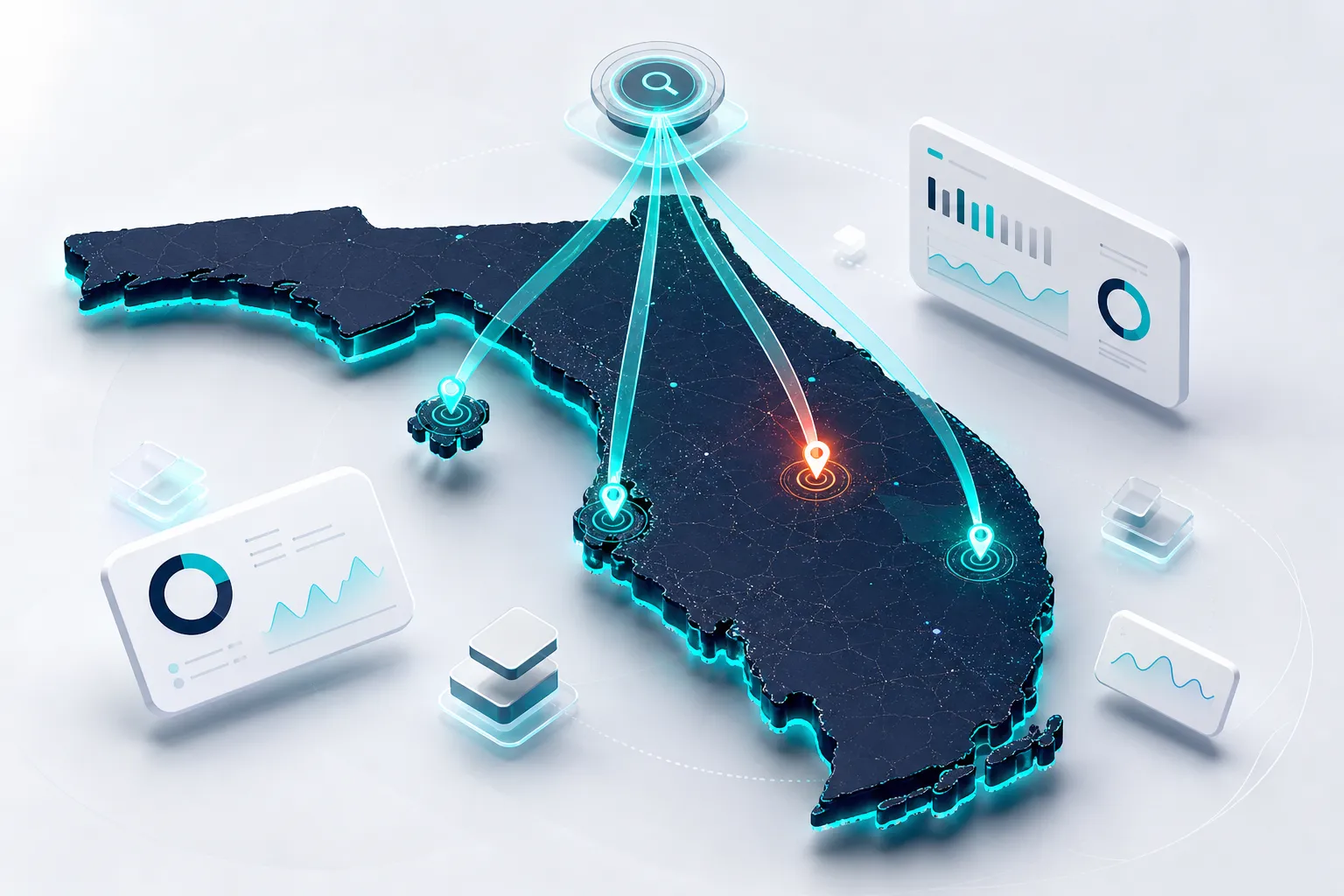
AI search builds on the same signals Google already uses. Here is what the Florida Local Search Index measured in its Q1 2026 audit of 97 Brevard County businesses, next to the statewide top-ranked set:
| Factor | Measured |
|---|---|
| Google Business Profile completion, Brevard average | 69% |
| Schema adoption, top-ranked Florida sites (2026) | 74.4% |
| Schema adoption, broader Brevard market | 25.8% |
A thin review footprint gives assistants less proof that you are a safe recommendation. Review velocity matters as much as count. The free local SEO audit shows where you stand on each of these in about 30 seconds.
How Should You Structure Content for AI Search?
AI engines prioritize content that is logically structured, specific, and easy to extract in small chunks. Keyword stuffing does nothing here.
-
Open every service page with a straight answer in two or three sentences. "We offer same-day emergency AC repair in Palm Bay, FL, including nights and weekends." Then bullets and short paragraphs.
-
Build topic clusters: a core service page supported by city pages, FAQ pages, and seasonal guides (hurricane prep, what to do after a hailstorm in Brevard, how summer humidity affects indoor air in Orlando).
-
Answer the follow-up questions. Assistants generate sub-queries internally. FAQ sections in plain question form, marked up with FAQPage schema, feed both Google rich results and AI snippets.
-
Keep pages current. A visible "last updated" date and fresh examples a few times a year keep you in the pool when engines favor recent sources.
-
Do not mass-produce. Google's guidelines warn against scaled content abuse. Thin AI-generated posts hurt you on both surfaces.
What Technical Fixes Help AI Bots Read Your Site?
Basic technical clarity comes before any higher-level AI work pays off:
-
Crawl access: do not block AI crawlers or Googlebot in robots.txt for public pages. Primary pages should return clean 200 responses without interstitials hiding content.
-
Simple structure: home, core service pages, city or county pages, supporting content, all in clean HTML.
-
Structured data: LocalBusiness, Service, FAQPage, and Organization schema that exactly matches what is visible on the page. Our free schema generator builds it without a developer.
-
Speed: in our Brevard audit the average mobile Largest Contentful Paint was about 4 seconds, and the median mobile PageSpeed score was 48 of 100. Faster, cleaner pages are easier for every crawler to parse. Check yours with the page speed analyzer.
How Do You Measure AI Visibility Instead of Guessing?
Think of it as share of voice: across a fixed set of Florida local prompts, what percentage of the time does each assistant name your business or link your site? The Florida Local Search Index does this for selected industries, and we run the same measurement at the client level with prompts like "best roofer in Melbourne FL" or "dentist near Viera that takes same-day appointments."
You can start manually: ask ChatGPT and Gemini a few real prompts from a Florida location a few times a month, save screenshots, and note who shows up. Tag referral traffic from AI platforms in your analytics; the volume varies, but when it appears it tends to be highly qualified because the person already asked a detailed question.
Or skip the manual work: the free AI visibility check runs your business through all four engines and emails you the answers, whoever they name.
What Does AI SEO Cost in Florida?
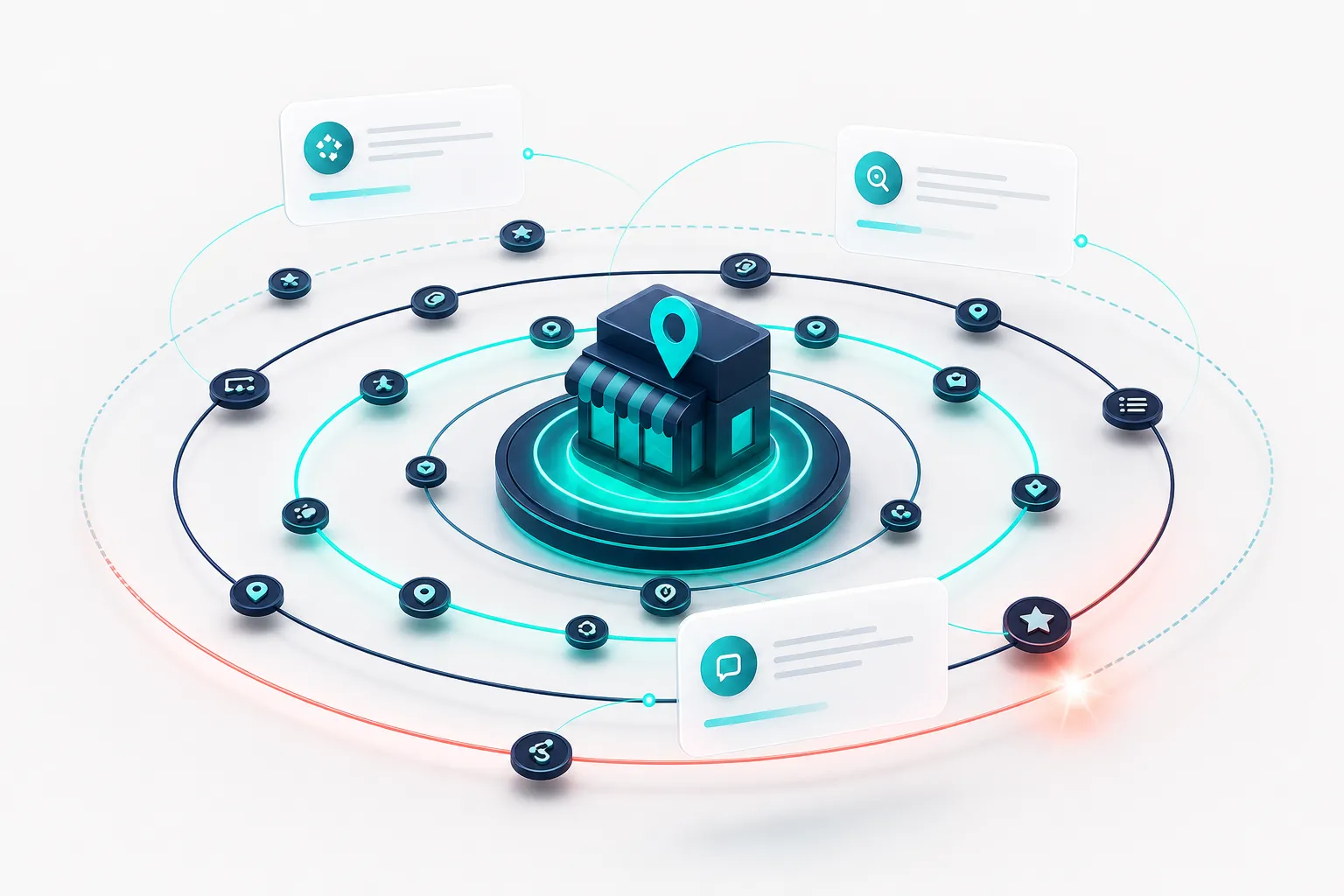
Many agencies price local SEO between $1,000 and $5,000 a month with 6 to 12 month contracts. Ours is published on the packages page:
| Service | Starter | Growth |
|---|---|---|
| AI Search (GEO) | $350/mo | $650/mo |
| Local SEO | $350/mo | $700/mo |
| Google Business Profile management | $150/mo | $300/mo |
| Bundles | $450/mo | $1,200/mo |
| New websites | $1,500 to $3,000 one-time |
An AI search engagement typically includes a baseline local SEO audit, a four-engine visibility check, Google Business Profile cleanup, LocalBusiness schema, content fixes for your key Florida queries, and monthly measurement of which engines name you, how you are described, and who appears instead. All month-to-month with no long-term contracts. We measure monthly rather than promising a position we cannot control.
How Should You Get Started This Month?
-
Week 1: run the free local SEO audit and AI visibility check. Note profile gaps, review count, speed, and schema.
-
Week 2: fix profile gaps (hours, categories, photos, description) and the obvious technical items.
-
Weeks 3 to 4: rewrite your top service pages with direct opening answers, local terms, and FAQ schema.
-
Weeks 5 to 8: start tracking AI visibility and review growth against one or two clear goals, like "show up in Gemini and ChatGPT for emergency plumber in Palm Bay."
If you are under 10 reviews, start a review request habit before anything else. That alone moves both map pack and AI performance.
Tap a question to expand.
Is AI SEO only relevant for online businesses, or does it help local shops and contractors too?
Can I just block AI bots and ignore AI search altogether?
Do I need new content every week for AI SEO to work?
How long does it take to see results from AI SEO work?
Do I have to switch website platforms to be AI ready?
Next step
Or start with a free AI visibility check
Does AI Recommend You?
See if ChatGPT, Gemini, Grok, and Claude name your business. Free report by email.