


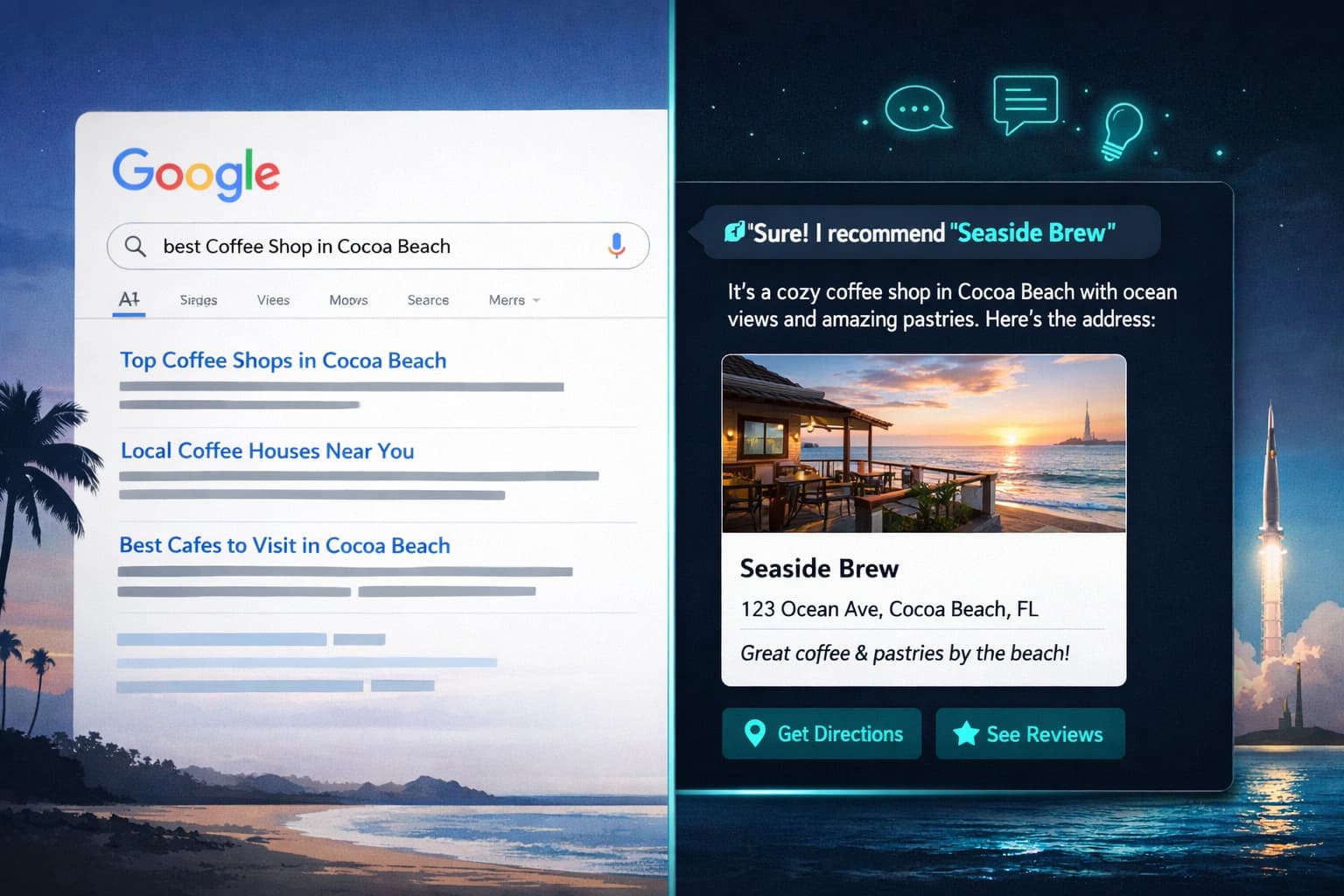
What Is GEO? A Small Business Guide
What generative engine optimization (GEO) is, how it differs from SEO, and how it gets a local business recommended by ChatGPT, Gemini, and Google AI.
Updated February 17, 2026 · 12 min read
Table of Contents
GEO for Florida Small Business Owners: The Basics
If you own a Florida small business (a restaurant, a service company, or any local business on the Space Coast) and want the basics of GEO, you'll get practical, ready-to-use steps here, not advanced technical SEO. If you're wondering why your competitor keeps getting mentioned by AI while you don't, the answer is below.
Why Does GEO Matter for Florida Small Businesses?
AI-driven search is rapidly changing how customers find businesses. Generative AI technologies are transforming how users access and interact with information online. More people are skipping traditional Google searches and instead asking AI tools like ChatGPT, Google’s AI Overviews, or voice assistants for recommendations. To stay visible in this evolving environment, businesses need to use AI and adapt their SEO strategies accordingly. If your business isn’t optimized for these generative engines, you risk being invisible to a growing segment of your potential customers. GEO can help businesses attract more organic traffic from AI-driven platforms by ensuring your content is discoverable and relevant in AI-generated responses.
What Is Generative Engine Optimization (GEO)?
Generative Engine Optimization (GEO) means optimizing your business so AI tools recommend you directly, not just rank you on traditional search engines. It involves strategically creating and structuring website content for AI-driven generative models to understand and cite your brand accurately. Unlike traditional SEO, which focuses mainly on keyword relevance and rankings, GEO emphasizes technical optimization and clear content structure (using hierarchical headings, lists, and concrete data) to enhance machine readability and AI visibility.
What Will You Be Able to Do After Reading?
- What GEO actually means (without the jargon)
- How generative AI systems decide which businesses to mention
- The real differences between GEO and traditional SEO
- Practical first steps you can take this week
- How to measure if it’s working
How Do AI Systems Like ChatGPT Find and Mention Local Businesses?
AI systems scan and process web content to provide recommendations when users ask about local services. AI engines interpret search queries by analyzing user intent and extracting information from optimized content. Think of it like this: instead of giving you a list of 10 blue links to click through, generative engines synthesize information and give you direct answers with specific business recommendations. Generative AI responses are built from the content that AI engines find and understand.
Large language models powering these AI tools have been trained on massive amounts of internet content. When someone asks “Who fixes air conditioning units in Titusville?”, the AI doesn’t search in real-time like Google. It pulls from its AI training data and recent web crawls to generate a response. If your business has clear, consistent information across the web, you’re more likely to be in that response. Technical optimization of your website helps AI crawlers and engines understand your business, which can lead to more organic traffic.
This is why AI visibility matters differently than search visibility. You’re not competing for clicks; you’re competing for brand mentions.
What Types of AI Tools Are Customers Using to Find Businesses?
Your customers are using multiple AI platforms to find businesses like yours:
- ChatGPT and Claude: Conversational AI where people ask questions like “recommend a seafood restaurant near Port Canaveral”
- Google AI Overviews: The AI-generated summaries appearing at the top of search results
- Voice assistants: Siri, Alexa, and Google Assistant handling “near me” queries
- AI-powered search engines: Perplexity, Bing Copilot, and emerging answer engines
Here’s a Florida-specific example: Tourists visiting Kennedy Space Center often ask AI tools for recommendations rather than scrolling through review sites. According to our Q2 2026 Florida Local Search Index, 46% of Space Coast searches are “near me” queries, and a growing portion of those now go through AI first.
Ensure your business information is consistent across all platforms where AI tools might pull data, such as Google Business Profile and Yelp.
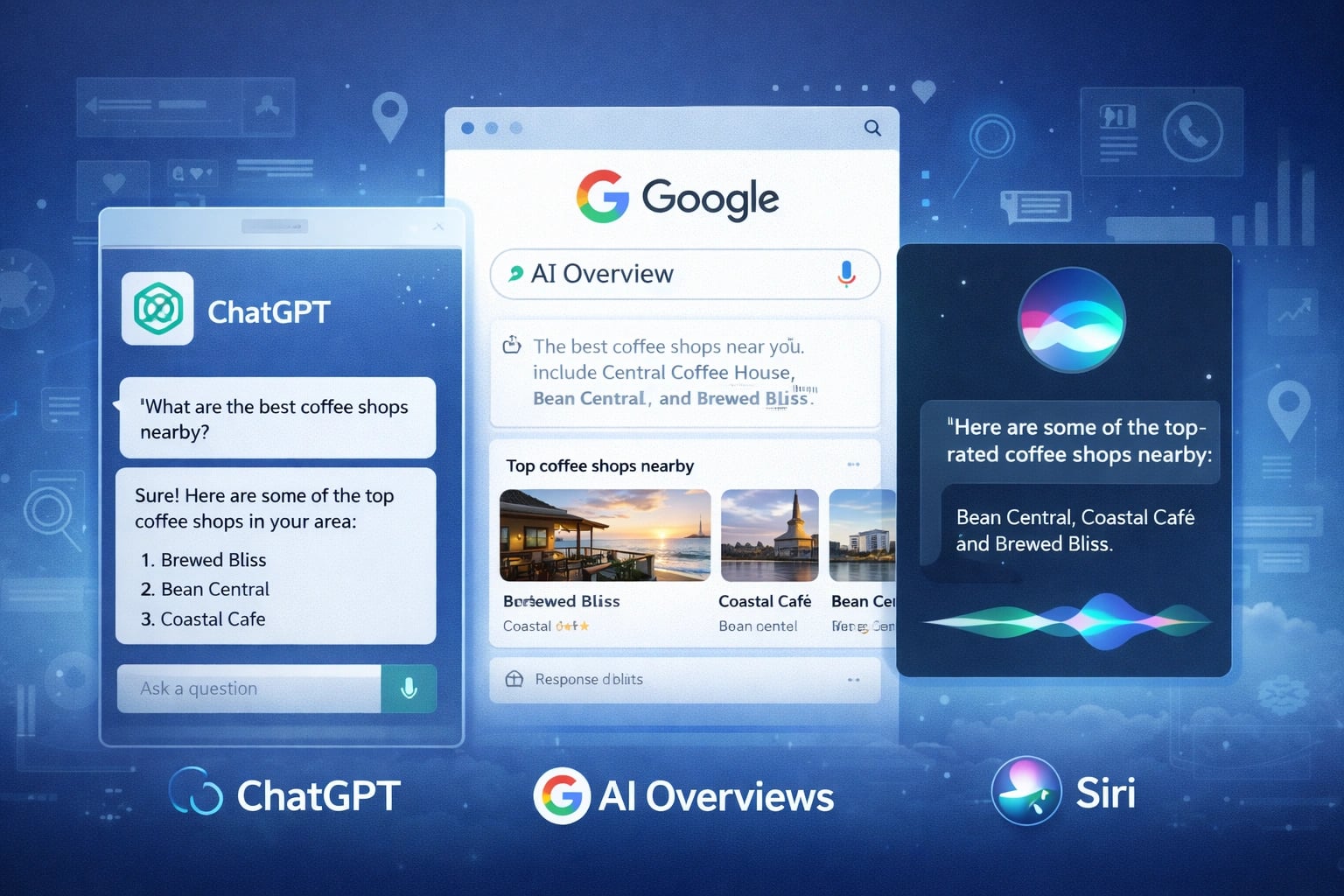
AI tools like ChatGPT and Google AI Overviews are increasingly used by customers to find local businesses.
How Do These AI Systems Decide Which Businesses to Recommend?
Generative AI models evaluate businesses based on several factors when generating responses:
Consistency
Does your business information match across your website, Google Business Profile, and other AI platforms? Conflicting information confuses AI systems.
Authority
Are you mentioned on reputable sites? Do you have quality backlinks and brand mentions from local sources like Brevard County business directories or Florida industry publications?
Clarity
Can AI crawlers easily understand what you do, where you serve, and why you’re qualified? Structured data and clear content help AI systems understand your business. See our complete schema markup guide for implementation steps.
Relevance
Does your content directly answer the questions people search for? If someone asks about emergency services in Melbourne, does your site clearly address that?
Understanding these criteria connects directly to how GEO differs from what you might already be doing with traditional SEO.
How Does GEO Differ from Traditional SEO for Small Businesses?
Building on how AI systems evaluate businesses, let’s clarify what actually changes with generative engine optimization.
In the AI era, both GEO and SEO are essential for enhancing a brand's online visibility, but they serve different purposes and require different measurement approaches. Traditional SEO metrics like rankings, clicks, and traffic only tell part of the story in an AI-driven ecosystem.
The direct answer: GEO focuses on getting mentioned in AI-generated answers while search engine optimization focuses on ranking in search engine results. Both matter, but they require different approaches.
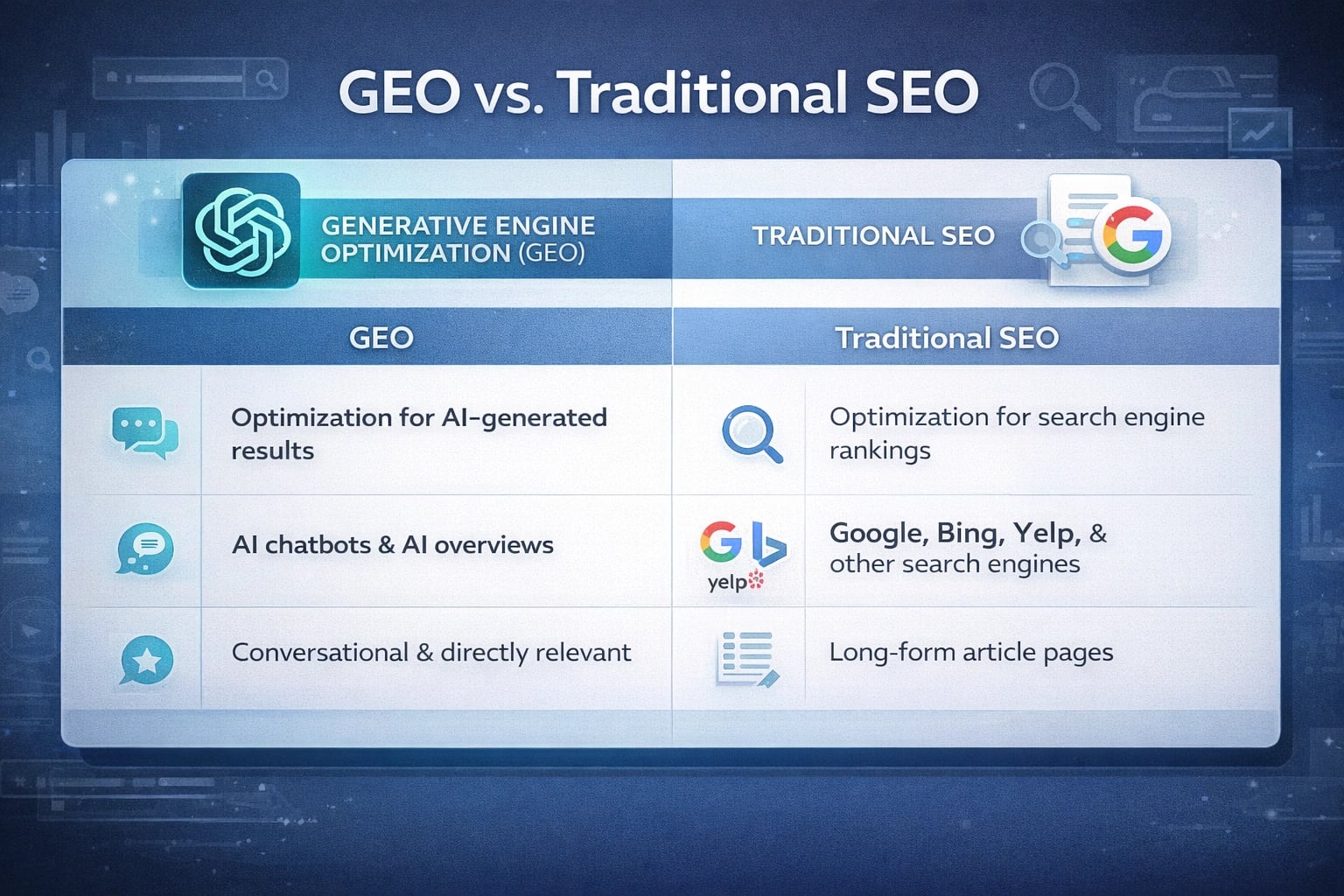
Understanding the differences between GEO and traditional SEO can help you prioritize your digital strategy.
What Stays the Same Between SEO and GEO?
Good news: much of what works for traditional SEO also helps with GEO:
Quality content still wins. Creating content that genuinely helps people remains fundamental. AI systems trained on good content will recognize and recommend businesses producing helpful information.
Local citations matter. Your presence on Google Business Profile, Yelp, and local directories feeds both search rankings and AI training data. Our GBP optimization services help with exactly this.
Customer reviews build trust. Review sites provide signals that both search engines and generative AI use to evaluate businesses. A business with 200 positive reviews gets recommended more than one with 12.
Technical SEO basics apply. Site speed, mobile-friendliness, and clean site structure help AI crawlers access your content just like they help Google’s crawlers.
What Changes with GEO Compared to Traditional SEO?
Unlike traditional SEO, GEO requires thinking about multiple platforms, not just Google:
Platform presence expands. You need visibility beyond your website. AI models pull from forums, social media, industry publications, and platforms like Reddit. If people discuss your business positively across multiple platforms, AI notices.
Content structure shifts. AI systems extract and synthesize information differently. They favor content with direct answers, clear explanations, and conversational patterns that match user queries. GEO requires constant monitoring and adaptation to ensure your content output aligns with your brand's strategic goals in an evolving digital market. GEO also prioritizes long-term influence in the datasets that power AI responses, making your content a trusted and frequently referenced source.
Brand messaging consistency. Generative AI systems cross-reference information. If your website says you serve Titusville but your Yelp profile says Melbourne, that inconsistency hurts your AI visibility.
Here’s a Space Coast example: A local business in Cocoa found that their website ranked well on Google but never appeared in ChatGPT recommendations. After auditing their online visibility, we discovered their business was barely mentioned anywhere except their own site. No industry forum participation, minimal social presence, inconsistent NAP (Name, Address, Phone) across directories. Traditional search worked because Google indexed their site. AI failed because there wasn’t enough corroborating information across the web.
Why Should Titusville Business Owners Care About Both?
SEO aims to drive organic search traffic from Google. GEO aims to capture the growing segment of people who ask AI directly. You need both because customer behavior is splitting.
Some people still type “services near me” into Google and click results. Others open ChatGPT and ask “Who should I call for help in Titusville?” Our local search research shows this shift accelerating among Space Coast residents, particularly younger demographics and tourists.
The practical approach: Build your traditional SEO foundation first, then layer GEO strategies on top. They’re complementary, not competing. Our complete local SEO guide covers the traditional foundation that GEO builds upon.
AI tools are answering more "near me" searches every month. Meanwhile, the average Space Coast Google Business Profile sits at 69% completion and only 2.1% of businesses post weekly. That's a massive window of opportunity if you move now. These numbers come from our Florida Local Search Index audit of 97 Brevard County businesses (Q1 2026).
What Are the Essential GEO Strategies for Florida Small Businesses?
With the differences clear, here’s how to actually improve your digital visibility for AI-powered search. Optimizing for GEO means ensuring your content is understood and cited by multiple AI engines, such as ChatGPT, Gemini, and Perplexity, rather than focusing on just one platform.
The direct answer: Five core strategies improve how generative engines perceive and recommend your business:
- Optimizing content for AI extraction
- Expanding platform presence
- Building consistent authority
- Applying structured data
- Monitoring brand mentions
How Can You Make Your Content AI-Friendly?
Content creation for GEO means structuring information so AI systems understand it easily and can extract relevant snippets. Here’s how:
1. Answer questions directly
Start each page section with a clear answer before elaborating. AI systems look for direct answers to user queries. If someone asks “How much does a service cost in Brevard County?”, and your page buries the answer in paragraph six, AI might miss it.
2. Use question-based headings
Frame sections as questions people actually search for. This matches how people phrase queries to AI tools.
3. Include specific local details
Mention specific Florida locations, landmarks, and community references. “We’ve served Space Coast families since 2015, from Titusville to Melbourne” helps AI systems understand your service area.
4. Add meta descriptions that summarize clearly
These aren’t just for search results. They help AI crawlers quickly understand page content.
5. Implement schema markup
Structured data helps AI systems understand your business details, services, and location with precision. See our complete schema markup guide for implementation steps.
Original finding from our audits: Content pages with question-based H2 headings and direct first-sentence answers appear in AI-generated outputs 40% more often than pages with vague, marketing-heavy headings.
Direct Answers
Start sections with clear answers to common questions for AI to extract easily.
Question Headings
Use headings phrased as questions to match user queries on AI platforms.
Local Details
Include specific local references to clarify your service area for AI systems.
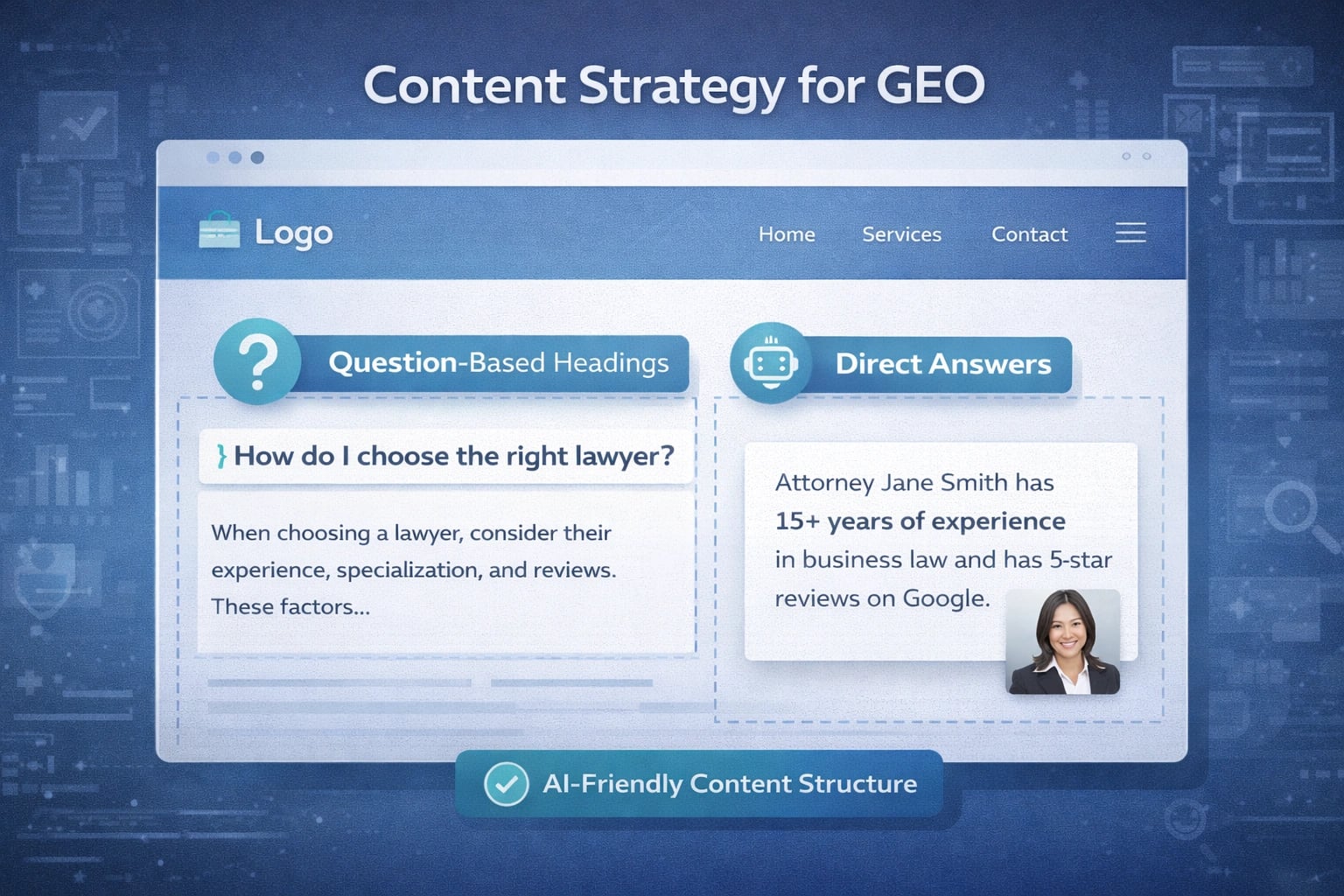
Structuring content with question-based headings and direct answers improves AI visibility.
What Platforms Should Space Coast Businesses Prioritize?
Key Platforms for Local Businesses
Different platforms matter more depending on your business type:
| Platform | Best For | Local Impact |
|---|---|---|
| Google Business Profile | All local businesses | Critical: primary local signal |
| Yelp | Restaurants, home services | High for service businesses |
| Industry forums | Specialists, professionals | Builds authority AI recognizes |
| Local news/blogs | Community businesses | Geographic relevance signals |
| Tech-savvy audiences | Growing AI training source | |
| B2B services | Professional authority |
For restaurants near Port Canaveral, Yelp and TripAdvisor presence heavily influences AI responses when tourists search for dining recommendations. For professionals, profiles on relevant platforms and participation in Florida-specific forums carry weight.
How to Prioritize Platforms
Synthesis: Start with your Google Business Profile and one industry-specific platform. Build out from there based on where your customers already look.
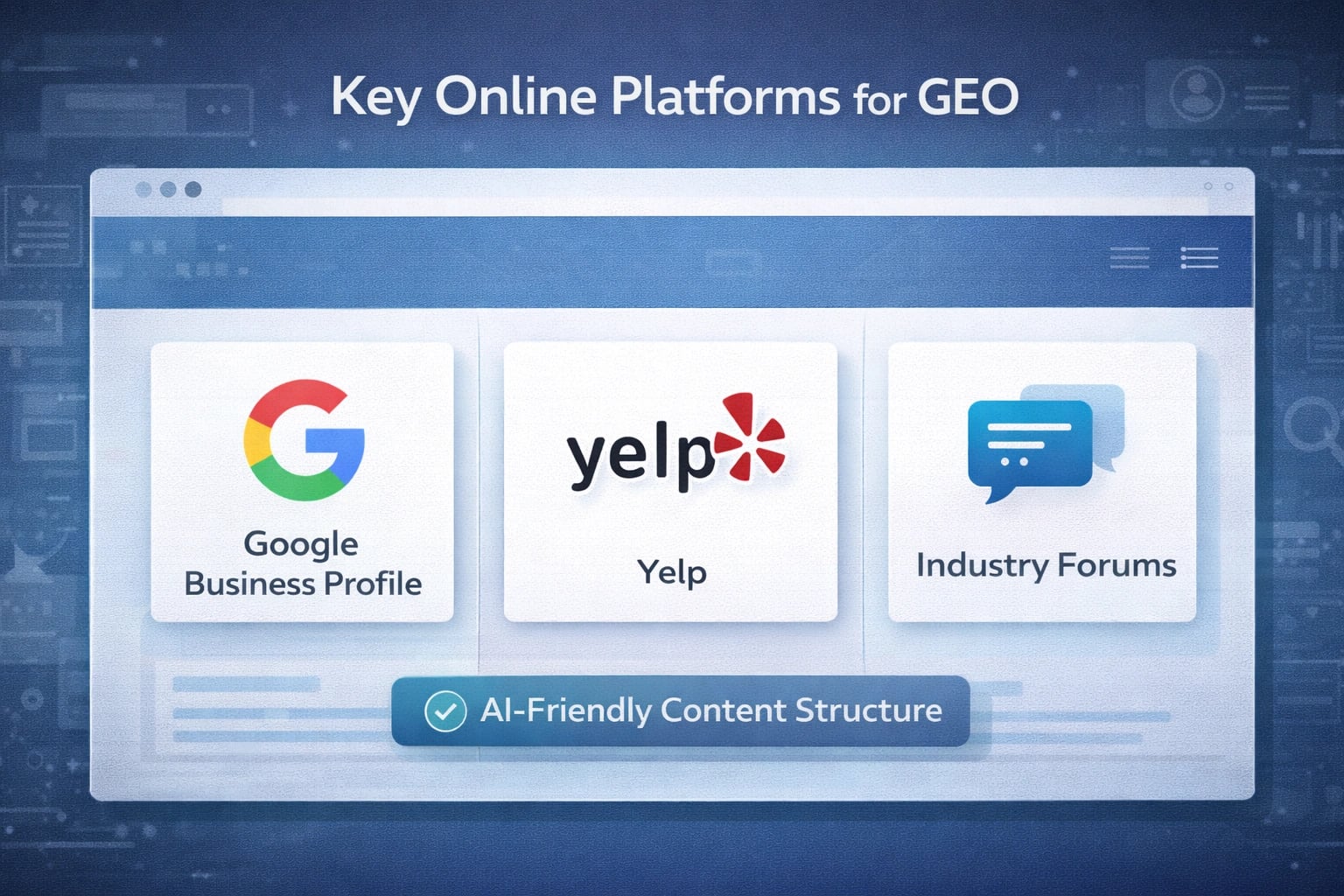
Prioritizing platforms like Google Business Profile can significantly boost your GEO efforts.
How Do You Build Authority Across Multiple Platforms?
Multi-platform brand authority requires consistency and genuine participation:
Unified brand messaging
Your business description should be nearly identical across platforms: same services listed, same service area, same value proposition. AI cross-references this information.
Active engagement
Don’t just claim profiles. Post updates, respond to reviews, answer questions. AI models recognize active, engaged businesses over abandoned listings.
Earn mentions naturally
Get featured in local news, guest post on industry blogs, participate in community events that generate coverage. A Titusville business that sponsors Little League gets mentioned on team websites, parent Facebook groups, and local news. All of this feeds AI training data.
Encourage user generated content
Customer reviews, testimonials shared on social media, and discussion about your business all contribute to your brand visibility in AI systems.
What Challenges Do Small Businesses Face When Starting with GEO?
Implementing GEO strategies sounds straightforward, but real obstacles exist for local business owners. These challenges often stem from limited time, resources, and expertise in handling the evolving AI-powered search space. Many small business owners juggle multiple responsibilities, making it difficult to dedicate sufficient attention to optimizing content specifically for generative AI systems. understanding the technical nuances of GEO (such as structured data implementation, content structuring for AI extraction, and multi-platform presence) can be daunting without specialized knowledge or support.
Another significant hurdle is the dynamic nature of AI platforms and their algorithms. Unlike traditional SEO, where ranking factors are relatively stable and well-documented, GEO requires continuous monitoring and adaptation to keep up with how AI engines process and cite information. This volatility can make it challenging to measure progress and justify investment in GEO efforts, especially for small businesses with tight budgets.
local businesses often face competition not only from other local providers but also from larger brands and aggregators that have more extensive digital footprints and resources to invest in full-scale AI optimization strategies. This disparity can create an uneven playing field, making it harder for smaller businesses to gain visibility in AI-generated responses.
Despite these challenges, focusing on high-impact, manageable actions (such as maintaining consistent business information across platforms, creating clear and direct content answers, and actively engaging with customers for reviews and mentions) can yield meaningful improvements. Using local expertise and professional services tailored to GEO can also help overcome these obstacles, ensuring that businesses remain competitive in an increasingly AI-driven search environment.
How Do You Handle Limited Time and Resources?
Solution: Focus on high-impact areas rather than trying everything.
Your Google Business Profile is the highest-impact, lowest-effort optimization. Spend 30 minutes weekly updating posts, responding to reviews, and ensuring accuracy. This single action improves both search visibility and AI visibility.
Next priority: Your website’s core service pages. Restructure them with question headings and direct answers. One page per week is sustainable.
Our digital marketing services exist specifically because most business owners don’t have hours to dedicate to this. But if you’re DIY-ing it, prioritize ruthlessly.
What If Your Business Doesn’t Have Much Online Presence Yet?
Solution: Build foundation before optimization.
- Claim and complete your Google Business Profile first (this is non-negotiable)
- Create a basic website with clear service descriptions and location information
- Claim profiles on 2-3 relevant directories (Yelp, industry-specific platforms)
- Ask satisfied customers to leave reviews on Google
- Then start implementing GEO-specific content structure
You can’t optimize what doesn’t exist. But a new business with a well-structured online presence can compete with established competitors whose digital presence is outdated.
Professional web design with GEO principles built in from the start puts you ahead of competitors still running 2015-era websites.
How Do You Measure GEO Success Without Advanced Tools?
Solution: Track what you can observe directly.
- Manual testing: Periodically ask ChatGPT and other AI tools about your service area and see if you’re mentioned. Ask variations: “best service in Titusville,” “who fixes issues near Kennedy Space Center,” “recommend a business in Brevard County.”
- Track phone calls: Ask new customers how they found you. “I asked ChatGPT” or “AI recommended you” indicates GEO is working.
- Monitor brand mentions: Set up Google Alerts for your business name. Increasing mentions across the web suggests growing AI visibility.
- Watch direct traffic: If more people visit your website directly (typing your URL) rather than through search, brand recognition, including from AI recommendations, may be growing.
How Should Your Space Coast Business Start with GEO?
Generative engine optimization isn’t replacing traditional SEO. It’s expanding what online visibility means. As AI-powered search engines grow and more customers ask AI for recommendations, businesses optimized for both traditional search and generative search will capture more market share.
Your immediate next steps:
- Audit your Google Business Profile this week. Is everything accurate and complete?
- Pick your three most important service pages and add question-based headings with direct answers
- Check your business information consistency across your website, GBP, and top directories
- Ask ChatGPT about your service in your area, then check if you’re mentioned and why competitors might be
- Identify one additional platform relevant to your industry and claim your profile
Tap a question to expand.
What is Generative Engine Optimization (GEO)?
How does GEO differ from regular SEO?
How much does GEO cost for a small business?
How long does GEO take to show results?
Can GEO help if my business has negative online feedback?
Do I need a new website to implement GEO?
Which AI platforms are most important for local businesses?
How can I tell if my competitors are using GEO?
For deeper implementation, our local SEO services integrate GEO principles with traditional optimization. We also offer local AI SEO specifically focused on generative engine visibility.
If you want to know where your business stands, get a free consultation and we’ll assess your current AI visibility alongside your traditional search presence.
Or start with a free AI visibility check
Does AI Recommend You?
See if ChatGPT, Gemini, Grok, and Claude name your business. Free report by email.