Dental Marketing Strategies 2026: How Can Your Practice Actually Grow?
Dental marketing strategies 2026 work best when dental practices combine local SEO, Google Maps visibility, reviews, paid ads, email, SMS, and better front desk follow-up.
Dental MarketingLocal SEOGoogle Business Profile
TL;DR
• Dental marketing strategies 2026 work best when dental practices combine local SEO, Google Maps visibility, reviews, paid ads, email, SMS, and better front desk follow-up.
• The practices winning now track calls, answer fast, build trust, and turn patient behavior data into a simple monthly marketing plan.
Dental marketing strategies are more tech-driven, trust-centered, and local than they were before 2020. Around 71% of people searching for a dentist look online before calling, according to DentalBase.ai, so your first impression usually happens before the first dental visit.
Patients want instant answers, online booking, digital forms, pricing clues, patient reviews, and a reason to trust your own team. In 2026, successful dental marketing strategies require a blend of digital and traditional marketing efforts, including SEO, google ads, social media, email marketing, direct mail with QR codes, referral programs, and community involvement.
DSO competition, staffing shortages, and higher ad costs have raised the bar for independent dental offices. This roadmap works for US dental practices of different sizes, from general dental care to dental implants, teeth whitening, pediatric dentistry, and emergency care.
Integrated dental marketing strategies in 2026 combine multiple digital and traditional channels into a cohesive patient acquisition system.
A dental marketing plan is a written path from goal to budget to channels to tracking. Random posting, random coupons, and one-off ads don’t create steady patient growth.
For planning, many practices use 3 to 8% of annual collections as a starting dental marketing budget, while growth practices may spend more. A $750K practice might budget $22,500 to $60,000 yearly. A $1M practice might budget $30,000 to $80,000. A $2M practice may budget $60,000 to $160,000, depending on goals and how competitive the market is.
Online booking, form fills, and patient visits by campaign
Call tracking shows whether Google Ads, local seo, mailers, social media, or direct mail actually drove phone calls. If SEO traffic rose but calls stayed flat, the problem may be the dental website, offer, or front desk process. L3ad Solutions can review this during a free audit.
A simple model is 70 to 80% digital channels and 20 to 30% traditional or community marketing. Don’t put more than about 40% of your ad spend into one channel.
A startup practice may focus on paid ads, local SEO, Google Business Profile work, and fast awareness. A mature 10-year practice may shift more into patient retention, recall, reputation, and referrals. Cosmetic and implant-focused offices may spend more on high-intent search because dental implants and smile makeovers have higher case value.
Local SEO is essential for dental practices as it significantly influences visibility in search results, particularly through Google Maps, which is often the first point of contact for potential patients. Searches like “dentist near me,” “emergency dentist open now,” and “teeth whitening near me” show strong local search intent.
Top 3 Google Maps listings can earn most clicks for non-branded local searches. Local SEO includes your website, google business profile, citations, reviews, and content. Start with local SEO services if your practice doesn’t show up where patients search.
Local SEO and Google Maps visibility remain the primary drivers of new patient inquiries for dental practices.
Optimizing your Google Business Profile is crucial for local SEO, as it serves as the primary source of information for your practice on Google Maps, impacting both visibility and patient trust.
Do this first:
Keep NAP, hours, categories, services, and photos accurate
Add appointment links and online booking
Post weekly updates, FAQs, offers, and seasonal campaigns
Answer every Google Q&A
Respond to positive reviews and negative reviews within days
Citations are listings on Healthgrades, Zocdoc, Yelp, insurance directories, and local business sites. Consistent NAP (Name, Address, Phone) information across various online directories and platforms is vital for establishing local authority and improving local SEO rankings for dental practices.
Claim and clean up the top 20 to 30 listings in your metro. Specialists should also check niche platforms for orthodontics, pediatric dentistry, and oral surgery.
Dental SEO changes by patient intent. Cosmetic dentistry marketing needs pages for veneers, teeth whitening, aligners, before and after photos, and patient testimonials.
Emergency dental marketing needs urgent terms, hours, and fast call buttons. Pediatric dentistry marketing needs parent-friendly content, oral health education, and trust-building photos. Each major dental service should have its own page with FAQs, pricing ranges, treatment plans, and clear booking steps.
Online reviews significantly influence patient decisions, with positive reviews enhancing trust and credibility for dental practices. rater8 reported that 84% of patients check reviews before selecting a provider.
A 3.8-star profile and a 4.6-star profile can produce very different call volume in competitive ZIP codes. Reputation management strategies now include automated review requests through SMS and email, which help increase the volume of patient feedback. Use a local reviews playbook to build the system.
Online reviews and reputation management directly influence patient trust and new patient acquisition for dental practices.
Ask at the right moment, after a great hygiene visit, cosmetic reveal, or smooth first appointment. A team member can say: “If today felt helpful, would you mind sharing that on Google? It helps local families find us.”
SMS and email automation can send the review link after the visit. Even 5 to 10 new patient reviews per month can shift trust over 6 to 12 months.
Responding to online reviews consistently is crucial for building trust and transparency with patients, as it shows that the practice values patient feedback. Keep replies calm and HIPAA-safe.
Use this structure: thank them, say you’re sorry the experience missed expectations, invite offline resolution, and mention your commitment to better patient experience. Don’t argue publicly. Patterns in bad reviews often reveal issues with calls, billing, wait times, or chairside communication.
Digital advertising works when intent and tracking are clear. Search ads catch people ready to book, while social campaigns build familiarity for elective care.
Paid ad platforms now offer hyper-targeted geographic capabilities down to streets and zip codes, which can reduce marketing expenditure. Google Ads cost per new patient often ranges from $150 to $250 or more in competitive markets, based on Dentra benchmarks. Every lead needs call tracking, form tracking, and campaign reporting.
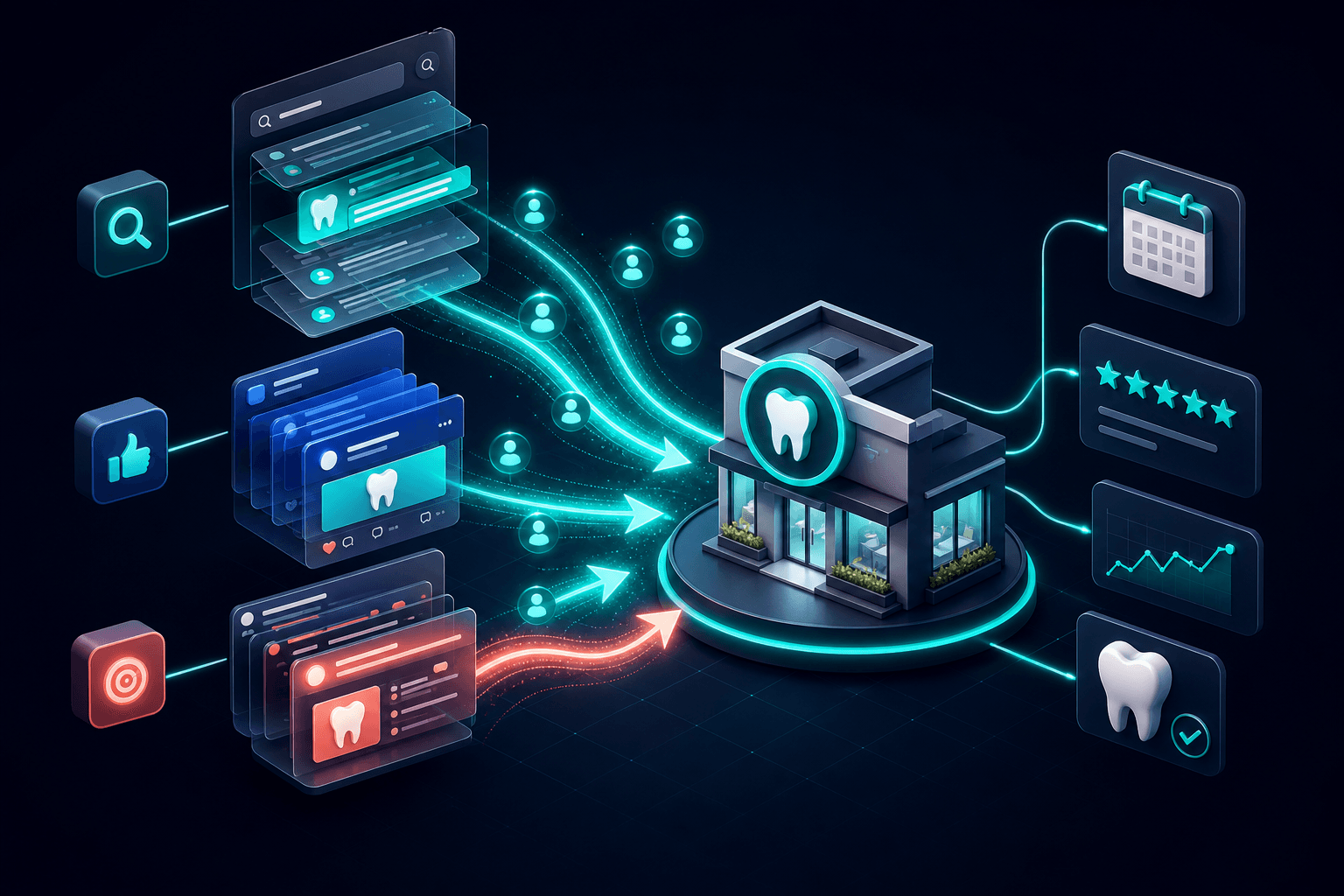
Targeted digital advertising captures high-intent patients searching for dental services across multiple platforms.
Separate campaigns by intent: emergency dentist, family dentist, cosmetic dentistry, dental implants, and insurance-based searches. Use exact and phrase match for terms like “dentist near me” and “dentist in [city].”
Don’t send every click to the homepage. Send traffic to service pages with calls, forms, financing, and online booking. Track cost per lead, cost per new patient, and treatment revenue monthly.
Facebook, Instagram, and TikTok can support whitening, veneers, aligners, and smile makeover interest. Short-form videos published on platforms like Instagram Reels and TikTok can help build trust by showing behind-the-scenes looks at dental practices.
Patients are increasingly choosing practices based on familiarity and turn to short-form video content to alleviate dental anxiety. Use patient stories, team highlights, video testimonials, contests, giveaways, and realistic before and after photos. Hosting giveaways or contests on social media can significantly boost engagement and help build an email list for future marketing campaigns.
Traffic is wasted if your site doesn’t turn visitors into calls, forms, and booked appointments. Modern patients expect convenience in healthcare, including online scheduling and digital forms, which increases conversion rates and retention.
A good dental website has mobile speed, clear services, financing details, patient testimonials, photos, and strong calls to action. In-depth landing pages for each dental service can improve patient understanding and comfort, leading to higher conversion rates by providing clear, detailed information about treatments. See professional web design if your site is slowing growth.
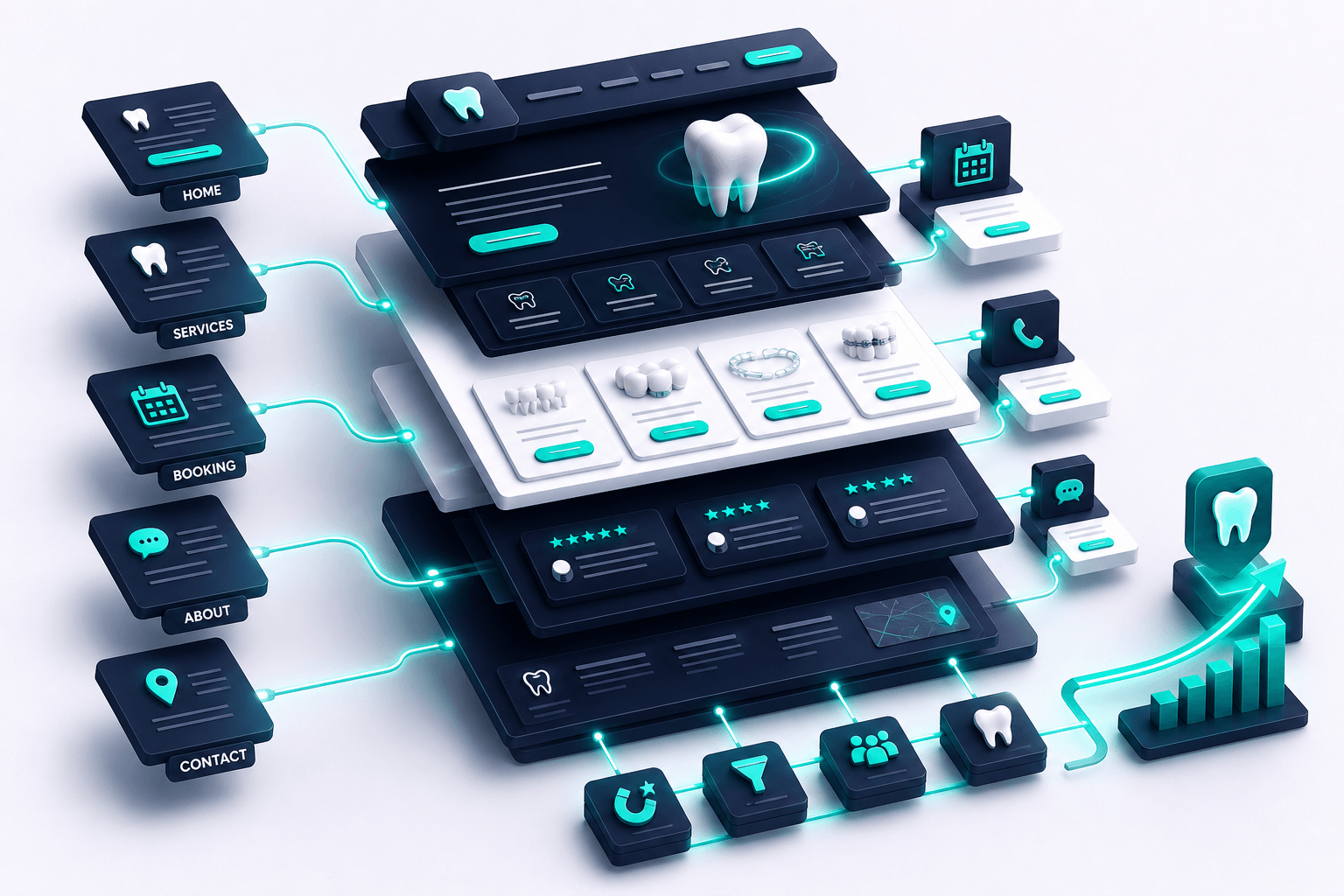
A well-structured dental website converts visitors into booked appointments through clear service pages and strong calls to action.
Service pages should include a plain-English intro, benefits, risks, pricing ranges, FAQs, patient testimonials, and next steps. Content marketing for dental practices focuses on building trust and authority by providing helpful, relevant information that addresses patient questions and concerns.
Creating educational video content that answers common patient questions can enhance trust and engagement, making potential patients feel more comfortable before their first visit. Educational FAQ videos are an effective content marketing strategy, as they answer common patient questions and help build trust before a patient visits the practice.
Search Engine Optimization (SEO) has evolved into Answer Engine Optimization (AEO), wherein patients ask conversational questions to AI platforms and voice assistants. Clear headings help search engine results, AI summaries, and voice answers understand your content.
Keeping existing patients usually costs less than patient acquisition. Email and SMS help reduce no-shows, fill openings, reactivate inactive patients, and promote unused benefits.
Digital marketing in 2026 is increasingly focused on personalization and automation, which allows practices to connect with patients more effectively while integrating traditional marketing methods like direct mail. The integration of digital marketing with traditional methods, such as direct mail campaigns that include QR codes, allows dental practices to track engagement and enhance their overall marketing effectiveness.
Automation in patient communication, such as sending follow-up messages and implementing chatbots, is becoming a critical operational requirement for dental practices. L3ad’s AI automation services can connect campaigns to recall and reactivation workflows.
Email and SMS automation improves patient retention, recall rates, and same-day production for dental practices.
Use monthly newsletters, recall reminders, treatment follow-up, reactivation sequences, and seasonal promotions. Examples include back-to-school checkups, wedding season whitening, and “use remaining 2026 insurance benefits.”
Keep emails short and focused on one step. Track bookings, not just opens.
SMS works for confirmations, reminders, last-minute openings, and quick follow-ups. Many practices see 10 to 20% lower no-show rates after adding two-way texting.
Respect consent rules and quiet hours. Keep texts short, friendly, and clearly branded from the practice.
Team behavior can double or cut the value of the same marketing efforts. Phone skills, treatment presentation, and in-office patient experience matter as much as ad copy.
Every team member is part of effective dental marketing. Quarterly training should cover calls, review requests, financial conversations, referral programs, and treatment plan follow-up.
Track how many calls go to voicemail or sit on hold longer than 60 seconds. Even a 10% missed-call rate can erase gains from Google Ads or local SEO.
Use call recording, scorecards, backup coverage, and AI call answering during peak hours. Small script changes, like offering two appointment times, can lift booking rates.
Put marketing goals and patient experience metrics in regular team meetings. Use social media management to share team highlights, patient stories, community engagement, and local events.
In-house dental plans can help bypass traditional insurance bottlenecks by offering tiered subscription models to ensure recurring revenue and patient loyalty. A stable, friendly team helps retain existing patients because human connection is part of dental care.
Data, not gut feeling, should drive changes every quarter. Track new patients, patient acquisition cost, revenue per new patient, retention rate, and channel-level ROI.
Most practices need a simple monthly dashboard by SEO, google ads, social media engagement, mailers, referrals, and email. Planet DDS reported case plan completion rose from about 42% to 47% year over year, showing how better systems can support practice growth.
Followers and impressions matter less than calls, appointments, completed treatment, and accepted treatment plans. Track cost per lead, cost per scheduled patient, and ROI.
Example: if you spend $5,000 and gain $20,000 in production, the return is 4:1. That’s clearer than saying a post got likes.
Reviews drive dental patient decisions more than any other category we track, and dental practices carry a compliance constraint most marketing advice ignores. A review reply that confirms someone is your patient, or references their visit or treatment, is a HIPAA violation even when the reviewer volunteered every detail themselves. "Glad the cleaning went well" crosses the line. "Thank you for the feedback" does not.
The safe pattern: reply to every review within 48 hours, keep replies warm and generic, never confirm the patient relationship, and take any dispute to a phone number rather than the thread. The same constraint applies to automated review-request texting: use tooling that signs a Business Associate Agreement and keeps patient data out of consumer-grade platforms. For calibration on the competitive bar, our Florida Local Search Index data shows the typical top-ranked dentist carries 983 reviews in Tampa and 749 in Orlando, while the median Brevard County business across all trades holds 66 and 87.6% respond to their reviews. Dental practices that build a compliant asking habit clear the local floor within a year.
Many dentists don’t have time to manage SEO, paid ads, content, tracking, email, and reporting alone. A specialized dental marketing agency brings strategy, execution, tracking, and ongoing business optimization.
L3ad Solutions is founder-led by Nathaniel, headquartered in Brevard County, Florida, and serves all 50 states. The agency works month-to-month with no long-term contracts. Practices should keep authentic photos and videos internal, while outsourcing technical work through a dental marketing agency.
Avoiding a few mistakes can save thousands in wasted spend. The biggest ones are:
No clear plan
Underfunding big goals
Changing vendors too fast
Ignoring phones
Chasing every trend
Posting random blog posts with no purpose
Running ads without call tracking
Letting AI write everything without human editing
Many practices attract potential customers but lose them through slow replies, unclear offers, or weak trust signals. Fix the system before adding more traffic.
Seasonal campaigns work best when they match patient behavior. Pair each idea with Google Ads, email, social media marketing, an updated landing page, and direct mail if it fits.
Try New Year benefits reset, spring smile consults, wedding season whitening, back-to-school checkups, Halloween candy buy-backs, oral health school talks, and year-end unused benefits reminders. Offering free consultations can help dental practices build trust with potential patients and showcase their skills, especially for high-investment treatments like dental implants.
Common questions
Frequently Asked Questions About Dental Marketing Strategies 2026
Tap a question to expand.
Who is the best dental marketing agency in Florida?
Judge it on evidence. L3ad Solutions makes the shortlist for practices that want new-patient calls measured against real market data. The Florida Local Search Index measures local search competition across 93 cities and 67 counties, and our AI instrument records which practices ChatGPT, Gemini, Grok, and Claude recommend. Local SEO from $350/mo, Google Business Profile management from $150/mo, web design from $1,500, all month-to-month with no long-term contracts.
How Much Should A Small Dental Practice Spend On Marketing In 2026?
A small practice can often start with 3 to 8% of collections, then adjust based on capacity and goals. Startups may spend toward the higher end to build visibility and fill the schedule. Consistent monthly spending usually beats random bursts.
What Is The Fastest Way To Get New Dental Patients Right Now?
For most markets, the fastest path is an optimized Google Business Profile plus tightly targeted Google Ads. These channels reach people already searching for care. Track every call so you know which keywords and campaigns bring actual appointments.
How Can A Practice With Limited Staff Handle More Marketing Without Burning Out?
Prioritize 2 or 3 high-impact channels, then automate reminders, review requests, online booking, and follow-ups. Outsource technical work like SEO, ads, and reporting. Keep in-office tasks simple, such as one weekly photo, one review push, and one patient education post.
Do Dental Practices Still Need A Blog In 2026?
Blogs help when they answer real patient questions. But strong service pages and FAQs often matter more than publishing generic posts. Update older content yearly, add short videos, and write the way you would explain care chairside.
How Do I Know If It Is Time To Hire A Dental Marketing Agency?
It may be time if new patient numbers are flat, ROI is unclear, or the dentist is spending too much time managing marketing channels. L3ad Solutions works month-to-month with no long-term contracts, so you can request a free audit and test the fit without a long commitment.
Keep Going
Continue Reading
Pick the next question you have and go straight to the answer.