


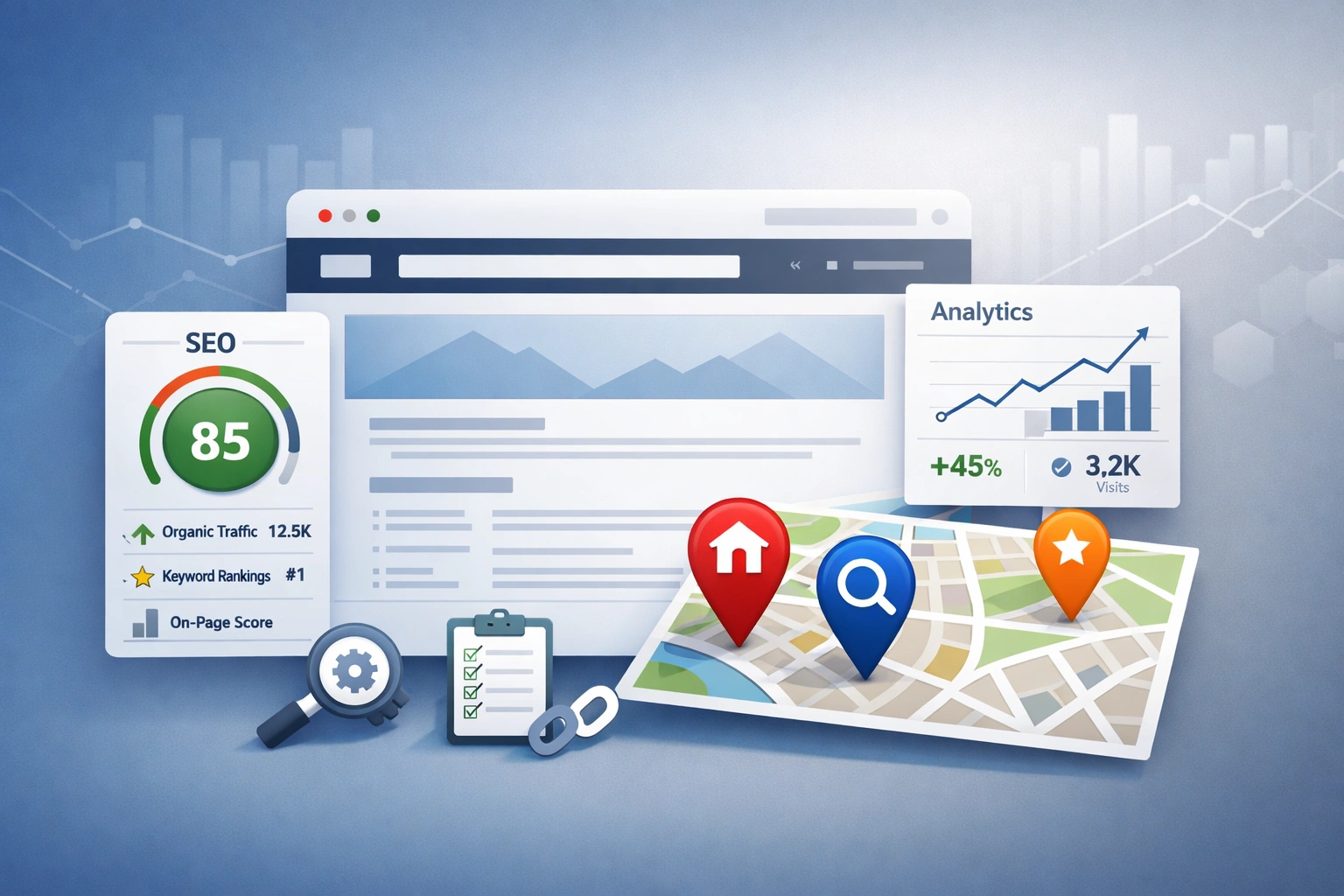
On-Page SEO for Florida Businesses
On-page SEO for Florida businesses: titles, content, structure, speed, and schema, and which fixes move rankings first. Practical, no jargon.
Updated March 18, 2026 · 15 min read
Table of Contents
• On-page SEO optimizes individual web pages to improve search rankings and user experience for Florida businesses. By focusing on title tags, content, and page speed, it drives more local leads. Invest in on-page strategies to increase visibility and convert searches into calls within 60-90 days.
On-page SEO services focus on optimizing individual web pages and on-page factors such as title tags, meta descriptions, header tags, and content to improve your website’s search rankings. For local Florida businesses, on-page SEO is the foundation for increasing leads and visibility online. Search engine optimization (SEO) includes both on-page and off-site SEO, and both are essential components for boosting your website’s performance in search results. This guide explains what on-page SEO services include, how they differ from off-site SEO, and why they are essential for local Florida businesses looking to increase leads and visibility online. Whether you’re running a business in Titusville, a med spa in Cocoa Beach, or a service provider in Melbourne, understanding and investing in on-page SEO can put 2-3 extra calls on your calendar each week. Most small businesses start seeing real movement within 60-90 days of proper on-page optimization.
On-page SEO is fully under your control, while off-site SEO (sometimes called off-site SEO) relies on external factors like backlinks and social media presence. Optimizing individual web pages and ensuring your content matches search intent are key to effective on-page SEO. Creating content that is relevant and high-quality is a core part of on-page SEO, helping your site rank higher and attract more qualified leads.
Think of your website like a physical storefront. On-page SEO is how you arrange the shelves, put clear signs in the window, and make sure customers can find what they need fast. We’ve watched a Titusville business go from zero calls on a specific service page to 2-3 inquiries weekly, just from fixing the title tag, speeding up load time, and adding a clear phone number above the fold.
If you run a local Florida business and want more leads and calls from your website, on-page SEO is where that starts. You'll learn the difference between on-page and off-page SEO, what services are included, how the process works, and what results to expect. On-page SEO helps search engines and users understand the content of a webpage, improving visibility and user experience.
What Can You Expect from Our On-Page SEO Services?
If you're searching for “on-page SEO services,” here is what you need to know:
- A clear definition of on-page SEO and how it differs from off-page SEO
- A breakdown of the core services included (keyword research, title/meta optimization, content, technical fixes, internal linking, tracking)
- Step-by-step overview of our process (audit, prioritize, fix, test, expand)
- Expected results and real-world examples from Florida businesses
- Frequently asked questions about on-page SEO for local companies
You’ll also get a few tips to help you improve your on-page SEO results.
By the end, you’ll know exactly what on-page SEO services can do for your business and how to get started.
What Is On-Page SEO and Why Does It Matter?
On-page SEO refers to all the actions you take directly on your website to improve its visibility in search engines and make it more useful for visitors. It is the practice of optimizing elements on a website to rank higher and earn more relevant traffic from search engines. It helps search engines and users understand the content of a webpage, improving both visibility and user experience. Key on-page SEO factors include not only content quality but also matching search intent and addressing user questions. This includes optimizing content, titles, meta descriptions, images, page speed, mobile layout, internal links, and conversion elements. The goal is to make each page clear, relevant, and easy for both users and search engines to understand.
For more definitions, visit our SEO glossary.
How Do On-Page SEO Services Differ from Off-Page SEO for Local Businesses?
On-page SEO (also known as on-site SEO) covers everything you control directly on your own site, including technical and content optimization such as improving page functionality, site performance, and conducting complete audits. Off-page SEO (or off-site SEO) refers to actions taken outside your website to improve its authority and reputation, such as earning backlinks, getting Google reviews, and building citations on directories. On-page SEO is fully under your control, while off-page SEO relies on external factors like backlinks and social media presence. Both on-page and off-page SEO are essential components of search engine optimization efforts, on-page SEO involves tasks performed on a webpage to improve search visibility, while off-page SEO involves tasks performed outside of your site to boost search visibility. Off-page SEO primarily focuses on link building, while on-page SEO focuses on optimizing content and HTML source code.
Here’s a quick comparison:
| On-Page SEO (What You Control) | Off-Page SEO (External Factors) |
|---|---|
| Title tag and meta title for each page | Google reviews and star ratings |
| Meta descriptions (the preview text in search results) | Local citations (Yelp, directories) |
| Header tags (H1, H2, H3 structure) | Backlinks from other websites |
| Page content and images | Social media mentions |
| Page speed and mobile layout | |
| Internal links between your web pages |
Definitions:
- On-site SEO: Technical and content optimization strategies performed on your website to improve search engine rankings, including optimizing content, HTML source code, and site performance.
- Off-site SEO: All activities performed outside your website to improve its search engine rankings, such as link building, reviews, and citations, which rely on external factors.
- Local SEO: A combination of on-page and off-page strategies focused on improving visibility for local searches (e.g., “AC repair near me”).
We saw this play out with two Cocoa Beach med spas last year. One invested in strong on-page content, fast-loading pages, and clear service descriptions. The other mostly bought directory listings and chased off-page SEO tactics. The first spa gained 20-30% more impressions from better snippets in search engine results pages, while the second struggled to convert visitors who landed on weak pages.
Summary Statement: On-page SEO, off-page SEO, and local SEO all work together to improve your online presence. On-page SEO ensures your website is clear and conversion-focused, off-page SEO builds your reputation and authority, and local SEO ties both together to help you rank in local searches.
- On-page SEO focuses on elements you control directly on your website, like content and speed.
- Off-page SEO involves external factors like backlinks and reviews to build authority.
- Both are essential for a complete search strategy, especially for local visibility.
Transition: Now that you understand the difference, let’s look at why on-page SEO is especially critical for Florida businesses.
Why Are On-Page SEO Services Critical for Florida and Space Coast Businesses in 2026?
Over 70% of Space Coast local service searches now start on mobile. Someone’s AC breaks at 2pm in Merritt Island, they grab their phone and type “AC repair near me.” If your site loads slow or looks broken on mobile, you’ve lost them before they even see your number. Ensuring your website is mobile-friendly is crucial for improving user experience and search rankings.
Core Web Vitals, a set of metrics defined by Google to measure real-world user experience for speed, responsiveness, and visual stability, are now a ranking factor. According to data from our Florida Local Search Index (Q2 2026 statewide benchmark), pages loading under 2.5 seconds convert roughly 28% more visitors than slower pages in Florida markets. Optimizing for page speed can improve your search visibility and reduce users' bounce rates. That’s not a small difference. That’s the gap between getting the call and losing it to your competitor down the road.
Over 70% of local searches in the Space Coast start on mobile devices. A slow or broken mobile site can cost you customers before they even see your contact information.
Data sourced from internal research at L3ad Solutions and the Florida Local Search Index (our quarterly analysis of local search performance across 90+ Florida cities).
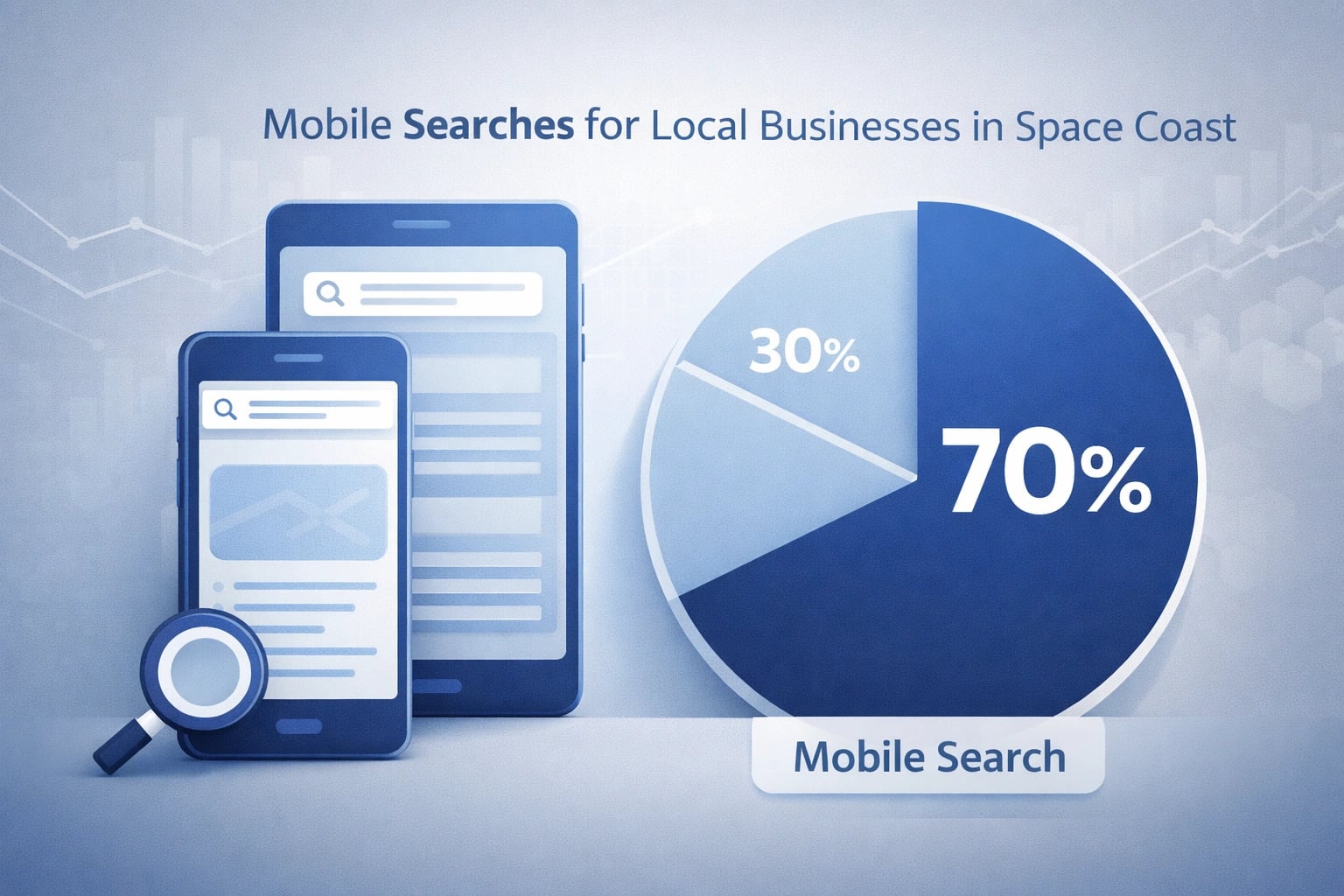
Mobile searches dominate local intent in Florida, making on-page SEO for speed and usability critical.
On-page SEO affects three things that matter to your bottom line:
- Visibility – Can search engines understand what your page is about? Do you show up for search queries your customers actually type?
- Clicks – Does your snippet (title and meta description tag) look better than the other 9 results on page one?
- Conversions – Once someone lands on your page, do they know what to do next? Is your phone number visible? Is the form easy to fill out?
A Merritt Island business had a service page buried on page 3 of Google search results. After fixing the title tag, adding location keywords, and improving page speed, the page climbed to page 1 within 8 weeks. A Titusville chiropractor saw a 34% increase in form submissions after we rewrote page content to match what patients were actually searching for. Increasing organic traffic is a key goal of on-page SEO, and tracking, analyzing, and optimizing for higher visibility in search engine results pages (SERPs) helps drive more visitors from search engines and improve overall website performance.
The rise of AI search tools and “near me” queries makes clean on-page content even more important. Search engines and AI tools both need to understand who you serve and where you serve them. Messy, unclear pages get skipped.
Transition: Next, let’s break down the core elements included in our on-page SEO services and how each one helps your business grow.
What Core Elements Are Included in L3ad Solutions’ On-Page SEO Services?
Our on-page SEO service is a structured checklist we run page by page to remove friction and improve search engine ranking. On-page SEO involves optimizing individual web pages by focusing on key on-page factors such as title tags, meta descriptions, header tags, and content.
Keyword Research
Identifying search terms your customers use to ensure each page targets the right audience.
Title & Meta Optimization
Crafting compelling titles and descriptions to improve click-through rates from search results.
Content Optimization
Writing clear, helpful content that answers questions and encourages action.
Technical SEO
Enhancing page speed and mobile usability for better user experience and rankings.
How Does Keyword Research and Mapping Improve Search Visibility?
- Keyword research and mapping: Keyword research is a critical step in on-page SEO, helping to identify the terms and phrases that target audiences use. We find what customers actually search and assign the right target keyword to each page. This involves using public tools like Google Keyword Planner, SEMrush, and our own local search research. Understanding user intent is essential for on-page SEO, as it guides how we create content and optimize each page.
- We look at phrases like “AC repair Titusville” or “best med spa in Melbourne FL” and judge how many people search for them each month and what they’re trying to accomplish.
- Each important page gets one main topic (primary keyword) mapped to it.
Example Mapping:
- “water heater repair Titusville” → Water Heater Repair service page
- “drain cleaning near me” → Drain Cleaning service page
- “services Cocoa Beach” → Cocoa Beach location page
- “how to unclog a garbage disposal” → Blog post (with link to services)
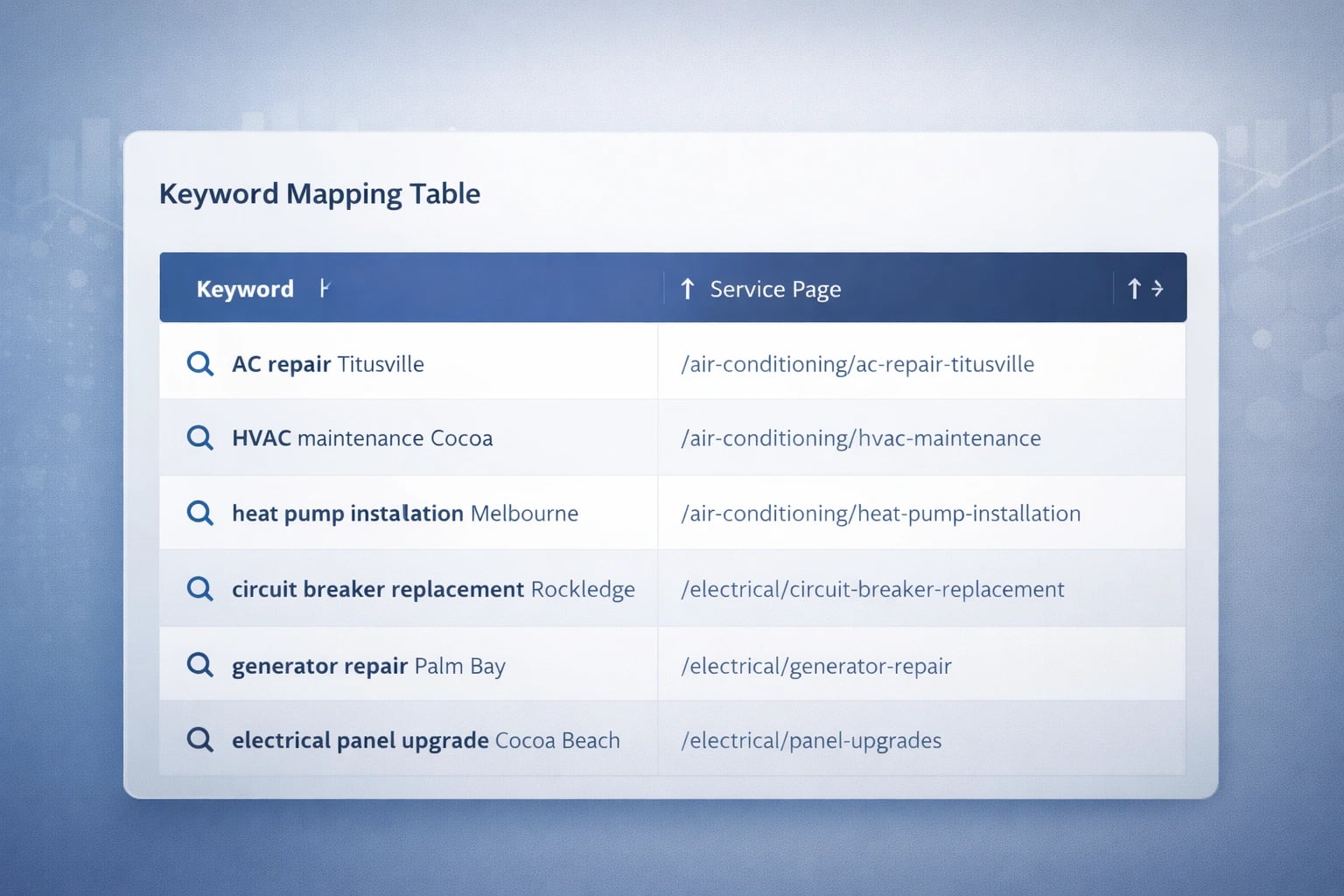
Mapping keywords to specific pages ensures your site targets the right local searches.
Why Is Title and Meta Optimization Crucial for Click-Through Rates?
- Title tags, headings, and meta descriptions: We rewrite page titles, headings, and meta descriptions so they clearly say what you do, where you do it, and why someone should call. Optimizing title tags is a key on-page SEO technique to improve search engine visibility.
- Your title tag is what appears as the blue link in search results. It should be 50-60 characters and include your service and location. Writing a relevant and accurate title tag that describes the content of the page is essential for both users and search engines.
- Your H1 heading (the main title on the page) should match the same intent.
- Your meta descriptions are the preview text below the title, ideally 150-160 characters with a clear reason to click.
Before and After Examples:
- Bad: “Services” Better: “Water Heater Repair Titusville | Same-Day Service”
- Bad: “About Us” Better: “Licensed Services in Brevard County Since 2008”
- Bad: “Contact” Better: “Get a Free Estimate | Titusville AC Repair”
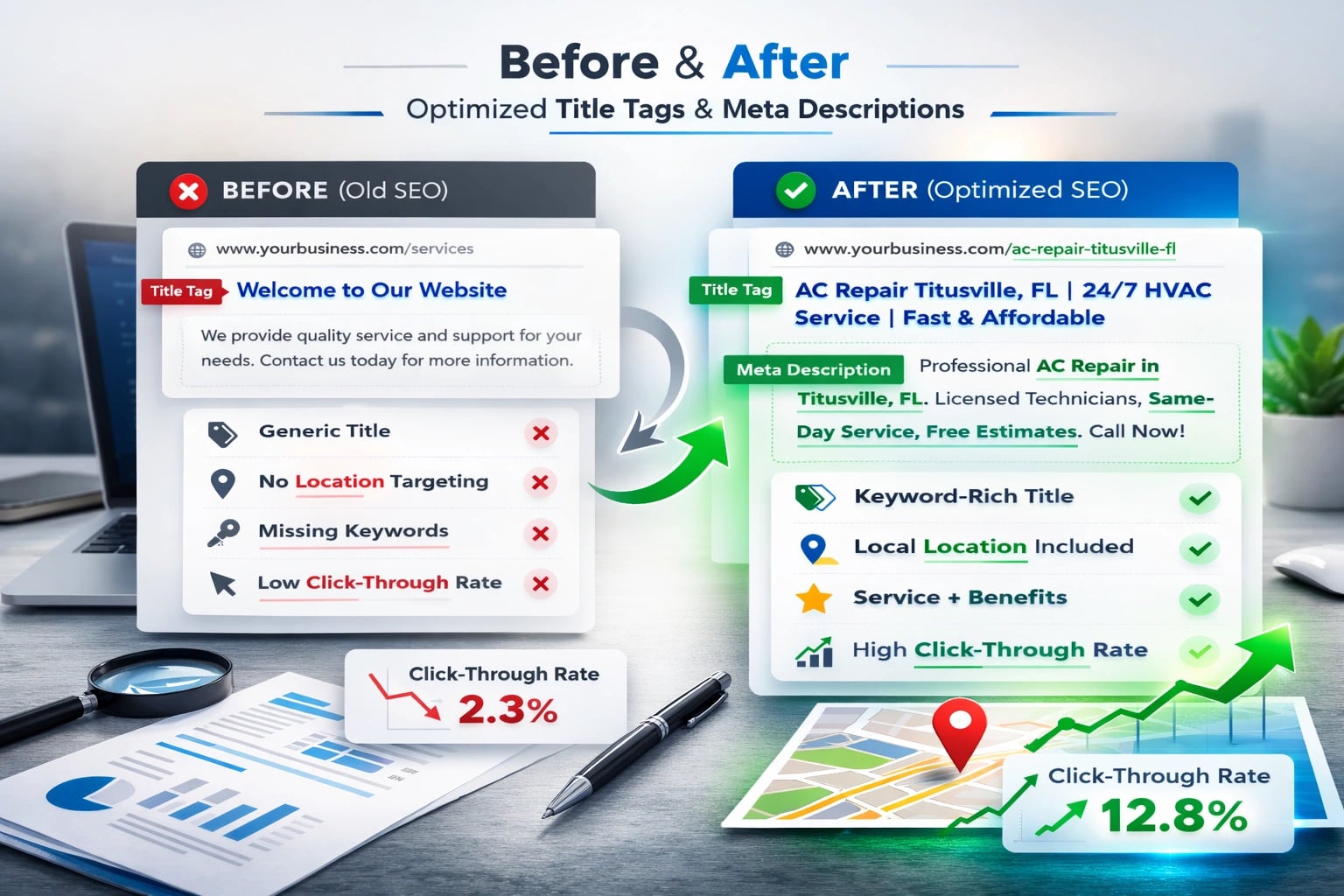
Optimized titles and meta descriptions can significantly improve your click-through rates.
How Does Content Optimization Drive Conversions?
- Page content optimization: We write copy that answers questions and converts, sounding like a helpful tech in your shop, not a robot.
- Every service page needs:
- Who you serve (homeowners, businesses, both)
- What you offer (explained simply)
- Service area (cities and neighborhoods)
- Pricing or ranges (even ballpark numbers help)
- FAQs (answer common questions)
- Next step (call button, form, or clear CTA above the fold)
- We optimize content for AI search tools using our AI search optimization process.
Why Is Technical SEO Essential for User Experience?
- Technical basics: We make your site load fast, work on phones, and use a simple structure search engine bots can crawl easily.
- Core Web Vitals: Google’s metrics for loading speed (under 2.5 seconds), interactivity (under 100ms delay), and visual stability.
- Compressing images: Large photos slow everything down. We convert them to WebP format, cutting file sizes 30-50%.
- Cleaning bloated code: Minifying CSS and JavaScript so pages load quicker.
- Mobile-first design: Tappable buttons, readable text, forms that work on phones.
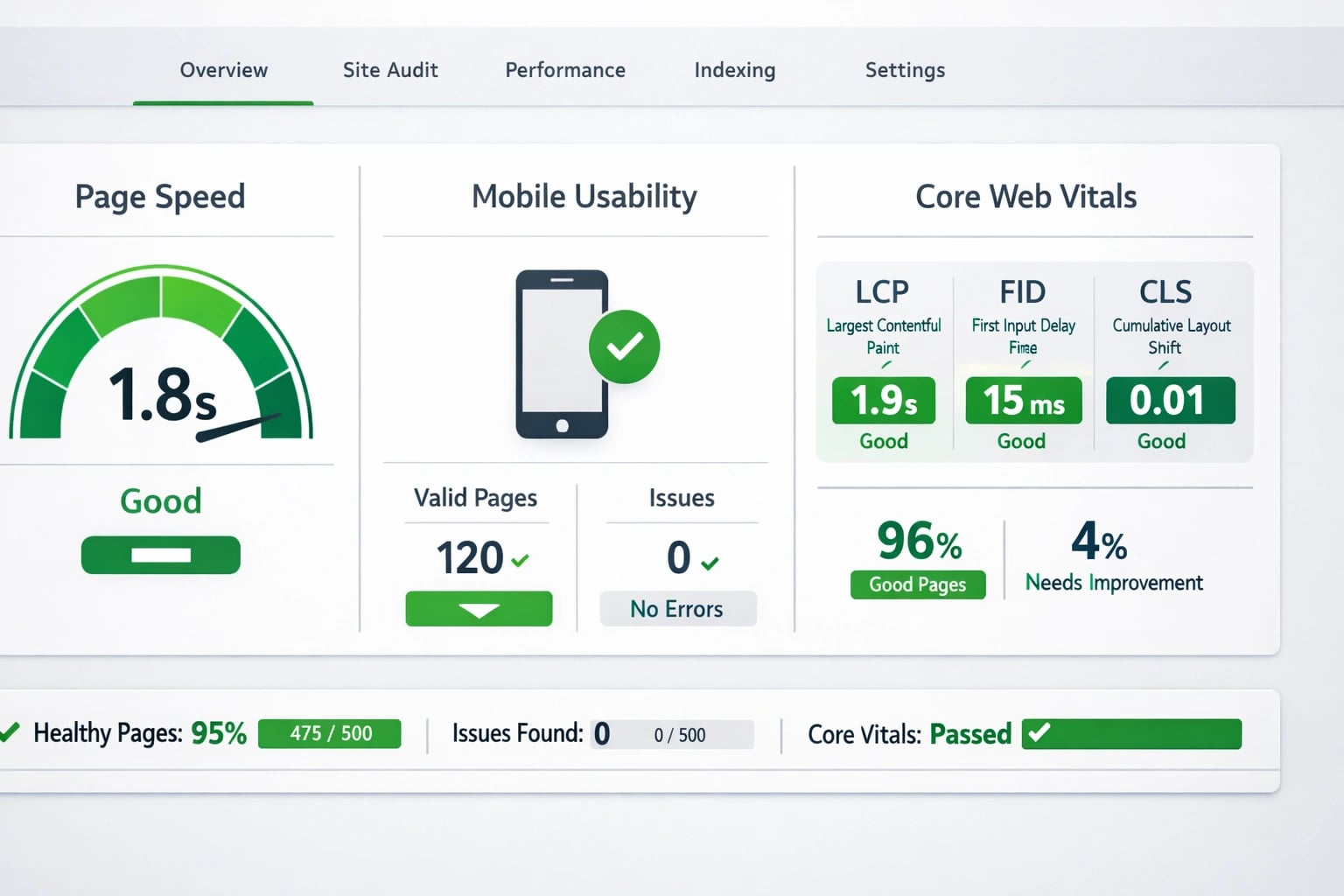
Technical SEO ensures your site performs well on all devices, a key ranking factor.
How Does Internal Linking Enhance Site Navigation?
- Internal links and site structure: We help search engines and visitors move through your site by linking related pages together.
- Good site structure looks like:
Home → Service Category → Service Page → City Page - We build internal links from blog posts to service pages using descriptive anchor text.
Internal Linking Rules:
- Every important page gets at least 2-3 internal links pointing to it
- Use descriptive anchor text (not “click here”)
- Link from high-traffic pages to pages you want to rank
- Avoid broken links and orphan pages
- Create logical paths visitors would actually follow
What Role Does Tracking and Reporting Play in On-Page SEO?
- Tracking setup: We set up call tracking numbers, tag forms, and use dashboards to show which pages produce leads.
- We use Google Search Console, Google Analytics, and call tracking tools to monitor rankings, traffic, and conversions.
Transition: Now that you know what’s included, let’s walk through our step-by-step process for delivering on-page SEO services.
How Do Search Engine Results Impact On-Page SEO Strategies?
When it comes to on-page SEO, understanding what actually shows up in search engine results pages (SERPs) is just as important as optimizing your own web pages. Search engines like Google use complex algorithms to decide which pages appear at the top, and why. But what do those rankings really mean for your business, and how can you use that information to improve your on-page SEO strategy?
Here’s how to break down and analyze search engine results so you can make smarter decisions about your website content and page optimization:
1. Search Intent Comes First Every search query has a purpose, whether someone wants to buy, learn, or find a local service. Matching your page content and meta descriptions to the user’s search intent is key. If your page doesn’t answer what people are really looking for, search engines will favor other relevant pages that do.
2. Keyword Research Drives Visibility Effective keyword research helps you find relevant keywords and phrases your customers actually use. By optimizing your title tag, header tags, and page content with these terms, you help search engines understand what your page is about and increase your chances of ranking for those search queries.
3. Meta Descriptions Influence Clicks A well-crafted meta description acts as your “ad copy” in the search engine results. It doesn’t directly impact rankings, but it can boost your click-through rate by making your listing more appealing than others on the page.
4. Internal Links Build Structure Strategic internal links connect related pages within your site, guiding both users and search engine bots to your most important content. This helps search engines understand your site’s structure and can boost the authority of key service pages.
5. External Links Signal Authority Links from other websites (external links) act as votes of confidence for your content. While off-page SEO refers to building these links, analyzing which competitors have strong backlinks can reveal why they outrank you, and where you might focus your own efforts.
6. Page Speed and User Experience Matter Page speed is a direct ranking factor. Slow-loading pages frustrate users and can drop in search engine results. Use tools like Google Search Console to monitor your Core Web Vitals and make sure your site loads quickly on all devices.
7. Mobile-Friendliness is Non-Negotiable With most local searches happening on mobile, your site must be responsive and easy to use on smaller screens. Search engines prioritize mobile-friendly web pages in their rankings.
8. Content Quality Wins High-quality, relevant content that matches search intent and answers real questions will always perform better. Avoid keyword stuffing, focus on providing value and using relevant keywords naturally throughout your page elements.
9. Technical SEO Supports Everything Technical SEO, like having an SSL certificate, clean URLs, and structured data, helps search engines crawl and index your site efficiently. These behind-the-scenes fixes can make a big difference in how your pages appear in search results.
10. Analytics and Tracking Close the Loop Use analytics tools to track which pages are ranking, which keywords drive relevant traffic, and where users drop off. This data helps you refine your on-page SEO checklist and focus on what actually moves the needle.
What Does an On-Page SEO Service Process with L3ad Solutions Look Like?
Our process is a 5-step loop we repeat on your most valuable pages first:
- Audit – Review your existing pages and find quick wins
- Prioritize – Rank pages by business impact and fix potential
- Fix – Implement specific on-page changes
- Test – Monitor results and refine based on data
- Expand – Roll winning patterns across more pages
We start with 5-10 revenue-driving pages (services, locations, key blogs) before touching secondary content. Fixing all the pages at once sounds efficient but spreads effort too thin.
This work often pairs with other digital marketing services like Google Business Profile optimization and local citations to create a complete on-page SEO strategy.
How Do We Audit Your Existing Pages to Find Quick Wins?
We run a manual and tool-based review (using tools like Google Search Console, Screaming Frog, and SEMrush) of your top pages, looking at rankings, content gaps, speed, and conversion elements. Auditing individual web pages is crucial to identify specific opportunities for improvement in content, structure, and internal linking. Using tools like Google Search Console also helps you analyze your keyword rankings and site indexing for each page.
Every page gets scored on three things:
- Visibility – Can people find this page? What keywords does it rank for? What relevant pages are missing?
- Clarity – Can visitors understand what you offer? Is the content readable?
- Action – Do they know what to do next? Is the phone number visible? Is there a form?
Our audit covers:
- Title tags and meta descriptions
- Page content quality and relevance
- Page speed and mobile experience
- CTAs and conversion paths
- Internal links to and from the page
- Image alt text and file sizes
Our audit output is a clear checklist, not a 40-page jargon report. It leads directly into a prioritized work plan you can actually understand.
How Do We Prioritize Pages for the Fastest ROI?
We rank pages by business impact: potential revenue from that service, current traffic to the page, and how far it is from page-one rankings. Optimizing individual web pages is essential for on-page SEO and achieving the fastest ROI, as it involves refining elements like title tags, meta descriptions, header tags, and content to improve search engine rankings, user engagement, and conversions.
Scenarios:
- Your “emergency service” page ranks #14. With title optimization and content improvements, we push it to #7.
- Your “installation” page ranks #47. That needs more work. We might prioritize other pages first unless installs are your bread and butter.
- You have no page for a key service even though you offer it. Creating a new optimized page is the priority here.
What Specific On-Page Changes Do We Implement?
We work through a consistent page SEO checklist for every page:
- Add city and service to the H1 heading
- Rewrite the title tag with target keyword and location
- Write a compelling meta description tag with a call to action
- Compress images and add descriptive image alt text
- Add an FAQ section answering common questions
- Include internal links from related pages
- Add external links to authoritative sources (other sites) to support your claims and build trust
- Add a clear CTA (phone number, form) above the fold
- Fix any broken links or duplicate content issues
Example: “Service in Titusville” page
- What causes issues (brief education)
- Our service process (step by step)
- Service areas (Titusville, Port St. John, Mims)
- Pricing transparency (starting at $XX or “free estimates”)
- FAQs (How long does it take? Do you offer same-day service?)
- Add external links to authoritative sources to support your claims and direct readers to helpful related resources
- Call-to-action button linking to contact form
All edits get shared with you for approval before we make significant copy or design changes. You stay in control of your website content.
How Do We Test and Refine Pages Over Time?
SEO is not “set it and forget it.” We track key pages and tweak them based on real numbers.
We watch three simple dials:
- Rankings – Is the page moving up for its target keyword?
- Click-through rate – Are more people clicking from search results?
- Conversions – Are visitors calling or filling out forms?
If rankings improve but CTR stays flat, the meta description might need work. If CTR is strong but conversions are low, the page content or CTA might be the problem.
Our feedback loop:
- Review data monthly
- Identify underperforming elements
- Make targeted adjustments
- Measure impact over 30-60 days
- Repeat
How Do We Expand Winning Strategies Across Your Site?
Once a pattern works on a few core pages, we roll similar structure and optimization out to more services and locations.
Florida example: We started with Titusville pages for a client. After proving the template worked (rankings, traffic, leads), we cloned the structure for Cocoa, Port St. John, Merritt Island, and Palm Bay. Each city got its own location page following the same page elements and optimization rules.
We also build content hubs: a main service page supported by 3-5 educational blog posts that all link back up.
Transition: With the process explained, let’s look at how on-page SEO adapts to new search trends like AI, featured snippets, and zero-click results.
How Does On-Page SEO Adapt to AI, Featured Snippets, and Zero-Click Results?
Good on-page SEO now means writing in a way that both Google and AI tools can quote easily and trust.
Featured snippets are the answer boxes at the top of Google that pull content directly from a page. If your page answers a question clearly and concisely, Google might feature it above the regular search results. You get visibility even if someone doesn’t click through.
Structured data markup is code added to your website that helps search engines better understand your content and display rich results (like star ratings, FAQs, or event details). Learn more in our glossary.
To win these spots, we structure pages with:
- Questions as headings (H2s and H3s)
- Direct answers in the first 1-2 sentences under each heading
- Bullet lists and numbered steps where appropriate
- Structured data markup when it makes sense
Space Coast example: We wrote a “How long does a roof last in Florida?” article with scannable Q&A sections. Each question got a direct answer followed by brief supporting detail. The page earned snippet-style placement, appearing in the featured answer box for that query.
Our GEO services take this further for businesses that want to appear in AI-generated answers more often. But even basic on-page SEO benefits from this approach. Clear, helpful content that matches user search intent performs better across the board.
Pages using question-based H2s win featured snippets about 15-20% more often than pages with generic headings. That’s a meaningful edge when you’re competing for attention in crowded local markets.
Transition: Next, let’s see how on-page SEO connects with your Google Business Profile and local SEO efforts.
How Do On-Page SEO Services Connect with Google Business Profile and Local SEO?
Your website and Google Business Profile (GBP) feed each other. Strong on-page signals support better map pack visibility.
When Google shows the local 3-pack (the map results with three businesses), it’s looking at signals from both your GBP listing and your website. If your site says “pressure washing Cocoa Beach” and your GBP says “exterior cleaning services in Melbourne,” Google gets confused. Consistency matters.
We align service names, cities, and categories across your site and Google Business Profile services. Same terminology. Same service areas. Same photos when possible. This helps search engines understand and trust your business details.
Example: A Cocoa Beach company had different service names on their website versus their GBP listing. We unified the language, added matching photos, and made sure both mentioned the same service areas. Map pack visibility improved within 6 weeks.
We often pair on-page packages with SEO strategy work so citations, reviews, and website content all tell the same story. Link building and external links help, but for many local businesses, solid on-page optimization plus a well-managed GBP is enough to rank higher in their area.
Ignoring either your website or your GBP weakens results. They work together.
Transition: To wrap up, here are answers to the most common questions about on-page SEO services for local businesses.
Tap a question to expand.
How quickly can I expect results from on-page SEO changes?
Is a one-time on-page SEO effort sufficient?
What is the typical cost of on-page SEO for a small Florida business?
Can on-page SEO alone improve my rankings without link building?
Will my existing website content be completely rewritten?
How do you ensure keywords are used naturally in content?
What’s the first step to getting started with on-page SEO help?
Good on-page SEO isn’t about tricks or gaming the system. It’s about making your web pages clear, fast, and useful for both search engines and users. For local Florida businesses, that means more visibility in search results, more clicks, and more calls from people ready to book.
If your pages aren’t pulling their weight, a few targeted fixes can change that faster than you’d expect. Start with your highest-value service pages. Measure what happens. Expand from there.
Or start with a free AI visibility check
Does AI Recommend You?
See if ChatGPT, Gemini, Grok, and Claude name your business. Free, emailed in minutes.