
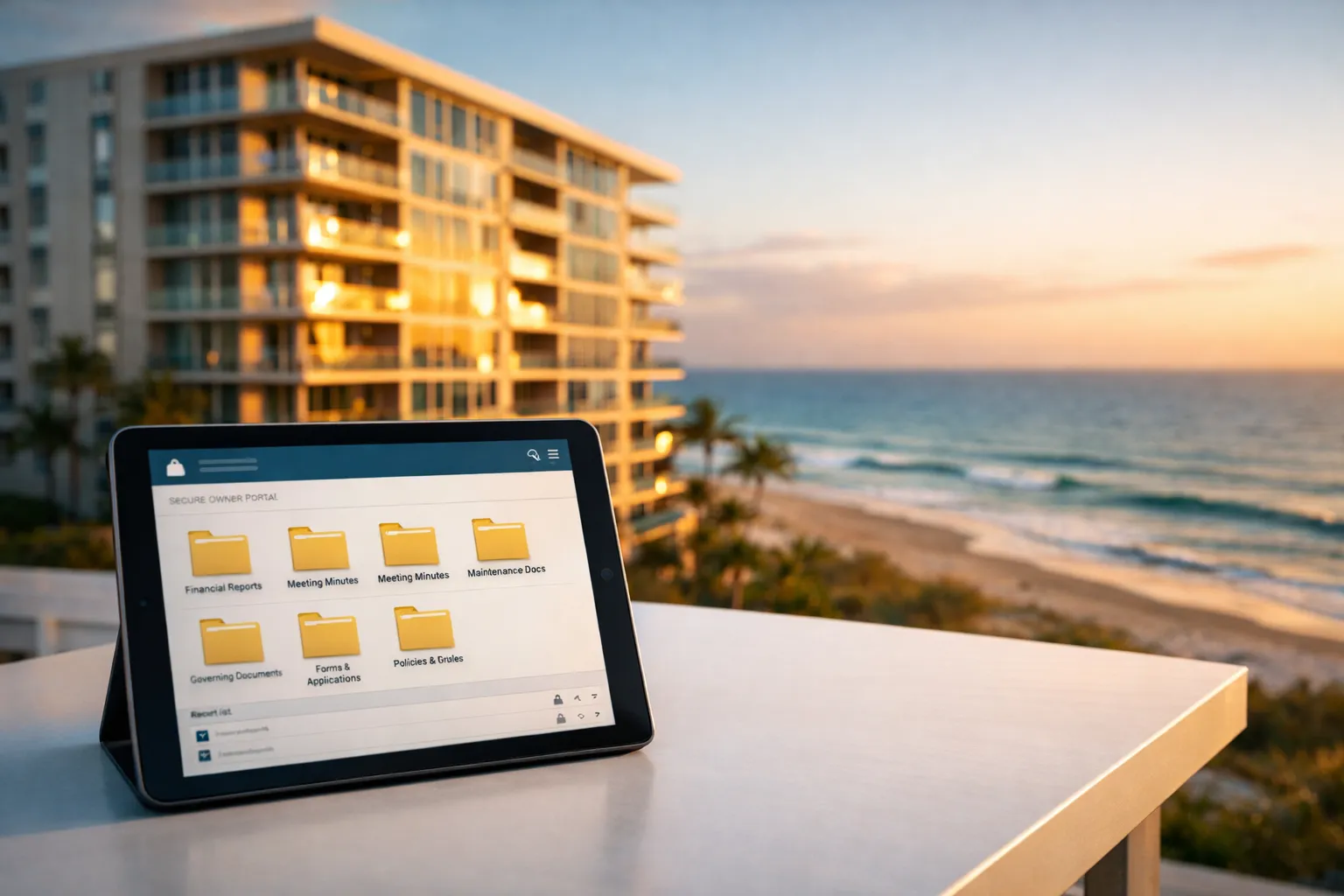
Florida Condo Website Requirements: What Does Your Association Need by 2026?
Florida condo associations with 25+ units need a compliant website by January 1, 2026. Here’s what the law requires and how to prepare.
Updated May 6, 2026 · 15 min read
Table of Contents
• Florida condo associations with 25+ units must provide digital access to official records via website or app by January 1, 2026. • Larger associations (150+) have been required since 2019; HOAs with 100+ parcels since 2025. • Records must live in a password-protected portal with redactions for privacy. • Non-compliance risks fines, owner complaints, and board liability. • Professional setup helps reduce volunteer workload while meeting all statutes.
This guide is for Florida condo board members, property managers, and association volunteers who need to understand and implement the new website requirements. Complying with these requirements is essential to avoid fines and ensure transparency for your community.
If you’re on a condo board in Florida, you’ve probably heard something about website requirements. Maybe at a board meeting. Maybe from your property manager. Maybe from a nervous neighbor who read something online. Here’s the reality: these requirements are real, they’re specific, and for many communities, the deadline is coming fast.
The good news? This isn’t rocket science. The rules are clear, the technology is straightforward, and getting compliant is absolutely doable for any association willing to put in some planning time. The association's website is a critical tool for transparency, record sharing, and legal compliance, making it essential to get this right. At L3ad Solutions, we’ve helped boards across Titusville, Cocoa, and Melbourne set up websites that meet these requirements without driving volunteer board members crazy.
Let’s break down exactly what the law says, who it applies to, and what you actually need to do.
What Are the Florida Condo Website Requirements in 2025–2026?
The Florida condo website requirements come from changes to Florida Statutes Chapter 718, specifically section 718.111(12)(g). The most recent update came through House Bill 1021, passed in 2024, which lowered the unit threshold from 150 to 25. If your condominium association has 25 or more residential units, you must provide digital access to official records through a website or mobile application by January 1, 2026.
The law defines "official records" broadly. Digital copies of all of the following must live in a password-protected section of the site:
- Articles of incorporation
- Bylaws
- Declaration of covenants
- Current rules and governing documents
- Meeting minutes
- Annual budgets
- Financial reports, tax returns, and financial statements
- The association's current insurance policies
If you aren't sure whether a document belongs on the list, assume it does and ask your attorney before leaving it off.
Florida law requires condominium associations with 25 or more units to maintain an official website or secure portal for official records by January 1, 2026. The website must host digital copies of governing documents, annual budgets, and meeting minutes. The website must include a password-protected section where official records are posted, ensuring that sensitive information is only accessible to members and staff due to the protected or restricted nature of certain documents and the legal obligation to restrict access. HOAs must ensure that information and records that cannot be shared with owners are not posted on the website, and any protected information must be redacted before posting.
This isn’t a brand new concept. The original push started with House Bill 1237 back in 2017, which introduced digital record access for larger condominium communities. That bill set a January 1, 2019 deadline for associations with 150 or more units. If you’re in a large oceanfront building, you should have had this in place years ago.
Here’s who needs to comply and when:
-
25 or more units: Must have a compliant website or app by January 1, 2026
-
150 or more units: Should have been compliant since January 1, 2019
-
Under 25 units: Not legally required yet, but smart to plan ahead
As of January 1, 2025, Florida HOAs with 100 or more parcels are required to have a website that meets specific legal requirements, including posting official records in a password-protected area. As of January 1, 2026, Florida law requires all condominium associations with 25 or more units to maintain an official website or secure portal for official records.
The new law also affects homeowners associations under Chapter 720. HOAs with 100 or more parcels must have a website by January 1, 2025. That parallel requirement signals that Florida is serious about digital transparency for community associations across the board. Expect enforcement attention to increase for condo associations too.
So what exactly are “official records”? In plain English, we’re talking about your governing documents (declaration, bylaws, rules), your financial documents (annual budget, financial report, insurance policies, tax returns, financial statements), and your meeting records (minutes, agendas, notices). Association members need to access such records through a password-protected section of your association’s website or a secure member portal.
Based on our observations and data from the Florida Local Search Index, at least 60% of mid-sized condominium communities on the Space Coast still lack a compliant records portal as of mid-2025. That’s a lot of boards scrambling over the next few months.
L3ad Solutions is a Space Coast agency based right here in Titusville. We’ve helped boards in Brevard County plan websites that fit these rules while staying easy for non-technical volunteers to manage. The key is starting early enough that you’re not making rushed decisions.
The dates and unit-count thresholds matter. Here’s the quick reference:
-
January 1, 2019: Original deadline for 150+ unit condos
-
January 1, 2025: Deadline for HOAs with 100+ parcels
-
January 1, 2026: New deadline for 25+ unit condos
-
Timeshare units: Handled separately under different provisions
Failure to comply with the new website requirements can result in penalties for the HOA, including potential fines and removal of board members by a quorum of unit owners.
If you’re on the fence about whether this applies to you, count your residential units. If the number is 25 or higher, you need a plan.
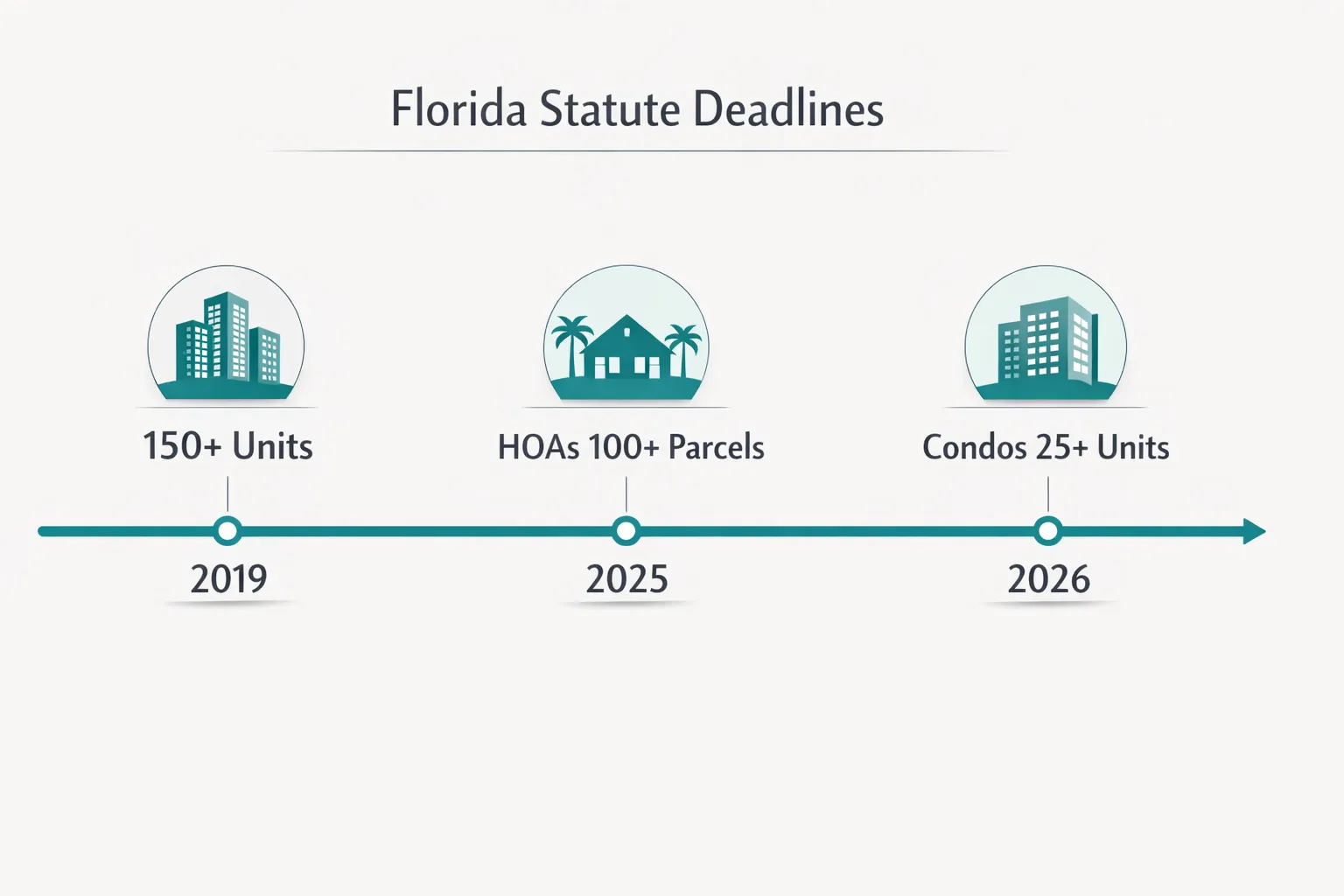
Key compliance deadlines for Florida condominium and homeowners associations.
Which Florida Laws Control Condo Website Rules and Digital Records?
The condo website requirements come mainly from Chapter 718 of Florida Statutes, especially section 718.111(12)(g). Later changes in House Bill 1237 (2017) and House Bill 1021 (2024) expanded and updated these requirements. The condominium act is the primary legal framework, but it works alongside other entity regulations for different association types.
Here’s how the statutes break down by association type:
-
Chapter 718: Covers condominium associations and their website/records requirements
-
Chapter 720: Covers homeowners associations with parallel digital access rules
-
The Homeowners Association Act: Contains similar transparency provisions for HOAs
Key statute sections you should know by number:
-
718.111: Powers and duties of associations, including records access and website requirements
-
718.112: Bylaws, meetings, and required notices for condo associations
-
720.303: Records access and websites for HOAs
-
720.303(4)-(6): Specific records access and retention rules for parcel owners
The unit-count vs. parcel-count distinction matters. Condo associations count residential units (apartments, condos). HOA requirements are based on parcels (lots, homes). A 30-unit condo building needs compliance by 2026. An affiliated homeowners association with 100 homes should already be compliant.
Here’s a concrete example: A mixed-use building in Melbourne with 40 residential condos and 10 commercial spaces counts the residential units. That’s 40, so they need a website. A Florida HOA development in Titusville with 95 single-family homes doesn’t hit the 100-parcel threshold yet, so no legal requirement (though it’s still smart to have one).
When we talk about terms like “declaration of condominium” or “protected information,” we’re using legal language that can feel dense. The declaration is basically your community’s constitution. Protected information includes things like Social Security numbers and bank account details that must stay private. If you run into unfamiliar marketing or technical jargon while researching vendors, our marketing terms explained explains many common terms.
This article is practical guidance. It doesn’t constitute legal advice. Boards should have the association’s attorney confirm specifics, since statutes evolve and your situation may have unique factors.
Does My Florida Condo Association Actually Need a Website Right Now?
If you have 25 or more units, yes. You’re required to provide digital access to association records through a website or mobile app by January 1, 2026. If you have 24 or fewer units, the law doesn’t require it yet, but it’s still smart to plan one.
Let’s look at the timeline. The original 2019 deadline applied to associations with 150 or more units. Many large condo associations should already have had a community website in place since January 1, 2019. Reality check: compliance has been spotty. Some large oceanfront properties were supposed to comply years ago but still have operational gaps like outdated documents or broken portals.
Two concrete examples from right here on the Space Coast:
Example 1: A 220-unit oceanfront condo in Cocoa Beach has been under the requirement since 2019. They should have a fully functional owner portal with all official documents posted and updated. If they don’t, they’re already at risk of complaints and fines.
Example 2: A 40-unit riverfront condo in Titusville now faces the January 1, 2026 deadline. They have time to plan properly, but waiting until November to start would be a mistake.
Timeshare units get slightly different treatment under the statutes. But mixed-use condos with traditional owners should assume the website requirement applies if they meet the unit threshold. Don’t assume your community is exempt without checking with your attorney.
When the law says “website or mobile application,” it means an online system where unit owners can log in from a browser or mobile device to view official records. It does not mean emailing PDFs when someone sends a written request. That’s the old way. The law expects a web portal or other protected electronic location where records are continuously available.
Even if your condo has fewer than 25 units, consider building a simple site now. Florida has a history of lowering thresholds over time. The jump from 150 units to 25 units happened in just a few years. A further drop to 10 units or even “all associations” isn’t far-fetched. Retrofitting under deadline pressure is harder and more expensive than doing it right the first time.
If your board doesn’t want to handle DIY website building under a legal deadline, professional web design is a reasonable investment. A properly built site can serve you for years with minimal ongoing volunteer effort.
What Documents Must Florida Condos Post on Their Website or Portal?
Florida law requires that certain documents be posted on the association’s website or secure portal, specifically in a password-protected section. Below are the main categories and required documents, organized for clarity. For meetings of the board of directors or members where owner participation is required, notices and agendas must be posted in advance for such meeting, ensuring transparency and compliance with statutory requirements:
Governing Documents
Declaration, bylaws, articles of incorporation, current rules, and amendments.
Financial Records
Budgets, financial reports, insurance policies, tax returns, and statements.
Meeting Materials
Notices, agendas, minutes from the past 12 months, and election documents.
Reserve & Inspection
Structural integrity reports, reserve studies, and related compliance documents.

Well-organized document portal makes compliance simple for board members and easy for owners.
Florida Statutes require that notice documents for meetings must be posted digitally where applicable. This includes your annual meeting notice and any recall meeting notice. Such notice materials need to appear in the portal with enough lead time for owners to actually use them.
Election materials like ballots and proxies are official documents, but boards need to be careful. Secret ballot rules exist for certain elections. Don’t post anything that would compromise voter privacy or violate your bylaws. When in doubt, check with your association’s attorney.
The association shall adopt written rules governing records retention. Your website should reflect those written rules. For example, keeping minutes online for at least 7 years mirrors common Chapter 718 and 720 timelines. Some records have even longer retention periods.
For site structure, we typically recommend organizing such documents into clear sections:
-
Documents: Governing documents, rules, recorded amendments
-
Financials: Budget, financial report, insurance, contracts
-
Meetings: Agendas, minutes, notices, election materials
Our HOA website services structure document libraries this way for both condo associations and HOAs. It makes finding specific records much easier for owners who just want to download their budget or check the pool rules.
How Should a Florida Condo Handle Privacy and Protected Information Online?
The law expects associations to protect information of a restricted nature. Official records must be accessible to unit owners without exposing things like Social Security numbers, bank account numbers, medical details, or attorney-client privileged content. Getting this wrong creates real liability.
Chapter 718 and Chapter 720 both carve out categories of records that owners have no right to inspect. These protected categories must never be uploaded to the website’s owner portal, or if they must be uploaded, they need thorough redaction first.
What Needs Redaction Before Posting?
-
Social Security numbers
-
Driver license numbers
-
Credit card numbers
-
Bank account and routing numbers
-
Personal financial information (like monthly income or account balances)
-
Medical records
-
Attorney-client privileged communications
-
Information identifying children in violation reports or incident reports
-
Personal phone numbers and emails if owners have requested privacy
Privacy Workflow for Posting Documents
-
The community association manager or management company prepares documents for upload.
-
Before posting, someone reviews each document and redacts sensitive information.
-
Documents go into the password-protected portal, organized by category.
-
Quarterly (at minimum), someone reviews links and files to confirm nothing private has slipped into the public section.
-
Remove outdated documents that no longer need to be accessible.
Accidental disclosure doesn’t automatically create liability if the association didn’t intentionally ignore the law. Mistakes happen. But repeated careless posting could be treated as knowing or intentional disregard of privacy requirements. That’s when fines or other penalties become more likely.
Public vs. Private Areas
Public Areas (no login required):
-
Community photos and amenity descriptions
-
General rules and contact information
-
Management company contact details
-
Basic community information for prospective buyers
Private Portal (login required):
-
Owner rosters with contact details
-
Financial ledgers and detailed financial statements
-
Violation notices and incident reports
-
Meeting minutes with specific owner discussions
-
Insurance policies with coverage details
-
Any document containing such information that identifies specific owners
A secure, properly structured portal can still be part of an overall search-friendly site. You want prospective buyers and residents to find your community online with accurate information. That’s where local SEO services come in. The public-facing portion of your site can rank well in search while the private portal stays protected.
- Always redact personal identifiers before posting any document
- Maintain separate public and private site areas
- Review uploaded files quarterly for accidental exposure
- Document your redaction and posting process for your records
What Technical Features Does a Compliant Florida Condo Website Really Need?
The state doesn’t demand a fancy design. But it does expect ongoing hosting, reliable uptime, password protection for official records, document upload capability, and timely updates. You can’t build a site once and forget about it. The association shall maintain continuous access for owners.
Must-Have Features for Compliance
-
Secure login for unit owners: Individual or shared credentials that restrict access to association members
-
File storage for PDFs: Room to upload governing documents, budgets, minutes, and policies
-
Folders or tags for organizing: A way to sort community documents into logical categories
-
Responsive design: The site must work on phones and tablets (most owners access via mobile device)
-
SSL encryption: The HTTPS padlock in the browser that protects data transmission
-
Role-based access: Different permissions for board members vs. owners vs. property manager
SSL (Secure Sockets Layer) is the technology that puts the padlock icon in your browser’s address bar. It’s important for any site holding private documents. Without it, data traveling between the owner’s device and your server could potentially be intercepted. Google and other search tools also treat HTTPS as a basic standard. Sites without it may get warnings or lower rankings.
Many boards underestimate the ongoing work required. It’s not just building the site. It’s keeping documents current, removing outdated files, updating meeting notices before each scheduled meeting, and responding when owners report access problems. DIY tools like simple website builders can work, but someone has to do the maintenance.
Florida’s statutes allow a mobile application instead of a traditional website. Same rules apply. The app needs secure access, organized records, and timely updates. Mobile apps often cost more to build and maintain than responsive websites, so most small-to-mid-size associations stick with web-based solutions.
At L3ad Solutions, we typically design condo and HOA sites as a main public site plus an owner portal. The public side shows off the community to prospective buyers. The private side holds all the association records behind secure login. Website design services built this way cover both marketing and compliance needs.
Owners increasingly find association sites through AI search tools, not just traditional Google. Someone might ask a tool like ChatGPT or Perplexity “What are the rules at [Your Condo Name]?” If your site is properly structured, those answers can pull from your official content instead of outdated third-party listings. AI search optimization helps your community show up accurately in these newer search experiences.
Quick Checklist of Technical Requirements
-
99%+ uptime hosting
-
SSL certificate (HTTPS)
-
Password-protected owner section
-
Document upload capability
-
Mobile-responsive layout
-
Role-based user permissions
-
No public search indexing of private areas
-
Regular backups
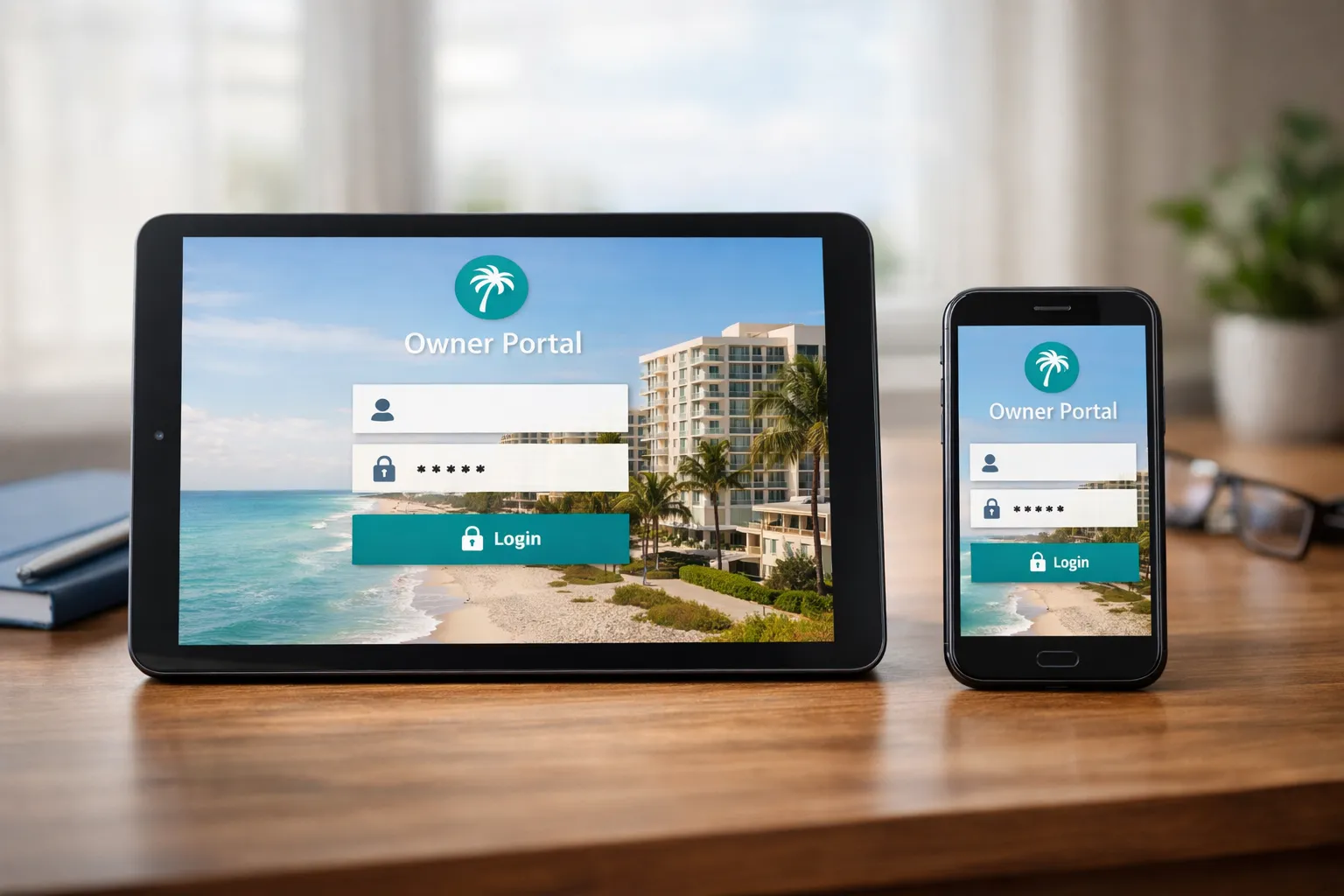
Secure, mobile-friendly login is non-negotiable for compliance.
How Should Florida Condo Boards Plan and Budget for a Compliant Website?
A realistic budget for a small-to-mid-sized condo in Florida is often in the $1,200 to $3,500 per year range. That includes design, hosting, security, and periodic updates. Ultra-basic DIY options can be cheaper upfront, but they shift labor to volunteers who may or may not have the time.
Boards should treat the website as an operating expense, not a one-time project. Florida law wants official records online “continuously.” That means ongoing costs for hosting, domain renewal, security updates, and someone’s time to upload new documents. Build this into your annual budget required for operations.
Key Planning Steps
-
Audit current records: What do you have? What’s missing? What needs redaction?
-
Decide public vs. private content: What goes on the open site vs. the secure portal?
-
Pick a platform or vendor: DIY builder, management company portal, or third party provider like L3ad Solutions?
-
Draft a records posting policy: For example, “Budgets posted within 14 days of adoption”
-
Set an internal schedule: Who uploads what, and when?
-
Assign backup responsibility: At least two people should have admin access
That last point matters more than you’d think. We’ve seen associations lose portal access because one board member resigned and took the only login credentials with them. Assign at least two people (usually a director and the property manager or authorized agent) to share responsibility for updates.
One small Titusville association we worked with reduced paper records requests by roughly 40% within a year after launching a simple owner portal. Owners stopped emailing the manager asking for copies of the budget or bylaws. They just logged in and downloaded what they needed. That saves staff time, reduces owner frustration, and documents that the board is meeting its obligations.
Comparison of Costs for Common Options
| Option | Typical Cost | Board Effort | Control Level |
|---|---|---|---|
| DIY builder (Wix, Squarespace) | $200-500/year | High | Medium |
| Management company portal | $1,000-2,500/year | Low | Low |
| Independent agency (L3ad Solutions) | $1,200-3,500/year | Low | High |
DIY has the lowest cash cost but the highest time investment from volunteers. Management company portals require less board effort but often come with limited customization. Some communities feel locked into their management company because switching would mean migrating their entire website. An independent agency provides tailored solutions that the association controls regardless of who manages the property.
Our digital marketing services can integrate the compliance site with broader marketing for communities that actively sell or lease units. If you want prospective buyers finding accurate, attractive information about your community, the website can do double duty.
Real numbers. Real tradeoffs. That’s the budget conversation boards need to have before the date required approaches.
- Full control of your data
- Customized to your community
- Meets exact Florida statutes
- Easy for volunteers to maintain
- Higher initial investment than DIY
- Requires choosing the right partner
What Common Mistakes Get Florida Condos in Trouble with Website Requirements?
Most problems we see at L3ad Solutions are simple operational mistakes, not sophisticated hacking or complex legal violations. Missing documents, no login protection, abandoned sites that no one maintains. These basic failures create the biggest risks.
Common Issues That Trip Up Condo Associations
-
No password-protected section: Records sitting on a public page anyone can access
-
Failing to post updated documents: Old annual budget still showing when the new one was adopted months ago
-
Ex-board members with admin access: Someone who resigned two years ago can still edit the site
-
Domain or hosting expiration: Nobody renewed the hosting, and the whole site goes dark
-
Email-only distribution: Sending PDFs on written request instead of maintaining a real portal
-
Unredacted personal information: Posting violation letters with names, unit numbers, and other sensitive information
Privacy mistakes deserve special attention. We’ve seen community documents posted with full bank account numbers visible in financial statements. Violation letters with children’s names. Owner rosters with personal email addresses that owners specifically asked to keep private. Each such disclosure creates potential liability.
One Space Coast example (details changed for privacy): A condo association lost its .com domain when a volunteer board member forgot to renew. The domain registrar sent notices, but they went to an old email address nobody monitored. When the site went down, so did board email addresses that used that domain. It took three weeks to regain access, during which owners couldn’t reach the board and the secure member portal was completely offline.
Relying solely on email for record access does not meet the “website or mobile app” requirement for associations above the threshold. Courts and regulators expect organized, searchable, continuous access. Responding to each written request individually may have been acceptable before 2019, but it’s not what the statutes envision now.
Put an annual “website compliance check” on your calendar. The best time is during budget season, when you’re already reviewing operations. Confirm all required documents are posted. Verify login access works. Check that no private information has leaked to public pages. Remove any outdated files that shouldn’t be there.
Consistent, accurate existing websites also help owners and prospective buyers find correct information. If your official site is outdated or broken, people will rely on third-party listings that may have wrong details about fees, rules, or amenities. Our Florida search data shows that many buyers research communities online before ever calling a realtor. Make sure what they find is accurate.
How Can L3ad Solutions Help Florida Condos Meet Website and Search Requirements?
L3ad Solutions is a Titusville-based agency that builds HOA and condo sites for communities across Brevard County and the broader Space Coast. We combine legal-compliance needs with owner-friendly design that doesn’t require technical expertise from board members.
Here are specific services we provide for florida associations:
Compliant Website Design with Owner Portals: We build sites that have a public-facing section for community marketing and a secure private portal for association records. Both sections work on any mobile device, meet SSL requirements, and are organized for easy navigation.
Document Library Setup: We create logical folder structures for your official documents, set up role-based access, and establish upload workflows so new documents get posted consistently.
Board Member Training: Volunteer board members shouldn’t need a computer science degree. We provide simple training so your team can upload meeting minutes and update notices without calling tech support.
Google Business Profile Integration: Many owners and prospective buyers find community information through Google Maps. Google Business Profile services help your association control what appears when someone searches for your community. Accurate hours, photos, and contact info reduce confusion and present a professional image.
The founder’s Intel operations and data analytics background shows up in how we approach these projects. We set up clear processes for document posting, create deadline reminders, and build quality checks so nothing falls through the cracks. If your board meeting approves new rules on Tuesday, there’s a process for getting them posted before the next scheduled meeting.
Some vendors only sell “template HOA sites” that look the same across hundreds of communities and don’t account for Florida-specific requirements. We customize based on actual Florida Statutes requirements and Space Coast internet habits. Data from the Florida Local Search Index helps us understand how residents actually search for community information in this market.
The practical benefits matter more than any technical bragging. Less board stress. Fewer owner complaints about missing documents. Fewer hours spent emailing PDFs to people who could find them online. Better visibility for your community when buyers are researching neighborhoods.
If you’re not sure whether your existing website meets the new requirements, request a free audit. We’ll review what you have, identify gaps, and give you honest recommendations. No obligation, no pressure.
Compliant Portals
Public marketing site paired with secure, password-protected records area that meets Chapter 718 rules.
Document Workflows
Simple processes so new minutes and budgets are posted quickly without extra volunteer burden.
Board Training
Short sessions so your team can manage the portal confidently without technical headaches.
AI Visibility
Structure content so AI tools like ChatGPT return accurate information from your official site.
- Count your residential units to confirm if the 2026 deadline applies
- Audit current records and identify what needs redaction
- Budget for ongoing maintenance, not just one-time setup
- Schedule a free review before making rushed decisions
Tap a question to expand.
What happens if our condo misses the website deadline?
Can we just use a residents-only Facebook group instead of a website?
How quickly do meeting minutes and budgets need to go online?
Do we have to give every owner a username and password?
Our condo is self-managed. Is DIY web design enough to comply?
Do these website rules affect how buyers see our community online?
Where can our board learn more about terms like “official records” or “protected information”?
What if our management company already provides a website?
If your condo has 25 or more units, the clock is ticking. January 1, 2026 isn’t far away, and getting ahead of the deadline means less stress and fewer rushed decisions. A compliant website isn’t just about avoiding fines. It’s about making life easier for owners, reducing board workload, and showing your community is professionally run.
Ready to find out where your association stands? Get a free consultation and we’ll give you an honest assessment of what you need to do before the deadline.