
Florida Condo Website Requirements: HOA Compliance Guide
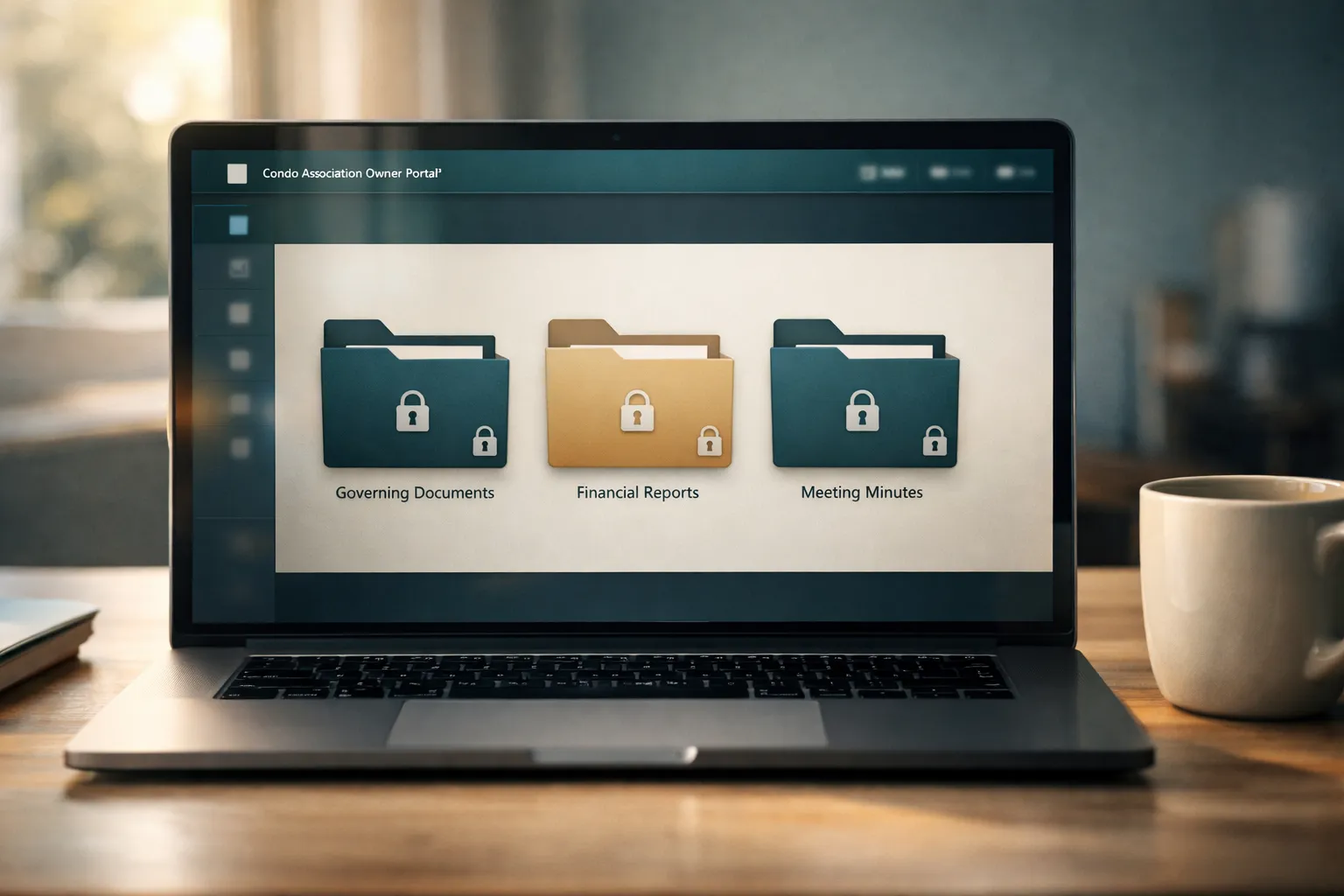
Florida Statute 718.111(12)(g) requires condo associations with 25 or more units to maintain a compliant website by January 1, 2026. Your site must include governing documents, meeting notices, financial reports, and budgets in a secure member portal.
Updated May 1, 2026 · 15 min read
Table of Contents
• Florida law requires most condo and HOA communities with 25+ units to maintain a secure website with governing documents, financial reports, and meeting records by January 1, 2026. • Documents must be organized in a password-protected owner portal. Public pages stay limited while sensitive records remain restricted. • L3ad Solutions builds compliant sites for Space Coast associations that are easy for boards to maintain without technical staff. • Proper structure reduces owner emails by 30-40% and helps avoid fines up to $100 per day.
Florida Statutes 718 and 720 spell out exactly what official records your association must post online. If you have 25 or more units, you’re on the clock. The rules cover everything from your declaration of condominium to your annual budget, and they specify how unit owners must be able to access such documents.
L3ad Solutions builds compliant condo and HOA websites across Florida, with a focus on communities here on the Space Coast. We read these statutes when we design sites, not after a board gets a complaint. If you want to see where your current site stands, grab a free HOA website audit and we’ll map out what’s missing.
What Florida laws actually require a condo or HOA website in 2026?
The two statutes that matter most are Florida Statute 718.111(12)(g) for condominium associations and Florida Statute 720.303(4) for homeowners associations. These laws were originally enacted through House Bill 1237 in 2017, signed by Governor Rick Scott, and have been tightened several times since.
For condos, the threshold used to be 150 units. That changed dramatically with House Bill 1021, passed unanimously on March 6, 2024, and signed by Governor Ron DeSantis on June 14, 2024. Now, any condominium association with 25 or more units must maintain a community website with a protected or restricted nature by January 1, 2026. Associations with 150 or more units should already be compliant since the original 2019 deadline.
For Florida HOA communities, the rules under the Homeowners Association Act are similar but keyed to parcels rather than units. Associations with 100 or more parcels must maintain websites as of January 1, 2025. Smaller community associations often look to their governing documents to see if additional requirements apply.
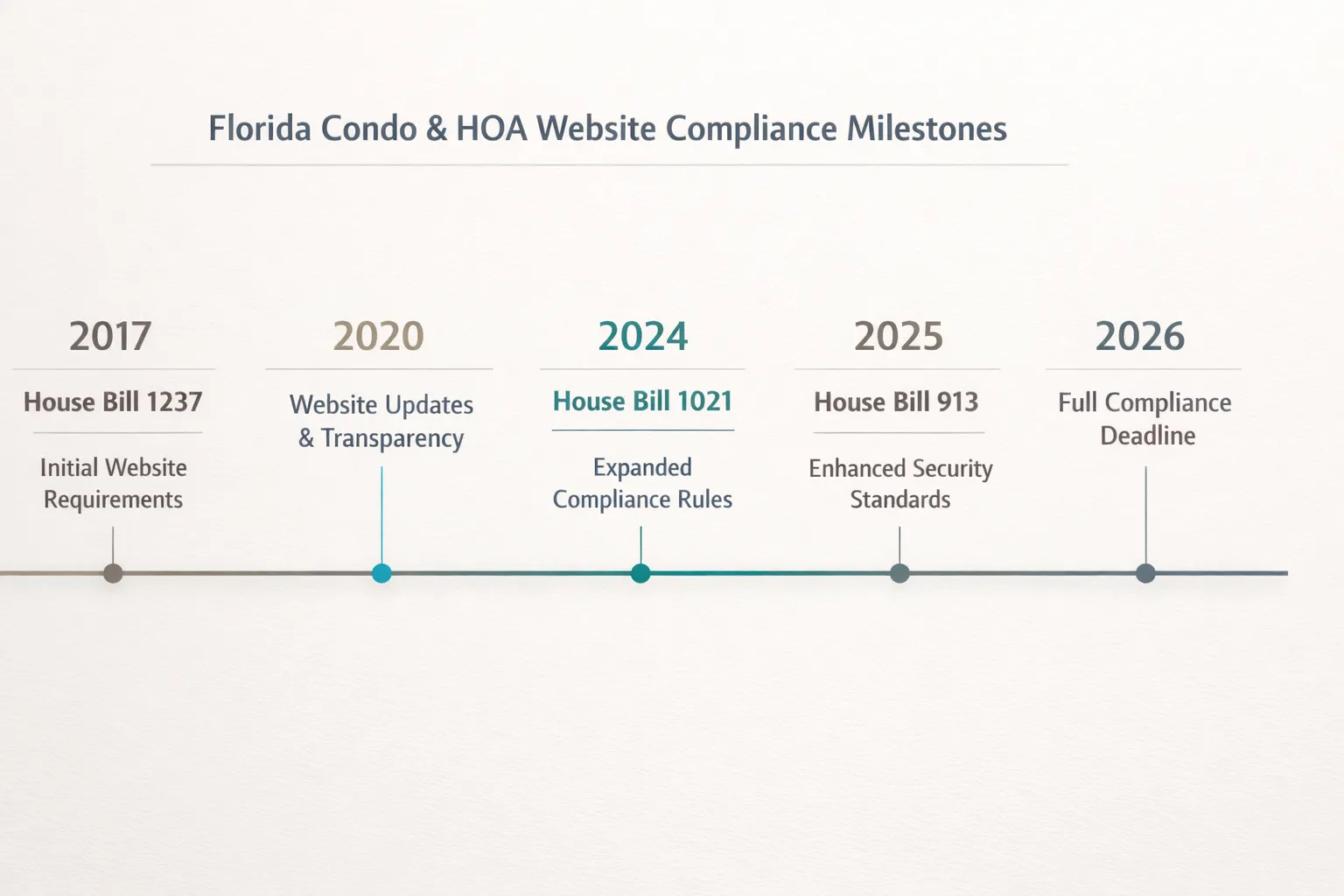
Key compliance deadlines for Florida condominium and homeowners associations
Here’s what confuses a lot of boards: the “website” doesn’t have to be a fancy standalone site. Florida Statutes allow you to use a subpage on a management company’s web portal, or any other protected electronic location, as long as unit owners have secure, password-protected access that keeps the public out. The key is that parcel owners and association members can reach official documents via the internet or a mobile device without needing to email the property manager for every PDF.
Requirements have tightened since the 2018 legislative changes following the post-Surfside collapse push for transparency. House Bill 913, passed April 30, 2025, added requirements for posting approved meeting minutes and hyperlinks to video recordings of all board and membership meetings from the prior 12 months. All such records must be posted within 30 days of receipt or creation.
If you’re unsure whether your community falls under these rules, talk to your association’s attorney. The statutes use specific language about “statutory voting” versus non-proxy voting that can affect which requirements apply. Non-compliance with Florida condo website regulations can result in owner complaints and penalties from the Florida Department of Business and Professional Regulation. Fines can run up to $100 per day, and owners can sue for denied inspection rights.
L3ad Solutions is based in Titusville, right here on the Space Coast. We routinely read these statutes when building HOA and condo sites because we’ve seen what happens when boards guess at compliance and get it wrong.
What governing documents must be posted on a Florida condo website?
Florida law requires condominium associations to post several governing documents online, including bylaws, articles of incorporation, and rules and regulations. These core documents belong in a secure owner portal, not on a public-facing web page where anyone can download them.
The list of required official documents includes the recorded declaration of condominium (including any amendment thereto), bylaws with all amendments, articles of incorporation, rules of the association, and current written policies and resolutions approved by the board.
Declaration of Condominium
Including all recorded amendments. Must be current and clearly labeled.
Bylaws & Articles
Full set with every change. Post within 30 days of updates.
Rules & Policies
Current board-approved rules and resolutions. Easy to find in owner portal.
Any amendments must be included and kept updated. Practical guidance from attorneys familiar with the Condominium Act suggests posting updates within 30 days of recording. The statute uses the word “promptly,” but 30 days has become the working standard, especially since House Bill 913 specified 30 days for meeting minutes and videos.
Florida law requires associations to post several governing documents online, ensuring residents have access to essential information. This isn’t optional for communities above the threshold. The association shall make these records accessible to unit owners through the website.
At L3ad Solutions, we set up a “Governing Documents” area with year-stamped filenames for easy compliance checks. Instead of a file named “Bylaws.pdf” that nobody knows when it was updated, you get “Bylaws_2024_Amendment.pdf” so board members and owners can see at a glance whether documents are current. Our HOA website services include this kind of practical organization by default.
A 200-unit Miami Beach condo that properly organized their governing documents reported reducing attorney queries by 50% because owners could find answers themselves. On the flip side, a 2023 Broward County lawsuit saw owners sue for withheld amendments that should have been posted online. The document required by statute wasn’t there, and the board paid for it.
How should meeting notices, agendas, and minutes be organized online for compliance?
Florida condos must provide digital access to board meeting and annual meeting notices, agendas, and approved minutes. Florida law requires community associations to provide digital access to important meeting-related documents, including meeting notices, agendas, and minutes. This applies to board meetings, membership meetings, and any scheduled meeting where official business happens.
The timing rules in plain English: most board meetings require at least 14 days notice under Florida Statute 718.112. Some emergency meetings have shorter windows. The association shall post such notice where members can find it. After House Bill 913, you also need to post hyperlinks to video recordings of meetings from the prior 12 months, all within 30 days of the meeting.
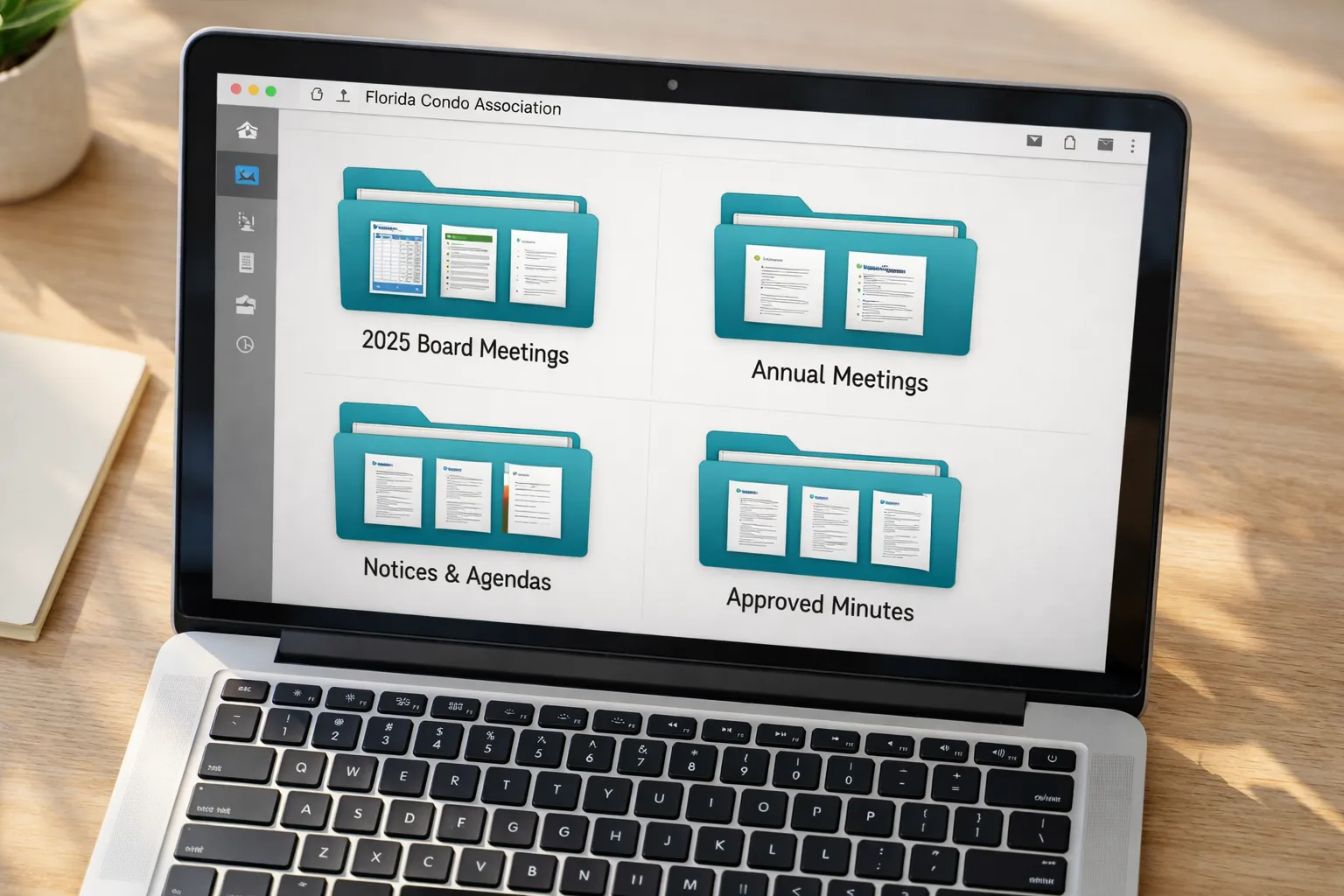
Recommended folder structure for meeting documents that satisfies Florida Statute 718.112
To facilitate document management, it is recommended to organize files in clearly labeled folders and subfolders, which helps residents quickly locate key information. Here’s a structure that works: Board Meetings folder organized by year, subfolders or grouped files for notices, agendas, and approved minutes, Annual Meetings with the same structure, and Special Meetings if they occur.
Condo websites must include features that allow for the organization of documents into clearly labeled folders and subfolders to facilitate easy access for residents. A “Community Documents” page with clearly labeled links helps owners avoid emailing the board for basics. When someone wants to know what happened at the January meeting agenda discussion, they can find it themselves.
L3ad Solutions bakes this structure into every condo site. Staff can drag and drop PDFs without touching code. A 120-unit Cocoa Beach association we worked with uses this approach and cut document-related email requests by about 40%. That’s 40% fewer interruptions for the community association manager and faster answers for residents.
If you’re thinking about professional web design for your association, make sure whoever builds it understands these posting requirements. A pretty site that makes compliance difficult isn’t worth much.
What financial reports and budgets must be available on your condo website?
Florida statutes require that financial documents, including budgets and financial statements, be made available digitally to residents of condominium associations. At minimum, owners must be able to see the most recent financial report and the current year’s annual budget without emailing the manager and waiting three days for a response.
The specific financial documents required include the proposed budget (before adoption), adopted annual budget (the final version), year-end financial statement, latest monthly or quarterly financial reports considered at board meetings, and reserve schedules and reserve studies (where applicable).
The annual budget required by statute isn’t just something you hand out at the annual meeting and forget. It stays online where association members can reference it throughout the year. Same with the financial report required by law. These aren’t secrets. Owners have a financial interest in understanding where their money goes.
Here’s a recommended layout for your association’s website: Annual Budgets section (proposed and adopted, labeled by year), Year-End Financial Statements, Monthly/Quarterly Reports, and Reserve Studies and Schedules.
Proper labeling matters. Instead of “Budget.pdf,” use “2024 Adopted Budget – Approved 10/15/2024.” This keeps owners from confusing drafts with finals, which is a common source of complaints and conflict of interest accusations when people think numbers are being hidden.
Transparent financial pages tend to reduce rumor and complaints. HOA management surveys show associations with clear online financials see 25-30% fewer rumor-driven complaints. A Palm Bay condo we know of posts monthly income and expense statements, and trust went up during a year when insurance costs spiked. Owners could see exactly why assessments increased instead of assuming the board was mismanaging funds.
Good organization also helps search visibility for owners searching their community by name. When your digital marketing services are done right, residents and prospective buyers find official documents instead of outdated third-party listings.
Which administrative and planning records must be posted, and which can stay offline?
Not every record must be online. Florida statutes specify that while some association records can be made available to the public, other information must be protected and accessible only to residents, promoting privacy and security. The line between what goes on the community website and what stays in the manager’s office isn’t always obvious.
- Reserve studies and engineering reports
- Maintenance schedules and insurance summaries
- Summaries of contracts over $500
- Major project planning documents
- Full owner ledgers and payment histories
- Attorney-client privileged communications
- Social Security numbers and screening reports
- Individual violation letters with owner names
Sensitive items like full owner ledgers or attorney-client communications should never be public-facing. A 2024 Melbourne condo exposed owner emails publicly by accident, risking privacy complaints and owner exodus. That kind of mistake is entirely avoidable with proper site structure.
L3ad Solutions works with boards to create a clear “Owner Resources” hub that balances transparency with privacy. We help associations across Brevard County and other cities through our Florida service areas, and getting this balance right is always part of the conversation.
How do you protect sensitive condo records with proper website access controls?
Florida law splits records into public, owner-access, and protected categories, so not everything belongs on an open web page. To comply with Florida’s digital access requirements, condo websites should have the capability to password-protect sensitive pages, ensuring that only authorized residents can access certain information.
In simple terms, access controls work like this: public pages show basic information anyone can see, owner portal pages hold governing documents, financials, and meeting minutes after login, and protected pages restrict sensitive records like owner rosters to specific roles.
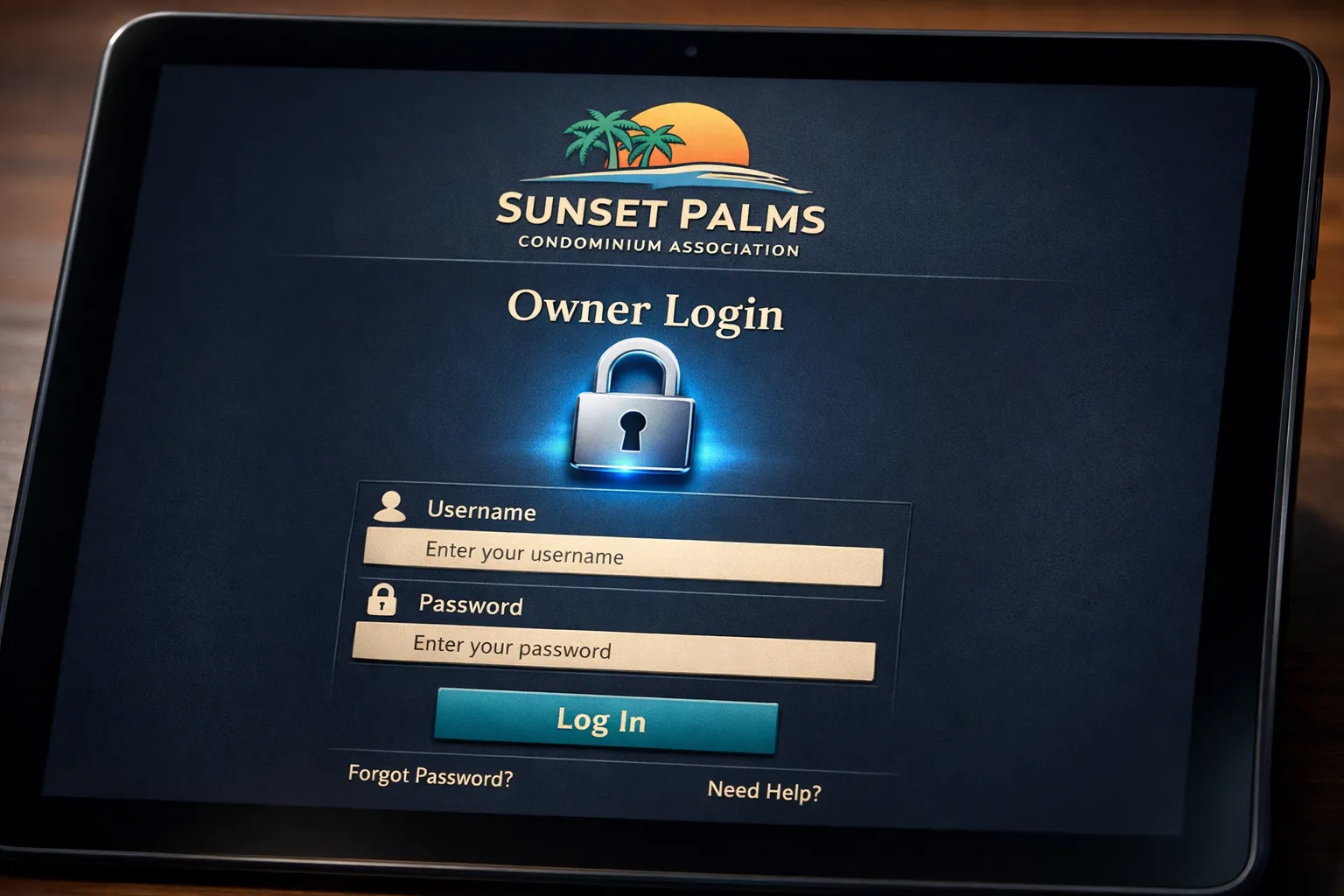
Example of a properly secured owner portal that meets Florida statute requirements
Password-protected owner portals with individual logins are the standard. Some associations use role-based access, where board members see more than general owners. Either way, the secure member portal needs actual security, not just a page that says “Owners Only” but doesn’t check credentials.
Security measures such as SSL encryption are necessary to protect sensitive data on association websites. That’s the padlock icon in your browser’s address bar. If your site doesn’t have HTTPS, you’re failing a basic security test. Some associations go further with SOC2 compliance, but HTTPS is the minimum.
Items that must never be publicly viewable include Social Security numbers, full payment histories, screening reports and background checks, and medical or emergency contact information.
A 2023 Florida case resulted in a $50,000 fine for an association that exposed owner rosters publicly. The knowing or intentional disregard for privacy rules can get expensive fast.
Clear visual cues help residents understand what requires login. A padlock icon or “Owners Only” label on navigation shows people what they can access versus what needs credentials. L3ad Solutions typically sets up protected sections for rosters, violation letters, and sensitive vendor contracts by default.
If terms like “SSL” or “role-based access” are new to you, our SEO glossary explains related web and security terms without the jargon.
How can your condo website stay compliant, fast, and easy to use without a full-time tech person?
A well-planned structure, simple content editor, and routine quarterly reviews are usually enough to stay compliant. You don’t need a webmaster on staff. You need a site built properly from the start.
Here’s a small maintenance checklist most boards can handle: upload approved board meeting minutes within 30 days, post adopted annual budget after approval and update year-end financial statement yearly, upload governing document amendments within 30 days of recording, and do a quick review quarterly to confirm all links work and documents are current.
- Upload approved minutes within 30 days of each meeting
- Post adopted budgets and year-end statements promptly
- Update governing documents within 30 days of recording
- Test all links and mobile access every quarter
- Confirm HTTPS and WCAG 2.1 AA accessibility standards
Sites must meet WCAG 2.1 Level AA standards for accessibility to individuals with disabilities. This matters because Florida has a significant retiree population, and many residents access documents from phones or tablets with accessibility features. Roughly 60% of retiree access in Space Coast communities comes via mobile device, so your site better work on phones.
Fast, mobile-friendly pages matter because a large portion of residents will check documents from phones. Pages should load in under 3 seconds. Anything slower and you’ll see 20% or more abandonment, people clicking away before the page loads. That means frustrated owners calling the management company instead of finding answers online.
You can check your site speed with a quick test. If it’s slow, fixing it is usually straightforward but requires someone who knows what they’re doing.
L3ad Solutions can run a free HOA website audit focused on Florida condo law compliance, site speed, and ease of use. We look at whether documents are organized properly, whether the protected electronic location actually protects, and whether the site loads fast enough for real people to use it.
Good structure also supports basic local SEO services so owners and buyers find the association’s website quickly in Google instead of outdated listing sites.
How does L3ad Solutions help Florida condo and HOA boards build compliant websites?
L3ad Solutions is a Titusville-based agency that designs condo and HOA websites around Florida’s specific statute requirements. We’re not a general web shop that happens to do association sites. We read Florida Statutes 718 and 720 before we build, not after a board gets a complaint from the DBPR.
The founder’s Intel operations and data analytics background shows up in how we structure information architecture. Every document has a clear category. Every update gets tracked. Board members know exactly where to put files and how to confirm they’re current.
We provide a secure owner portal with password protection and role-based access, a document library organized by category, mobile-first design that works on phones and tablets, speed optimization for fast load times, and clear how-to documentation so board members can update without calling us.
A 120-unit Cocoa Beach condo we worked with cut document-related email requests by about 40% after launch. The community association manager spent less time digging up PDFs and more time on actual management. Owners stopped complaining about not being able to find meeting minutes because the minutes were exactly where they expected them to be.
Our HOA website services cover the full compliance checklist. We also handle website design services for communities that want something more polished than a basic template. And if you’re looking at the bigger picture of how your association shows up online, marketing and advertising in Florida is where we help communities think beyond just compliance.
We’re not trying to lock anyone into long contracts. Month-to-month works for most associations, and if you want to bring updates in-house eventually, we’ll document exactly how to do it.
What are the most common mistakes Florida condo boards make with their websites?
Boards make the same handful of mistakes over and over. Here are the ones we see most: outdated documents (about 60% of association sites we audit have governing documents that haven’t been updated after amendments were recorded), no password protection, hard-to-find meeting info, and non-mobile layouts.
A Melbourne condo left owner emails visible to the public for months. Anyone could scrape that list for phishing targets. The board didn’t realize the exposure until an owner complained. That’s the kind of privacy issue that damages trust and can trigger complaints to the Florida Department of Business and Professional Regulation.
Missing required documents violates owner inspection rights under the Condominium Act. Owners can submit a written request for records, and if those records should have been online, the board’s in a weak position. Knowing or intentional disregard for posting requirements can escalate to fines.
We recommend a simple yearly “website health check.” Go through every required category, confirm documents are current, test the login system, and check that mobile access works. You can use a free SEO audit tool to catch technical problems that also affect residents.
L3ad Solutions offers month-to-month help, so boards aren’t locked into long contracts just to keep existing websites updated. If you need help for six months while you get organized and then want to maintain it yourself, that works.
How can Florida condos use their websites for more than just compliance?
Once the legal basics are covered, your community website can do a lot more than host PDFs that nobody reads. The site becomes a communication hub that actually makes life easier for everyone.
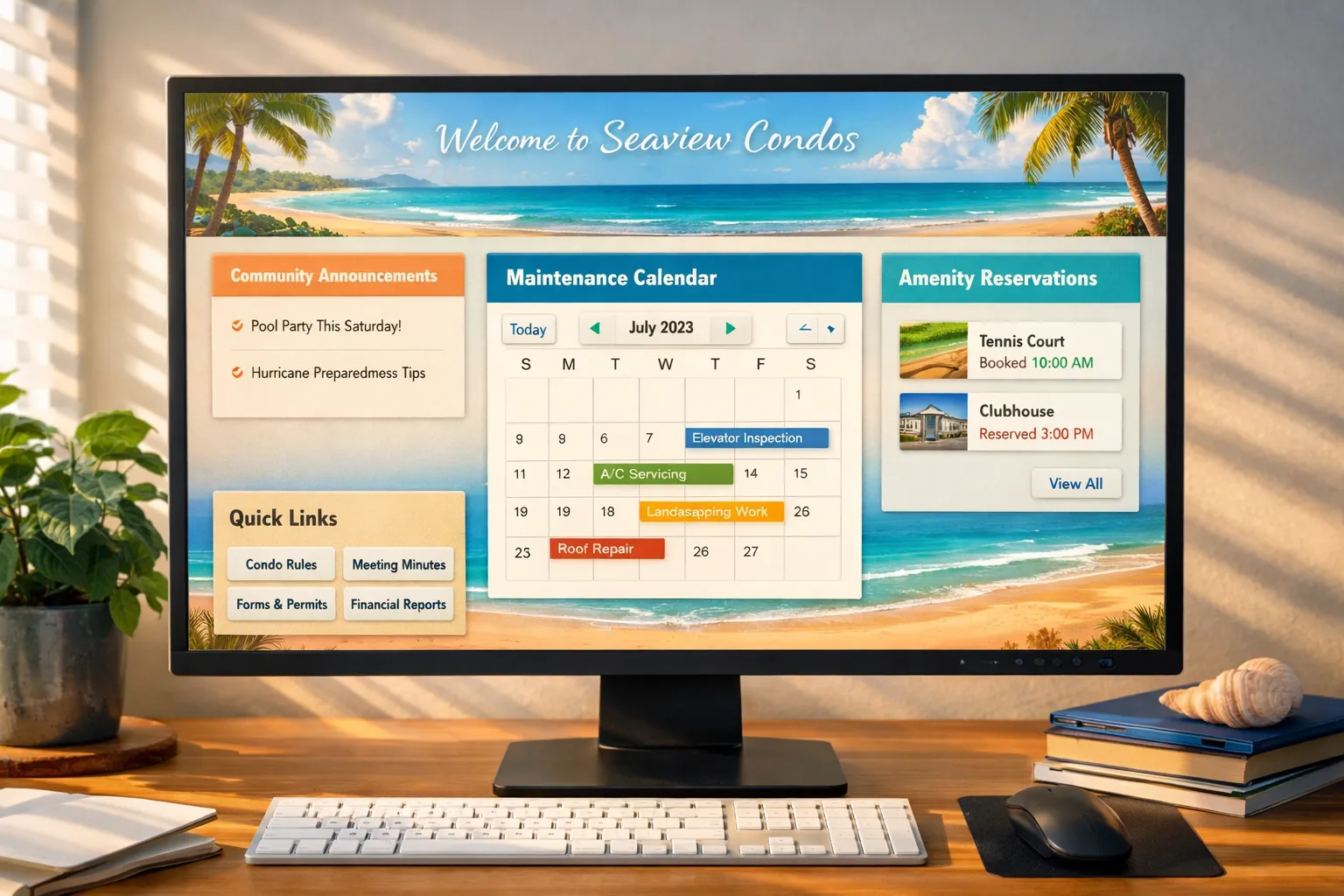
Beyond compliance: a practical community hub that reduces manager workload
Sections worth adding beyond compliance include announcements for hurricane prep notices, pool closures, and vendor schedules, maintenance calendars so owners know what’s happening before trucks show up, amenity rules and schedules that cut repetitive questions to managers, and photo galleries that build community pride.
Strong Google Business Profile services and on-site content help future buyers find accurate information instead of outdated third-party listings. If someone Googles your community name, your official site should come up first with correct data.
Online forms save everyone time. Work order submissions, gate access requests, architectural review applications, vendor registration. Instead of paper forms that get lost, everything routes to the right person automatically.
For associations where timeshare units or rental properties are part of the mix, the website helps owners and authorized agents get information without calling during office hours. A third party provider managing rentals can access what they need through proper credentials.
We help associations add AI automation for routine confirmation emails and reminders. In plain English: automatic follow-up messages. When someone submits a work order, they get a confirmation. When the board meeting is coming up, owners get a reminder. This kind of automation cuts community association manager time by around 30%.
Note for condos involved in real estate marketing: websites operated by real estate agents need to include proper MLS attribution and ensure listing data accuracy. Real estate websites in Florida must include broker details such as the licensed name of the brokerage and licensee information. Florida real estate marketing websites must comply with standards set by the Florida Real Estate Commission (FREC) and the National Association of REALTORS® (NAR). If your condo site includes any listing features, make sure those bases are covered.
Compliance is the starting point, not the end goal. Once you’re not worrying about whether you’ll get fined, you can focus on making the site actually useful.
What are quick next steps for bringing your Florida condo website up to code?
Getting compliant doesn’t require a six-month project. Here’s a simple action plan a board president or secretary can start in under an hour: gather your documents and pull current versions of declaration, bylaws, articles of incorporation, rules, financial statements, and budgets. Map what’s online now and compare against what’s required. Pick a secure platform that supports password-protected sections. Schedule a board review and assign someone to own the website updates. Finally, test access with a few owners.
You can run a local SEO audit as a quick technical check alongside compliance work. It catches issues like slow load times, broken links, and mobile problems that affect whether residents can actually use the site.
L3ad Solutions can do a free document-mapping call for Florida associations to identify compliance gaps. We’ll look at what you have, what you need, and give you a straight answer about how much work it is to get current.
If you want to stop guessing about statutes and tech, get a free consultation and we’ll walk through your specific situation.
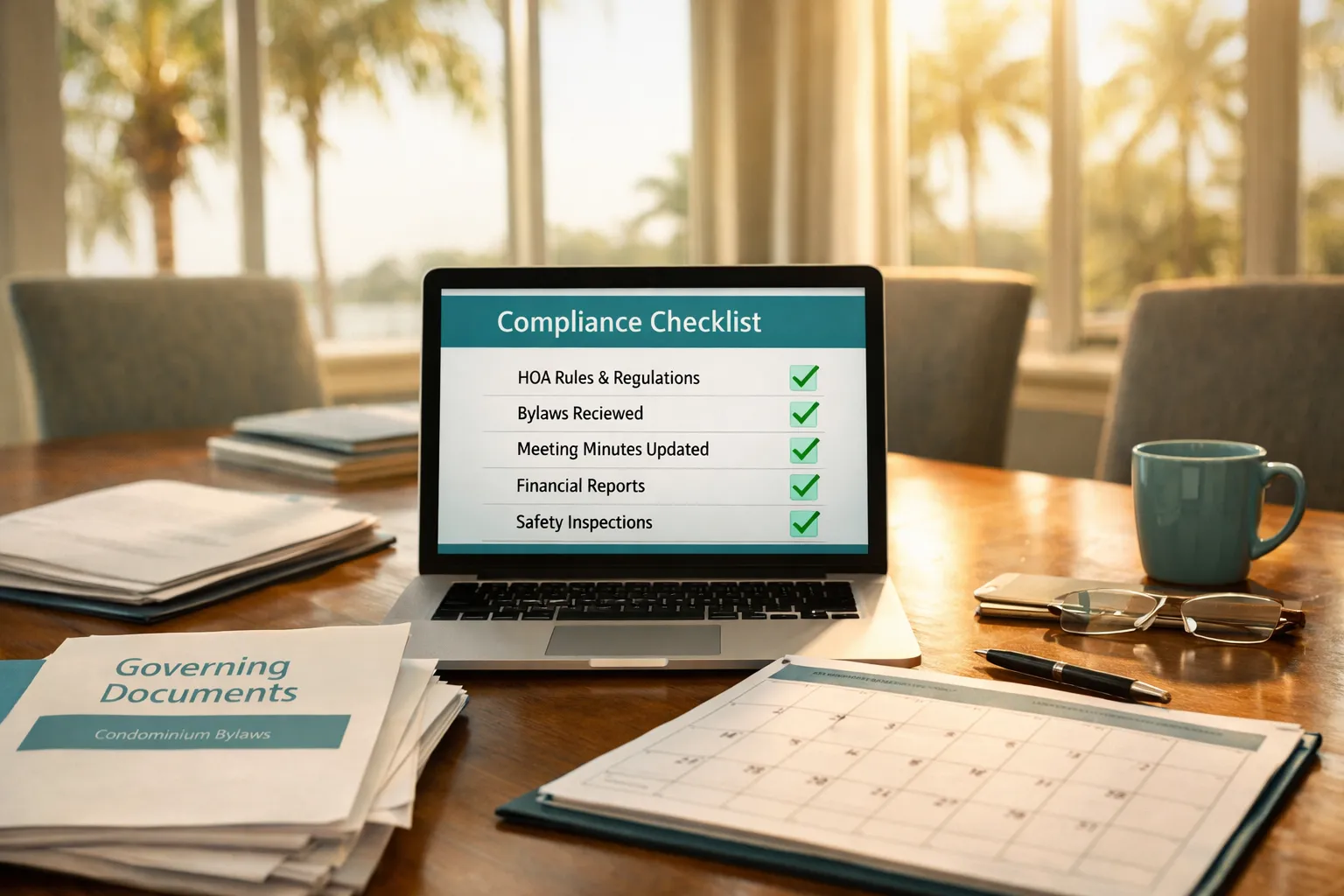
A simple yearly website health check keeps your association compliant and avoids costly fines
Getting your Florida condo website compliant doesn’t have to be complicated, but it does have to happen. The deadlines are real, the statutes are specific, and the good news is you can handle this faster than you probably think.
Start with the basics. Gather your documents. Confirm what’s already online. Fix the gaps. If you want help figuring out exactly where you stand, L3ad Solutions runs free compliance audits for Florida associations.
Schedule a free consultation and we’ll tell you exactly what your association needs to do, no guessing required.
Tap a question to expand.
Do all Florida condos need a website?
Can we use our management company’s portal?
How often do we have to update documents?
What records should never go online?
How secure does our site need to be?
What does a compliant site usually cost?
How many owners actually use these sites?
Ready to bring your association website into compliance without the headache? Our team builds secure, easy-to-maintain sites that meet every Florida statute requirement while making life simpler for your board and residents.