


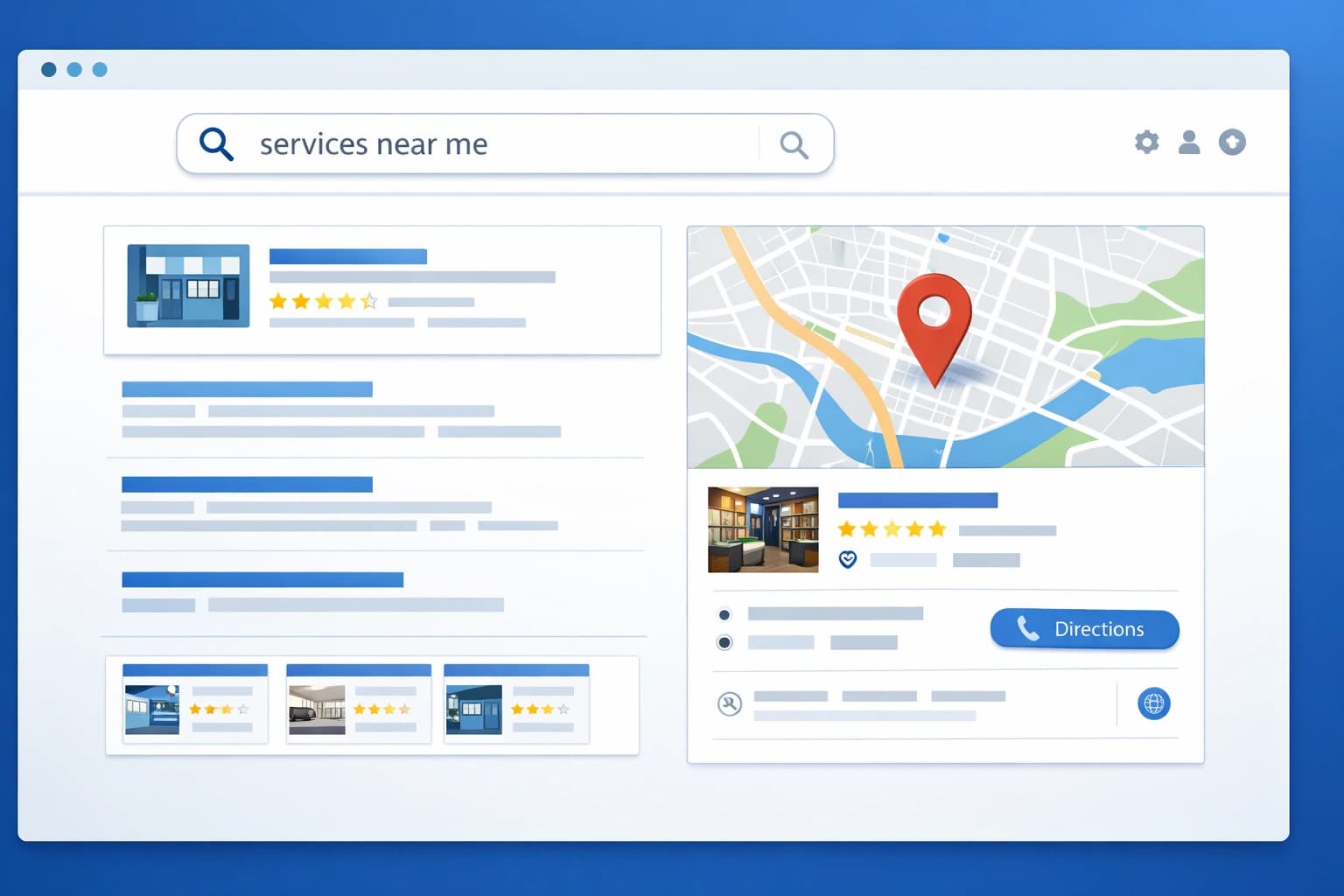
What Is SEO? A Plain-English Guide for Local Businesses
What SEO is and how it helps a local business get found online: rankings, Google Maps, reviews, and what to do first. Beginner-friendly, no jargon.
Updated February 5, 2026 · 15 min read
Table of Contents
Key Takeaways
SEO, or search engine optimization, is the practice of earning visibility in Google and other search engines without paying for ads. When someone types a query for services in their area, the businesses that appear in those results have invested in SEO to get there. For local businesses, this means showing up in Google’s map pack, organic results, and mobile searches when nearby customers are actively looking for your services.
Strong SEO combines three interconnected areas: technical health (making sure search engines can access your site), on-page content (optimizing what visitors see), and off-page signals (reviews, citations, and links that build trust). At L3ad Solutions, we pair SEO with professional web design and lead tracking so business owners can see actual calls, form fills, and booked appointments coming directly from search.
SEO is a long-term investment. Most businesses see meaningful results in 3-6+ months. But once that organic traffic starts flowing, it often becomes the most profitable digital marketing channel because you’re not paying for every click like you do with ads. For local businesses specifically, our complete local SEO guide covers how to apply these principles to your area.
- SEO helps local businesses appear in organic search results without paying for ads.
- It combines technical health, on-page content, and off-page signals like reviews.
- Results take 3-6+ months but can become a highly profitable channel.
What Is SEO (Search Engine Optimization)?
Search engine optimization is the process of optimizing your website and online profiles so search engines like Google, Bing, and Apple Maps show your business higher for searches relevant to your services. It’s about making your digital presence visible to people who are already looking for what you offer.
When you search for something on Google, you’ll typically see two types of results: paid ads (labeled “Sponsored” at the top) and organic results below them. SEO focuses entirely on earning those organic placements, the ones you don’t pay for directly. While paid ads disappear the moment you stop spending, organic search results continue driving website traffic as long as you maintain your rankings.
Here’s what this looks like in practice for local businesses:
- “Emergency repair Cocoa” → A homeowner needs urgent service at 2 AM
- “Med spa in Melbourne FL” → Someone researching aesthetic providers before booking
- “Estate planning attorney near me” → A family preparing legal documents
Each of these searches represents a potential customer with immediate intent. SEO connects these real people with nearby service providers who can solve their problems.
Modern search engine optimization also affects visibility beyond traditional blue links. Answer engine optimization now influences how your business appears in AI-powered results and voice searches through Siri, Alexa, and Google Assistant.
L3ad Solutions offers integrated digital marketing services that combine SEO, website design, and conversion optimization specifically for local businesses ready to capture more of this search traffic.
SEO connects your business with customers who are actively searching for your services, making it a powerful tool for generating qualified leads.
The Three Core Pillars of SEO
Modern SEO work divides into three pillars: technical SEO, on-page SEO, and off-page SEO. Strong performance requires attention to all three. Neglecting any one pillar undermines the others.
Technical SEO means making sure major search engines can easily crawl, index, and understand your site. This covers the technical aspects most business owners never see: site speed optimization, mobile-friendliness, secure HTTPS connections, structured data markup, and clean site architecture. Think of it as the foundation of a house: invisible but essential.
On-page SEO involves optimizing content and structure on each page. This includes keyword research and targeting, heading structure, internal links between pages, image optimization, and clear calls to action that drive leads. On page optimization ensures both visitors and web crawlers understand what each page offers.
Off-page SEO builds trust and authority beyond your website. It comes from local citations (directory listings), customer reviews, and quality backlinks from relevant websites. Search engine algorithms interpret these external signals as votes of confidence for your business.
Our local SEO services are built around auditing and improving all three pillars for sustained online visibility and lead generation.
Technical SEO
Ensures search engines can crawl and index your site with fast loading, mobile-friendliness, and secure connections.
On-Page SEO
Optimizes content on your site with keywords, headings, and calls to action to attract and convert visitors.
Off-Page SEO
Builds trust through reviews, citations, and backlinks to establish authority beyond your website.
How Search Engines Work: Crawling, Indexing, Ranking
Behind every Google search lies a three-step process: crawling, indexing, and ranking. Technical issues at any step can break the chain and prevent your web pages from appearing in search results.
Understanding this process helps explain why some websites rank while others remain invisible, and what you can do about it.
| Step | What Happens | What Can Go Wrong |
|---|---|---|
| Crawling | Bots discover pages via links and sitemaps | Broken links, blocked pages, slow servers |
| Indexing | Google decides whether to store the page | Thin content, duplicate pages, noindex tags |
| Ranking | Algorithm orders results for search queries | Weak relevance, poor user experience, low authority |
Our SEO strategy always begins with a crawl and index health check, then fixes issues so Google can properly see and evaluate your site.
Crawling: Getting Your Pages Discovered
Web crawlers (also called bots or spiders) discover pages by following links across the internet. For your site to rank, these crawlers first need to find all your important pages.
Several elements help crawlers move through your site efficiently:
- XML sitemaps that list all important URLs
- Clean navigation menus with logical structure
- Internal links connecting related service and location pages
- Fast server response so crawlers don’t time out
Avoid orphan pages (pages with no internal links pointing to them) and excessive URL parameters that confuse crawlers. Consolidating thin or duplicate content prevents search engine crawling resources from being wasted on low-value pages.
For multi-location or multi-service businesses, proper site architecture becomes especially critical. Map your URL structure clearly before investing heavily in content work. Retrofitting a messy structure later costs significantly more time and money.
Regularly monitor crawl errors and 404 pages using tools like Google Search Console, fixing issues as part of ongoing SEO maintenance.
Indexing: Being Eligible to Show Up
Just because a crawler finds a page doesn’t mean Google will index it. Search engines evaluate whether each page provides enough unique value to deserve a spot in their database.
Low-quality or duplicate content often gets skipped entirely. Over time, pages that don’t earn engagement may be de-indexed.
For local service businesses, this means creating content that matters:
- Create indexable pages for each high-intent service (“roof replacement,” “Botox injections,” “bathroom remodeling”) rather than lumping everything onto one generic “Services” page
- Use canonical tags correctly when similar content must exist on multiple URLs
- Avoid creating thin pages that add little value beyond what already exists
Correct use of noindex tags and canonical markup helps search engines focus on your most important lead-generating pages rather than getting confused by duplicates.
Part of our website design services is planning page templates and content structure so your key offers are easy to index and rank from day one.
Ranking: Competing for the Top Spots
Once your pages are indexed, search engine algorithms determine where they appear for specific search queries. Hundreds of ranking signals influence this ordering.
Major factors include:
- Match to search intent (does the page answer what the searcher wants?)
- Content quality and depth
- Page speed and mobile usability
- Backlink profile and domain authority
- User engagement signals (time on page, bounce rate)
For local SEO specifically, Google’s local algorithm weighs additional factors:
- Proximity to the searcher
- Relevance of business categories
- Review volume and ratings
- Completeness of your Google Business Profile
User engagement directly supports better keyword rankings over time. When visitors quickly leave your site (pogo-sticking back to search results), it signals quality problems. Conversion-friendly design keeps visitors engaged and sends positive signals to search algorithms.
We track ranking improvements alongside calls, form fills, and bookings so owners see both visibility and revenue impact. Check our proven results page for examples.
Paid Search vs. Organic Search
A typical Google search results page displays paid ads at the top (marked “Sponsored”) followed by organic listings below. On mobile, the map pack often appears for local searches, pushing organic results further down.
Both channels have distinct advantages:
Paid Search Pros:
- Instant visibility: go live today
- Precise control over targeted keywords and budget
- Ideal for time-sensitive promotions (seasonal tune-ups, limited-time offers)
- Easy to scale up or down based on capacity
Organic Search Pros:
- Compounding, long-term organic traffic that doesn’t stop when ad spend pauses
- Higher trust from many users who skip ads
- Lower cost per lead over time once rankings are established
- Builds lasting digital asset value
Many successful local businesses run both channels. They use SEO to reduce cost per lead over time while paid search fills immediate gaps or tests new service offerings in a competitive market.
The key insight: paid ads rent visibility while SEO builds ownership of organic search results.
L3ad Solutions designs landing pages and digital marketing services so both paid and organic traffic encounter clear messaging and strong calls to action that convert visitors into leads.
- Organic builds long-term traffic without ongoing ad costs.
- Higher trust from users who often skip ads.
- Becomes a lasting digital asset for your business.
- Organic takes months to see significant results.
- Requires consistent effort to maintain rankings.
- Less control over immediate visibility compared to paid.
What Is an SEO Strategy?
An SEO strategy is a documented plan connecting your business goals with specific SEO actions and timelines. Rather than random tactics, a strategy provides the roadmap for where you’re going and how you’ll get there.
A complete SEO plan goes beyond keywords to include:
- Site structure and technical improvements
- Content roadmap (what pages to create, when)
- Local listings and citation building
- Review generation systems
- Measurement and reporting framework
Consider how strategy differs across local businesses:
| Business Type | Strategic Priority | Target Keywords |
|---|---|---|
| Med Spa | High-margin services | “laser hair removal Melbourne FL” |
| Roofing Company | Storm-season emergencies | “emergency roof repair Brevard County” |
| Family Lawyer | High-intent legal needs | “divorce attorney near me” |
A solid strategy also clarifies what not to pursue immediately. Many business owners waste budget chasing low-value keywords or copying competitors without understanding why. Strategic focus identifies the fastest, highest-ROI opportunities for your target market.
Our service packages are built around clear strategies, not random checklists of SEO tasks.
A well-defined SEO strategy prioritizes high-ROI opportunities specific to your market, avoiding wasted effort on low-value tactics.
Setting SEO Objectives That Match Your Business
Vague goals like “get more clients” don’t provide enough direction. Define 3–5 measurable objectives that your in-house SEO team or agency partner can work toward:
- “Increase organic calls by 40% in 6 months”
- “Achieve top-3 map pack visibility for 5 core service keywords”
- “Generate 25 new form submissions monthly from organic search”
Tie objectives to your actual sales funnel:
- Impressions (how often you appear)
- Clicks (visitors to your site)
- Leads (calls, forms, bookings)
- Appointments (scheduled consultations)
- Revenue (closed business)
Different business models require different SEO campaigns and metrics. Appointment-based clinics may prioritize scheduled consultations. Emergency services focus on immediate calls. Legal services might emphasize consultation requests.
Part of our consultation process is turning vague goals into specific KPIs that owners can track in dashboards and call logs.
Local SEO: How It Differs from General SEO
Local SEO focuses on getting your business found by people searching within a specific area, especially on mobile search and in Google Maps. While basic SEO principles apply, local optimization requires additional specialized tactics.
The “local pack” (map with 3 business listings) appears for queries like “repair near me” or “dentist Brevard County.” For brick-and-mortar and service-area businesses, this map visibility often drives more leads than traditional organic results.
Key local signals that influence Maps visibility:
- Google Business Profile completeness and activity
- NAP consistency (name, address, phone across the web)
- Local citations on directories and industry sites
- Review volume, ratings, and recency
- Proximity to the searcher’s location
Industries where local SEO typically produces outsized returns:
- Dentists and medical practices
- Med spas and aesthetic clinics
- Electricians and maintenance services
- Home improvement specialists
- Chiropractors and physical therapists
- Family lawyers and estate planning attorneys
- Gyms and fitness studios
L3ad Solutions focuses heavily on local SEO for Space Coast businesses and other Brevard County companies where local visibility directly translates to booked appointments.
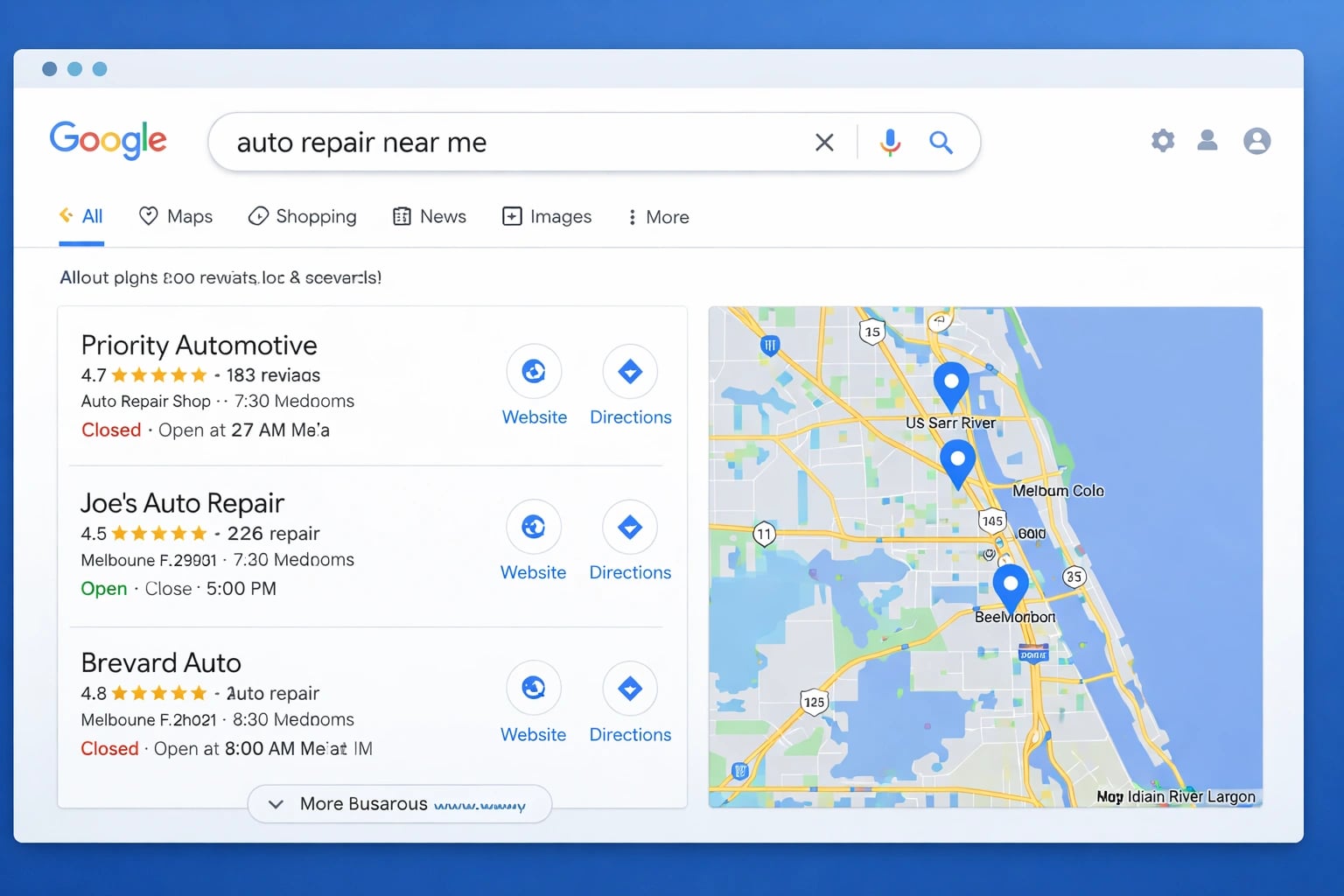
The Google local pack often appears for 'near me' searches, making local SEO critical for visibility.
Google Business Profile and Maps Visibility
Your Google Business Profile (GBP) is often the first thing customers see on mobile: a tap-to-call button, directions, reviews, photos, and service information all in one place. For many local businesses, GBP optimization drives more leads than the website itself.
Key optimization steps for your profile:
- Categories: Select the most accurate primary category and relevant secondary categories
- Services: Add all services with descriptions
- Service areas: Define the geographic areas you serve
- Hours: Keep regular and holiday hours accurate
- Photos: Upload quality images of your work, team, and location
- Q&A: Answer common questions proactively
- Posts: Share updates, offers, and news regularly
Review generation deserves special attention. Ask happy clients for reviews after completing work, and respond to both positive and negative feedback professionally. Google analytics shows that businesses with more reviews and higher ratings earn more clicks and calls.
Our Google Business Profile services include setup, optimization, and ongoing posting to improve Maps rankings and call volume.
- Choose accurate categories and list all services.
- Define service areas and keep hours updated.
- Upload quality photos and post regular updates.
- Encourage and respond to customer reviews.
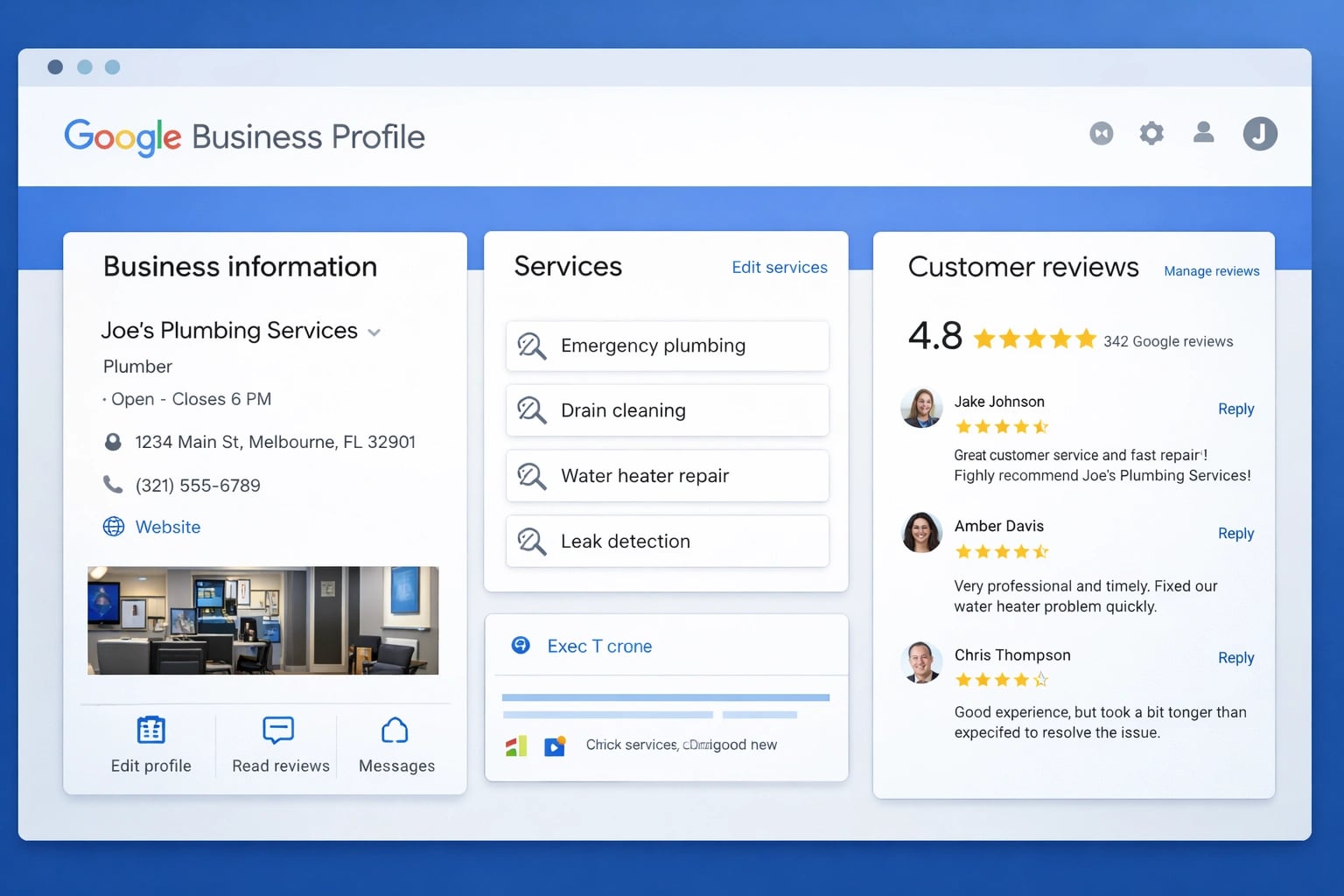
Optimizing your Google Business Profile can significantly boost local visibility and customer engagement.
Local Citations, Directories, and Reviews
Citations are mentions of your NAP information (name, address, phone) on directories like Yelp, Apple Maps, Facebook, and industry-specific sites. Consistency across these listings supports local trust signals that influence search engine results.
Common citation issues that hurt your website’s SEO:
- Old addresses from previous locations
- Disconnected phone numbers still listed
- Business name variations (LLC vs. no LLC)
- Duplicate listings on the same directory
Cleaning up these inconsistencies should be a priority before building links or adding new citations.
For ongoing review generation, create a simple request process:
- Complete the job or appointment
- Send SMS or email follow-up within 24 hours
- Include direct link to your Google review page
- Thank customers who leave reviews
Review content matters beyond just star ratings. Reviews mentioning relevant keywords (“great emergency service,” “best treatment in Melbourne”) can influence what you rank for. Recency matters too. A steady stream of new reviews signals an active, trustworthy business to search algorithms.
On-Page SEO and Website Conversion
On-page SEO encompasses everything you control on your website pages: titles, headings, content, internal links, images, and calls to action. For local businesses, content optimization and conversion design are inseparable. SEO ranking is worthless if visitors can’t quickly understand what you offer and how to contact you.
Each main service page should include:
- Clear headline stating exactly what service you provide
- Concise value proposition explaining why customers choose you
- Trust elements like reviews, certifications, and before/after images
- FAQs addressing common questions and objections
- Strong calls to action for calls, forms, or booking
Our professional web design focuses on speed, clarity, and conversion tracking so owners see exactly which pages generate leads.
Avoid jargon-heavy copy that impresses no one. Use plain language, local references (cities, neighborhoods), and customer-focused messaging. Your target audience doesn’t care about “synergistic solutions.” They want to know if you can solve their problem today.
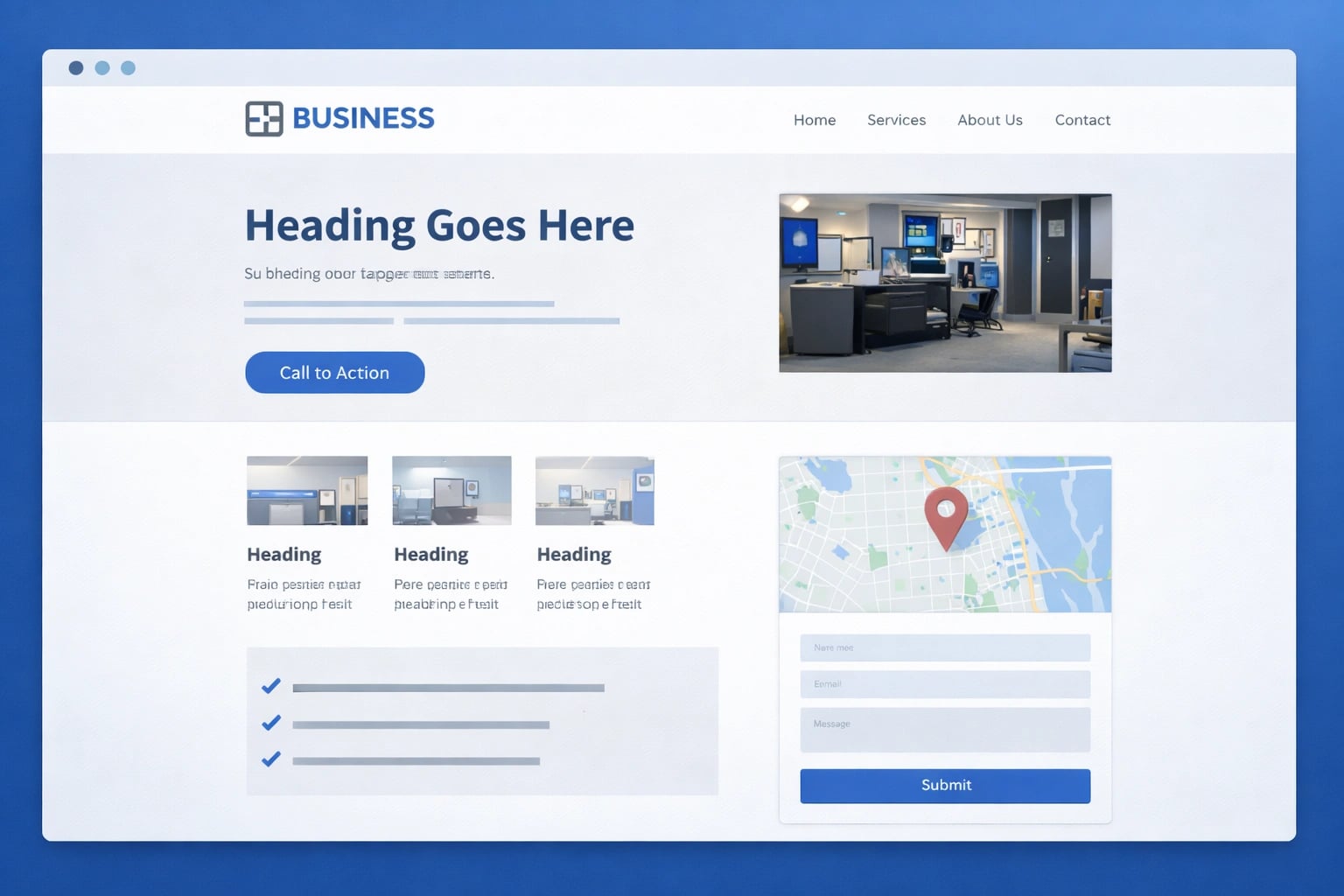
Effective on-page SEO ensures your website is both search-friendly and conversion-focused.
Key On-Page Elements to Get Right
Essential on-page elements for local service pages:
| Element | Best Practice |
|---|---|
| Title Tag | Include primary keyword + location, under 60 characters |
| Meta Description | Compelling summary with call to action, under 155 characters |
| H1 Heading | One per page, matches title intent |
| H2/H3 Headings | Organize content logically with secondary keywords |
| Images | Compressed for speed optimization, descriptive alt text |
| Internal Links | Connect to related services and location pages |
Each page should target a primary keyword plus closely related phrases. Avoid keyword stuffing. Search engines penalize awkward repetition that degrades content quality.
Contact options need to be immediately visible:
- Tap-to-call buttons that work on mobile
- Short forms (name, phone, brief message)
- “Book Consultation” or “Get Free Estimate” buttons
- Sticky headers or floating contact bars
Include localized trust signals: service area badges, certifications, local media mentions, and testimonials from customers in your area. Creating content that demonstrates local expertise builds relevance for geographic searches.
Measuring SEO: What to Track
SEO success isn’t just about ranking screenshots posted to a dashboard. It should connect directly to measurable leads and revenue that impact your bottom line.
Core metrics to monitor:
- Organic traffic: Visitors arriving from unpaid organic search results
- Keyword rankings: Position changes for targeted keywords
- GBP views and actions: How often people see and interact with your profile
- Calls: Phone calls from website and GBP
- Form submissions: Contact and quote requests
- Online bookings: Scheduled appointments
Best SEO tools for tracking include Google Analytics (website behavior), Google Search Console (search performance), and call tracking software (phone lead attribution). These tools help attribute leads to organic search rather than guessing which marketing channels perform.
Review reports monthly with specific questions:
- Which pages generate the most leads?
- Which keywords actually convert to customers?
- Which service lines need more organic traffic and visibility?
Many SEO companies offer reporting, but do they connect those reports to actual revenue? That’s the difference between vanity metrics and useful data.
L3ad Solutions includes lead and call tracking in many of our transparent pricing plans so clients can see real ROI from SEO work.
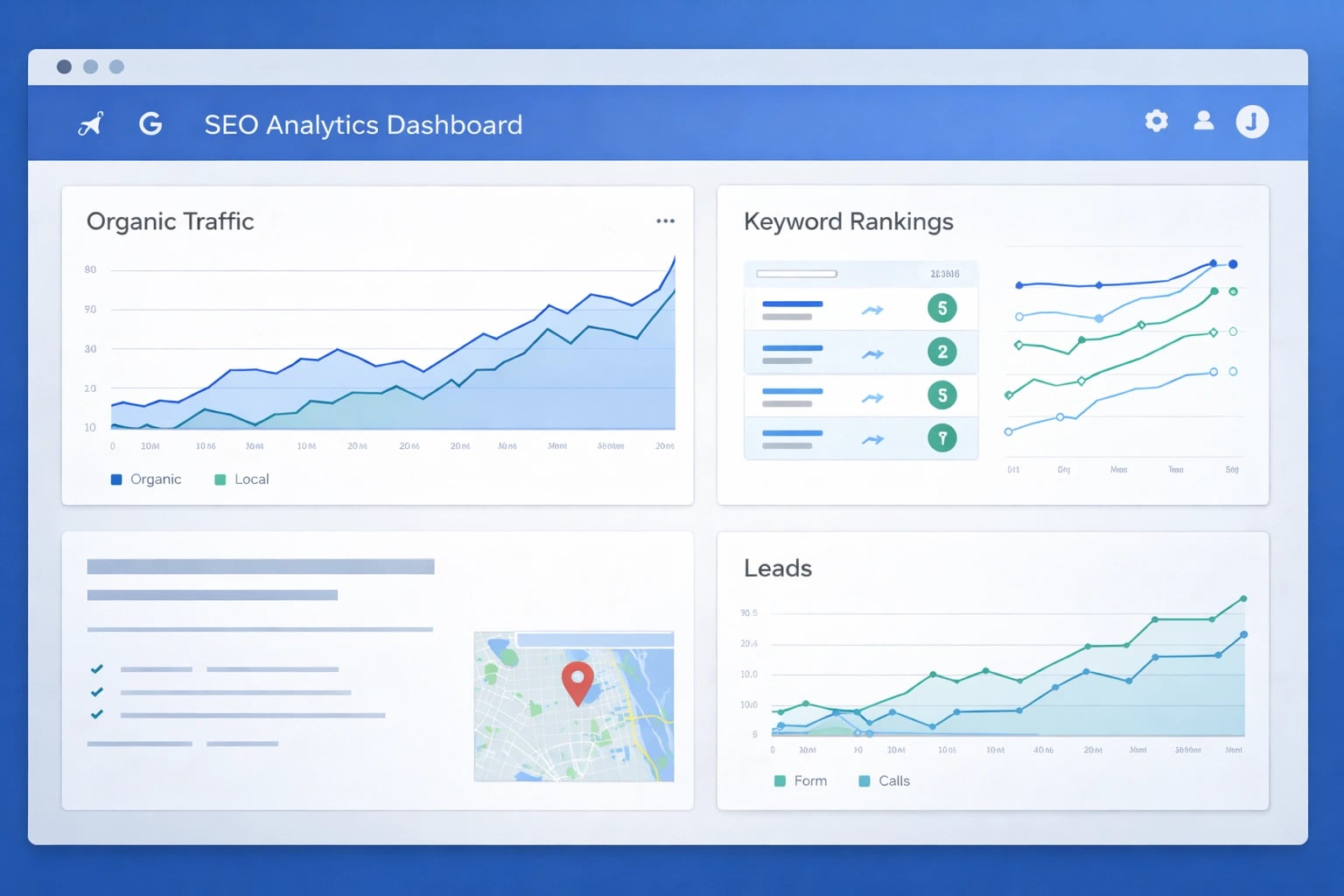
Tracking the right SEO metrics helps connect search visibility to real business outcomes.
Do You Need to Hire an SEO Agency?
Some business owners attempt DIY SEO, and for very basic tasks (claiming your Google Business Profile, asking customers for reviews, publishing helpful blog content), that’s entirely reasonable.
But DIY SEO typically stalls due to:
- Time constraints: Running a business leaves little time for learning SEO
- Technical gaps: Schema markup, crawl optimization, and site speed require expertise
- Algorithm changes: Search engine algorithms evolve constantly; what worked last year may not work today
Situations where hiring an SEO firm makes particular sense:
- Operating in competitive metros with many firms already optimizing for the same keywords
- Managing multiple locations requiring coordinated local strategies
- Highly regulated industries (healthcare, legal) with content compliance requirements
- Ready to scale quickly and need professional execution
A good SEO engagement should include:
- Thorough technical and content audit
- Clear strategy with prioritized actions
- Regular reporting tied to leads and revenue
- Alignment with your sales process and service capacity
A good SEO partner won’t promise instant rankings. They explain methodology in plain English and connect activities directly to lead generation.
We invite you to see examples of client results showing how SEO plus conversion-focused design impacted leads and revenue for local businesses.
Ready to understand where you stand? Request a free audit to learn what’s realistically achievable in your market.
How L3ad Solutions Approaches SEO for Local Businesses
L3ad Solutions is a B2B agency focused on local service providers (home services, trades, clinics, med spas, legal practices, fitness studios, and more) in defined service areas.
Our philosophy centers on measurable outcomes:
- Build fast, clear websites that convert visitors
- Optimize Google Business Profile for maximum Maps visibility
- Implement local SEO that targets high-intent search queries
- Track every call, form, and booking back to specific pages and campaigns
The typical engagement flows like this:
- Discovery call: Understand your business, goals, and current challenges
- Site and GBP audit: Identify technical issues, content gaps, and competitive opportunities
- Strategy presentation: Prioritized roadmap with realistic timelines
- Implementation: Execute technical fixes, content optimization, and local SEO tactics
- Ongoing optimization: Monthly reviews, reporting, and continuous improvement
Our industry-specific marketing experience helps us speak the language of your niche and prioritize the highest-value services first. We’ve seen what works for effective partnerships and know how to deliver SEO that drives appointments.
Ready to grow leads from organic search? See our SEO services or get a free consultation to discuss your goals.
FAQ About SEO for Local Businesses
Tap a question to expand.
How long does SEO take to work for a local business?
Is SEO worth it if I'm already running Google Ads?
Can I handle SEO myself?
How long does SEO take to work for a local service business?
Most local businesses begin seeing noticeable movement in 2–3 months for low-competition terms. More competitive services and cities typically require 4–6+ months before meaningful SEO success appears in more organic traffic and leads.
Timelines depend on several factors: current site quality, competition level in your market, existing review count, and how consistently you update content and your Google Business Profile.
Many business owners underestimate the commitment required. Treat SEO as a 12-month minimum investment if you want durable gains rather than short-term spikes that fade.
Is SEO still worth it if I’m already running Google Ads?
SEO and Google Ads complement each other. They’re not mutually exclusive. Many businesses use paid search for immediate visibility while SEO builds long-term, lower-cost organic search traffic.
Ranking organically for your main services reduces dependency on ads and stabilizes lead flow, especially when ad costs rise during competitive seasons. Search engine optimization creates an owned asset rather than rented visibility.
Use shared tracking to compare cost per lead from paid versus organic. Many SEO experts recommend running both channels initially, then shifting budget toward whichever delivers better ROI as data accumulates.
Can I handle SEO myself, or do I really need an expert?
Owners can handle certain basics: claiming and optimizing your Google Business Profile, asking satisfied customers for reviews, and publishing helpful content about your services. These activities require time but not specialized expertise.
However, advanced website optimization (technical SEO audits, structured data implementation, content marketing strategy, building links ethically) usually benefits from a specialist who does this work daily.
DIY efforts often stall due to time and knowledge gaps, leading to half-finished optimizations and missed opportunities. Even if you prefer staying hands-on, a professional audit and roadmap can prevent costly missteps and focus your efforts on what actually moves the needle.
How do I know if an SEO agency is using safe, long-term tactics?
Ask potential partners about transparent reporting, content quality standards, link-building methods, and how they measure SEO success beyond rankings. Search engine optimization should connect to business outcomes.
Warning signs of problematic agencies:
- Promising instant top rankings or assured results
- Vague language about “secret methods” or proprietary techniques
- Unwillingness to explain their approach in plain English
- Focus only on rankings without discussing leads or revenue
A reliable SEO partner explains their methodology clearly and ties activities directly to lead generation and revenue growth.
Does SEO work the same way for every industry?
While core SEO principles remain consistent, each industry has unique search behavior, regulations, and competition levels requiring adapted approaches.
Healthcare and legal practices face strict content rules. You can’t make certain claims without compliance review. These industries often need optimization services familiar with HIPAA, legal advertising rules, and similar constraints.
Trades and home services rely heavily on emergency searches (“urgent repair now”) and “near me” queries, requiring strong local presence and fast-loading mobile pages.
Our experience across your industry and other local niches helps tailor strategies to real-world buyer journeys and constraints rather than applying generic SEO playbooks.
Or start with a free AI visibility check
Does AI Recommend You?
See if ChatGPT, Gemini, Grok, and Claude name your business. Free report by email.