



How to Choose an SEO Company
How to choose an SEO company without getting burned: the vetting questions, the red flags, pricing sanity checks, and the contract terms to refuse.
Updated August 23, 2026 · 18 min read
Table of Contents
What Is Local SEO and Why Does It Matter?
Local SEO helps businesses appear in local search results, driving more organic traffic to their websites. By optimizing for local searches, businesses can attract more customers to their physical stores and increase foot traffic. If you’re a local business owner, understanding local SEO is essential for growing your customer base and staying ahead of competitors in your area.
Picking a Local SEO Company Without Getting Burned
If you own a local business and want to avoid the common SEO pitfalls, you'll get what to look for, the red flags to avoid, and how to evaluate companies for your specific needs. Whether you're comparing local specialists or figuring out how to choose an SEO company in general, you'll leave with vetting questions, pricing sanity checks, contract terms to avoid, and the honest cases where you shouldn't hire anyone yet.
Introduction to Local SEO
Local SEO is the process of optimizing your business’s online presence to attract more customers from relevant local searches on search engines like Google. For local businesses, showing up in the right place at the right time (whether that’s in Google Maps, the local pack, or local listings) can make all the difference in driving foot traffic and generating leads.
A reputable local SEO company should provide a full suite of services, including Google Business Profile optimization, citation management, and local content creation. This means making sure your business appears in the top search results when potential customers search for services you offer in your area.
Traditional SEO focuses on general search visibility, while local SEO targets customers in specific geographic areas. Local SEO strategies involve a combination of keyword research to target the right local keywords, technical SEO to ensure your site runs smoothly, and Google Business Profile optimization to stand out in local search.
A reputable local SEO company will help you manage all these moving parts, from building accurate local listings to optimizing your Google Business Profile and ensuring your website is set up for local search success. The goal? To boost your online visibility, connect with more local customers, and turn those searches into real-world business. For a detailed breakdown of what consultants should deliver, see our guide on hiring an SEO consultant.
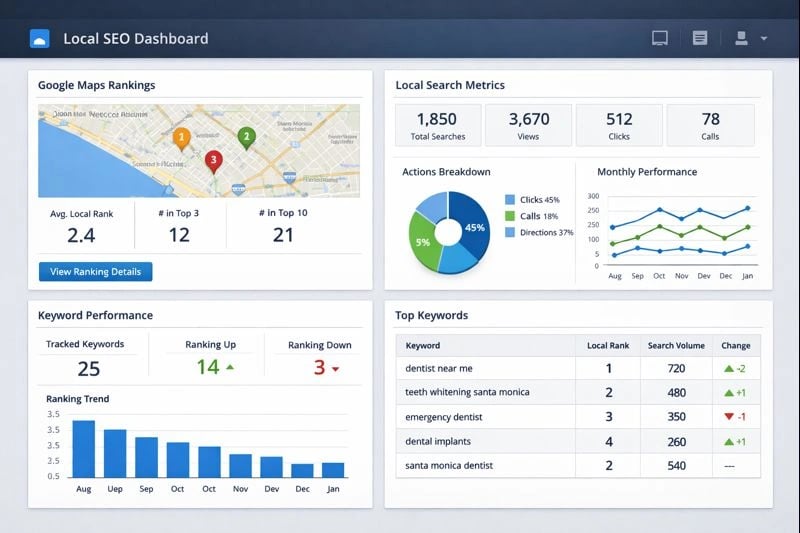
A local SEO dashboard helps track your visibility in Google Maps and search results.
Transition: Now that you understand what local SEO is and why it matters, let’s look at the real-world challenges local business owners face when choosing an SEO company.
Real-World Pitfalls: Why Choosing the Right Local SEO Company Matters
Talk to enough local business owners and you hear the same story: months of retainer payments to a “highly recommended” SEO agency, and almost nothing to show for it. A handful of phone calls, most of them unqualified. No new customers. No clear answer about where the money went.
If you’ve owned a local service business for more than a couple of years, you’ve either lived this story yourself or know someone who has. Rankings tanked after the first few months. Reports were 40-page PDFs filled with colorful graphs that meant nothing. The agency stopped returning calls. Maybe they promised you’d be “number one on Google” and then blamed the algorithm when it didn’t happen.
Here’s the thing: for local businesses (whether you’re in home services, healthcare, legal, or fitness) local SEO matters more than almost any other marketing channel. It’s how strangers find you when they search “AC repair Melbourne FL” or “med spa near Cocoa Beach.” It’s how you get phone calls, booked appointments, and form fills from people who are ready to hire today. For local businesses with a physical store, optimizing for local searches can attract more customers directly to your physical store and increase foot traffic. To maximize local visibility and customer engagement, it’s essential to incorporate SEO into your overall marketing strategy.
I run L3ad Solutions, a local SEO and web design company serving service businesses, so I see both sides of this decision. I’m going to be brutally transparent about what good and bad agencies actually do, what you should pay, and how to tell the difference before you sign anything.
Many businesses have faced significant losses due to poor SEO partnerships. Ensure you choose an agency with a proven track record and transparent practices.
Transition: With the stakes this high, let’s clarify exactly what you need from a local SEO company to avoid these common pitfalls.
Key Needs from a Local SEO Company
The term “SEO” is vague enough that agencies can hide behind it indefinitely. But for local service businesses, what you really need boils down to three things: visibility, trust, and conversions.
Visibility: Showing Up Where Your Customers Are Searching
- Appearing in Google Maps and the local pack for queries like “estate lawyer Titusville” or “services near me”
- Ranking on page one of search results for the services and cities you actually serve
- Being found on other search engines and local listings your customers use
- If your business has multiple locations, you should have dedicated pages and listings for each location to improve search engine visibility and accuracy.
Trust: Looking Legitimate When People Find You
- Strong online reviews with recent, positive feedback (aim for 4.5+ stars and 50+ reviews)
- Consistent NAP (Name, Address, Phone) across every directory and listing, as local SEO strategies include ensuring your business information is the same everywhere.
- A professional web presence that makes strangers feel safe calling or booking
- Local SEO companies often focus on generating positive reviews on local directories and social media platforms to enhance your reputation.
Conversions: Turning Visibility into Revenue
- Clear offers and calls-to-action on your website and Google Business Profile
- Easy ways to call, fill out a form, or book an appointment
- Tracking that shows which pages and keywords actually generate leads
- Local SEO increases conversion rates by targeting people searching for specific products or services in a particular area.
Before you start calling agencies, write down your concrete business goals. Something like “increase booked jobs from Google by 30% in 6 months” or “get to 40+ reviews with a 4.8+ average rating” gives you a way to measure success.
One more thing: if your website is slow, confusing, or looks like it was built in 2012, you probably need both professional web design and SEO, not SEO alone. A great SEO campaign can’t fix a website that drives visitors away.
Visibility
Ensure your business appears in local search results and Google Maps for relevant queries.
Trust
Build a credible online presence with consistent information and strong reviews.
Conversions
Turn search visibility into real leads with clear calls-to-action and tracking.
Transition: Once you know what you need, it’s time to understand what separates a good local SEO agency from the rest.
What Good Local SEO Agencies Actually Do (Vs. What They Say)
Every agency proposal sounds the same: “We’ll optimize your site, build your authority, and get you more leads.” The only way to tell agencies apart is to understand what real work actually looks like.
Foundational Audit Work
A good agency starts by digging into your current situation, not just running an automated report. This means auditing your site structure, your Google Business Profile, your local citations, your competitors’ strategies, and your existing lead sources. They should be using tools like Google Search Console and GBP Insights to understand what’s actually happening, not just guessing. Want to walk into those conversations already knowing your weak spots? Run a free local SEO audit first and judge every pitch against it.
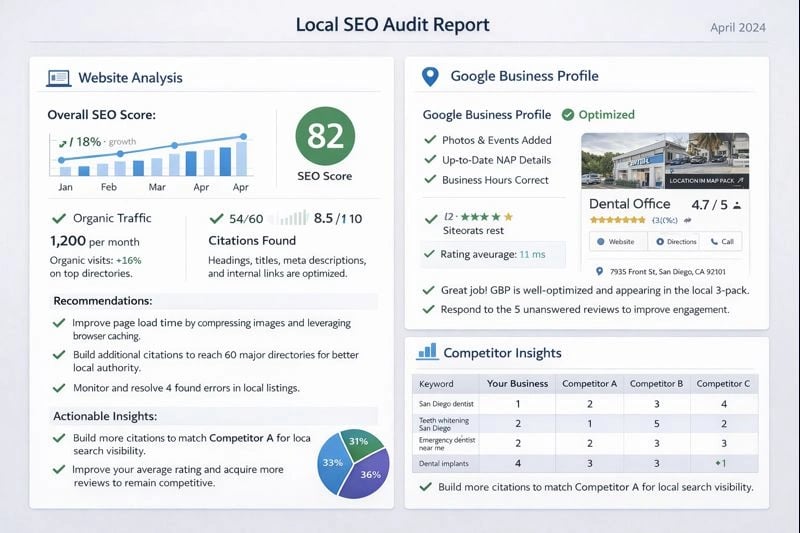
A detailed SEO audit identifies key areas for improvement in your online presence.
On-page and Technical SEO
Real work includes fixing site speed issues, resolving mobile optimization problems, building local landing pages for each service and city you target, cleaning up internal linking, and adding clear calls-to-action. These changes should be visible on your live site. If you can’t see what changed, nothing probably did.
True Local SEO Tasks
This is where the rubber meets the road for local businesses. Proper GBP optimization includes completing every field, choosing the right categories, adding services, uploading quality photos, posting updates, and managing Q&A. Beyond that, you need NAP consistency across 50+ directories, local content that targets specific service and city combinations, and genuine local links from chambers of commerce, local news, and community partners.
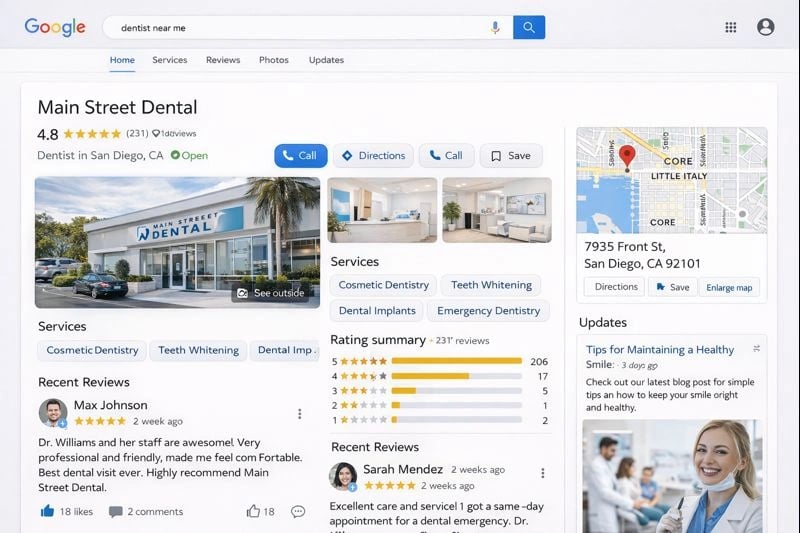
An optimized Google Business Profile is critical for local search visibility.
Conversion Tracking and Reporting
Any agency worth hiring will set up call tracking, form tracking, and lead source reporting. You should know which pages generate revenue, which local keywords drive calls, and what your cost per lead actually is.
Plenty of agencies charge premium retainers and do nothing but send automated ranking reports, with no real changes on the site or Google Business Profile. A telling test: ask to see your Google Search Console access. If the agency never connected it, they were never measuring anything real.
If you want to see what a concrete scope of work should include, our local SEO services page breaks it down in plain English. The service scope of an SEO package directly impacts both the cost and the level of results you can expect. A broader service scope typically means a higher investment, but also more thorough and effective SEO. The broader the scope of services needed, the higher the investment required for SEO.
When evaluating agencies, make sure they follow ethical practices and avoid black hat tactics. Adhering to search engine guidelines is crucial to avoid penalties and ensure long-term success.
- Conduct thorough audits of your current online presence.
- Implement on-page and technical SEO fixes for better performance.
- Optimize Google Business Profile and ensure NAP consistency.
- Provide detailed conversion tracking and clear reporting.
Transition: Now that you know what real work looks like, let’s explore the benefits of working with a reputable SEO agency.
Benefits of Working with an SEO Agency
Partnering with a reputable SEO agency can transform how local businesses grow. An experienced SEO team brings industry expertise, proven processes, and access to the latest SEO tools, giving your business a competitive advantage in the local market.
Why Work with an Agency?
- A good SEO agency will work with you to develop a tailored SEO strategy that aligns with your business goals, whether you want to increase brand awareness, drive more organic traffic, or convert more leads into customers.
- By applying their knowledge of search engine optimization, they can help you improve your online visibility, climb the search rankings, and reach more potential customers in your area.
- Beyond just implementing SEO tactics, a quality agency provides regular reporting and analysis, so you always know how your SEO campaign is performing.
- This data-driven approach allows you to make informed decisions and adjust your strategy for maximum ROI.
- With the right SEO partner, you can focus on running your business while they handle the complexities of search engine optimization.
Choose an agency that offers regular performance reports to keep track of your SEO progress and make data-driven decisions.
Transition: An agency isn’t the only option. Before you shortlist anyone, decide which type of help fits your situation.
Agency vs. Freelancer: Which Should You Actually Hire?
Most advice about how to choose an SEO company skips a basic question: do you need an agency at all? You have three realistic options, and each one fits a different situation.
When a Freelancer Makes Sense
A skilled independent SEO can be a great fit when your budget is tight and your problem is well-defined: a technical audit, a batch of city pages, a Google Business Profile cleanup. You’ll often get more senior attention per dollar, because you’re paying one person instead of an agency’s overhead.
The tradeoffs are real, though. A freelancer is a single point of failure. If they get sick, get busy, or take a better contract, your momentum stops. And most freelancers are strong in one area (content, or technical, or local) rather than all of them. If you hire one, you become the project manager, and you need to be comfortable judging whether the work is any good.
When an Agency Makes Sense
Local SEO done properly needs several different skills: technical fixes, content writing, GBP management, citation cleanup, and conversion tracking. An agency bundles those skills with a process, so the work keeps moving without you chasing it. You also get continuity: if one person leaves, the engagement doesn’t collapse.
The risk with agencies is the bait-and-switch: a sharp senior strategist runs the sales call, then your account lands with a junior coordinator managing 30 clients. Always ask who will actually do the work, how many accounts that person handles, and how you’ll see what was completed each month.
When Doing It Yourself Makes Sense
If your business is new and your budget is zero, start with the basics yourself: complete every field of your Google Business Profile, ask every happy customer for a review, and reply to every review you get. Our Florida Local Search Index, which measures 93 cities and all 67 Florida counties, shows the typical top-ranked listing carries 98 reviews, and 87.6% of the Brevard County businesses we audited reply to their reviews. That’s the bar, and much of the work to reach it is free. It just takes consistency.
Whichever route you choose, the vetting process is the same: proof of results, a clear process, and plain-English answers to your questions.
Transition: Before you sign with any agency, it’s crucial to ask the right questions to ensure you’re making the best choice.
Questions to Ask Before You Sign Anything
Print this checklist. Bring it to every sales call. The answers will tell you everything you need to know.
| Question | Good Answer | Bad Answer |
|---|---|---|
| “What does progress usually look like at 3, 6, and 12 months for local businesses?” | Honest acknowledgment that months 1-2 are setup and audits, meaningful ranking and lead improvements at 3-6 months, compounding growth at 12+ months | “You’ll be on page one in 30 days” or vague promises without timeline |
| “Who will actually do the work, and how can I see what was changed on my site and GBP each month?” | Named team members or account managers, with a specific list of completed tasks in each report | “Our proprietary system handles everything” or no clear answer |
| “How will you show me which keywords, pages, and campaigns are generating calls and booked jobs?” | Reference to call tracking software, Google Analytics goals, and conversion reporting | “We send you a ranking report” or confusion about tracking |
| “Can you show me case studies or examples from local service businesses similar to mine?” | Specific examples with real numbers (calls increased by X%, leads doubled in 6 months) | Generic testimonials or examples only from ecommerce/national brands |
| “What is the minimum commitment, and what happens if we want to pause or stop after 4-6 months?” | Month-to-month or a short initial term, no long-term contracts, clear exit process | 12-18 month lock-in with penalties, or evasive answers |
| “Do you have experience with businesses in competitive Florida markets?” | Specific examples from Central Florida, understanding of local competition | No local experience or claims that “location doesn’t matter” |
| “What SEO tools do you use for keyword research, citation audits, and tracking?” | Named tools like Google Search Console, BrightLocal, SEMrush, Google Keyword Planner | “We use proprietary software” with no specifics |
When evaluating answers, look for specificity. Vague promises are a warning sign. Any serious agency should be able to show you client results with concrete before-and-after metrics.
Transition: Knowing what to ask is important, but spotting red flags early can save you from costly mistakes.
Red Flags: How to Spot a Bad Local SEO Company Fast
The search engine optimization industry has more than its share of smoke and mirrors. Most bad experiences could have been avoided by noticing a few early warning signs.
- Unrealistic promises about rankings or speed: No ethical SEO agency can promise specific rankings because Google controls the algorithm, not them. Anyone promising top rankings is either lying or planning to use black hat SEO tactics that will get you penalized.
- Suspiciously cheap “all-inclusive SEO”: Real SEO work takes hours from skilled people every month. A rock-bottom retainer pays for automation, templated content, or nothing at all. For reference, our own Local SEO service starts at $350 per month against a defined, published scope. If a quote is a small fraction of that and claims to include everything, ask exactly what work gets done each month and who does it.
- Secrecy about tactics and access: If the agency refuses to explain their SEO strategy, hides behind “proprietary methods,” or won’t give you access to Google Search Console or your own Google Business Profile, walk away. Lack of transparency about methods and reporting is a common pitfall when hiring an SEO agency. You should own your accounts and understand what’s being done.
- Generic, non-local focus: If their case studies are mostly ecommerce or national campaigns and they can’t talk specifically about Maps rankings, online reviews, and city-specific service pages, they’re not a local SEO specialist. Traditional SEO tactics don’t always translate to local search success.
- Report-only agencies: If the only visible activity is a monthly PDF with rankings and traffic numbers, but you can’t point to specific pages, content, or optimizations completed that month, you’re paying for reports, not results.
Here’s what a year of fake SEO usually looks like once it’s finally audited: a Google Business Profile that was never touched, zero local citations built, zero pieces of local content created, and a stack of ranking reports for keywords nobody in the target audience actually searches.
When looking for a good agency, reputable agencies confidently showcase case studies, avoid long-term contracts, and update their strategies to include modern SEO techniques like GEO and AI optimization.
- Transparent tactics and full access to your accounts.
- Specific case studies with local business success.
- Clear reporting tied to lead generation and revenue.
- Promises of quick rankings or suspiciously low pricing.
- Lack of local focus or generic SEO approaches.
- No visible site changes, just automated reports.
Transition: Red flags show up in sales calls. The next set shows up in the fine print.
Contract Terms to Avoid Before You Sign
Plenty of businesses spot the sales-call red flags and still get trapped by the paperwork. Read every SEO contract for these terms before signing:
- 12-24 month lock-ins with cancellation penalties: A confident agency doesn’t need to trap you. Look for month-to-month agreements or a short initial term. (For what it’s worth, we work month-to-month with no long-term contracts, and we think that should be the industry standard.)
- The agency owns your accounts or content: The contract should state in writing that you own your domain, your website content, your Google Business Profile, and your analytics data. Some agencies “host” the content they create and delete it when you leave. That means you were renting your own marketing.
- No written scope of deliverables: “Ongoing SEO services” with no list of what happens each month is a blank check. Demand specifics: pages created, citations built, GBP updates, reports delivered.
- Auto-renewal with a narrow cancellation window: Some contracts quietly renew for another full term unless you cancel within a specific window. Check the renewal clause and put a reminder on your calendar.
- Reporting only through the agency’s dashboard: You should have direct owner access to Google Search Console, Google Analytics, and your Google Business Profile. If the only numbers you can see are the ones the agency chooses to show you, you can’t verify anything.
- A vague or missing exit process: What happens on the day you cancel? Who hands over logins, content files, and tracking setups? Good contracts answer this before you ever need to ask.
Transition: Understanding the risks is key, but let’s talk about what you should expect to invest and how long it takes to see results.
Understanding Budgets, Timelines, and Realistic Expectations
Money and timing are where most frustrations happen, especially after a previous bad experience. Let me give you real numbers.
Pricing Sanity Checks Before You Compare Quotes
There is no universal “going rate” for SEO. Pricing depends on how competitive your market is, the current health of your site, and how broad the scope of work is. Anyone quoting you an industry average is guessing, so anchor your comparison in real, published numbers instead.
Here’s our actual pricing at L3ad Solutions, published on our site: Local SEO starts at $350/month, Google Business Profile management starts at $150/month, bundles run $450-$1,200/month depending on scope, and new websites are a one-time $1,500-$3,000. Those aren’t the only honest numbers in the industry, but they give you a reference point: a real agency doing real local SEO work can operate in that range with a defined scope.
Sanity checks to run on any quote:
- Ask for the scope in writing at each price tier. What pages get created? What GBP work happens monthly? What gets reported? A price without a scope is meaningless.
- Be suspicious of rock-bottom “everything included” retainers. Skilled hours cost money. A retainer that couldn’t cover a few hours of a professional’s time each month is paying for automation or templates.
- Don’t assume expensive means good. Some of the worst report-only agencies charge premium retainers. Ask what hours and deliverables the price actually buys.
- Watch for setup fees that dwarf the monthly. A large upfront “onboarding fee” followed by a cheap retainer often means the real work happens once, then the meter just runs.
- SEO agencies charge in three main ways: monthly retainers, project-based pricing, and hourly consulting. Retainers fit ongoing local SEO; projects fit one-time work like a site rebuild or audit.
Realistic Timeline Expectations
- Months 1-2: Audits, fixes, and setup. Don’t expect big traffic jumps yet.
- Months 3-6: Meaningful improvement in local rankings, Maps visibility, and call volume.
- Months 6-12+: Compounding organic traffic growth and sustainable lead generation.
Meaningful movement usually shows up in the 3-6 month window, and the strongest returns compound after a year of consistent work. Any agency promising faster is either guessing or planning shortcuts you’ll pay for later.
Industries like attorneys and med spas in competitive Florida markets typically need more aggressive budgets and longer timelines. A small, niche service in Brevard County might see faster movement. It depends on your competition and starting point.
Here’s the honest caveat: SEO is not a switch you flip. It compounds over 6-12+ months, and pausing too early is one of the most expensive mistakes local businesses make. You’re building an asset that generates leads for years, but only if you give it time.
As strategies and costs have evolved, modern SEO now incorporates advanced techniques like Generative Engine Optimization (GEO), structured content, strong E-E-A-T signals, and author authority to ensure your business is cited and understood by AI platforms and search engines.
Our own service packages are built to be transparent about what’s included at each level. You should demand that same clarity from any agency you consider.
Match the retainer to a written scope, plan on 3-6 months before noticeable movement, and treat any quote that comes without a defined scope of work as a guess.
Transition: With a clear understanding of budgets and timelines, let’s discuss how to evaluate an agency’s experience and local expertise.
How to Evaluate an Agency’s Experience and Local Market Knowledge
“10 years of experience” on a homepage means nothing without proof, especially for local search, which has evolved dramatically since Google introduced the local pack.
Steps to Evaluate an Agency
- Look for case studies with concrete metrics: Not just “traffic went up” but specific numbers: “Calls increased from 15 to 47 per month,” “Form submissions doubled in 4 months,” “Moved from position 12 to position 2 for primary keyword.” Ask about ROI focus: did their work generate actual revenue?
- Check if they have experience in your industry: Does the agency have a proven track record with home services, healthcare, legal, fitness, or clinics similar to your business? An agency that understands your industry will move faster because they already know the target audience and competitive market.
- Assess their local understanding: For Space Coast businesses, ask if they know the difference between competing in Melbourne vs. Palm Bay vs. Titusville. Do they understand seasonal trends and snowbird patterns? An agency that treats “Florida” as one market doesn’t understand local SEO.
- Read reviews off the agency’s site: Check Google, Clutch, and other platforms. Look for comments about communication, honesty, and results over 6-12 months, not just initial excitement. See if they’ve successfully helped other clients in similar situations.
- Treat certifications as a bonus, not a guarantee: Google Partner status means the agency has met certain ad spend thresholds. It doesn’t guarantee SEO success. Certifications are nice, but they’re no substitute for local case studies and references.
- Ask for 1-2 references you can actually call from similar-sized local businesses. Ask those references one simple question: “What actually changed in your lead volume after working with this agency?”
- Review case studies for specific, measurable results.
- Confirm industry experience relevant to your business.
- Ensure deep understanding of local market dynamics.
- Check independent reviews and request client references.
Transition: Once you’ve evaluated experience, it’s time to assess your current local search visibility and identify areas for improvement.
Evaluating Local Search Visibility
Understanding where your business stands in local search is the first step toward building a successful SEO campaign. Evaluating your local search visibility means taking a close look at how your business appears across Google Business Profile, local listings, and other online platforms that matter to your target audience.
A skilled local SEO company will start with a detailed audit of your online presence. This includes:
- Checking the accuracy and consistency of your local citations
- Analyzing your Google Business Profile for optimization opportunities
- Reviewing your website’s content to ensure it speaks directly to your local customers
- Assessing your presence in local directories and identifying gaps where your business could be more visible
By pinpointing strengths and weaknesses in your current local search footprint, your SEO company can recommend targeted improvements, like building new local citations, enhancing your Google Business Profile, or creating content that resonates with your community. The result is a stronger, more visible presence in local search, making it easier for your target audience to find and choose your business.
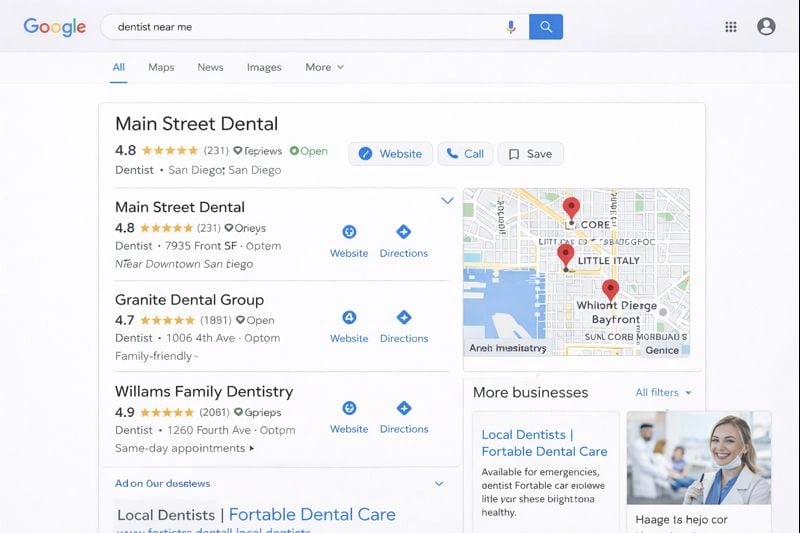
Local search results highlight your business in the Google local pack and maps.
Transition: With your visibility assessed, let’s review what a healthy local SEO strategy should include.
What a Healthy Local SEO Strategy Should Include
Use this as a checklist. Most sound local SEO strategies share these components and, when executed well, can enhance your business's visibility across various platforms, including AI-driven search results such as those from AI search engines and Google AI Overviews. Modern SEO now requires strategies that address these new technologies to ensure your business is cited and visible in both traditional and AI-powered search environments.
- Technical and on-page fundamentals:
- Fast, mobile-friendly site (site speed matters for both rankings and conversions)
- Clear service pages for each offering
- Location pages for key cities you serve
- Clean URL structure and proper heading hierarchy
- No keyword stuffing or outdated tactics
- Google Business Profile optimization:
- Complete build-out with accurate business information
- Correct primary and secondary categories
- Services, products, and attributes filled in
- Quality photos (20+ is a good target)
- Regular posts, FAQ management, and messaging enabled
- Ongoing GBP optimization to stay competitive
- Local SEO services include optimizing Google Business Profiles to enhance visibility in local search results.
- Local content:
- Specific service + city pages (e.g., “Roof Repair in Merritt Island”)
- FAQs addressing local problems and conditions
- Content that references local landmarks, events, or situations where appropriate
- Regular updates to maintain relevance
- Citations and NAP consistency:
- Consistent Name, Address, Phone across major directories (100+ for full coverage)
- Regular checks for duplicates and incorrect local listings
- Clean-up of outdated information from previous locations or phone numbers
- Review generation and management:
- A structured system to request reviews after completed jobs
- Prompt responses to all reviews (positive and negative)
- Integration of reviews across Google and industry-specific sites
- Goal of 4.5+ stars with 50+ reviews for strong online presence
- Local link building:
- Partnerships with local organizations and chambers of commerce
- Sponsorships that generate genuine local backlinks
- PR in local news outlets
- Avoidance of link farms and low-quality directory spam (white hat SEO only)
- Conversion optimization:
- Visible phone numbers and click-to-call buttons
- Forms that are easy to complete on mobile
- Online booking integration where appropriate
- Clear calls-to-action on every page
Local SEO companies provide ongoing strategy adjustments based on performance metrics to ensure continuous improvement. It's also important to evaluate the tools and techniques the agency uses to ensure they are up-to-date with the latest SEO trends, including modern SEO practices and optimization for AI search and Google AI Overviews.
All of this works best when built on a solid foundation. A conversion-focused site created with strategic website design services will generate more customers from the same amount of traffic.
Technical SEO
Fast, mobile-friendly site with clear service and location pages.
GBP Optimization
Complete profile with accurate info, photos, and regular updates.
Local Content
Targeted pages for services and cities with relevant local references.
Review Management
Structured system to generate and respond to customer feedback.
Transition: While local SEO is crucial, don’t overlook the importance of traditional SEO for broader online visibility.
Importance of Traditional SEO
While local SEO is essential for businesses with a physical location, traditional SEO remains a cornerstone of any effective online marketing strategy. Traditional SEO focuses on optimizing your website for search engines through techniques like keyword research, crafting compelling meta tags, and building high-quality backlinks. These foundational elements help your site rank higher in organic search results, driving more traffic and increasing your online visibility.
A good SEO agency understands that the best results come from combining traditional SEO with local SEO. By integrating both approaches, your business benefits from a complete SEO strategy that targets not only local customers but also a broader audience searching for your services online. This means more opportunities to attract organic traffic, build authority, and grow your brand.
Incorporating traditional SEO into your marketing strategy ensures your website is technically sound, content-rich, and optimized for both users and search engines. Whether it’s through strategic link building, optimizing meta tags, or conducting in-depth keyword research, traditional SEO lays the groundwork for sustainable growth and long-term SEO success.
Transition: Local markets have unique challenges. Here’s what’s specific to Florida and the Space Coast.
Space Coast & Florida-Specific Challenges to Ask About
Local search isn’t identical everywhere. Coastal Florida has its own quirks that any good agency should understand.
- Seasonality matters: Snowbird traffic changes search patterns from November through April. Hurricane season affects demand for roofing, restoration, and emergency services. HVAC searches spike in summer, marine services peak in spring. A good SEO team will plan content and campaigns around these patterns, not ignore them.
- Geo-clustering affects visibility: Google treats Melbourne, Palm Bay, Cocoa, Titusville, and Merritt Island as distinct markets. You can’t just target “Florida” and expect to rank well in Brevard County. Location-specific pages and GBP category optimization are essential for building visibility in each area.
- Local expertise shows in the details: Agencies who understand Space Coast businesses can prioritize the right suburbs and neighborhoods. They know that a service business in Melbourne faces different competition than one in Viera. They understand that tourist-area businesses deal with sharp search spikes during peak seasons.
Questions to ask about local knowledge:
- “Can you show me local keyword research for Central Florida?”
- “Do you have Maps screenshots showing results in this market?”
- “How would you approach building local links in Brevard County specifically?”
Avoid companies that propose generic “USA-wide” link building strategies with no regional relevance. That approach might work for national ecommerce, but it’s ineffective SEO for local service businesses.
Transition: Once you’ve chosen an agency, you need to know how to measure their performance. Let’s look at what good reporting should include.
What Good Reporting Actually Looks Like
Most business owners have received confusing reports with 40 pages of colorful graphs and absolutely no insight into revenue. Good reporting is different.
Key Elements Every Monthly Report Should Include
- Calls and form submissions: Direct measure of potential customers contacting you
- Booked appointments/jobs: The ultimate measure of SEO success
- Top-performing pages: Shows what content is actually driving leads
- Priority keyword rankings: Tracks progress on terms your local customers search
- Work completed this month: Specific pages, GBP changes, links earned, fixes made
Reports should come from real data sources: Google Analytics, Google Search Console, call tracking software, and GBP Insights, not just a rank tracker screenshot. Any good agency will connect these tools to show the full picture of your online visibility and lead generation.
Work completed should be specific: A good report doesn’t just show numbers; it explains what the SEO consultant or team actually did. “Published 3 new service area pages,” “Earned 2 local backlinks from Brevard chamber and local news,” “Fixed mobile speed issues on 4 key pages.” If they can’t tell you what they did, they probably didn’t do much.
A short call beats a long PDF: A 15-20 minute monthly walkthrough in plain English is more valuable than a 40-page document. The agency should help you interpret results and explain next steps, not just dump data and disappear.
Ask any agency you’re considering for a sample anonymized report. Judge it by one standard: can you understand what happened and whether it’s working?
Our digital marketing services always connect vanity metrics like traffic and rankings to what actually matters: booked jobs and revenue. This is the standard you should expect from any provider.
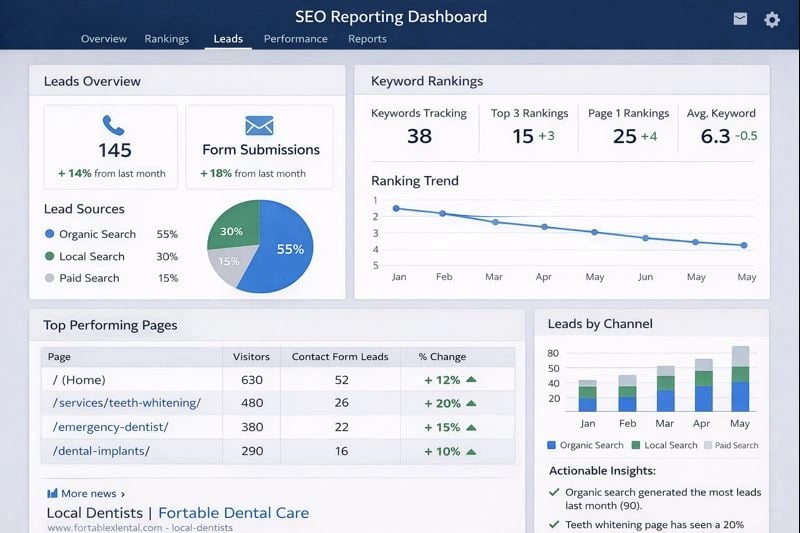
Good SEO reporting connects traffic and rankings to actual leads and revenue.
Transition: There’s one more honest question to answer before you hire anyone: whether you should hire at all right now.
When Not to Hire an SEO Company Yet
Sometimes the right move is to wait, or to fix a few basics before committing to a monthly retainer. An agency that only ever says “yes, sign here” isn’t giving you advice, it’s closing a sale.
You’re probably not ready to hire yet if:
- Your business is brand-new and you don’t have a clear offer, written service descriptions, or a basic working website. SEO amplifies what exists. It can’t amplify nothing.
- Cash flow can’t sustain 6-12 months of consistent spending. Quitting at month three wastes the setup work from months one and two. If the budget only covers a quarter, spend it on a one-time project (an audit, a site fix) instead of a retainer you’ll have to abandon.
- Your website is slow, broken on mobile, or badly outdated. SEO work can’t stick to a site that drives visitors away. A modest rebuild ($1,500-$3,000 for most local service sites) often needs to come first.
- You can’t give the engagement a few hours a month. Even the best agency needs approvals, photos of real work, and your help asking customers for reviews.
Free and low-cost steps to take before hiring anyone:
- Complete your Google Business Profile: correct hours, real photos, a plainly written business description.
- Ask recent customers for reviews, and respond to every review you already have.
- Fix obvious website problems: broken links, missing contact info, forms that don’t work on a phone.
This foundation work matters more than most owners expect. Our FLSI data shows most Florida businesses leave this ground open (the average Brevard County profile is 69% complete and only 25.8% carry structured data), and much of that foundation is work you can start yourself this week.
An honest SEO company will sometimes tell you to start smaller or wait until you’re ready. That’s a sign of integrity, not a lost sale.
Transition: If you’re still unsure, here’s how to test an agency before making a big commitment.
Soft Next Step: How to Test an Agency Without a Big Commitment
Skepticism is healthy after being burned before. You don’t have to sign a 12-month contract to see if an agency knows what they’re doing.
- Start with an audit or short-term engagement: A focused audit that identifies quick wins and major issues is a reasonable first step. It lets you see how the agency thinks, communicates, and prioritizes, without committing to a full retainer.
- Judge the agency by the clarity of their audit: Are problems and fixes concrete, prioritized, and understandable? Or is everything buried in jargon and vague promises? A good agency should be able to explain what’s broken and why it matters in terms you understand.
- Look for sustainable growth, not shortcuts: The right partner will talk about an ongoing process of improvement, not magic tricks. They’ll be honest that hiring an SEO is an investment that compounds over time, not a one-time fix.
- We offer a low-pressure starting point: L3ad Solutions provides a free audit for local service businesses so you can see exactly what we’d fix before spending a dollar. No obligation, no hard sell. Just a clear picture of where you stand.
The right local SEO company will be transparent, realistic about 3-6 month timelines, and focused on leads and revenue, not vanity metrics or empty promises. They’ll help you build a strong online presence that generates more customers for years to come.
If you’ve been burned before, I get it. But the right partner is out there. You just need to know what to look for.
Checklist: How to Choose a Local SEO Company
When selecting a local SEO company, keep these key factors in mind:
- Ethical, white-hat techniques: Ensure the agency follows search engine guidelines and avoids black-hat tactics.
- Proven experience and track record: Look for a local SEO company with proven experience and a track record of success in your industry.
- Case studies with measurable results: Analyze case studies for real, quantifiable improvements in leads, calls, or revenue.
- Clear communication: The agency should provide regular, easy-to-understand reports and be transparent about their methods.
- Local market knowledge: Evaluate their understanding of your specific geographic area and industry.
- Full-service offering: The agency should offer Google Business Profile optimization, citation management, and local content creation.
- Transparent pricing: Avoid agencies that make unrealistic promises or hide their pricing structure.
- Client reviews and testimonials: Check for positive feedback from similar businesses.
- Up-to-date tools and techniques: Make sure the agency uses current SEO strategies and adapts to new trends.
- Long-term partnership focus: Choose an agency interested in your ongoing success, not just quick wins.
By following this checklist, you’ll be well-equipped to choose a local SEO company that delivers real results and helps your business grow.
Or start with a free AI visibility check
Does AI Recommend You?
See if ChatGPT, Gemini, Grok, and Claude name your business. Free report by email.