


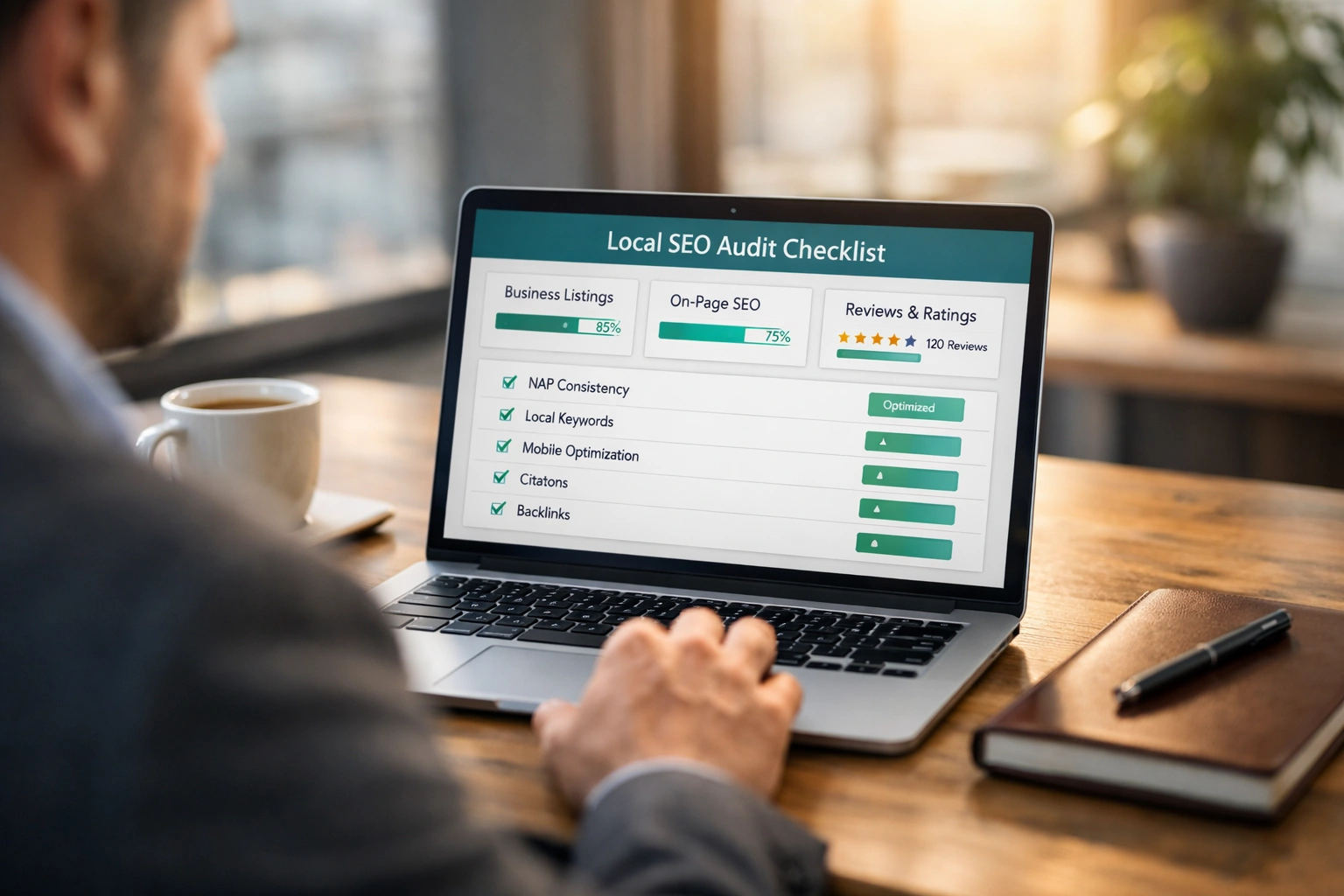
Local SEO Audit Template (Free)
A free local SEO audit template: check your Google Business Profile, directory listings, site speed, and keywords in one pass. Or run our instant audit.
Updated February 20, 2026 · 15 min read
Table of Contents
Why Do Small Businesses Need a Local SEO Audit Template?
TL;DR: A local SEO audit template helps small business owners systematically check their online presence for problems preventing customers from finding them. It covers your Google Business Profile, website optimization, local listings, and competitor analysis in a step-by-step checklist. Think of it as a health inspection for your digital storefront, catching issues before they cost you more leads.
You'll get everything you need to use a local SEO audit template effectively: what it includes, how to customize it for your business type, and the step-by-step process for completing audits yourself. For a broader understanding of how all these pieces fit together, see our complete local SEO guide. If you would rather have the checks run for you, our free local SEO audit scores the same areas in about 30 seconds. We won’t get into advanced technical SEO errors like server configurations or custom coding. That’s territory for an SEO expert. Instead, we’re focusing on what small business owners can actually do themselves.
Who is this for? If you’re a Brevard County restaurant owner wondering why competitors show up before you in Google search, a Melbourne business trying to get more phone calls, or a Titusville service business frustrated by invisible online presence, this is for you.
A local SEO audit template is a systematic checklist that helps business owners identify and fix online visibility problems without hiring expensive consultants. It also provides practical insights for business owners, offering specific recommendations to improve SEO performance.
Here’s what you’ll gain from using one:
- Find specific ranking issues holding back your local search presence
- Identify and fix SEO issues such as technical errors, missing tags, broken links, and site structure problems
- Improve your Google Business Profile to attract more customers
- Fix website problems hurting your SEO score
- Monitor what competitors are doing better than you
- Increase visibility in local search results within your service area
A thorough SEO audit can identify opportunities for improvement in keyword targeting, content quality, and technical SEO. This ensures your website is optimized for both users and search engines, helping you stay ahead of the competition.
Use your audit template monthly to catch issues before they cost you customers. Consistency is key to staying ahead of competitors.
What Exactly Is a Local SEO Audit Template?
A local SEO audit template is simply a structured checklist for evaluating how well your business shows up when nearby customers search for what you offer. Think of it like a home inspection checklist, but instead of checking for foundation cracks and leaky pipes, you’re checking for incorrect business information, missing keywords, and broken links that drive potential customers to competitors.
The key difference between a general website audit and a local SEO audit is geographic focus. General SEO cares about ranking nationally. Local SEO cares about ranking for “services near me” or “best tacos in Cocoa Beach.” If your customers come from a specific area (and for most small businesses, they do), local is what matters. A local SEO audit template also helps you evaluate site performance for local search, ensuring your website is optimized for visibility and effectiveness in your target area.
Here’s a useful analogy: restaurant health inspections don’t just ask “is the food safe?” They check specific categories: food temperature, handwashing stations, pest control, storage practices. Each category has specific items that get checked. A local SEO audit template works the same way, breaking down your entire site’s online presence into checkable categories with specific items in each.
A website audit reviews on-page SEO, technical SEO, content quality, schema markup, mobile usability, speed, internal links, and indexing issues.
Google Business Profile
Checks completeness and accuracy of your most visible local asset.
NAP Consistency
Ensures your business information matches across all directories.
Website Performance
Evaluates mobile-friendliness and page speed for local searches.
Local Keywords
Verifies use of location-specific terms in content and tags.
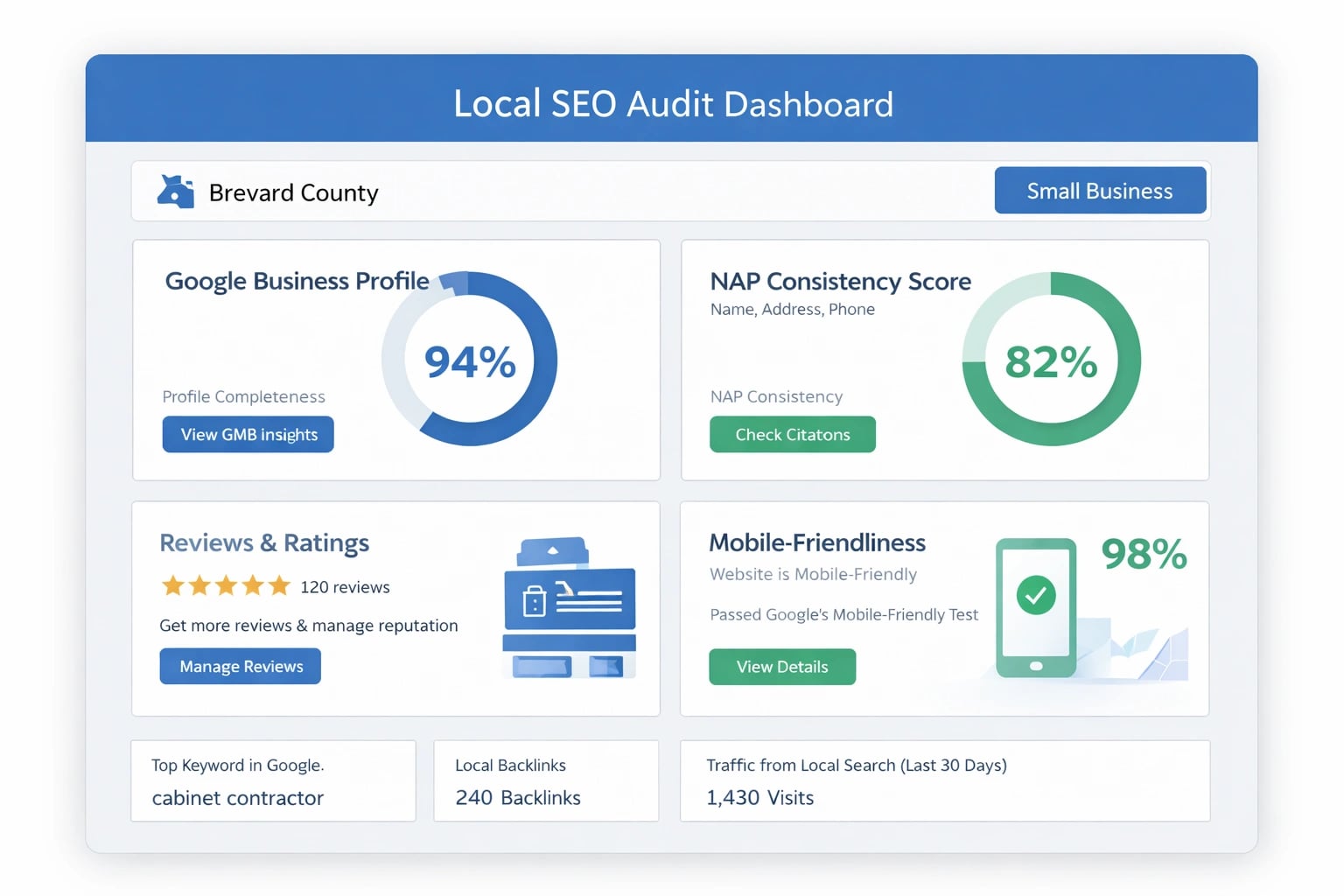
A local SEO audit dashboard helps visualize key areas needing improvement for your business.
What Are the Core Components Every Template Should Include?
Every effective local SEO audit template should cover these foundational areas:
Google Business Profile completeness: This is your most visible local asset. The template checks whether your profile is verified, categories are accurate, hours are current, and photos are recent. Based on our local search research, businesses with complete GBP profiles significantly outperform those with missing information in Google Maps.
NAP consistency across directories: NAP stands for Name, Address, Phone number. Your template should verify this information matches exactly across your website, Google Business Profile, Yelp, Yellow Pages, and industry-specific business listings. NAP consistency refers to the exact matching of the Name, Address, and Phone number across the website and citations.
Website mobile-friendliness and page speed: Most local searches happen on phones. Your template needs to check whether your site loads quickly and functions properly on mobile devices. Effective page optimization (including technical improvements to structure, images, and scripts) can further boost local SEO results by enhancing both speed and user experience.
Local keyword optimization: Are you actually using the terms customers search for? Your template should check page titles, meta tags, headings, and content for location-specific target keywords.
Understanding these components prepares you for the detailed breakdown of what to actually check in each category.
How Does This Differ From DIY SEO Tools?
Automated SEO tools like a free SEO audit tool or seo analyzer can scan your site and spit out data points. They’ll tell you page speed scores, identify broken links, and flag indexing issues. That’s useful, but it’s not the same as understanding what to do about it.
A template provides context and understanding. It tells you why something matters for your specific business. A free seo checker might flag “missing alt text on 47 images” as an issue. A good template helps you understand that for a Melbourne business, adding alt text with service terms matters more than for a Cocoa Beach surf shop where image aesthetics might take priority.
Here’s the practical difference: a Brevard County electrician and a Space Coast wedding venue both need local SEO. But their audit priorities differ. The electrician needs to emphasize emergency service keywords and NAP consistency across directories. The venue needs Google Maps visibility, photo optimization, and review management. Generic automated tools don’t make these distinctions. A well-designed template with your customizations does.
How Should You Prepare Before Starting a Local SEO Audit?
Before you start your local SEO audit, a little preparation goes a long way toward making the process smooth and effective. Start by gathering all your essential business information: your Google Business Profile login, website admin access, and credentials for any social media accounts tied to your business. Make sure you have a current list of your target keywords and phrases that reflect what your customers are searching for in Google.
Next, take stock of your existing local search presence. This means knowing where your business is already listed online, from Google Business Profile to other local business listings and directories. Review your current reviews and ratings to get a sense of your online reputation.
Use free SEO tools like Google Search Console and Google Analytics to collect data on your website’s performance, traffic sources, and user behavior. These platforms offer valuable insights that will help you identify issues and opportunities during your local SEO audit. Having this information at your fingertips ensures you can quickly and accurately complete your audit, make the most of your chosen SEO audit tool, and implement recommendations that will boost your local search presence.
By preparing these resources in advance, you’ll be ready to tackle your local SEO audit efficiently and set your business up for better visibility in Google search and across all your business listings.
What Should Your Local SEO Audit Template Cover?
Now we move from understanding what a template is to knowing exactly what items it should include. Each section below represents a major category your template needs to address, with specific checkpoints in each.
How Do You Audit Your Google Business Profile?
Your Google Business Profile is typically the first thing customers see when they search for your business, or for services you offer. This section of your template should cover:
Business information accuracy checklist:
- Is your business name exactly correct (no keyword stuffing)?
- Does the address match your website and other business listings exactly?
- Is the phone number correct and actively answered?
- Are business hours accurate, including holiday hours?
- Is the primary category the most specific option available?
- Are secondary categories relevant and complete?
Photo optimization requirements:
- Do you have a recent, high-quality profile photo and cover image?
- Are there interior and exterior photos showing your actual business?
- Are photos geotagged with your location?
- Have you added photos in the last 90 days?
Review response tracking:
- Are all reviews (positive and negative) responded to?
- Are responses professional and personalized?
- What’s your average star rating?
- When was your last review received?
Posts and updates frequency:
- Have you posted in the last 30 days?
- Do posts include calls-to-action?
- Are you using offers, updates, and event post types appropriately?
For deeper optimization, our Google Business Profile services can help businesses that need hands-on support.
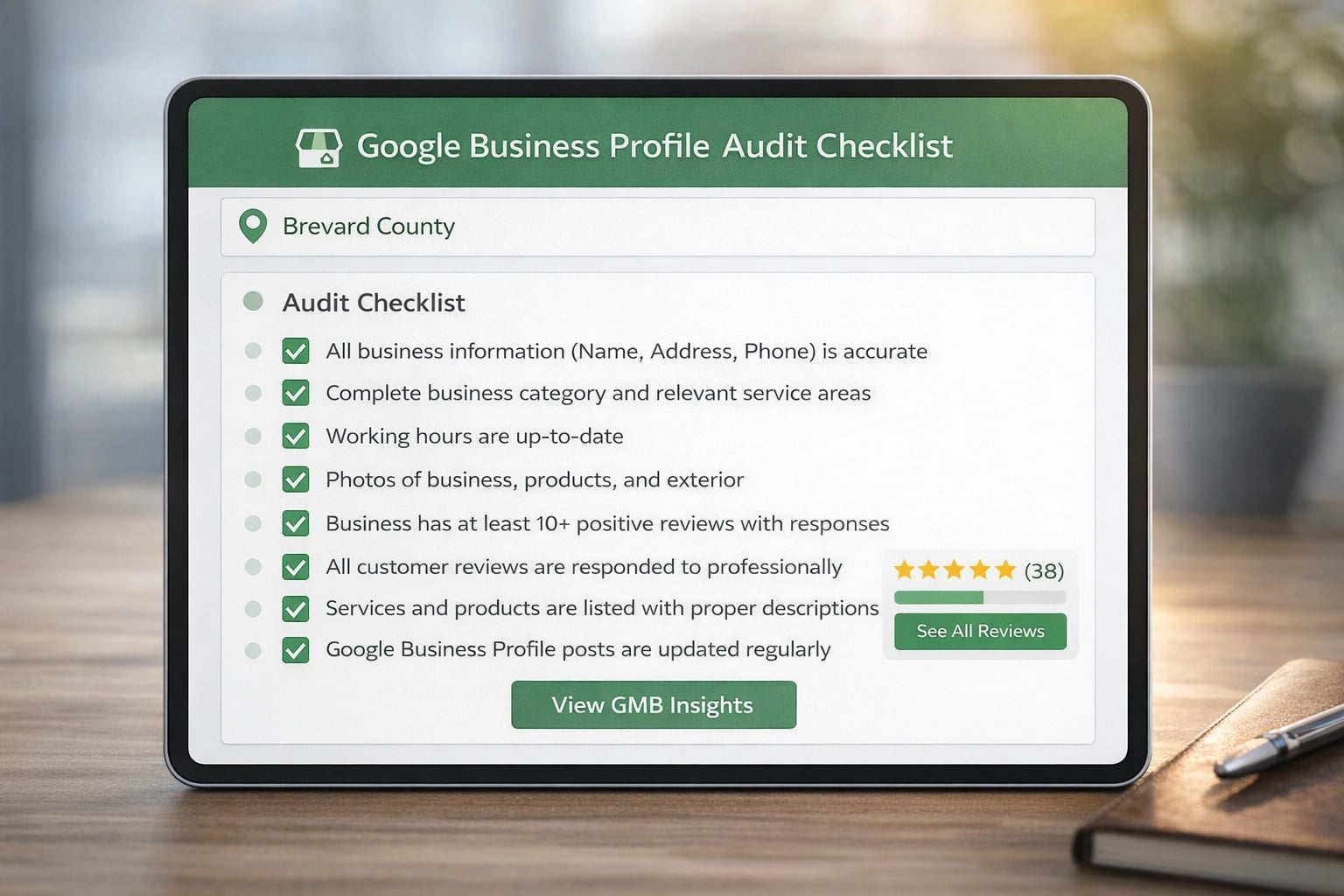
A structured checklist ensures no detail is missed in your Google Business Profile audit.
What Website Elements Need Regular Checking?
Your website is where search engines decide whether to send you more organic traffic or not. Your template should audit these on-page SEO elements:
Mobile usability on phones: This is critical for Space Coast businesses because tourists and residents alike search from phones. Your template should verify:
- Does the site load properly on mobile?
- Can users tap phone numbers to call directly?
- Is text readable without zooming?
- Do buttons and links have enough spacing for fingers?
Page loading speed testing: Slow pages kill conversions. Check:
- What’s your core web vitals score?
- Do pages load in under 3 seconds on mobile?
- Are images compressed appropriately?
- Is there unnecessary code slowing things down?
Local keyword placement: Your template should verify that target keywords appear in:
- Page titles (including city/neighborhood names)
- Meta tags and descriptions
- H1 and H2 headings
- Body content naturally
- Image alt text
Contact information visibility:
- Is your address on every page (typically in footer)?
- Is the phone number clickable on mobile?
- Does your contact page include embedded Google Maps?
- Is there LocalBusiness structured data implemented?
- Structured data through LocalBusiness Schema helps search engines understand the business's physical location and hours.
These elements form the foundation of effective professional web design for local businesses.
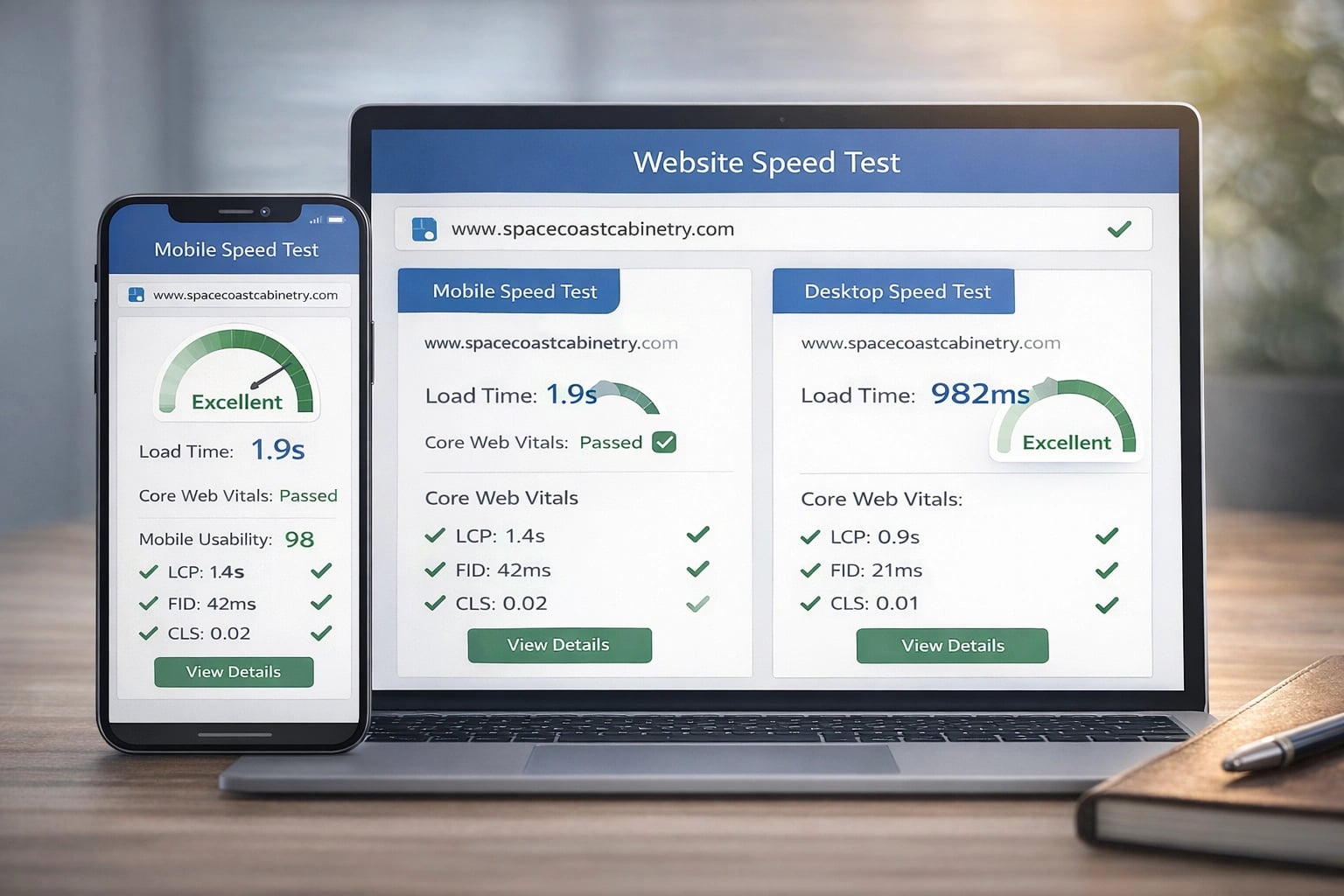
Testing mobile speed is crucial for retaining visitors searching in the Space Coast area.
How Do You Verify Local Directory Listings?
Beyond Google, your business exists across dozens of local listings and directories. Your template should include:
NAP consistency across top 15 directories: Check your business information on:
- Apple Maps
- Yelp
- Facebook Business
- Bing Places
- Yellow Pages
- Industry-specific directories
Industry-specific directory presence: For each business type, there are directories that matter more. A business needs to be on relevant platforms. Your template should identify which directories are priorities for your industry.
Duplicate listing identification: Search for your business name plus city on Google. Multiple listings for the same location confuse search engines and split your reviews. Flag duplicates for merging or removal.
Getting this right improves how search engines evaluate your entire site and local relevance.
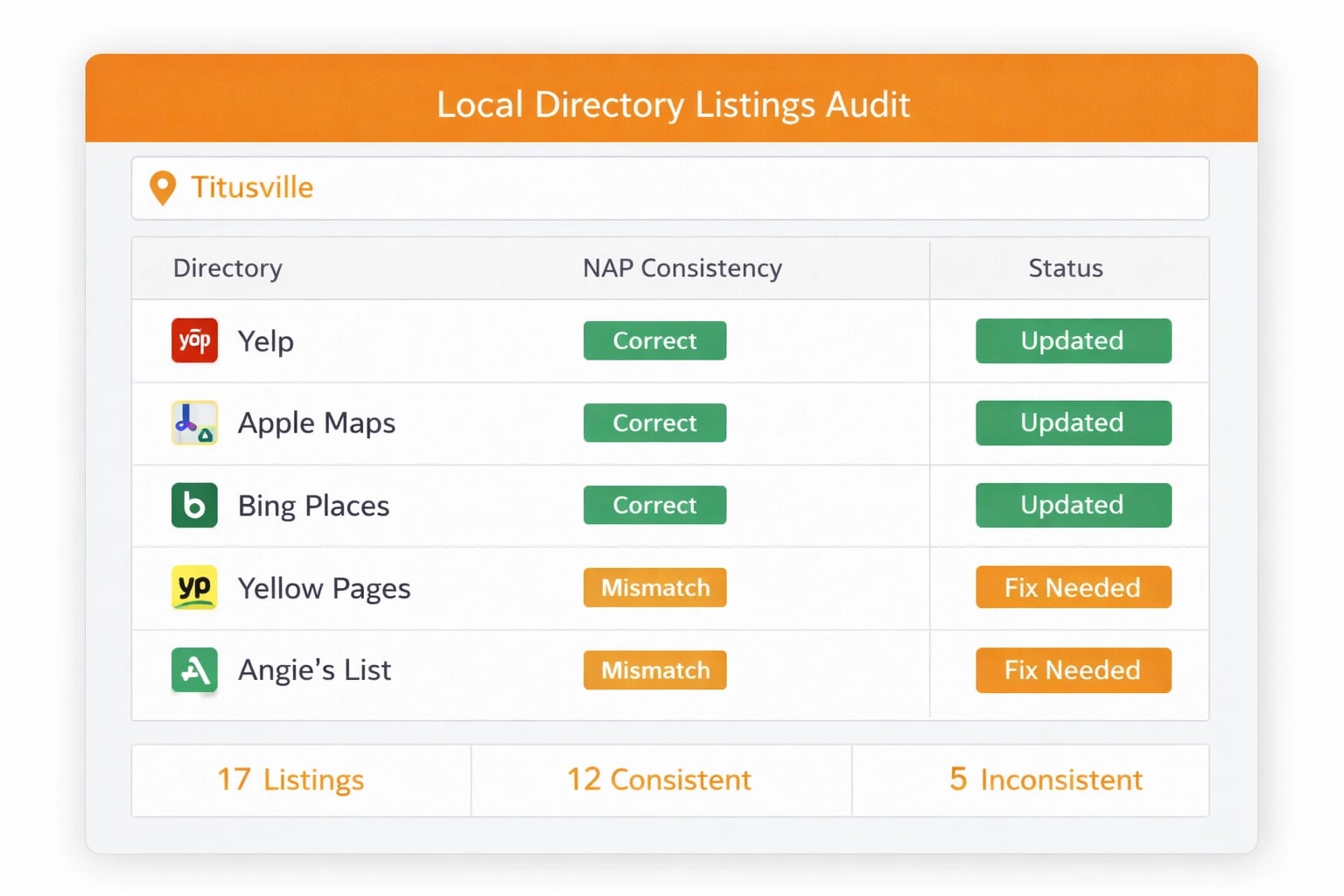
Ensuring NAP consistency across directories boosts local search relevance for Titusville businesses.
How Can a Technical SEO Audit Uncover Hidden Site Issues?
A technical SEO audit is your secret weapon for uncovering hidden issues that could be quietly costing your business valuable traffic and customers. This part of your local SEO audit focuses on the behind-the-scenes elements that help search engines understand, index, and rank your website.
Start by checking your site’s page speed and mobile responsiveness, two factors that directly impact both user experience and your rankings in search results. Use a website SEO checker or free SEO tools to quickly identify technical SEO errors like broken links, duplicate content, and indexing issues. These tools will generate a detailed report highlighting critical errors and offering specific recommendations for improvement.
Don’t overlook the importance of meta tags, structured data, and internal links. Well-optimized meta tags help search engines display your pages accurately in search results, while structured data (like LocalBusiness schema) clarifies your business details for Google. Internal links guide both users and search engines through your site, boosting page authority and helping important pages rank higher.
Regular technical SEO audits are essential for small business owners who want to stay ahead of the competition. By routinely checking for and fixing technical issues, you ensure your website is always performing at its best, making it easier for potential customers to find you online and for your business to climb the search rankings.
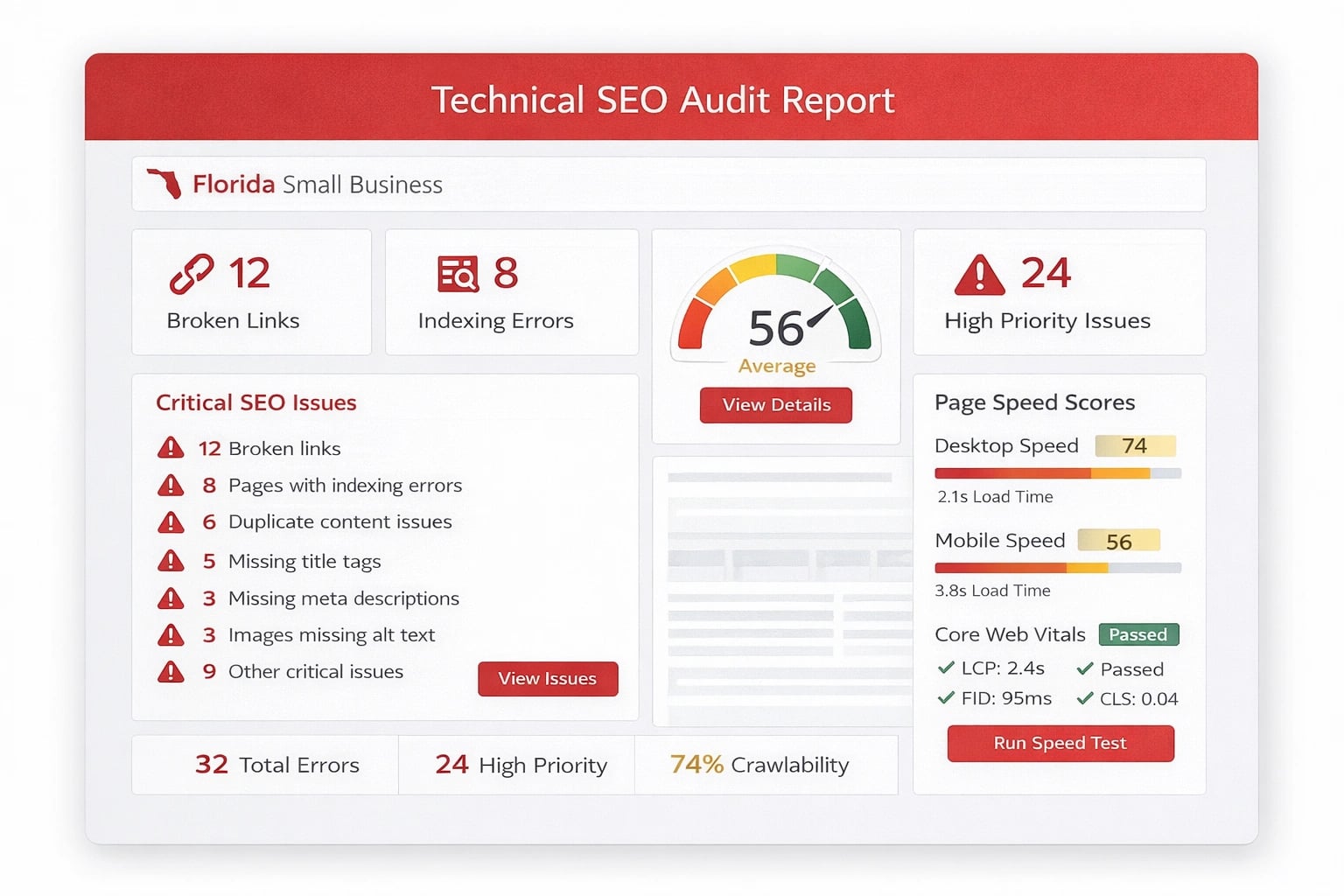
A technical SEO report reveals hidden issues impacting your Florida business’s online visibility.
How Does a Content Audit Impact Local Search Visibility?
A content audit is a powerful way to evaluate whether your website’s content is truly working to attract more organic traffic and convert potential customers. This process involves reviewing every piece of content on your site (blog posts, service pages, product descriptions, and even video content) to ensure it’s relevant, high-quality, and optimized for your target keywords.
Begin by using a free SEO audit tool or SEO audit tool to analyze your content’s performance. Look for thin content (pages with little value or substance), as these can drag down your overall SEO score and hurt your local search presence. Check that your most important pages are targeting the right keywords and that your meta tags and alt text are fully optimized for both users and search engines.
A strong content audit will also help you spot opportunities to build authority in your niche, improve your search rankings, and drive more organic traffic. Make sure your content answers the questions your customers are actually asking and reflects the unique aspects of your local business.
Regularly updating and refining your content based on analytics data and user feedback is key to maintaining a competitive edge. By keeping your content fresh, relevant, and optimized, you’ll not only improve your SEO score but also attract more traffic, generate more leads, and convert more visitors into loyal customers.
How Do You Actually Use the Template Step-by-Step?
Having a template is worthless if it sits in a folder unused. Here is how to actually run your audit on a regular schedule.
What’s the Recommended Monthly Audit Process?
Monthly audits work best for most small businesses. Quarterly audits miss problems too long; weekly is overkill unless you have active reputation issues. Here’s the actual process:
When to use monthly vs. quarterly audits: Monthly works for businesses actively trying to improve rankings or those in competitive markets (restaurants, professional services). Quarterly can work for established businesses with stable rankings who just need maintenance checks.
Your monthly audit checklist:
- Check Google Business Profile for accuracy and new reviews. Log into your profile, verify hours and contact info, respond to any new reviews, check for suggested edits Google may have made
- Test website speed on mobile device. Use Google’s PageSpeed Insights to check your homepage and key service pages for critical errors
- Verify top 5 directory listings for accuracy. Spot-check Yelp, Facebook, Apple Maps, and two industry directories for correct NAP information
- Review competitor Google Business Profile. Look at 2-3 top competitors’ profiles for ideas: What posts do they make? How many reviews? What photos?
- Check local keyword rankings. Search your main keywords + city on Google (incognito mode) and note where you appear
- Update business information if needed. Fix any outdated info, add new photos, post an update
- Document findings and create action plan. Write down what needs fixing and assign yourself deadlines
- Schedule next audit. Put the next audit date on your calendar now
This process takes 1-2 hours monthly for most businesses. That’s a small investment to stay ahead of competitors and catch issues before they cost you customers.
How Do You Prioritize Audit Findings?
Not all issues are equally urgent. Use this framework to decide what to tackle first:
| Priority Level | Issue Type | Impact on Business | Time to Fix |
|---|---|---|---|
| High | Incorrect phone number on Google | Losing calls daily | 15 minutes |
| High | Suspended/unclaimed GBP | Invisible to local searchers | 1-2 weeks |
| High | Website broken on mobile | Losing most visitors | 1-3 days |
| Medium | Missing or outdated photos | Lower engagement | 1 hour |
| Medium | Slow pages loading | Higher bounce rate | 1-2 days |
| Medium | Incomplete directory listings | Weaker local signals | 2-3 hours |
| Low | Missing structured data | Minor ranking factor | 1-2 hours |
| Low | Thin content on service pages | Less ranking potential | 2-4 hours |
| Low | Minor directory inconsistencies | Small trust signal | 1 hour |
The principle: Fix anything that directly prevents customers from contacting you first. Then fix things that make you less visible. Finally, address optimization improvements that build authority over time.
If you find high-priority issues you can’t fix yourself, our local SEO services can help identify issues and provide specific recommendations.
What Are the Most Common Local SEO Audit Mistakes to Avoid?
Even business owners who try to audit their presence make predictable errors. Here’s how to avoid them.
Why Do Business Owners Skip Google Business Profile Optimization?
The most common mistake is “set it and forget it” thinking. Business owners create their profile during setup and never touch it again. Then they wonder why competitors with active profiles rank higher in Google Maps.
The solution: Treat your GBP like social media that needs regular attention. Set a monthly calendar reminder. Add new photos quarterly. Post updates about promotions, seasonal services, or community involvement. Respond to every review within 48 hours. This ongoing activity signals to Google that your business is active and engaged.
How Do You Avoid Focusing Only on Rankings?
Many business owners obsess over top rankings without tracking what actually matters: phone calls, form submissions, and store visits. You can rank higher and still get fewer customers if you’re ranking for terms nobody searches.
The solution: Track actual customer actions as your primary metrics. Google Analytics shows form submissions and traffic sources. Call tracking (even just asking “how did you find us?”) reveals which channels work. A detailed report of rankings means nothing if revenue doesn’t follow. Focus your seo analysis on conversion signals, not vanity metrics.
What’s Wrong With Generic Audit Templates?
Using templates designed for national brands or different industries wastes time and misses what matters for your specific business. A template built for e-commerce sites checking for duplicate content across product pages isn’t helpful for a local business.
The solution: Customize your template for your business type and local market conditions. A Titusville restaurant needs different checkpoints than a Melbourne law firm. Adjust the directory list, keyword priorities, and competitive analysis sections to match your reality.
Our SEO glossary can help you understand terms you encounter while customizing your template.
What Are Your Next Steps After Completing the Audit?
A local SEO audit template is a tool for ongoing business health, not a one-time fix. The businesses that win in local search treat auditing as a regular practice, not a project.
Here’s your action plan:
- Download and customize a template for your business type. Start with a basic template and add industry-specific directories and keywords
- Complete your first full audit within 7 days. Don’t overthink it; start checking boxes
- Fix high-priority issues immediately. Anything preventing customer contact comes first
- Schedule monthly audit dates in your calendar. Same day each month, non-negotiable
- Track results over a 3-month period. Note traffic, calls, and ranking changes to measure impact
For businesses in Florida, where over 3 million small businesses compete for attention, consistent local SEO audits are critical. The Space Coast region, with its growing tourism and business community, offers unique opportunities for those who maintain a strong online presence.
Tap a question to expand.
How often should I use my local SEO audit template?
What’s the biggest mistake small businesses make with local SEO audits?
Do I need technical skills to use a local SEO audit template?
How long does a complete local SEO audit take?
What should I do if my audit reveals major problems?
Can I use the same template for multiple business locations?
How do I know if my local SEO audit template is working?
Should I hire someone or do the audit myself?
For businesses ready to scale beyond DIY auditing, local AI SEO tools can automate monitoring and quickly identify issues before they cost customers. And if you want a professional assessment before starting, get a free consultation to see what issues might be hiding in your current presence.
Businesses that treat auditing as routine consistently get more traffic, more leads, and more customers from local search. The template just makes it systematic instead of overwhelming.
Or start with a free AI visibility check
Does AI Recommend You?
See if ChatGPT, Gemini, Grok, and Claude name your business. Free, emailed in minutes.