


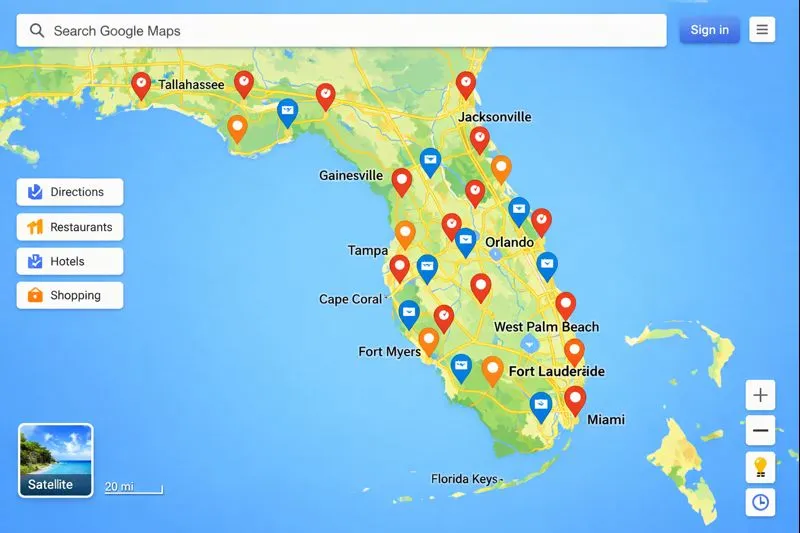
Google Maps Ranking Strategies for Florida
A playbook to improve Google Maps visibility across Florida: strengthen each Google Business Profile, build reviews, and fix the signals that hold you back.
Updated January 20, 2026 · 10 min read
Table of Contents
Introduction
If you operate a Florida business with multiple locations, your growth hinges on one critical factor: visibility in Google Maps. Pairing Maps visibility with a broader lead generation strategy for Florida businesses will maximize the return on your local SEO investment. Ranking higher in Google Maps rankings in Florida through effective local SEO can transform your business. Appearing in the Map Pack (the top local results on Google Search and Maps) drives more calls, direction requests, and walk-ins to your brick-and-mortar stores without inflating ad spend.
If you run a multi-location Florida business and want better Google Maps rankings across multiple cities, you'll get a clear, repeatable process to:
- Rank more locations in the Map Pack and attract local customers
- Strengthen your local presence in competitive Florida markets
- Optimize Google Business Profiles for every branch
- Build location pages that convert (and avoid duplicate content pitfalls)
- Boost reviews, relevance, and local authority statewide
If you’re committed to improving Google Maps rankings in Florida, understanding how local SEO and multi-location SEO work together is essential.
Understanding Local SEO and Multi-Location SEO
What is Local SEO?
Local SEO focuses on enhancing your online presence to appear in local searches such as “near me,” “best [service] in [city],” or “open now.” The objective is to attract local customers actively searching for your services. Key elements include:
- Google Business Profile optimization
- Local citations and directories
- Reviews and reputation signals
- Location-specific website content
- Map visibility and proximity signals
- Optimizing for local search queries and results
What is Multi-Location SEO?
Multi-location SEO scales local SEO across several locations. It involves optimizing each physical location to rank in its specific market, even if your brand spans multiple cities or regions. This requires managing multiple Google Business Profiles and tailored strategies to rank in diverse search results.
A strong multi-location SEO strategy includes:
- Consistent NAP (name, address, phone) across the web
- Individual Google Business Profile per location
- Unique location pages (city pages) targeting local keywords
- Location-based reviews and reputation management
- Local links and community authority signals
With a solid grasp of local and multi-location SEO, you’re ready to address the unique challenges Florida businesses face in ranking across multiple cities.
Why Multi-Location Businesses Struggle to Rank in Florida
Florida’s market is competitive, fast-growing, and highly localized. Brick-and-mortar stores, especially those with multiple locations, encounter distinct challenges in maintaining visibility across regions. A business ranking well in Orlando might be invisible in Tampa. Google often prioritizes proximity, favoring businesses closest to the searcher, particularly on mobile.
Common multi-location challenges include:
- Inconsistent business information across locations
- Incomplete or inconsistent local business listings, causing missed opportunities in each market
- Duplicate location pages with thin content
- Unmanaged reviews (or reviews concentrated in only one city)
- Incorrect categories or incomplete GBP profiles
- Poor internal linking and weak local authority
The solution lies in a system that enhances relevance, distance signals, and prominence for each market.
Understanding these hurdles paves the way to mastering how Google Maps rankings function and which factors you can influence.
How Google Maps Rankings Work (The 3 Core Factors)
Google typically ranks Map results based on three primary factors:
- Relevance: How well your business matches the search query.
- Distance: How close your business is to the searcher’s location.
- Prominence: How well-known and reputable your business appears online, through reviews, citations, and links.
Search engines use these signals to determine local pack visibility. Optimizing these factors can significantly boost your Google Maps rankings in Florida.
1) Relevance
How closely your listing aligns with the search intent:
- Categories
- Services
- Business description
- Website content alignment
- On-page location signals
- Use of location-specific keywords and relevant content
2) Distance (Proximity)
How near your business is to the searcher or queried city:
- You can’t “fake” proximity, but strong location signals and service-area strategies can expand visibility.
3) Prominence
How trusted and recognized your business is online:
- Review quantity and quality
- Citations and directory presence
- Links and brand mentions
- Local authority and consistency
- Positive reviews and reputation management tools
For multi-location businesses, prominence and relevance are the most controllable levers.
Now that you understand what drives Google Maps rankings, let’s craft a scalable strategy for your Florida locations.
Step 1: Build a Multi-Location SEO Strategy That’s Actually Scalable
A statewide or regional strategy succeeds only when each location is treated as a standalone business. A tailored local SEO strategy for every location addresses unique search intent and competition, helping individual branches rank higher in local search results and Google Maps packs. Implementing a coordinated multi-location SEO campaign and using management tools can simplify tasks like tracking rankings, monitoring citations, and maintaining accurate profiles for consistent, scalable results.
Core Elements of a Strong Multi-Location Strategy
- Keyword research by city (not a single list for the entire state)
- Standardized NAP formatting across all listings
- Unique Google Business Profile optimization per location
- Location-specific landing pages for each city/area, with unique, localized content, consistent NAP details, local keywords, tailored service descriptions, testimonials, and clear CTAs
- Review strategy generating city-specific proof
- Local link building to support each market
- Ongoing reporting and iteration (local SEO isn’t “set and forget”)
A well-branded storefront can enhance local visibility in Florida markets.
With your scalable strategy established, the next step is optimizing Google Business Profiles for every location.
Step 2: Google Business Profile Optimization for Every Location
Your Google Business Profile (GBP) is the cornerstone of Google Maps rankings. To maximize local search visibility in Florida, optimize each location's GBP to ensure it's complete, consistent, and active. Our Google Business Profile management services can help you maintain optimized profiles across all your locations. Managing multiple profiles is crucial if your business operates across various areas.
GBP Optimization Checklist Per Location
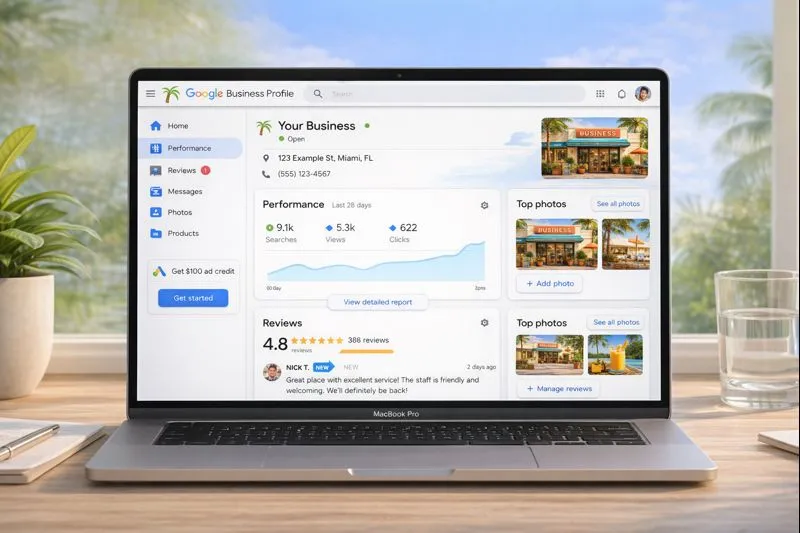
A well-optimized GBP dashboard reflects active management for better rankings.
Once your Google Business Profiles is optimized, it’s time to create high-performing location pages that distinguish each branch in its market.
Step 3: Create High-Performing Location Pages (City Pages)
To rank across Florida cities, your website must support each location with a dedicated page. Creating location-specific pages with unique, relevant content is vital for improving Google Maps rankings in Florida. Individually optimized pages ensure maximum visibility and proper representation in each area.
What to Include on Each Location Page
- Unique headline targeting the city + service (e.g., “Plumbing in Sarasota, FL”)
- Local service description tailored for that market
- Embedded Google Map for that branch or service area
- Accurate NAP details (name, address, phone) consistent with listings and GBP
- Location-relevant photos (not generic stock)
- City-specific reviews and testimonials (when possible)
- Clear CTAs (call, schedule, get estimate)
- FAQ section with city-based questions
- Internal links to related services and nearby location pages
Best Practice URL Structure (Examples)
- /locations/miami/
- /locations/tampa/
- /locations/orlando/
Or service-first silos:
- /plumbing/tampa-fl/
- /hvac/orlando-fl/
- /roofing/jacksonville-fl/
Choose one structure and maintain consistency.
With location pages set, ensure your business information is consistent everywhere online.
Step 4: NAP Consistency and Local Citations
NAP consistency is foundational. Mismatched names, addresses, or phone numbers across the web can erode Google’s confidence in your listings. Maintaining accurate local and business listings across platforms is crucial for improving Google Maps rankings in Florida. Using industry-specific directories for citation building further strengthens local SEO.
Where to Check NAP Consistency
- Your website (header/footer + location pages)
- Google Business Profile
- Apple Maps
- Yelp
- Bing Places
- Industry directories
- Local directories and chamber listings
Citation Strategy for Multi-Location Florida Businesses
- Build core citations for every location first
- Add high-quality local citations (Florida-specific directories, city sites, local associations)
- Maintain identical formatting across every listing
This boosts prominence and supports Maps rankings. Next, focus on reviews to improve your rankings further.
Step 5: Reviews That Drive Google Maps Rankings
For multi-location SEO, reviews should be balanced across locations. If one branch has 300 reviews and another has 12, the latter will struggle. Gathering positive reviews for each location builds trust and can boost local rankings, enhancing visibility in Google Maps searches.
Review Strategy for Multiple Florida Cities
- Ask after every completed job or purchase
- Use SMS and email for review requests
- Make the link easy (one tap)
- Train staff on timing and wording
- Respond quickly and professionally
Extra Win: When customers naturally mention the city or neighborhood in reviews, it reinforces location relevance without forced keyword spam.
With a strong review strategy, build local links to enhance authority in each Florida market.
Step 6: Local Links That Build Authority in Each Florida Market
Local links and brand mentions strengthen prominence. For multi-location businesses, focus on links that bolster each city.
Local Link Sources That Work
- Chambers of commerce
- Local sponsorships and event pages
- Community organizations
- Florida business associations
- Local news mentions
- Vendor/partner pages
- Local blogs and neighborhood publications
Prioritize quality and relevance. A few strong local links can outperform dozens of weak ones.
With local authority growing, address technical SEO to support your rankings.
Step 7: Technical SEO to Support Local Rankings
Even the best local strategy can falter if your site is slow, confusing, or not mobile-friendly. Implementing structured data (like LocalBusiness schema), focusing on URL structure and meta titles, and using Google Search Console to monitor performance are essential for strong Google Maps rankings in Florida.
Technical Priorities for Multi-Location Local SEO
- Mobile-first layout and fast load speed
- Clean internal linking between services and locations
- Proper indexation (no accidental “noindex” on location pages)
- Strong title tags and meta descriptions (city + service)
- Schema markup (LocalBusiness, Organization, FAQ where relevant)
- Regular site audits for crawl, speed, and structure issues
With the technical foundation covered, manage search results and reputation at scale.
Managing Search Results and Reputation at Scale
Multi-location businesses must monitor visibility by city, as rankings can vary significantly. Tracking search rankings, using Google Search, and consistently monitoring local SEO efforts are vital for ongoing success.
Ongoing Reputation Management
- Monitor reviews for each location
- Respond consistently with brand voice
- Flag spam reviews where appropriate
- Track sentiment trends
- Use feedback to improve operations (Google rewards quality over time)
Now, tailor your strategy for specific locations with a repeatable blueprint.
Location-Specific SEO Strategy: A Repeatable Blueprint
- Research local keywords by city and specific location the business serves
- Optimize the GBP with correct categories/services tailored to each particular location
- Build a unique location page with city-specific content and geo-specific keywords for every specific location
- Strengthen citations and NAP consistency for each particular location the business serves
- Generate reviews for that location
- Build local links in that city’s ecosystem
- Track rankings, clicks, calls, and direction requests for each specific location
- Improve monthly (posts, photos, FAQs, content updates) for every particular location the business serves
Do this for every location and each one is optimized for its own market, which is what makes the results measurable.
Measuring Success: What to Track
Key Metrics for Multi-Location SEO
To gauge improvements in Google Maps rankings in Florida, track performance per location. Search engines use these metrics to assess local visibility and ranking.
- Map Pack visibility (by city)
- GBP profile views and actions
- Calls, website clicks, direction requests
- Local keyword rankings per market
- Location page traffic and conversions
- Review velocity and rating trends
- Citation accuracy and coverage
Set clear goals for each location and review monthly. Tracking these metrics helps identify successes and areas needing focus.
Common Multi-Location SEO Mistakes to Avoid
- Copy/pasting content across location pages
- Using one generic “service areas” page instead of real city pages
- Inconsistent NAP across listings
- Wrong GBP categories or missing services
- Letting reviews pile up without responses
- Slow mobile performance and confusing UX
- Ignoring local link building
- Not tracking results by location (only statewide averages)
Avoiding these pitfalls keeps your SEO efforts on track for maximum results.
Best Practices Summary: How to Boost Google Maps Rankings in Florida
Google Business Profile Management
- One verified GBP per physical location
- Unique optimization for each GBP (categories, services, photos, posts)
Location-Specific Landing Pages
- Unique location page for each city/branch with real local content
Building Local Backlinks
- Strong NAP consistency and citations for every location
- Local backlinks supporting each market
Technical SEO Considerations
- Mobile speed and technical SEO done right
- Monthly tracking and iterative improvements
Following these best practices positions you to improve Google Maps rankings in Florida.
Advanced Google Maps Ranking Strategies for Florida Expansion
Strategy 1: Service + City Content Clusters
Beyond city pages, build clusters like:
- Tampa HVAC Repair
- Tampa AC Installation
- Tampa Duct Cleaning
Interlink them to the Tampa location page to increase topical authority per market.
Strategy 2: GBP Posting Cadence
Weekly posts per location keep profiles active and boost engagement signals:
- Promotions
- Project highlights
- FAQs
- Seasonal service reminders (especially valuable in Florida)
Strategy 3: “Proof” Enhancements
For each location:
- Add more real photos
- Include job-site images
- Add short Q&A content
- Update services and attributes quarterly
Google rewards active, well-maintained profiles. (Note: GBP stands for Google Business Profile, the central hub for managing your presence on Google Maps and Search.)
These advanced strategies can further expand your reach and authority across Florida.
Conclusion: Stop Guessing and Start Ranking Across Florida
Ranking multiple business locations in Florida isn’t luck. It’s the result of a structured multi-location local SEO system that strengthens:
- Google Business Profile
- City pages and location-specific content
- NAP consistency and citations
- Reviews and reputation
- Local authority signals and links
- Technical performance and tracking
If your locations excel in one city but are invisible in the next, the fix often lies in location-specific relevance + consistent authority signals.
Or start with a free AI visibility check
Does AI Recommend You?
See if ChatGPT, Gemini, Grok, and Claude name your business. Free report by email.